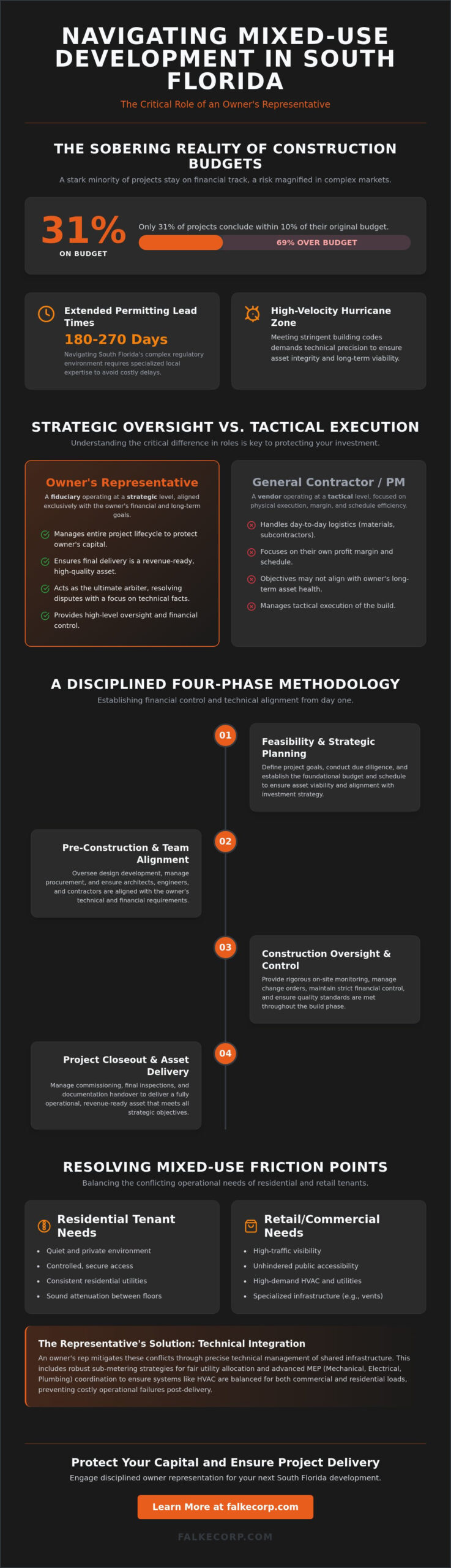
Only 31% of construction projects in 2026 successfully conclude within 10% of their original budget. For developers in South Florida, this statistic is particularly sobering when considering the 180 to 270 day permitting lead times and the technical rigors of the High-Velocity Hurricane Zone. Engaging a qualified owner’s representative for mixed-use developments isn’t merely a project management choice; it’s a necessary financial safeguard. You’re likely aware that the intersection of retail, residential, and hospitality requirements often creates a friction point where vendor coordination fails and transparency disappears.
This guide details how a professional representative navigates these operational complexities to protect your capital and ensure project delivery. We’ll explore the impact of the 9th Edition Florida Building Code and the 2026 updates to the Live Local Act on your asset’s viability. By the end, you’ll understand the disciplined oversight required to deliver revenue-ready assets on schedule while minimizing the risks posed by current material tariffs and labor shortages. Our analysis focuses on the technical precision and financial control necessary to manage the conflicting requirements of multi-tenant ecosystems effectively.
Key Takeaways
- Understand the fiduciary role of a professional advocate who manages the entire development lifecycle and maintains a clear distinction between ownership interests and general contracting operations.
- Learn the technical strategies required to balance the conflicting operational needs of residential and retail tenants through the precise management of shared infrastructure and utility metering.
- Discover the disciplined four-phase methodology an owner’s representative for mixed-use developments employs to establish financial control and technical team alignment from the earliest feasibility stages.
- Identify the specific technical competencies, including vertical transport and MEP coordination, necessary to evaluate potential partners for complex, multi-layered construction projects.
- Gain a strategic perspective on delivering revenue-ready assets within the unique regulatory and environmental frameworks of the Miami, Ft. Lauderdale, and West Palm Beach markets.
What is an Owner’s Representative for Mixed-Use Developments?
An owner’s representative for mixed-use developments is a professional fiduciary who manages the entire project lifecycle on behalf of the developer or investor. This role isn’t simply about oversight; it’s about translating complex architectural and engineering data into actionable strategic decisions. Mixed-use assets present a unique challenge because they require the simultaneous management of residential, retail, and sometimes hospitality components. Each sector demands specific technical standards, from sound attenuation between floors to specialized utility metering for commercial tenants. The representative ensures these conflicting requirements don’t compromise the asset’s overall integrity.
While a General Contractor is responsible for the physical execution of the build, their objectives don’t always align with the owner’s long-term financial health. A contractor’s focus is often on their own margin and schedule efficiency. In contrast, the owner’s representative maintains strict financial control and ensures the final delivery is a revenue-ready asset. They apply the foundational principles of Construction management to mitigate risks that could otherwise lead to costly litigation or operational failures after the building opens. This layer of professional advocacy is what protects the owner’s capital from the inherent volatility of the construction market.
The Fiduciary Duty of the Owner’s Rep
The representative serves as the owner’s eyes and ears on the job site, providing a level of transparency that’s often missing in traditional construction arrangements. They ensure every decision aligns with the owner’s specific investment goals, such as maximizing leasable square footage or ensuring durability for long-term hold strategies. When conflicts arise between architects, engineers, and contractors, the representative acts as the ultimate arbiter. They resolve disputes by focusing on technical facts rather than defensive posturing, keeping the project moving toward its scheduled completion while maintaining the quality standards defined in the pre-construction phase.
Owner’s Rep vs. Construction Project Manager
It’s vital to distinguish between strategic and tactical roles. A Construction Project Manager (PM) typically handles day-to-day logistics, such as material deliveries and subcontractor scheduling. The owner’s representative operates at a strategic level, managing the PM to ensure accountability across all workstreams. They provide the high-level oversight necessary to catch errors before they become structural or financial liabilities. For a deeper analysis of these roles, you can explore the Owner’s Rep vs Project Manager: Key Differences in Florida. This hierarchical structure ensures that the technical competence of the field team is always directed by the owner’s strategic vision.
Navigating the Complexity of Mixed-Use Assets
Mixed-use assets function as intricate systems where competing operational and financial requirements must coexist within a single structural footprint. A residential tenant expects a quiet, private sanctuary, while a retail operator requires high-traffic visibility and unhindered operational accessibility. Managing these divergent needs necessitates a systematic interpretation of technical specifications. A professional Role of an Owner’s Representative involves auditing the design for these specific friction points before they manifest as costly operational failures. This oversight ensures that the asset’s long-term value remains protected against the friction of multi-sector integration.
Shared infrastructure remains one of the most significant technical hurdles in these developments. Centralized HVAC systems must be engineered with precise load balancing to handle the high cooling demands of commercial spaces alongside the variable requirements of luxury residential units. Utility metering is equally critical. Without a robust sub-metering strategy established during the design phase, owners often find themselves subsidizing the energy costs of commercial tenants, which directly erodes the asset’s net operating income. Implementing these controls early ensures the final asset is truly revenue-ready for every stakeholder, a standard that defines the most successful development management strategies.
Operational Integration Challenges
Technical precision in acoustic and vibration isolation is paramount for resident retention. High-output HVAC units or commercial kitchen exhaust fans located on shared mechanical floors can transmit structural vibrations that compromise the living experience in units above. An owner’s representative for mixed-use developments ensures that the structural design includes appropriate dampening and decoupling measures. Logistics also require meticulous planning. Separate loading docks and waste management streams must be established to prevent the odors and noise of retail operations from impacting residents. Security systems must be similarly segmented, using sophisticated access control to maintain privacy while allowing public access to commercial zones.
The Importance of Pre-Construction Planning
Success in complex developments is determined long before the first concrete pour. Identifying design conflicts during the modeling phase prevents expensive change orders that typically derail project timelines. Rigorous pre-construction feasibility studies can prevent up to 20% of downstream budget overruns by identifying systemic flaws in the early design stages. This is why many institutional investors prioritize Strategic Pre-Construction Services in Miami as a non-negotiable risk mitigation tool. By coordinating brand standards for hospitality components within the mixed-use shell early, the representative ensures the final asset is fully functional and ready to generate revenue upon delivery.
A Disciplined Four-Phase Methodology for Financial Control
Effective capital protection in 2026 requires more than occasional site visits; it demands a structured, phase-based framework that addresses risks before they compound. An owner’s representative for mixed-use developments utilizes a four-phase methodology to ensure technical and financial alignment across the project’s lifespan. This systematic approach is vital when only 31% of construction projects currently stay within 10% of their original budget. By dividing the development into distinct stages, the representative can implement specific controls that protect the owner’s interests from the initial feasibility study through the final certificate of occupancy.
The first two phases establish the project’s foundation. During Phase 1 (Concept and Feasibility), the representative sets the physical and financial baseline, accounting for the 4% to 6% construction cost escalation projected for 2026. Phase 2 (Pre-Construction and Design) focuses on assembling a technical team capable of handling the complexities of multi-layered construction. This phase ensures that the architectural vision doesn’t exceed the established budget and that all engineering systems are optimized for the asset’s specific use cases. Without this early discipline, the project risks significant scope creep during the more capital-intensive stages of the build.
Phase 3: Rigorous Construction Oversight
Execution requires an unwavering focus on accountability. During this stage, the representative manages the Construction Phase Management in Florida to ensure that subcontractors adhere to the precise quality standards defined in the design phase. They implement daily reporting and transparent financial tracking to identify variances in real time. This level of oversight is essential for navigating the current labor shortage of 500,000 workers, as it ensures that the available workforce is utilized efficiently and that schedule milestones are met without compromising structural integrity or safety protocols.
Phase 4: Ensuring a Seamless Close-out
The transition from a construction site to an operational asset is often where developers lose the most momentum. Phase 4, Commissioning and Close-out, focuses on finalizing the punch list and conducting rigorous inspections across all asset types within the development. The owner’s representative for mixed-use developments coordinates the handover of all ‘As-Built’ documentation, warranties, and operating manuals. This process ensures the facility is fully operational and generating revenue on day one. By managing the complexities of diverse occupancy requirements, the representative guarantees that both residential and retail components are ready for their respective tenants without delay.
Selection Criteria: Evaluating Technical Competence and Local Expertise
Selecting an owner’s representative for mixed-use developments requires a rigorous assessment of technical depth that extends far beyond general project management. The complexity of 2026 construction demands mastery of multi-layered systems, where concrete structural integrity, advanced MEP (mechanical, electrical, plumbing) coordination, and vertical transport logistics must be perfectly synchronized. A representative must demonstrate a proven ability to manage these interdependencies without compromising the project’s financial baseline. This technical competence is especially critical when managing the integration of high-traffic retail zones with private residential tiers, as each requires distinct engineering standards and life-safety protocols. For developers with international interests, identifying specialized engineering consultants for infrastructure projects Middle East is a key step in ensuring these technical benchmarks are maintained across different regional markets.
In South Florida, “local knowledge” is a technical requirement rather than a geographic preference. The representative must possess an intimate understanding of the High-Velocity Hurricane Zone (HVHZ) standards, which mandate specific impact-resistant materials and enhanced roof systems. These requirements add layers of cost and inspection complexity that can derail a budget if not managed with precision. Effective communication remains the backbone of this role, as the representative must lead multi-disciplinary teams of architects, engineers, and specialized subcontractors, ensuring that the owner’s strategic vision remains the primary driver of every site-level decision.
Navigating South Florida’s Regulatory Landscape
Success in Miami-Dade and Broward counties depends on navigating a regulatory environment that’s increasingly stringent. A qualified representative understands the nuances of the 9th Edition of the Florida Building Code and the impact of HB 803, which establishes new deadlines for local building departments to review permit applications starting July 1, 2026. Given that permitting lead times in South Florida can range from 180 to 270 days, administrative expertise is vital for maintaining the project schedule. They must also manage the 2026 updates to the Live Local Act (HB 1389), ensuring that affordable housing components and tax exemptions are correctly vested at the point of building permit issuance.
Technical and Financial Vetting
Vetting a potential firm must include a deep dive into their ability to manage complex ‘Change Order’ negotiations. With nonresidential construction input prices seeing a 12.6% annualized increase in early 2026, the representative’s role in price stabilization is paramount. Owners should verify references from both hospitality and retail sector clients to confirm the firm’s ability to coordinate diverse brand standards within a single structural shell. Assessing a firm’s previous project ROI provides the most objective measure of their professional qualifications. For developers seeking to secure their investment against these market volatilities, engaging a specialist in owner’s representation ensures that technical oversight is matched by financial discipline.
FALKE Atlantic: Disciplined Owner Representation in South Florida
FALKE Atlantic operates as a strategic extension of the owner’s organization, providing the unwavering technical oversight required to protect capital in the high-stakes South Florida real estate market. Our firm specializes in managing the entire development lifecycle, from initial site selection and feasibility through final commissioning and asset handover. By acting as a professional fiduciary, we ensure that the owner’s strategic vision remains the primary driver of every technical decision. This commitment to meticulous financial control is essential in a market defined by 12.6% annualized increases in construction input prices and complex regulatory shifts. We provide the stability and expertise necessary to transform conceptual designs into revenue-ready assets within the Miami, Ft. Lauderdale, and West Palm Beach markets.
The role of an owner’s representative for mixed-use developments is most critical when navigating the friction points between diverse tenant requirements. At FALKE Atlantic, we leverage our deep understanding of the High-Velocity Hurricane Zone (HVHZ) standards and the 9th Edition Florida Building Code to mitigate risks before they impact the project’s bottom line. Our methodology focuses on transparency and accountability, ensuring that every stakeholder, from the general contractor to the MEP engineers, adheres to the established budget and quality benchmarks. We don’t merely report on progress; we actively manage the process to prevent the scope creep and delays that frequently derail complex multi-layered builds.
Why FALKE Atlantic is the Strategic Choice
Our firm’s technical competence is evidenced by our history of managing high-profile, complex developments, including the Prada store in the Miami Design District. This experience allows us to anticipate the unique integration challenges of luxury retail and commercial components within a mixed-use shell. We maintain a boutique approach to project management, ensuring that senior-level practitioners provide direct, dedicated attention to every project. This senior involvement is a non-negotiable standard that prevents the communication gaps often found in larger, decentralized firms. For developers seeking to secure their investments in 2026, engaging a specialized Owner’s Representative Miami: Protecting Your Real Estate Assets provides a layer of professional advocacy that is indispensable.
Next Steps for Your Mixed-Use Development
Initiating a partnership with FALKE Atlantic begins with a comprehensive consultation to align our disciplined oversight with your specific investment objectives. During this initial phase, we assist in preparing for critical feasibility and site selection meetings, ensuring that your project’s baseline is physically and financially sound. Our team analyzes the impact of current material tariffs and labor shortages on your specific timeline, providing a realistic roadmap for project delivery. Contact FALKE Atlantic to secure the professional representation required to navigate the complexities of your next South Florida development and ensure the long-term viability of your real estate assets.
Securing Asset Viability in the 2026 South Florida Market
The successful delivery of complex mixed-use assets in 2026 requires more than general management; it hinges on the integration of technical precision and unwavering financial discipline. We’ve analyzed how a structured, phase-based methodology mitigates the systemic risks of cost overruns and regulatory delays inherent in the South Florida landscape. Engaging a specialized owner’s representative for mixed-use developments ensures that your capital remains protected from the initial feasibility study through final commissioning. This strategic partnership acts as the primary safeguard for your investment’s long-term value and operational integrity.
FALKE Atlantic provides this level of professional advocacy across Miami-Dade, Broward, and Palm Beach counties. Our team utilizes a disciplined four-phase methodology to maintain maximum transparency and accountability for every stakeholder involved in the build. Having managed high-profile projects such as the Prada store in the Design District, we understand the specific technical rigors of multi-tenant integration and climate-specific requirements. Secure your mixed-use investment with FALKE Atlantic’s expert representation. We’re prepared to ensure your development reaches its full revenue potential through meticulous oversight and technical excellence.
Frequently Asked Questions
What is the typical fee structure for an owner’s representative on a mixed-use project?
Industry standards for owner’s representation fees generally range from 1% to 5% of the total project value. For mid-size developments with predictable phases, fees often fall between 1% and 3%, while smaller or technically complex projects may reach the 5% threshold. Fixed monthly fees between $15,000 and $50,000 are also common for projects with well-defined schedules and staffing requirements.
Can an owner’s representative help with site selection and feasibility in Miami?
An owner’s representative for mixed-use developments provides essential oversight during site selection by analyzing zoning opportunities under the Florida Live Local Act and the Infill Redevelopment Act. They evaluate the technical viability of environmentally impacted land in Miami-Dade and Broward, ensuring that residential density caps and administrative approval pathways align with the owner’s financial objectives. This early-stage technical vetting is critical for identifying potential infrastructure constraints before capital is committed.
How does an owner’s rep differ from a general contractor’s project manager?
A general contractor’s project manager focuses on the tactical execution of the build, including subcontractor scheduling and material logistics. In contrast, an owner’s representative acts as a strategic fiduciary who manages the entire development lifecycle to protect the owner’s capital. They provide a layer of accountability that ensures site-level decisions don’t compromise long-term asset value or the owner’s broader investment goals.
What specific certifications should I look for in a mixed-use owner’s rep?
Look for practitioners holding the Certified Construction Manager (CCM) or Project Management Professional (PMP) designations. Technical degrees in engineering or architecture are equally vital, as they provide the foundation for navigating the High-Velocity Hurricane Zone requirements in Miami-Dade. Proven experience with multi-tenant infrastructure and complex MEP coordination is often more indicative of success than any single certification.
How does an owner’s representative manage change orders to prevent budget overruns?
The owner’s representative for mixed-use developments manages change orders through rigorous technical vetting and market-based cost negotiation. By utilizing data on 2026 material price escalations and current tariffs, they verify the necessity and pricing of every request. This disciplined oversight ensures that contractors don’t use change orders to recover margins or expand the scope beyond the established project baseline.
At what stage of development should I hire an owner’s representative?
Engagement should ideally occur during the initial concept and feasibility phase. Early involvement allows the representative to establish a disciplined financial baseline and identify design conflicts during the modeling stage. This proactive approach prevents the expensive downstream liabilities that typically occur when technical oversight is introduced only after construction has commenced.
What is the role of an owner’s rep during the commissioning and close-out phase?
During close-out, the representative coordinates final inspections, punch list completion, and the systematic handover of all As-Built documentation and warranties. They ensure that every component of the mixed-use shell is fully operational and compliant with local building codes. This meticulous process guarantees that the facility is revenue-ready for both residential and retail tenants on the first day of occupancy.
How do owner’s reps handle conflicts between residential and retail design requirements?
Representatives resolve these conflicts by prioritizing technical solutions for shared infrastructure, such as advanced acoustic isolation and vibration dampening between commercial and residential zones. They ensure that loading dock logistics and waste management streams are physically separated to preserve the residential living experience. Precise utility sub-metering is also established early to prevent operational cost imbalances among different tenant types.