The financial viability of a high-rise development often depends less on the architectural vision and more on the precision of the supply chain within the urban core. For owners, managing construction logistics in downtown Miami is no longer a secondary task for the general contractor; it’s a primary strategic risk that requires rigorous oversight. You likely recognize that the constrained environment of the Downtown Miami Construction Grid, coupled with freight transportation costs rising by 17.3 percent over the last year, creates a landscape where even minor inefficiencies result in significant budget bleed.
It’s understandable to feel concerned about the volatility of material costs, such as the 105.9 percent increase in diesel fuel prices, which complicates every delivery window. This guide provides the technical framework necessary to navigate these complexities, ensuring your project remains resilient against regulatory fines and logistical bottlenecks. We will examine the critical role of Owner’s Representation in optimizing vertical transportation, executing complex Maintenance of Traffic plans under new fee structures, and preparing for the 9th Edition of the Florida Building Code. By implementing a systematic approach to procurement and site access, you can protect your project’s ROI and maintain a predictable timeline despite the inherent volatility of the Miami market.
Key Takeaways
- Understand why managing construction logistics in downtown Miami requires a shift from tactical oversight to a comprehensive financial risk management strategy.
- Navigate the complexities of the 2026 regulatory environment, including updated MOT permit fees and specific requirements for sidewalk and lane diversions.
- Evaluate the technical efficiency of vertical transportation systems to prevent labor idle time and ensure seamless material flow during the high-rise fit-out phase.
- Adopt a Just-in-Time (JIT) procurement model to mitigate the lack of on-site staging area while insulating the project from material price volatility.
- Leverage the expertise of an Owner’s Representative to provide rigorous oversight of general contractors and protect the project’s long-term ROI.
The Downtown Miami Construction Grid: Why Logistics is a Strategic Risk
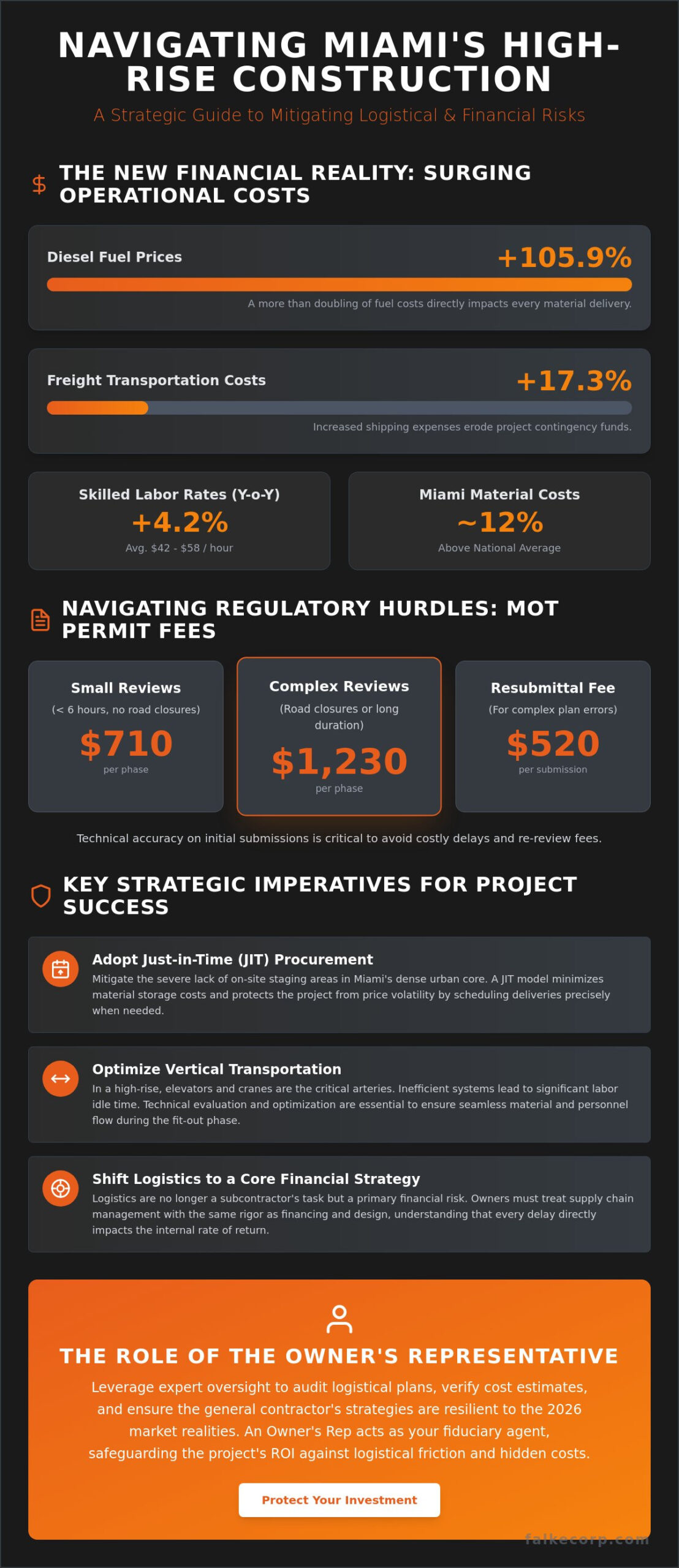
In the context of Miami’s high-density urban core, construction logistics represents the systematic orchestration of material flow, labor synchronization, and spatial management. It’s no longer a tactical task relegated to a subcontractor; it’s a strategic risk that dictates the project’s ultimate internal rate of return. Managing construction logistics in downtown Miami requires a sophisticated understanding of a zero-sum environment where every square foot of staging area must be justified by its contribution to the critical path. When logistics fail, the resulting hidden costs include idle labor, permit expirations, and the activation of liquidated damages. With labor rates in Miami averaging between $42 and $58 per hour, representing a 4.2 percent year-over-year increase, the financial penalty for a disorganized job site is immediate and compounding.
The 2026 infrastructure landscape, particularly in the Brickell and downtown corridors, presents a unique challenge. Freight transportation costs have surged by 17.3 percent since 2025, while diesel fuel prices have increased by 105.9 percent. These macroeconomic pressures mean that any inefficiency in the delivery schedule isn’t just an inconvenience; it’s a direct depletion of the project’s contingency fund. For owners, maintaining rigorous oversight of these variables is a core component of their fiduciary duty to stakeholders and investors.
Geography as a Constraint: Brickell, Edgewater, and the Design District
The “urban canyon” effect in Brickell and Edgewater creates significant site access challenges that differ vastly from less dense areas like North Bay Village. While North Bay Village might offer more predictable access routes, the downtown core is subject to the extreme volatility of city-wide events. The arrival of Art Basel or Formula 1 races can effectively paralyze local transit, requiring logistical plans that account for total road closures and restricted delivery windows. A project’s success depends on the ability to navigate these external shocks without halting the momentum of the build. Site access isn’t a static condition; it’s a variable that must be managed daily.
The Financial Impact of Logistical Friction
Logistical friction occurs when the physical reality of the site contradicts the theoretical schedule. A two-hour delivery delay for structural steel doesn’t just stall one crew; it cascades through the multi-trade schedule, delaying MEP (mechanical, electrical, and plumbing) rough-ins and interior finishing. Because material costs in Miami are approximately 12 percent above the national average, the cost of storing materials off-site or managing multiple deliveries must be carefully balanced. An Owner’s Representative plays a critical role here, auditing the general contractor’s logistical estimates to ensure they’re grounded in the reality of the 2026 market rather than optimistic, surface-level projections.
Navigating Miami’s Regulatory Hurdles: MOT Plans and Public Works
Regulatory compliance in the urban core isn’t just an administrative formality; it’s a critical path constraint. Managing construction logistics in downtown Miami is fundamentally an exercise in regulatory precision, where the City of Miami Public Works Department and Miami-Dade County enforce stringent requirements for any activity impacting the public right-of-way. Effective October 1, 2025, Miami-Dade County implemented a revised fee schedule for Maintenance of Traffic (MOT) plan reviews. Small reviews, defined as work not exceeding six hours without road closures, now carry a $710.00 fee per phase. Complex reviews, which involve road closures or longer durations, cost $1,230.00 per phase. These costs emphasize the necessity of technical accuracy in the initial submittal to avoid resubmittal fees, which reach $520.00 for complex plans.
For high-traffic areas like Brickell or the Central Business District, the city often mandates the use of off-duty police officers to manage traffic flow during lane diversions. This requirement adds a layer of scheduling complexity, as these officers must be booked well in advance. Because Procurement and Staging space is at a premium in the urban core, the MOT plan becomes the project’s primary interface with the city. Failure to adhere to these plans or non-compliance with Miami-Dade County noise and vibration ordinances results in immediate work stoppages and penalties that double the original permit fee. Technical competence in this area is non-negotiable for protecting the project schedule.
Maintenance of Traffic (MOT) Strategy
A professional MOT plan must detail every aspect of pedestrian and vehicular safety, including sidewalk closures and lane diversions. The City of Miami requires a minimum 10-day advance notice for specific street impacts. This window allows for coordination with neighboring properties to minimize logistical conflict, ensuring that two adjacent projects don’t attempt road closures simultaneously. Strategic Owner’s Representation can facilitate this high-level coordination, preventing the friction that often arises between developers in dense urban canyons.
Permitting and Insurance: Beyond the Basics
Municipal entities require specific protections before allowing work in the public right-of-way. Certificates of Insurance (COI) must meet rigorous standards, particularly regarding the “Description of Operations” box, which must explicitly name the municipal entities as additional insureds. Coordination with the Department of Environmental Resources Management (DERM) is also required for any work that might impact local infrastructure or environmental standards. These clearances aren’t optional; they’re the foundation of a legally compliant and stable construction site. Ensuring these details are handled with precision safeguards the owner from liability and prevents costly delays at the municipal level.
Vertical Transportation and Site Access: Managing the High-Rise Constraint
Vertical throughput represents the most significant operational bottleneck in high-rise development. Managing construction logistics in downtown Miami is essentially a study of vertical capacity; as the structure rises, the time required to transport labor and materials increases exponentially. Unlike horizontal projects where access is multi-point, a 60-story tower in the urban core relies on a finite number of buck-hoists. The transition from temporary hoists to permanent service elevators during the fit-out phase is a high-risk period. Technical oversight ensures that this transition doesn’t stall the interior trades. Owners must evaluate the efficiency of buck-hoist configurations against the permanent elevator’s capacity to maintain the project’s momentum.
The 2026 safety standards for high-wind crane operations in South Florida introduce more rigorous protocols for projects within the High-Velocity Hurricane Zone (HVHZ). These standards require sophisticated monitoring systems and specific tie-back engineering to withstand wind events of at least 160 mph. Because material costs in Miami are 12 percent above the national average, the financial impact of crane downtime is severe. Every hour a crane is “weathervaned” or locked down represents lost productivity that can’t be easily recovered within a constrained urban schedule.
Crane Logistics and Swing Rights
Crane operations in Miami’s “urban canyon” involve complex legal and technical preparations. Owners must secure “swing rights” or air rights from adjacent property owners to allow the crane’s jib to rotate over neighboring parcels. In narrow corridors like those found in the Central Business District, tower crane assembly and disassembly are high-stakes maneuvers that require total road closures and extensive coordination with municipal authorities. Hurricane season, spanning from June to November, introduces a predictable but volatile variable that requires a documented “Hurricane Preparedness Plan” to mitigate risk and ensure site stability during extreme weather events.
Elevator Sequencing and Labor Productivity
Labor productivity is the primary victim of poor vertical planning. When trades spend significant time waiting for a hoist, “wait-time waste” accumulates across the entire workforce. With Miami labor rates rising 4.2 percent annually, these inefficiencies represent a substantial financial leak. Implementing a “block reservation” concept for multi-trade sequencing allows for more predictable material flow. This method ensures that high-priority deliveries, such as MEP components or heavy glazing, don’t conflict with peak labor transit times. Strategic Owner’s Representation provides the analytical oversight needed to audit these hoist logs and hold the general contractor accountable for vertical efficiency.
Procurement and Staging: The ‘Just-in-Time’ (JIT) Model
Traditional on-site staging is a luxury that doesn’t exist in the urban core. Most high-rise developments in the Central Business District or Brickell utilize 100 percent of their lot coverage, leaving zero square footage for material laydown. Managing construction logistics in downtown Miami necessitates a transition to the Just-in-Time (JIT) delivery model, where components arrive precisely when the installation crew is ready to receive them. This methodology eliminates the “double handling” of materials and prevents the site from becoming a warehouse, which is essential for maintaining safety and trade productivity on cramped floor plates.
The success of a JIT strategy depends on the use of off-site receiving warehouses, typically located in industrial hubs like Doral or Medley. These facilities serve as consolidation centers where materials are inspected and “pre-unboxed” before being sent to the site. Removing excess packaging at the warehouse significantly reduces the volume of waste generated on-site, which is a critical advantage when vertical transportation capacity is limited. It also allows for early detection of shipping damage, ensuring that only pristine materials enter the urban canyon.
Off-site Consolidation Centers
Utilizing a third-party logistics (3PL) provider for material staging offers a strategic buffer against supply chain volatility. These centers manage the “last mile” coordination, ensuring that deliveries from the warehouse to the Downtown site occur during precise windows that don’t conflict with peak traffic or other trade deliveries. By keeping the site clear of excess inventory, JIT reduces the risk of material damage from ongoing construction activities and mitigates the potential for theft in high-density environments. Owners should verify that their general contractor’s Construction Phase Management plan includes a detailed 3PL integration to maintain this logistical discipline.
Digital Logistics Tracking
Digital tools provide the transparency required to manage these complex flows. Building Information Modeling (BIM) is now used for logistical path planning, allowing teams to visualize how heavy equipment or large components will move through the site before they arrive. Real-time GPS tracking for major material deliveries, such as concrete pours or structural steel, provides the project team with accurate ETAs, allowing for immediate adjustments to the labor schedule. Digital “delivery windows” are enforced through scheduling software, preventing truck queuing on Miami’s busy streets and avoiding the regulatory fines associated with unauthorized road obstructions. This level of technical precision ensures that the supply chain serves the project schedule rather than disrupting it.
The Owner’s Representative: Safeguarding ROI through Logistical Excellence
The owner’s financial exposure is highest when the technical complexities of the urban core are left to the sole discretion of the general contractor. FALKE Atlantic Corporation functions as the strategic partner for logistical oversight, ensuring that managing construction logistics in downtown Miami remains a disciplined, data-driven process. Professional Owner’s Representation provides the necessary friction to prevent general contractor logistical failures from becoming the owner’s financial burden. We don’t just observe; we audit the systems that govern your project’s flow. It’s our responsibility to ensure that the theoretical schedule aligns with the physical reality of the Miami grid.
FALKE’s Role in Pre-Construction Planning
Effective risk mitigation begins long before the first delivery truck arrives on site. During the audit of a general contractor’s pre-construction services Miami, we identify “red flag” logistical assumptions that could derail the project’s budget. These often include unrealistic hoist cycle times, inadequate MOT planning, or a lack of off-site consolidation strategy. We verify the feasibility of the proposed plan against the 2026 regulatory environment, ensuring that the construction phase management florida plan is robust enough to handle the specific constraints of the “urban canyon.” Our goal is to eliminate logistical ambiguity during the bidding phase, preventing future claims for additional time or resources.
Maintaining Financial Control and Transparency
Logistical friction is frequently cited as the justification for predatory change orders and schedule extensions. In our approach to commercial project management miami, we focus on maintaining absolute transparency between the site and the owner’s ledger. By monitoring vertical transportation logs and digital delivery windows, we prevent “change order fraud” related to purported logistical delays. This level of technical scrutiny is especially critical for retail and hospitality projects where a firm opening date is tied to revenue generation. We ensure that your asset is delivered revenue-ready, with every logistical hurdle cleared through superior planning rather than expensive, reactive solutions.
FALKE Atlantic Corporation utilizes a proprietary four-phase methodology that integrates logistical excellence into the project’s DNA. We manage the complexity so you can maintain the stability of your investment. Managing construction logistics in downtown Miami doesn’t have to be a source of uncertainty for your capital. We invite you to a consultation to audit your current project’s logistical plan and ensure your development is positioned for success in Miami’s competitive landscape.
Securing Your Development’s Future Through Technical Precision
Successful execution in the urban core requires a shift from reactive problem-solving to proactive, systems-based management. You’ve seen how integrating a Just-in-Time delivery model and optimizing vertical throughput are essential for mitigating the financial risks of the Miami grid. Technical mastery over the 2026 regulatory landscape ensures that your project avoids the work stoppages and penalties that often plague less disciplined developments. By prioritizing logistical excellence, you transform a potential vulnerability into a controlled, predictable component of your project’s success.
Managing construction logistics in downtown Miami is a complex undertaking that demands unwavering professional oversight. FALKE Atlantic Corporation provides this through a disciplined four-phase methodology and a commitment to owner-first advocacy in all vendor management. Our expertise in high-value Miami developments ensures that your capital is protected from the volatility of the current market. We invite you to Schedule a Strategic Consultation with FALKE Atlantic to audit your logistical plan and secure the stability of your project’s ROI. Your vision deserves the highest standard of professional management.
Frequently Asked Questions
What is an MOT plan and why is it required for Miami construction?
A Maintenance of Traffic (MOT) plan is a technical document detailing how vehicular and pedestrian safety will be maintained during construction activities that impact the public right-of-way. The City of Miami requires these plans to mitigate urban congestion and ensure compliance with safety standards. As of October 2025, Miami-Dade County charges $710.00 for small reviews and $1,230.00 for complex reviews per phase to ensure all diversions are engineered correctly.
How do I manage construction deliveries in the high-traffic Brickell area?
Managing construction logistics in downtown Miami, particularly in the Brickell corridor, requires the adoption of a Just-in-Time (JIT) delivery model supported by off-site consolidation centers in industrial hubs like Medley. Because lot coverage is often 100 percent, deliveries must be scheduled within precise windows to avoid queuing on narrow streets. Coordination with off-duty police officers is frequently mandated for lane diversions to maintain traffic flow during major material transfers.
Are there specific hours for construction deliveries in Downtown Miami?
Delivery hours are governed by municipal noise ordinances and the specific conditions of the approved MOT permit. Generally, the City of Miami restricts heavy material deliveries to daytime hours to minimize residential disruption, though certain large-scale pours or crane assemblies may require specific night work permits. Owners should ensure their general contractor coordinates these windows with the Public Works Department to avoid double-fee penalties for unauthorized work started outside of permitted hours.
How does an Owner’s Representative help with construction logistics?
An Owner’s Representative provides the technical oversight needed to audit the general contractor’s logistical estimates and staging plans. By monitoring vertical transportation logs and material flow, they prevent change order fraud related to purported logistical delays. This advocacy ensures that managing construction logistics in downtown Miami remains a controlled process that protects the project’s internal rate of return and keeps the schedule predictable.
What happens if a crane needs to swing over a neighboring building in Miami?
If a tower crane must swing over an adjacent parcel, the developer must secure swing rights or air rights through a formal legal agreement with the neighboring property owner. This agreement typically includes indemnification clauses and technical specifications for the crane’s operation. Failure to obtain these rights can lead to immediate legal injunctions and costly work stoppages that jeopardize the entire project timeline.
Can I store construction materials on the sidewalk in the City of Miami?
Storing materials on public sidewalks is strictly prohibited unless a specific sidewalk closure permit has been issued as part of an approved MOT plan. Even with a permit, the City of Miami prioritizes pedestrian access and often requires the construction of protected walkways. Utilizing off-site receiving warehouses is the standard professional approach to managing inventory without obstructing the public right-of-way or incurring municipal fines.
How do Miami high-rise projects handle elevator reservations for contractors?
High-rise projects utilize a block reservation system to manage the finite capacity of buck-hoists and service elevators. This systematic approach assigns specific time slots to different trades, reducing wait-time waste for labor and ensuring that high-priority materials reach the correct floor without conflict. Professional management of these reservations is critical for maintaining productivity, especially during the high-intensity fit-out phase of a development.
What is the notice period for street closures in Miami-Dade County?
The City of Miami typically requires a minimum 10-day advance notice period for any activity that results in street closures or significant traffic impacts. This window allows municipal authorities to coordinate with emergency services and neighboring developments to prevent logistical paralysis in the urban core. Strategic planning ensures that these notice periods are integrated into the master schedule to avoid critical path delays during the construction phase.