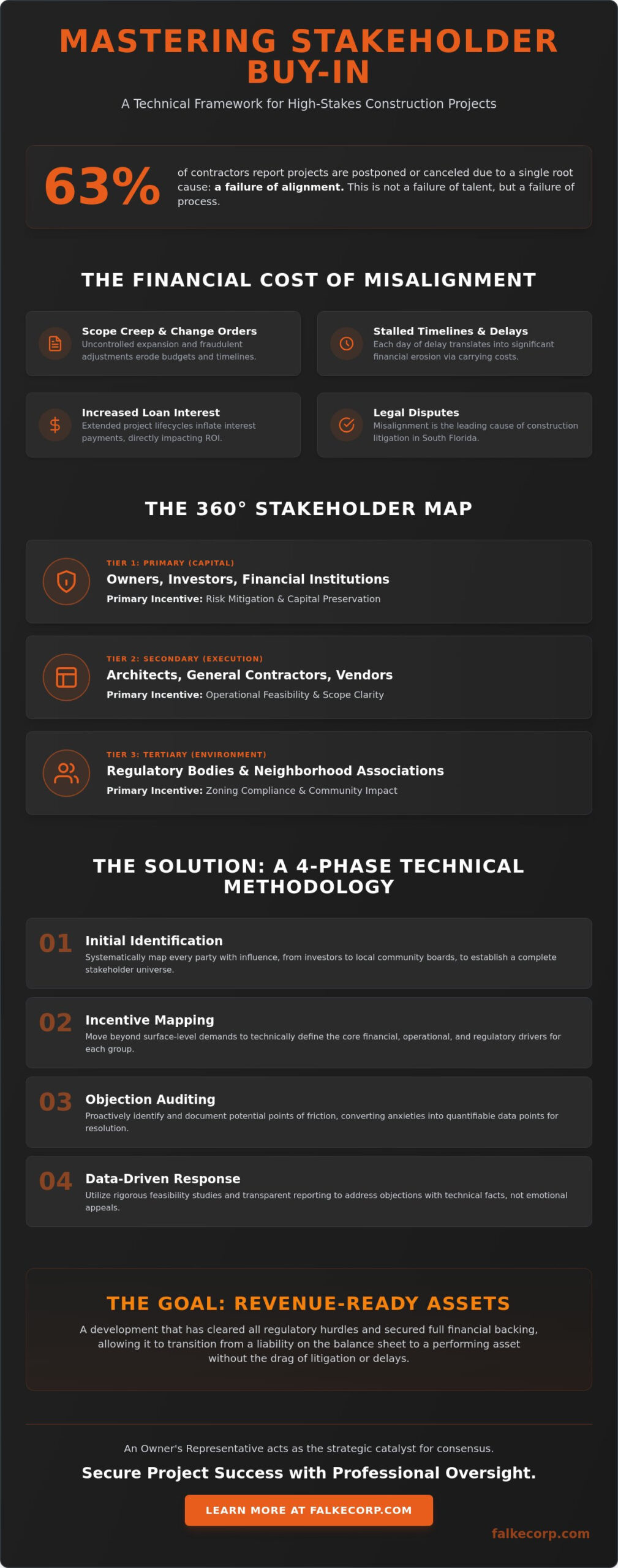
If 63% of contractors report that their projects were postponed or canceled in the first half of 2026, the failure rarely stems from a lack of engineering talent. Instead, it’s a failure of alignment. Mastering how to get buy-in from stakeholders for a construction project isn’t an exercise in emotional persuasion; it’s a disciplined technical process rooted in risk transparency and financial control. You’ve likely seen how a single neighborhood objection in Broward County or a budget transparency concern from an investor can stall a development before the first permit is even filed.
We understand that navigating the complex zoning of Miami-Dade or the rigid ROI expectations of institutional partners requires a high level of professional rigor. This guide provides the methodology required to secure executive and community consensus for South Florida’s most demanding developments. You’ll learn how to master project alignment to ensure your development starts on time with full financial backing. We’ll explore the specific frameworks for reducing friction during entitlement and establishing the professional trust necessary to manage third-party vendors with absolute precision.
Key Takeaways
- Define stakeholder buy-in as a technical alignment of project objectives with specific financial and operational incentives to ensure long-term structural stability.
- Discover how to get buy-in from stakeholders for a construction project by utilizing data-driven feasibility studies that preemptively address budget transparency and zoning objections.
- Establish a “single source of truth” through structured communication frameworks that eliminate information silos and protect the project from vendor-driven bias.
- Formalize the pre-construction phase to rigorously vet design assumptions and budget estimates before significant capital is committed to the development.
- Leverage the expertise of an Owner’s Representative to act as a strategic catalyst for consensus, providing the professional oversight necessary to navigate complex entitlement phases.
Defining Stakeholder Buy-In within the Construction Lifecycle
Stakeholder buy-in isn’t a vague sentiment or an emotional agreement. In the context of high-stakes development, it’s the professional alignment of project objectives with the specific incentives of every party involved. This alignment ensures that the owner’s vision is technically and financially synchronized with the expectations of investors, regulators, and the community. Achieving early consensus isn’t just about smooth meetings; it’s a fundamental requirement for long-term financial stability. Without a disciplined approach to stakeholder management, a project remains a collection of conflicting interests rather than a unified path toward a revenue-ready asset.
Project owners often find that the primary obstacle to progress is a lack of clarity regarding how to get buy-in from stakeholders for a construction project during the pre-construction phase. When incentives aren’t mapped early, the project risks internal friction between executives and investors, as well as external resistance from local authorities. The ultimate goal of this alignment is the creation of “Revenue-Ready Assets.” This term describes a development that has cleared all regulatory hurdles and secured full financial backing, allowing it to transition from a liability on the balance sheet to a performing asset without the drag of litigation or delays.
The 360-Degree Stakeholder Map for Florida Developments
A successful project requires a tiered understanding of influence. The primary tier consists of the owners, investors, and financial institutions providing the capital. Their primary incentive is risk mitigation and the preservation of capital. The secondary tier includes the technical executors: architects, general contractors, and specialized vendors. Their focus is on operational feasibility and scope clarity. Finally, the tertiary tier involves the external environment, specifically Miami-Dade or Broward regulatory bodies and local neighborhood associations. These groups hold the power of entitlement and can halt a project if their concerns regarding zoning or community impact aren’t addressed with technical precision.
The Financial Cost of Misalignment
Misalignment is the leading cause of construction litigation in South Florida. When stakeholders don’t share a single vision, the project inevitably suffers from scope creep and, in extreme cases, change order fraud. In high-value markets like West Palm Beach, even minor delays translate into significant financial erosion through increased loan interest and carrying costs. If you aren’t sure how to get buy-in from stakeholders for a construction project, you’re essentially allowing the project’s ROI to be dictated by external friction. A project that lacks consensus is a project that is vulnerable to the highest costs of the construction lifecycle: legal disputes and stalled timelines.
Strategic Identification of Motivations and Objections
Identifying the specific drivers behind every stakeholder’s position is a prerequisite for project stability. This requires a disciplined mapping of financial versus operational incentives. Owners often struggle with how to get buy-in from stakeholders for a construction project because they treat the process as a social negotiation rather than a technical discovery. We utilize a four-phase methodology to structure this discovery: initial identification, incentive mapping, objection auditing, and technical response. By treating stakeholder needs as data points, you can move away from emotional appeals and toward a project structure that serves all parties involved.
Feasibility studies serve as the primary tool for converting perceived risks into technical realities. In the pre-construction phase, stakeholders often harbor anxieties that aren’t grounded in site-specific data. By providing rigorous, data-backed answers to early objections, the project team can dismantle opposition before it hardens into institutional resistance. Research on Stakeholder Engagement in Construction emphasizes that social and ethical responsibility, when quantified, becomes a powerful lever for alignment. This data-driven approach is essential for any development management strategy that aims to minimize friction during the entitlement phase.
Addressing the #1 Objection: Risk and Budget Volatility
Budget volatility is the primary psychological barrier for construction stakeholders. With material prices projected to increase by 2% to 4% in 2026, investors are increasingly cautious about capital commitments. To mitigate this, project owners should propose fixed-fee management structures that remove the incentive for service providers to inflate costs. Full transparency in vendor selection further reduces the suspicion of kickbacks or fraud; this ensures that investors feel their capital is under professional stewardship. When you demonstrate a controlled financial environment, the path of how to get buy-in from stakeholders for a construction project becomes significantly clearer.
Mapping Neighborhood and Regulatory Incentives
In South Florida, neighborhood associations in areas like Coral Gables or North Bay Village often view new developments as a threat to local character or infrastructure. Securing their buy-in requires a shift from offering “concessions” to providing “community benefits” that align with local government goals. This might include infrastructure improvements or public space enhancements that address specific neighborhood pains. Integrating environmental and hurricane resilience standards isn’t just a regulatory requirement; it’s a strategic asset that wins approval from both regulators and residents. Demonstrating a commitment to long-term structural integrity provides the technical competence that neighborhood boards demand.
Communication Frameworks for High-Stakes Construction
Establishing a “single source of truth” is the only way to prevent information silos that lead to project drift. When data is fragmented, stakeholders develop conflicting interpretations of progress, which inevitably erodes trust. Effective Real Estate Development Management Services rely on a centralized repository where every design iteration, budget adjustment, and permit status is recorded in real-time. This structure ensures that when an owner asks how to get buy-in from stakeholders for a construction project, the answer is always backed by verifiable data. Centralizing management through a professional representative prevents the design team and construction phase managers from operating in isolation, a common cause of costly mid-project corrections.
The Lean Construction Institute emphasizes the importance of Early Stakeholder Involvement as a primary method to reduce waste and improve project predictability. By standardizing communication protocols from the outset, you create a culture of technical accountability. This process isn’t about increasing the frequency of meetings; it’s about implementing structured, phased reporting that aligns with the project’s specific technical milestones. When every third-party vendor is managed through a centralized owner representative, the project gains a level of cohesion that is impossible to achieve through decentralized coordination.
Transparency through Professional Reporting
Objective oversight requires a disciplined reporting model to ensure the representative’s interests remain aligned exclusively with the owner’s objectives. Visual dashboards play a critical role in this framework. They translate complex engineering data and schedules into clear insights for non-technical executives and investors. Financial control reports are equally vital, providing a granular look at capital expenditure to mitigate the anxiety stakeholders feel during periods of market volatility. This level of transparency transforms skepticism into professional confidence, demonstrating that the project is under expert supervision.
Navigating Local South Florida Dynamics
Communicating with Miami-Dade or Broward permitting offices requires a deep understanding of local bureaucratic nuances. Managing stakeholders during the entitlements phase is particularly delicate, as this is when community and regulatory interests often clash with the development’s goals. Utilizing specialized Construction Project Management Florida expertise allows owners to anticipate local logistical challenges before they become roadblocks. Professional managers act as the primary interface between the project and local authorities, ensuring that technical submissions are precise. Knowing how to get buy-in from stakeholders for a construction project in the Florida market means respecting local precedents while maintaining a firm grip on the project’s technical and financial requirements.
Tactical Engagement: From Consultation to Advocacy
Transitioning from conceptual agreement to active advocacy requires a framework that transforms stakeholder interest into technical commitment. Determining how to get buy-in from stakeholders for a construction project effectively involves a five-step tactical model. This begins with formalizing the pre-construction phase to vet every design and budget assumption against market realities. Once assumptions are validated, the design team must be assembled under a disciplined management structure to ensure alignment with the owner’s financial objectives. Conduct site feasibility studies early to eliminate “unknown” variables like geotechnical surprises or environmental liabilities that often trigger stakeholder doubt. Before any site work begins, establish a clear change-order management protocol to maintain control over the budget. Finally, transition to construction phase management only when a pre-aligned consensus has been documented and verified.
Early Involvement and Pre-Construction Consensus
Involving key parties during the concept phase significantly reduces resistance during the final commissioning stages. When stakeholders see their technical requirements addressed early, they’re more likely to support the project during high-pressure entitlement phases. This consensus is built upon the rigorous vetting of architects and contractors. You must ensure these vendors meet specific owner standards for technical competence and financial stability. Utilizing Strategic Pre-Construction Services acts as a primary risk-mitigation tool; it provides the data necessary to satisfy even the most skeptical investors or regulatory boards.
Conflict Resolution and Scope Management
Disputes between the design team and the general contractor are common but manageable with a structured resolution framework. Scope creep is a frequent cause of stakeholder anxiety, as it directly erodes the project’s ROI. To prevent this, the owner representative acts as a neutral advocate who protects the project’s integrity without vendor-driven bias. This oversight ensures that any adjustments to the project scope are technically necessary and financially justified. If you’re struggling with how to get buy-in from stakeholders for a construction project, establishing this neutral buffer is often the most effective solution. Professional management ensures that the project remains a stable, predictable investment for all parties involved.
To secure your project’s financial future and ensure technical alignment from day one, explore our Development Management solutions today.
The Owner’s Representative as the Catalyst for Consensus
The distinction between a standard project manager and a specialized Owner’s Representative Miami is fundamental to the long-term viability of a development. While a project manager is often tasked with the day-to-day execution of site activities, the Owner’s Representative serves as a strategic extension of the owner’s executive team. This role is designed to provide the high-level oversight necessary to navigate the technical complexities of South Florida’s real estate market. When considering how to get buy-in from stakeholders for a construction project, the presence of a dedicated advocate provides a level of professional assurance that standard execution roles cannot match. This oversight acts as a critical buffer, protecting the owner from vendor-driven bias and ensuring that every decision serves the project’s financial integrity.
FALKE Atlantic Corporation adopts a disciplined, four-phase methodology that builds executive trust through radical transparency. By acting as the central point of contact for all third-party vendors, we eliminate the conflicting narratives that often arise during complex builds. Our focus remains squarely on the creation of revenue-ready assets, ensuring that the transition from a capital-intensive construction phase to an operational reality is seamless. This professional stewardship is what transforms a project from a series of high-risk tasks into a stable, high-performing investment.
Why Professional Oversight Secures Executive Confidence
Dedicated representation ensures that transparency isn’t just a goal but a technical standard. An “Owner-First” perspective is essential when managing specialized vendors who may prioritize their own operational convenience over the owner’s ROI. A boutique consultancy specializing in the nuances of South Florida real estate provides a specific type of peace of mind. We understand the local regulatory landscape and the financial pressures of the 2026 market, allowing us to maintain strict financial control throughout the project lifecycle. This rigor is essential for owners who require absolute certainty before committing significant capital.
Moving from Concept to Commissioning
The journey from initial stakeholder alignment to the final project close-out is a test of structural and managerial discipline. While early consensus is vital, the final validation of stakeholder satisfaction occurs during commissioning and close-out. These final phases ensure that the built asset meets all technical specifications and is ready for its intended commercial use. Successful project delivery requires a consistent management thread from the first feasibility study to the final walkthrough. Owners looking to optimize their development strategy should seek a Commercial Project Management Miami consultation to ensure their next project is technically aligned and financially secure. Mastering how to get buy-in from stakeholders for a construction project is ultimately about demonstrating that every phase of the work is under the control of a competent, objective expert.
Securing Structural Alignment for Future-Ready Developments
The successful delivery of complex South Florida developments in 2026 relies on the transformation of conflicting interests into a unified technical path. Mastering how to get buy-in from stakeholders for a construction project requires moving beyond surface-level consultation toward a disciplined framework of risk transparency and financial control. By establishing a single source of truth and utilizing data-driven feasibility studies, owners can preemptively address the budget volatility and regulatory hurdles that often stall projects in Miami-Dade and Broward counties. This professional rigor ensures that consensus is built on technical reality rather than optimistic projections.
FALKE Atlantic Corporation provides the professional oversight necessary to act as a catalyst for this consensus. Our disciplined four-phase methodology ensures that your project remains focused on the creation of high-quality, revenue-ready assets while protecting your interests from vendor-driven bias. We invite you to Request a Strategic Owner’s Representation Consultation to align your next development with the highest standards of professional rigor. Achieving full alignment today ensures your project starts on time and remains under strict financial stewardship until the final commissioning. We look forward to securing the stability of your next major asset.
Frequently Asked Questions
What is the difference between stakeholder buy-in and stakeholder engagement?
Stakeholder buy-in is the formal technical alignment of project objectives with specific stakeholder incentives, whereas engagement refers to the ongoing communication process. While engagement ensures that parties are kept informed, buy-in represents a definitive commitment to the project’s financial and operational trajectory. Without buy-in, engagement is merely a dialogue that lacks the structural support required for project execution.
How early should I involve stakeholders in a Miami construction project?
You should involve stakeholders during the initial concept phase to ensure total alignment before significant capital is committed. In the Miami market, early involvement is a prerequisite for navigating complex zoning and entitlement processes. Proactive engagement at this stage prevents institutional resistance from local boards and neighborhood associations that could otherwise stall the development during the permitting phase.
What is the most common reason stakeholders withdraw their support?
The primary reason for a loss of support is a lack of budget transparency or perceived financial volatility. When stakeholders encounter information silos, they often perceive an increase in risk that erodes their confidence in the project’s ROI. Maintaining a single source of truth for all project data is the only way to prevent the skepticism that leads to project postponement.
Can an Owner’s Representative help with neighborhood association objections?
An Owner’s Representative acts as a professional buffer by translating technical project data into “community benefits” that neighborhood associations can support. This objective oversight allows the owner to address neighborhood objections with technical precision rather than emotional negotiation. By managing these external dynamics, the representative secures the local consensus necessary for a project to move forward without friction.
How do I handle a stakeholder who is fundamentally opposed to the project budget?
You handle budget opposition by implementing fixed-fee management structures and utilizing data-driven feasibility studies to justify all capital requirements. Understanding how to get buy-in from stakeholders for a construction project often involves removing the incentive for vendors to inflate costs. This demonstrates a commitment to financial control that reassures even the most cautious investors.
What role does a site feasibility study play in securing buy-in?
A site feasibility study eliminates “unknown” variables, such as geotechnical or environmental liabilities, that frequently trigger stakeholder doubt. By providing empirical data during the pre-construction phase, you convert perceived risks into manageable technical realities. This data-driven approach provides the objective proof that stakeholders require before they formally commit to a high-stakes development.
How does hurricane resilience planning affect stakeholder confidence in Florida?
Hurricane resilience planning provides stakeholders with tangible evidence of long-term structural integrity and risk mitigation. In the Florida market, demonstrating adherence to high-velocity hurricane zone standards is a primary method for securing regulatory and financial buy-in. When a project is engineered for resilience, stakeholders perceive it as a stable, low-risk asset that is protected from regional environmental threats.
What are the four phases of real estate development mentioned in this guide?
The four phases include initial identification, incentive mapping, objection auditing, and technical response. This methodology ensures that every stakeholder’s needs are treated as data points rather than emotional hurdles. By following this structured path, owners can move from initial consultation to active advocacy, ensuring the project begins with full financial backing and professional alignment.