With international buyers accounting for 52% of all new construction condominium sales in South Florida, the challenge of managing international construction investments in Miami has evolved into a high-stakes exercise in technical risk mitigation and regulatory compliance. It’s common for remote investors to feel the weight of Miami-Dade’s complex permitting hurdles and the persistent fear of change order fraud when local oversight is absent. You likely understand that without a constant physical presence, language barriers and cultural nuances in contracting can lead to significant deviations from your original financial projections and project specifications.
This guide explains how professional owner representation acts as a dedicated fiduciary buffer to align contractor execution with your specific investment objectives. You’ll discover how to navigate the stringent requirements of the 9th Edition of the Florida Building Code and High-Velocity Hurricane Zone mandates to maximize your return on investment. We will outline a structured approach to project management that ensures full financial transparency and the delivery of a revenue-ready asset, completely free of the legal or technical debt that often plagues unmonitored remote developments.
Key Takeaways
- Analyze the strategic transition from finished luxury assets to ground-up development and the heightened risk profile associated with remote project management.
- Discover the fundamental role of a professional fiduciary in managing international construction investments in Miami to align technical execution with long-term financial objectives.
- Navigate the complexities of the 2026 Florida Building Code updates and hurricane-resiliency mandates to prevent regulatory delays and unforeseen permitting costs.
- Establish a digital oversight framework and rigorous change order management protocols to ensure full financial transparency throughout the construction lifecycle.
- Distinguish between the operational roles of architects, general contractors, and owner’s representatives to protect your capital from technical debt and fraud.
The Landscape of International Construction Investment in Miami
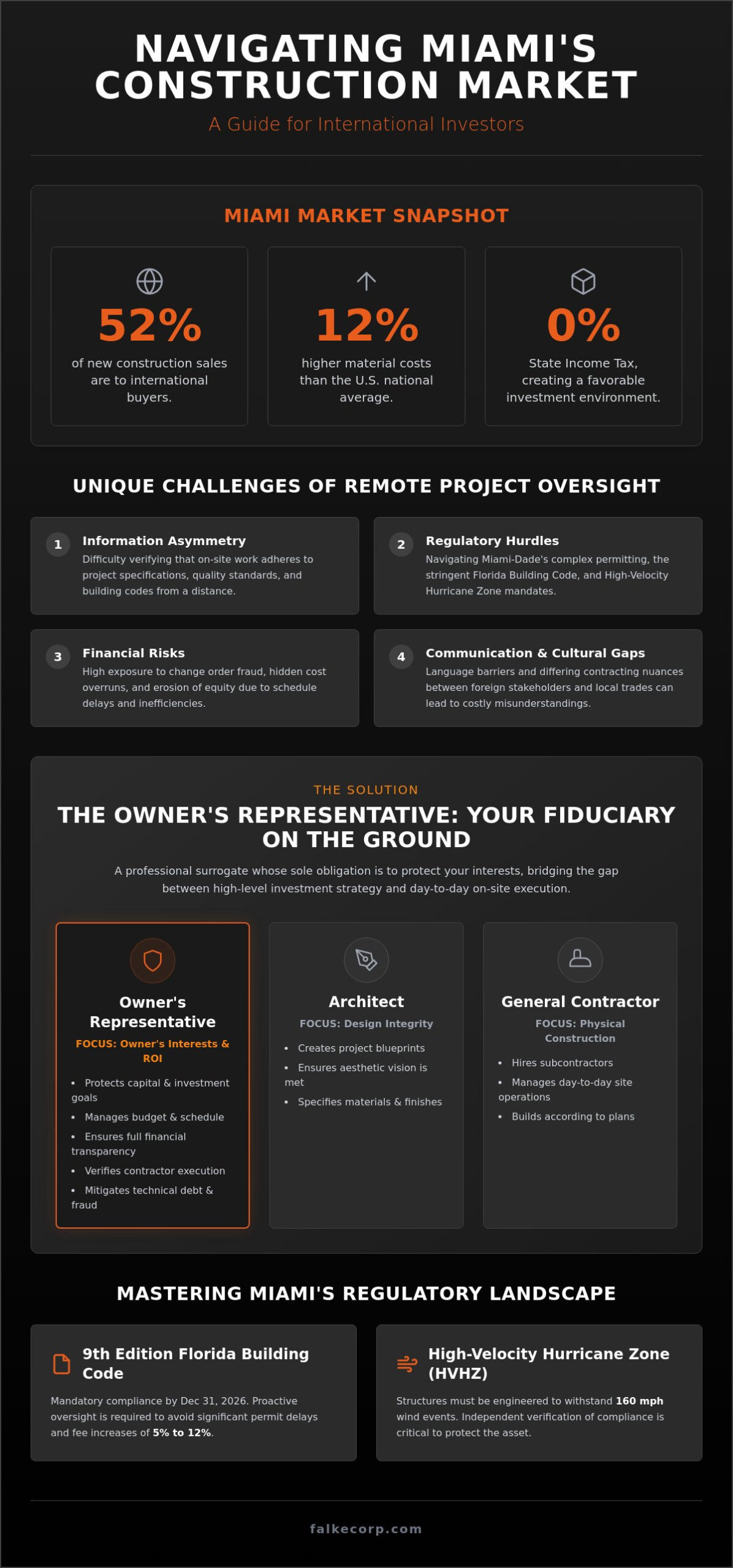
The 2026 fiscal year has solidified Miami’s status as a primary destination for global real estate capital. Data from the MIAMI Association of REALTORS® indicates that international buyers now represent 52% of new construction sales, with a significant influx of investment originating from Colombia and Mexico. This trend isn’t limited to the simple acquisition of residential units; there’s a profound shift toward ground-up development. Investors are moving away from the safety of finished assets to capture the higher margins found in the pre-construction and construction phases. Successfully managing international construction investments in Miami requires a sophisticated understanding of local market dynamics, where material costs are currently 12% higher than the national average.
Why Miami Remains a Global Hub for Real Estate Capital
The sustained appeal of the South Florida market is rooted in its structural stability and favorable tax framework. Florida’s general state sales tax of 6% and the lack of state income tax provide a compelling financial environment for international entities. We’re seeing a rise in institutional-size multifamily and hospitality projects that require complex capital stacks and rigorous oversight. While Miami-Dade remains the epicenter, the strategic expansion into Fort Lauderdale and West Palm Beach reflects a desire for diversified risk. These secondary targets allow investors to leverage the region’s overall growth while mitigating the higher entry costs associated with the urban core.
The Unique Challenges of Remote Project Oversight
Remote ownership introduces a layer of risk often categorized as information asymmetry. It’s difficult for an owner located in Bogotá or Mexico City to verify that a contractor is adhering to the 160 mph wind event standards required by the High-Velocity Hurricane Zone (HVHZ) mandates. Communication gaps between foreign stakeholders and local trades often lead to delays. A disciplined approach to Construction management is essential to bridge these distances. With labor rates in 2026 averaging between $42 and $58 per hour, any inefficiency in the schedule results in a rapid erosion of equity. Navigating the transition to the 9th Edition of the Florida Building Code on December 31, 2026, requires a local fiduciary who can ensure that permit applications are compliant to avoid the 5% to 12% increase in permit fees seen in recent years. Protecting foreign capital demands more than just occasional site visits. It requires a permanent, technical presence to ensure the project remains a revenue-ready asset. Without a local representative, managing international construction investments in Miami becomes an exercise in reactive crisis management rather than proactive value creation.
What is an Owner’s Representative in Miami’s Construction Market?
An Owner’s Representative serves as a professional fiduciary, acting as the primary surrogate for an investor throughout the entire development lifecycle. This role is distinct from other project stakeholders because the representative’s sole obligation is to protect the owner’s interests without the conflicting incentives inherent in contracting or design. When managing international construction investments in Miami, this technical surrogate provides the oversight necessary to bridge the gap between high-level investment strategy and on-site execution. They manage every technical and financial facet of the project, including budgeting, scheduling, and the rigorous vetting of vendor selections.
It’s vital to distinguish the Owner’s Representative from the General Contractor or the Architect. While an architect focuses on design integrity and a general contractor focuses on the physical assembly of the building, the representative focuses on the project’s overall viability and financial health. General contractors operate on profit margins tied to construction costs, which can occasionally lead to misaligned incentives regarding change orders or material substitutions. The representative eliminates this friction by providing an independent layer of verification, ensuring that every decision aligns with the owner’s original pro forma.
Owner’s Rep vs. Project Manager: Understanding the Hierarchy
The hierarchy of oversight often confuses international groups. A Project Manager typically handles tactical, day-to-day coordination of specific tasks on the job site. In contrast, an Owner’s Representative operates at a strategic level, overseeing the project manager, the design team, and the general contractor simultaneously. This executive oversight is essential for Construction Project Management in Florida: A Strategic Guide for Owners, as it ensures that technical oversight never loses sight of the broader investment goals. For those located outside the United States, this hierarchy provides a single, reliable point of contact who possesses the authority to enforce standards across all tiers of the project.
The Fiduciary Duty: Protecting the Owner’s Wallet
The core value of a representative lies in their fiduciary duty. In a market where foreign investors in Miami’s real estate market are driving record-breaking development volumes, the risk of “change order inflation” is a persistent threat. A representative performs a granular review of every line item and technical specification to prevent scope creep. They ensure that financial reporting remains transparent and that every dollar spent is documented and justified. By implementing these rigorous protocols, we help owners avoid the technical debt that arises from unmonitored construction phases. If you’re currently planning a South Florida development, engaging a dedicated Owner’s Representative is the most effective way to secure your equity against local market volatility and operational mismanagement. This professional buffer ensures that managing international construction investments in Miami remains a disciplined financial endeavor rather than a series of unpredictable expenses.
Navigating Miami-Dade Regulatory and Environmental Hurdles
The regulatory framework of Miami-Dade County is among the most rigorous in the United States, presenting a formidable barrier for those managing international construction investments in Miami without local representation. Unlike other metropolitan markets, Miami requires a granular understanding of both municipal zoning codes and county-wide environmental mandates. The entitlement phase, which encompasses land use approvals and community impact reviews, often dictates the ultimate success of the project’s pro forma. Technical precision during this stage is mandatory to prevent the legal and technical debt that arises from non-compliant site plans or improper zoning applications.
The transition to the 9th Edition of the Florida Building Code on December 31, 2026, further complicates the landscape. This update requires all new permit applications to adhere to elevated structural and energy standards. Navigating these changes demands a proactive strategy to ensure that designs remain compliant through the approval lifecycle. Local expertise is the only reliable method to mitigate the risk of permit rejection, which can result in months of delay and significant cost overruns.
Permitting and Entitlements in South Florida
A disciplined approach to the permitting phase includes the use of “dry-run” reviews to identify potential code conflicts before formal submission. This process is essential when coordinating with regional utilities such as Florida Power & Light (FPL) and the Miami-Dade Water and Sewer Department (WASD). Early infrastructure coordination prevents the site-access delays that frequently plague unmonitored projects. Effective July 1, 2026, House Bill 803 allows for a 50% reduction in permit fees if a private provider is utilized for all plans reviews and inspections. Leveraging these regulatory incentives requires a representative who understands the administrative nuances of the Miami-Dade Building Department. For a comprehensive analysis of these early-stage risks, consult our guide on Strategic Pre-Construction Services in Miami: The Owner’s Guide to Risk Mitigation.
Building for Resilience: Climate and Code Compliance
Resilience is a technical requirement in South Florida, not a design preference. The High-Velocity Hurricane Zone (HVHZ) mandates that building envelopes withstand wind events of at least 160 mph. These standards apply to all new multi-story residential constructions within five miles of tidal waters. Integrating sustainable design elements is also necessary to meet the 2026 energy efficiency standards, which impact everything from HVAC specifications to glazing selections. The intense humidity and cyclical hurricane season in South Florida necessitate a strictly phased construction schedule to protect building envelopes and manage workforce availability during peak weather events. By addressing these environmental factors during the design phase, owners ensure their asset is prepared for the long-term realities of the Miami climate. This level of foresight is a cornerstone of managing international construction investments in Miami effectively.
Actionable Strategies for Remote Construction Oversight
Successfully managing international construction investments in Miami requires more than a local address; it demands a structured digital architecture that provides real-time visibility into technical progress. A digital command center serves as the central repository for all project documentation, including daily logs, submittals, and high-resolution site imagery. This transparency allows remote stakeholders to verify that material installations match the approved specifications. Given that material costs in Miami are 12% above the national average, any deviation from the plan results in significant financial erosion. Rigorous change order management protocols must be established at the project’s inception. Every proposed modification requires a technical validation and a cost-benefit analysis before approval to prevent the scope creep that frequently exhausts contingency funds.
Financial auditing is a critical component of risk mitigation during the construction phase. In Florida, the collection of partial and final lien waivers from all subcontractors and suppliers is a non-negotiable requirement. This process ensures that the property remains free of legal encumbrances and prevents the risk of double payment. Independent third-party quality control inspections should be scheduled at critical milestones, such as building envelope sealing and MEP rough-ins. These inspections provide an objective verification of workmanship that complements the mandatory municipal inspections.
Phase-Gate Management: Controlling the Flow of Capital
A disciplined capital deployment strategy relies on phase-gate management. This methodology dictates that funds are only released upon the successful completion of verified technical milestones. Utilizing the four-phase methodology developed by FALKE Atlantic Corporation ensures that the project remains on schedule and within the established budget. For a detailed breakdown of these operational requirements, see our guide on Construction Phase Management in Florida: The Owner’s Guide to Execution. This system provides international investors with the assurance that their capital is being utilized efficiently and that the project is advancing toward a revenue-ready state without accumulating technical debt.
Vendor and Contractor Selection for International Owners
Selecting a General Contractor in the South Florida market involves exhaustive due diligence. We analyze the contractor’s historical performance on similar asset classes, their current bonding capacity, and their relationships with local trades. Managing the bidding process through a transparent, competitive framework is essential to ensure that pricing reflects current market rates, where labor averages between $42 and $58 per hour. The Owner’s Representative leads these negotiations to secure contract terms that protect the owner’s equity. If you’re looking to establish a secure oversight framework for your next project, the Owner’s Representation services at FALKE Atlantic Corporation provide the local technical expertise required to manage these complex vendor relationships. This strategic alignment ensures that managing international construction investments in Miami remains a predictable and profitable endeavor.
Why FALKE Atlantic Corporation is the Strategic Partner for Miami Investments
The complexities of the South Florida market necessitate a partner with deep technical competence and an unwavering commitment to transparency. FALKE Atlantic Corporation provides this essential oversight, acting as the primary local extension of your international investment team. By assuming full responsibility for the technical and financial performance of the asset, we eliminate the operational blind spots that often lead to project failure in remote developments. Our firm maintains a proven track record in the hospitality, retail, and luxury residential sectors, ensuring that every project we oversee is delivered as a high-quality, revenue-ready asset. Managing international construction investments in Miami requires a partner who treats your capital with the same discipline as a fiduciary, and FALKE Atlantic Corporation fulfills this role through rigorous process management from initial concept to final commissioning.
We minimize financial and operational risks by integrating our technical expertise into every phase of the development lifecycle. This proactive involvement ensures that the information asymmetry between foreign owners and local contractors is permanently resolved. By maintaining a constant presence on-site and within municipal departments, we ensure that the project remains compliant with all regulatory mandates, including the 2026 updates to the Florida Building Code. This level of oversight is the only reliable method to protect your equity from the volatility of the local construction market.
Our Disciplined Four-Phase Methodology
FALKE Atlantic Corporation utilizes a structured methodology to ensure consistent delivery across all asset classes. This system is designed to provide predictable outcomes in even the most complex regulatory environments:
- Concept to Feasibility: We align the owner’s initial vision with current market realities, verifying that the project’s pro forma is structurally sound and financially viable before significant capital is deployed.
- Design and Pre-Construction: FALKE Atlantic Corporation oversees the selection of the design team and manages the entitlement process to set a technical foundation that minimizes future change orders.
- Construction Oversight: We maintain a relentless focus on the construction schedule and budget, utilizing real-time digital tracking to enforce contractor accountability and technical precision.
- Commissioning and Close-out: Our team manages the final technical inspections and the collection of all essential documentation, ensuring a seamless transition from construction to active operations.
Protecting Your Interests in South Florida
Securing a resilient asset in Miami-Dade or Broward County requires a representative who possesses both engineering depth and local administrative knowledge. For a detailed analysis of our risk mitigation strategies, read our guide on Owner’s Representative Miami: Protecting Your Real Estate Assets in 2026. We invite you to contact us for a tailored consultation to discuss how we can support your specific development goals. This strategic alignment is the most effective way to ensure that managing international construction investments in Miami results in a high-performing, revenue-ready asset. FALKE Atlantic Corporation serves as the unwavering technical guardian of international construction capital, ensuring that every project phase adheres to the most stringent standards of structural and financial integrity.
Securing Long-Term Asset Performance in the Miami Market
The successful delivery of a revenue-ready asset in South Florida depends on the technical alignment of design, permitting, and construction execution. You’ve seen how the 2026 Florida Building Code updates and the unique environmental demands of the High-Velocity Hurricane Zone create a high-stakes environment for remote owners. Effectively managing international construction investments in Miami requires more than just capital; it demands a local fiduciary who prioritizes your financial interests over contractor profit margins. By implementing a disciplined four-phase methodology and leveraging deep expertise in Miami-Dade permitting, we eliminate the information asymmetry that often leads to scope creep and technical debt.
Our fiduciary-first approach ensures that your project remains on schedule and within the established pro forma. We invite you to Secure Your Miami Investment with Professional Owner Representation to ensure your development meets the highest standards of structural and financial integrity. We look forward to acting as your resolute technical partner in the South Florida market.
Frequently Asked Questions
How does an Owner’s Representative differ from a General Contractor?
The primary difference lies in the fiduciary obligation to the owner. An Owner’s Representative acts as a professional surrogate whose sole responsibility is to protect the investor’s financial and technical interests. While a General Contractor manages the physical assembly and operates on profit margins tied to construction costs, the Representative provides an independent layer of oversight. This role ensures that contractor performance, budget adherence, and material quality align strictly with the owner’s original objectives.
Why is Miami-Dade construction permitting so difficult for international investors?
The complexity stems from the multi-layered approval process involving municipal zoning, county environmental departments, and the High-Velocity Hurricane Zone (HVHZ) requirements. Navigating these hurdles is particularly challenging during the transition to the 9th Edition of the Florida Building Code. International investors often face delays due to a lack of familiarity with local administrative protocols. A local representative mitigates these risks by managing the entitlement phase and ensuring all technical submittals meet rigorous county standards.
What are the typical fees for Owner’s Representation in Miami?
Fees for professional representation are generally structured as a percentage of the total construction cost or a fixed monthly retainer based on the project’s complexity. These costs are typically offset by the financial savings generated through disciplined change order management and schedule optimization. Professional firms provide a detailed fee proposal after conducting a thorough review of the project’s specific technical requirements, anticipated duration, and the necessary level of oversight within the South Florida market.
How can I manage a construction project in Miami if I live in Europe or Latin America?
Successfully managing international construction investments in Miami from abroad requires the establishment of a digital oversight framework and a local technical surrogate. This approach provides remote stakeholders with real-time access to site documentation, high-resolution imagery, and financial audits. By utilizing a local fiduciary, investors in Europe or Latin America can enforce project standards and verify site progress without the necessity of constant physical travel, ensuring the asset remains on a predictable path toward completion.
What is the most common reason for construction budget overruns in Florida?
Uncontrolled change orders and scope creep are the most frequent causes of budget inflation in the Florida market. These issues often arise from incomplete pre-construction documentation or a lack of technical verification during the design phase. Without a representative to perform granular reviews of every line item, contractors may submit modifications that significantly increase costs. Rigorous management protocols ensure that every proposed change is technically justified and remains within the established investment pro forma.
Does an Owner’s Rep handle the project close-out and commissioning?
Yes, overseeing the commissioning and close-out phase is a fundamental component of the representative’s role. This process includes the verification of all building systems, the collection of final lien waivers, and ensuring that all municipal inspections are successfully passed. This disciplined approach prevents the accumulation of technical debt and ensures that the property is delivered in a revenue-ready state. It provides the owner with a seamless transition from the construction phase to active asset management.
How does the Florida climate affect construction timelines for new developments?
The South Florida climate dictates a strictly phased construction schedule to account for the annual hurricane season and high humidity levels. Intense weather events can halt site work and affect the availability of local trades, while humidity levels impact the timing of building envelope sealing and interior finishes. A local representative anticipates these environmental factors during the pre-construction phase to build a resilient timeline. This foresight prevents weather-related delays from escalating into significant financial losses for the investor.
What insurance should an international investor require from a Miami contractor?
Investors must require comprehensive coverage, including General Liability, Workers’ Compensation, and Excess Umbrella Liability. Depending on the project’s specific risk profile, it is also standard to mandate Professional Liability and Pollution Liability insurance. A Representative verifies that all insurance certificates are current and that the owner is named as an additional insured party. This level of verification is a critical safeguard when managing international construction investments in Miami to protect equity against unforeseen site liabilities.