
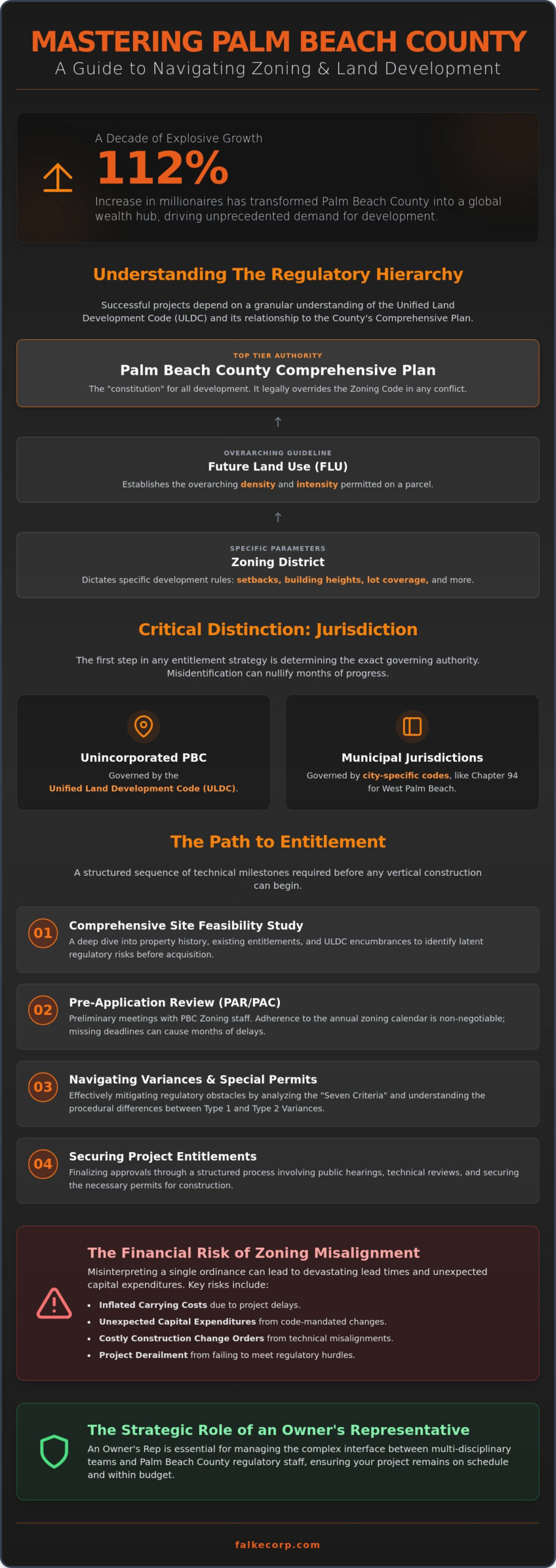
Palm Beach County has witnessed a 112% increase in millionaires over the past decade, transforming the region into a global wealth hub and driving unprecedented demand for sophisticated commercial and residential assets. This rapid expansion means that successfully navigating zoning regulations in Palm Beach County is no longer just a procedural step; it’s a critical financial variable. Owners often find themselves stalled by the opaque requirements of the Unified Land Development Code (ULDC) or blindsided by the 2026 impact fee increases that affect everything from fire rescue to public buildings.
You’re likely aware that misinterpreting a single ordinance can result in devastating lead times for public hearings and unexpected capital expenditures. It’s frustrating when regulatory hurdles threaten to derail a meticulously planned timeline. This guide provides the technical clarity you need to master the ULDC Supplement 32 and its upcoming updates to ensure your project remains on schedule and within budget. We’ll examine the 2026 zoning fee schedule, the specific deadlines for Development Review Officer intake, and the strategic framework required to secure project entitlements without compromise.
Key Takeaways
- Identify the critical distinctions between Zoning Districts and Future Land Use (FLU) designations to establish a legally sound foundation for your project’s density and intensity.
- Execute a structured approach to navigating zoning regulations in Palm Beach County by integrating comprehensive site feasibility studies before property acquisition.
- Analyze the “Seven Criteria” and the procedural differences between Type 1 and Type 2 Variances to effectively mitigate regulatory obstacles and potential delays.
- Quantify the financial implications of carrying costs and construction change orders that result from technical misalignments during the entitlement phase.
- Understand the strategic role of an Owner’s Representative in managing the complex interface between multi-disciplinary teams and Palm Beach County regulatory staff.
Understanding the Palm Beach County Unified Land Development Code (ULDC)
The Unified Land Development Code (ULDC) serves as the definitive technical framework for all land development activities within unincorporated Palm Beach County, Florida. This document isn’t merely a set of guidelines; it’s a rigid regulatory system that dictates the fundamental feasibility of every commercial and residential asset. The Planning, Zoning & Building (PZB) Department acts as the primary authority for code enforcement, ensuring that every site plan adheres to the precise standards set forth in the current Supplement 32. Owners must recognize that the PZB’s mandate is the strict application of these rules to maintain the county’s structural and aesthetic integrity.
A critical distinction that owners must internalize is the hierarchical relationship between Future Land Use (FLU) designations and Zoning Districts. While the FLU establishes the overarching density and intensity permitted on a parcel, the Zoning District provides the specific development parameters, including setbacks, building heights, and lot coverage. Misaligning these two layers is a frequent cause of project failure during the initial review phases. Successfully navigating zoning regulations in Palm Beach County requires a granular understanding of how these designations interact to either limit or expand your project’s potential floor area ratio and unit count.
Unincorporated PBC vs. Municipal Jurisdictions
Determining the exact jurisdictional authority is the first step in any entitlement strategy. If a site lies within a municipality like the City of West Palm Beach, it’s governed by Chapter 94 of their specific code rather than the County ULDC. This distinction is vital because annexation efforts can shift a property’s jurisdiction mid-application, potentially nullifying months of progress. Your entitlement strategy must account for these geographic boundaries to avoid costly jurisdictional conflicts that arise when county and municipal standards clash.
The Hierarchy of Palm Beach County Land Regulations
The Palm Beach County Comprehensive Plan functions as the “constitution” for development; in any legal conflict, it overrides the Zoning Code. Owners must analyze Article 3, which details Overlays and Districts, alongside Article 4, which governs Use Regulations. Many projects encounter resistance not from general zoning rules, but from “Use-Specific” requirements. These are technical caveats buried within the code that can impose additional buffering, specialized parking ratios, or operational restrictions based on the specific business type proposed. Professional oversight during the pre-construction phase ensures these nuances are identified before capital is committed to a non-viable site plan.
Navigating the Entitlement Process: From Site Feasibility to Approval
The entitlement process in Palm Beach County is a structured sequence of technical milestones that begins long before vertical construction commences. Successfully navigating zoning regulations in Palm Beach County requires owners to move beyond surface-level site assessments. A comprehensive site feasibility study Florida is the prerequisite for identifying latent regulatory risks that could compromise a project’s financial viability. This phase involves a deep dive into the property’s history, existing entitlements, and potential encumbrances within the ULDC to establish a realistic development baseline.
Once feasibility is established, the next critical step is the Pre-Application Review (PAR) or Pre-Application Conference (PAC). These meetings with PBC Zoning Technicians and staff from the Planning, Zoning & Building Department provide a preliminary assessment of the project’s alignment with county standards. Adhering to the annual zoning calendar is non-negotiable; for instance, the July 2026 intake for PAR/PAC is strictly set for 11:59 pm on July 29th. Missing these deadlines can delay a project by several months, inflating carrying costs and disrupting the broader development schedule. Professional oversight during these staff-level negotiations often determines whether a project proceeds smoothly or faces repetitive cycles of comments and revisions.
The Pre-Construction Feasibility Phase
Distinguishing between ‘By-Right’ development and ‘Conditional Use’ approvals is fundamental to project planning. By-right projects proceed through administrative review by the Development Review Officer (DRO), which is generally more predictable. Conditional uses, however, require public hearings before the Zoning Commission or the Board of County Commissioners. This phase must also account for concurrency requirements, ensuring that infrastructure for traffic, utilities, and schools can support the proposed density. In Palm Beach, environmental preservation constraints or historical designations can impose additional layers of review that must be addressed during pre-construction to avoid mid-cycle design changes.
Managing Third-Party Consultants
A primary challenge for owners is reconciling an architect’s aesthetic vision with the technical limitations of the ULDC landscape and buffering standards. Civil engineers must also integrate PBC-specific drainage requirements and setbacks early in the design phase to prevent late-stage revisions that impact the site’s yield. A qualified Owner’s representative Miami ensures that these multi-disciplinary teams operate in sync, translating complex zoning mandates into actionable design instructions. This proactive coordination prevents the ‘design-redesign’ loop that often plagues projects where zoning is treated as a secondary concern rather than a primary design driver.
Variances and Special Permits: Overcoming Zoning Obstacles
When a project’s technical requirements conflict with the rigid standards of the ULDC, owners must utilize specific legal mechanisms to secure approvals without compromising the asset’s functional intent. Successfully navigating zoning regulations in Palm Beach County often involves the pursuit of a variance, which is a formal departure from code requirements such as setbacks, parking ratios, or building height. These aren’t granted lightly; the county mandates adherence to the ‘Seven Criteria,’ a rigorous set of standards designed to prove that literal enforcement of the code would result in an unnecessary and undue hardship. It’s essential to understand that financial hardship alone is rarely sufficient; the applicant must demonstrate that unique physical circumstances of the land prevent reasonable use under existing regulations.
The path to approval depends on whether the request qualifies as a Type 1 or Type 2 Variance. Type 1 Variances are typically administrative, handled by the Development Review Officer (DRO), and apply to minor deviations. In contrast, Type 2 Variances require a public hearing before the Zoning Commission. For owners seeking to expedite timelines, Administrative Deviations offer a strategic alternative for specific code sections, allowing staff to approve minor technical adjustments without the protracted schedule of a public hearing. This distinction is critical for maintaining the project’s momentum and avoiding the long lead times associated with the public hearing calendar.
Securing a Variance in PBC
Establishing ‘Unique Circumstances’ requires a data-driven approach, often involving topographical surveys or historical land-use analysis to show why a property cannot meet standard code requirements. Preparing for hearings before the Zoning Commission or the Board of County Commissioners demands a disciplined presentation of facts rather than emotional appeals. Proactive community engagement is equally vital; addressing neighbor concerns regarding density or traffic before the hearing can prevent organized opposition that often leads to costly deferrals or project denials.
Special Permits and Conditional Uses
While a variance modifies a physical standard, a Special Permit or Conditional Use approval governs how the land is used. Unlike a permanent Rezoning application, Special Permits are often time-limited or subject to specific operational conditions. Owners must ensure that their construction quality control Miami processes align strictly with these permit conditions during the execution phase. Failure to adhere to these technical stipulations can lead to the revocation of the permit or significant delays during the final close-out and commissioning stages, particularly as the county increases oversight on use-specific ordinances like the 2025 Green Market updates.
The Financial Risk of Zoning Delays and How to Mitigate Them
Financial exposure in property development is most acute during the entitlement phase, where regulatory friction directly translates into mounting carrying costs. Navigating zoning regulations in Palm Beach County requires a rigorous focus on the project schedule; every month of inaction incurs debt service, property tax liabilities, and administrative overhead. Technical misalignments discovered late in the process don’t just delay the start of construction. They often necessitate complex construction change order management strategies once vertical work begins. If a site plan is approved with conditions that the design team hasn’t fully vetted for constructability, the resulting modifications during the build phase can lead to significant budget overruns and timeline erosion.
Protecting the project’s ROI demands an aggressive approach to schedule management. This involves more than just tracking deadlines; it requires anticipating the technical objections that lead to deferrals. Managing these variables effectively requires the oversight of a dedicated Development Management partner to ensure that technical compliance doesn’t erode project profitability through unnecessary delays.
Impact Fees and Concurrency Costs
Owners must account for the 2026 impact fee schedule, which underwent significant adjustments on January 1, 2026, across categories including fire rescue, roads, and public buildings. Additionally, a 2.7% increase was applied to several county fees on March 1, 2026, in accordance with the Consumer Price Index (CPI). These aren’t static figures. They’re dynamic variables that require precise calculation using the PBC Impact Fee Estimator early in the feasibility phase. Strategic timing of these payments is essential for preserving cash flow during the pre-construction period. Negotiating ‘Proportionate Share’ agreements for traffic mitigation also requires specialized technical data to ensure the owner isn’t over-contributing to regional infrastructure improvements beyond the project’s actual impact area.
Avoiding Scope Creep During Entitlements
During public hearings and staff-level reviews, ‘condition creep’ poses a substantial risk to the project’s financial baseline. This occurs when county staff or boards suggest ‘voluntary’ enhancements, such as specialized architectural treatments or enhanced buffering, that quickly become mandatory permit conditions. Without a professional gatekeeper, these additions can inflate the cost of materials and labor. It’s imperative that the construction bidding Florida process is informed by the final, certified site plan to ensure all zoning-mandated elements are accurately reflected in the contract sum. A professional Owner’s Representative serves as the strategic lead in these negotiations, ensuring that technical compliance is achieved without sacrificing the project’s financial stability.
Why an Owner’s Representative is Essential for Palm Beach Zoning
The technical complexity of the ULDC requires more than just legal counsel; it demands a strategic lead who can synthesize the competing interests of architects, civil engineers, and county staff into a single, actionable development plan. An Owner’s representative Miami acts as this central authority, ensuring that every design decision and legal argument serves the project’s long-term financial stability. Navigating zoning regulations in Palm Beach County is a multi-disciplinary effort where the Owner’s Rep manages the critical interface between the private development team and public regulatory bodies. This professional oversight ensures that transparency remains high and that financial controls are strictly enforced from the initial concept through to final commissioning.
FALKE Atlantic Corporation applies a disciplined four-phase methodology to manage these complexities, encompassing pre-construction, construction, commissioning, and close-out. By integrating zoning strategy into the earliest pre-construction phases, we eliminate the technical gaps that often lead to repetitive staff comments or public hearing deferrals. Our approach focuses on technical competence and professional reliability, providing owners with the unwavering confidence required to manage large-scale capital investments in a highly regulated landscape.
The FALKE Atlantic Corporation Strategic Advantage
We provide a single point of accountability for complex developments, particularly within high-stakes retail and hospitality sectors where speed-to-market is a primary driver of ROI. In these environments, regulatory dilution is a constant threat. This occurs when a project’s original vision is eroded by excessive county-mandated conditions or buffering requirements. We protect the owner’s vision by negotiating technical solutions that satisfy ULDC requirements without compromising the asset’s functional value. Our experience in navigating zoning regulations in Palm Beach County allows us to anticipate staff objections and resolve them through data-driven technical arguments rather than costly design concessions.
From Entitlements to Close-out
The entitlement process doesn’t conclude with a Board of County Commissioners vote. Successfully managing the transition from zoning approval to building permit issuance is critical for maintaining the project’s momentum and avoiding idle carrying costs. We ensure that all zoning conditions are meticulously tracked and integrated into the final construction documents. This continuity is essential during the construction project close-out, where failure to meet a single landscape stipulation or site plan condition can delay the issuance of a Certificate of Occupancy. To secure your project’s timeline and mitigate regulatory risk, we recommend requesting a strategic consultation to evaluate your specific Palm Beach County development requirements.
Securing Your Development Timeline in Palm Beach
The technical intricacies of the Unified Land Development Code and the evolving 2026 fee structure necessitate a rigorous, systems-based approach to development. We’ve established that successful project outcomes depend on the seamless integration of technical site feasibility, aggressive schedule management, and the precise application of the Seven Criteria for variances. Navigating zoning regulations in Palm Beach County is a process where the margin for error is increasingly narrow; the financial consequences of regulatory friction are profound and often irreversible without professional intervention.
FALKE Atlantic Corporation serves as the strategic lead for high-net-worth and corporate entities, providing the technical competence required to protect complex South Florida entitlements. Our disciplined four-phase methodology ensures that your project remains a stable investment, free from the volatility of unmanaged regulatory cycles. By centralizing accountability, we safeguard your capital from the initial concept through to the final close-out. Secure your project’s ROI with FALKE Atlantic Corporation’s Owner’s Representation services. We look forward to establishing a partnership that ensures your vision is executed to the highest professional standards.
Frequently Asked Questions
Where can I find the zoning regulations for unincorporated Palm Beach County?
The regulations are hosted on the Palm Beach County Planning, Zoning & Building (PZB) Department website within the Unified Land Development Code (ULDC). As of July 2026, the code is currently at Supplement 32. Owners should access the Zoning Division’s digital portal to review the most recent ordinances and the official zoning map to ensure they’re referencing the latest technical standards for their specific parcel.
How do I determine if my property is in a municipal or unincorporated area?
You can verify a property’s jurisdiction by using the Palm Beach County Property Appraiser’s Public Access system (PAPA). By searching the Parcel Control Number (PCN), the “Tax District” field will indicate whether the site falls within a specific city’s boundaries or under the jurisdiction of the Board of County Commissioners. Properties in unincorporated areas are strictly subject to the County’s ULDC standards rather than municipal codes.
What is the Unified Land Development Code (ULDC) in Palm Beach County?
The ULDC is the primary regulatory document governing land use, density, intensity, and building placement within unincorporated Palm Beach County. It translates the broad policies of the Comprehensive Plan into enforceable technical standards. Successfully navigating zoning regulations in Palm Beach County requires a deep understanding of the ULDC’s articles, which cover everything from environmental protections to specific use regulations and landscaping requirements.
How long does the rezoning process typically take in Palm Beach County?
The rezoning process generally requires six to nine months, though complex projects involving significant land use amendments can extend beyond a year. This timeline includes mandatory phases such as pre-application conferences, staff review cycles, and public hearings before both the Zoning Commission and the Board of County Commissioners. Adhering to the strict annual zoning calendar deadlines is essential to avoid adding several months of delay to this standard schedule.
What are impact fees and how do they affect my development budget?
Impact fees are one-time technical charges assessed on new development to fund public infrastructure necessitated by project growth. Effective January 1, 2026, the county updated its fee schedule for roads, parks, schools, and fire rescue. These fees are calculated based on land use type and square footage; they must be accounted for early in the development management phase to prevent significant capital shortfalls during the permitting process.
Can I meet with a PBC planner before submitting my application?
Yes, the Zoning Division offers Pre-Application Reviews (PAR) and Pre-Application Conferences (PAC) for this purpose. These formal meetings allow owners and their representatives to present preliminary site plans to staff and receive technical feedback on potential code conflicts. Engaging in this process is a strategic necessity for identifying regulatory hurdles before committing to a final design or submitting a formal application for public hearing.
What is a zoning variance and when is it required for a project?
A variance is a formal authorization to depart from specific ULDC requirements, such as setbacks, lot coverage, or parking ratios. It’s required when the literal enforcement of the code creates an undue hardship due to the physical characteristics of the land. Applicants must satisfy the “Seven Criteria” during a public hearing, demonstrating that the request is the minimum necessary to allow for reasonable use of the property.
How does the City of West Palm Beach zoning differ from the County code?
The City of West Palm Beach utilizes its own Code of Ordinances, specifically Chapter 94, which features distinct density, architectural, and procedural standards compared to the County. While the County ULDC focuses on unincorporated areas, the City code is tailored to urbanized municipal environments with different setback and height allowances. Navigating zoning regulations in Palm Beach County requires confirming whether the property is subject to these municipal rules or the broader County land development standards.