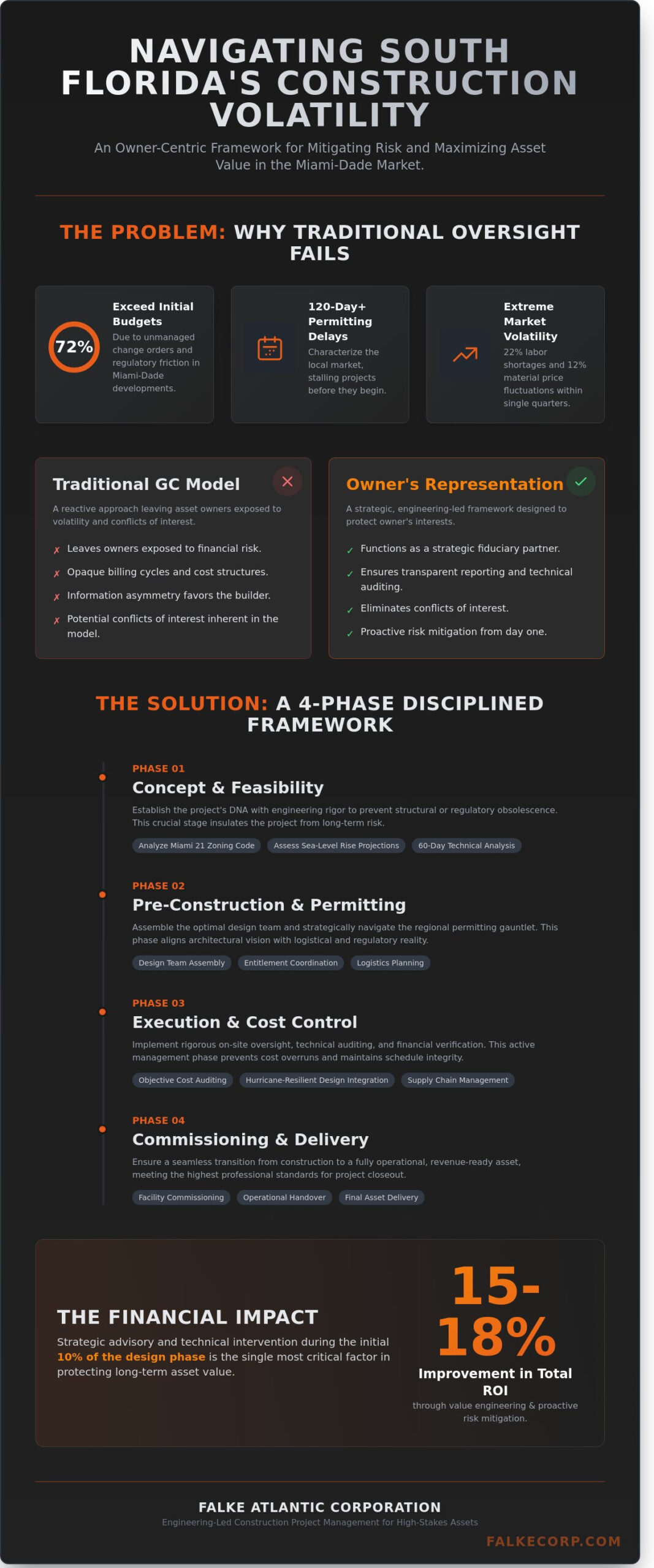
According to a 2023 industry analysis, 72% of commercial developments in the Miami-Dade area exceed their initial budgets by at least 15% due to unmanaged change orders and regulatory friction. If you’re an asset owner, you likely recognize that the current state of construction project management Florida demands more than just a signed contract; it requires a rigorous, engineering-led oversight strategy. You’ve probably felt the frustration of opaque billing cycles and the 120-day permitting delays that characterize the local market.
We agree that the traditional general contractor model often leaves owners exposed to unnecessary financial volatility and operational gaps. This guide provides a disciplined, owner-centric framework designed to restore transparency and technical precision to your capital projects. You’ll learn how to implement a system that secures financial control, mitigates the specific risks of Florida building codes, and ensures your asset is revenue-ready exactly when the schedule dictates. We’ll examine the precise workflows needed to transition from fragmented oversight to a unified, high-performance management structure.
Key Takeaways
- Analyze the unique volatility of the South Florida market to understand why traditional management frameworks frequently fail in high-growth corridors.
- Implement a disciplined four-phase development lifecycle that prioritizes technical feasibility and rigorous pre-construction coordination within the Miami-Dade landscape.
- Establish a clear distinction between owner’s representation and general contracting to eliminate conflicts of interest and ensure objective auditing of all project costs.
- Optimize your approach to construction project management Florida by mastering the regional permitting gauntlet and integrating hurricane-resilient design into your execution schedule.
- Leverage technical competence and strategic partnership to mitigate risks when delivering high-stakes commercial and residential assets in Dade and Broward Counties.
Navigating the South Florida Construction Landscape
The tri-county area encompassing Miami, Ft. Lauderdale, and West Palm Beach represents one of the most volatile high-growth corridors in the United States. Technical execution in this region requires a departure from standard oversight models. Traditional Construction management often fails here because it treats the project as a static set of variables. In reality, the Atlantic Coast market is a fluid system where labor shortages reached 22% in 2023 and material price indices fluctuated by 12% within single fiscal quarters. Project success isn’t found in mere supervision; it’s secured through rigorous asset delivery and risk insulation. This transition from “watching the builder” to “engineering the outcome” defines the modern standard for Construction project management Florida professionals.
Effective management in this territory functions as a strategic fiduciary partnership. It’s about protecting capital against the friction of local bureaucracy and market instability. When a project moves beyond the 50% completion mark, the cost of course correction increases exponentially. We prioritize early-stage technical intervention to ensure that the project remains insulated from the common pitfalls of South Florida’s rapid expansion. This approach treats every decision as a calculation of long-term asset value rather than a temporary fix for a site-level hurdle.
The Complexity of the Florida Market
Rapid urban development in Dade and Broward counties has compressed construction timelines while simultaneously straining the local infrastructure. In 2023, residential and commercial starts in Miami-Dade saw a 14% increase, which placed unprecedented pressure on the regional supply chain. Local expertise in specific municipalities like North Bay Village and Miami Beach is non-negotiable for project viability. These areas enforce unique environmental regulations and strict permitting windows that can stall a project for 60 to 90 days if not managed with precision. Logistics planning must account for the 42-week lead times currently seen in specialized electrical components and the high turnover rates within the regional labor pool.
Protecting the Owner’s Interest
The primary role of a project management consulting firm is to eliminate the information asymmetry that naturally exists between owners and builders. Contractors possess granular data that owners often lack; our duty is to level this field through transparent reporting and technical auditing. By implementing strategic advisory during the initial 10% of the design phase, owners can realize a 15% to 18% improvement in total ROI through value engineering and proactive risk mitigation. This fiduciary responsibility ensures that every dollar spent aligns with the technical requirements of the build. We don’t just monitor progress. We verify that the structural and financial integrity of the project meets the highest professional standards, preventing the cost overruns that typically plague unmanaged Florida developments.
The distinction between a successful delivery and a stalled project often rests on the caliber of Construction project management Florida firms selected for the task. It’s not enough to have a general understanding of building processes. You need a partner who views the construction site as a complex industrial system. This mindset allows for the identification of bottlenecks before they manifest as financial losses. We focus on the continuity of operations, ensuring that the transition from groundbreaking to facility commissioning is handled with the same engineering rigor applied to the initial blueprints. Precision is the only hedge against the unpredictability of the South Florida market.
The Four Phases of Disciplined Development Management
Execution in the Florida market requires a methodical transition through four distinct phases to ensure technical viability and financial stability. Phase 1 centers on Concept and Feasibility, where we establish the project’s DNA. In Miami-Dade, this involves a 60 day window for analyzing the Miami 21 zoning code and assessing sea-level rise projections for the year 2050. Without this initial engineering rigor, the project risks structural or regulatory obsolescence before ground is even broken. Phase 2 moves into Pre-Construction, where the primary objective is design team assembly and entitlement coordination. This phase aligns the architectural vision with the logistical realities of the site.
Phase 3 shifts to Active Construction, requiring rigorous oversight of vendors and adherence to tight schedules. Project managers must maintain a presence on-site to verify that every cubic yard of concrete meets the specified compressive strength. The final stage, Phase 4, involves Commissioning and Close-out. This isn’t merely a walkthrough; it’s a systematic verification that all systems, from HVAC to life safety, operate at peak efficiency. This process ensures the developer receives a revenue-ready asset that meets all 2024 compliance standards. Effective construction project management Florida professionals treat these phases as an integrated engineering lifecycle rather than isolated tasks.
Pre-Construction and Site Selection
Site feasibility studies in Florida must account for complex environmental regulations, specifically those mandated by the Department of Environmental Protection (DEP). We analyze soil conditions and groundwater levels to prevent 15% budget spikes during foundation work. Assembling the architectural and engineering team during the first 30 days is vital for maintaining the project timeline. This early collaboration allows for budget benchmarking, where we create a realistic pro forma based on current 12% annual inflation rates for raw materials in the South Florida region. All planning must integrate the requirements of the Florida Building Code to ensure the structure withstands 175 mph wind loads. For those seeking technical excellence in these early stages, exploring comprehensive industrial solutions provides the necessary engineering foundation.
Active Oversight and Financial Control
Maintaining financial discipline during the build requires a cold, objective analysis of every line item. We monitor the G702 and G703 payment applications with precision to prevent overbilling. These documents serve as the ledger of record, ensuring that capital is only released when 100% of the corresponding work is verified. Schedule management utilizes the Critical Path Method (CPM) to track the 150 to 200 interdependent tasks found in modern developments. In a high-velocity environment, construction project management Florida demands a structured Request for Information (RFI) process. We implement a strict 48 hour response protocol for all RFIs to avoid the 20% labor inefficiency that occurs when trades are left idle. This level of control isn’t about micromanagement; it’s about the engineering reliability required to deliver a project on time and within the 5% contingency margin.
Success in the Florida construction sector isn’t found in optimistic projections, but in the relentless application of technical standards. By treating each phase as a critical engineering milestone, we eliminate the variables that lead to cost overruns. The focus remains on stability, quality, and the delivery of a high-performing asset.
Owner’s Representation vs. General Contracting in Miami
The distinction between a General Contractor (GC) and an Owner’s Representative (OR) defines the financial trajectory of any major build. In the context of Construction project management Florida, the GC functions as the delivery engine, while the OR serves as the technical auditor. A fundamental conflict of interest exists when the entity responsible for execution also manages the budget. GCs often prioritize their internal margins; they might overlook sub-optimal scheduling if it keeps their specialized labor teams occupied. This misalignment of goals frequently leads to “budget drift” that owners don’t detect until the project reaches 70% completion.
An Owner’s Rep operates on a fixed-fee basis, removing the incentive to inflate project costs. This structure ensures that every engineering decision aligns with the owner’s long-term ROI rather than the builder’s quarterly profit. During a 2022 luxury retail expansion in Miami’s Design District, FALKE Atlantic Corporation identified $412,000 in overlapping line items within a GC’s “self-performed” concrete bid. Without external oversight, these costs would’ve been absorbed into the base contract, reducing the owner’s capital for interior finishes. The OR protects the owner’s interests by acting as a fiduciary, ensuring that technical competence drives the project forward.
The Conflict of Interest Problem
General Contractors face a structural paradox. Their primary revenue comes from the delta between the contract price and actual execution costs. When a GC self-performs trades like electrical or masonry, they effectively grade their own work. This lack of transparency leads to “margin padding” where contingency funds are depleted prematurely. Effective Construction project management Florida requires a third-party expert to validate that technical specifications meet the 2023 Florida Building Code without unnecessary gold-plating. Independent oversight ensures that the builder’s convenience never supersedes the project’s structural or financial integrity.
Strategic Vendor Management
The procurement phase in Miami requires rigorous technical vetting. Owner’s Reps utilize competitive bidding to force transparency. In a “Lump Sum” contract, the GC assumes the risk but often inflates the initial price to cover unknowns. Conversely, “Cost Plus” contracts offer transparency but require constant auditing to prevent scope creep. A professional representative manages these regional climate risks by ensuring the project’s insurance and structural specifications account for the increased frequency of high-velocity hurricane zones (HVHZ) requirements. This methodical approach to vendor selection mitigates long-term liability.
Audit protocols for change orders are critical. Statistics from 2023 indicate that unmanaged change orders can increase Miami project costs by 12% to 18%. An Owner’s Rep scrutinizes every request for additional funds, verifying that the “unforeseen condition” wasn’t actually a failure in the GC’s initial site survey. They analyze the impact of every change on the critical path of the schedule. This technical guardianship ensures that the project maintains its structural and financial integrity from groundbreaking to the final certificate of occupancy. By maintaining a professional distance from the trades, the OR provides the objective data necessary for informed executive decision-making.
Mitigating Regional Risks: Permitting, Climate, and Cost Control
The execution of high-tier assets in the South Florida market requires a synthesis of engineering precision and regulatory foresight. Technical competence in this region isn’t merely about structural integrity; it’s about navigating a dense web of municipal requirements and environmental variables that can jeopardize a project’s financial viability if not managed with absolute discipline. A failure to synchronize these elements results in catastrophic budget variances and schedule slippage.
Permitting and Entitlements in South Florida
Navigating the regulatory landscape in Miami-Dade County requires a calculated approach to the “Dry-Run” permitting process. This system allows for a preliminary, concurrent review of plans by essential departments, including Fire, Zoning, and the Department of Regulatory and Economic Resources, before the formal submission. Utilizing this method effectively can reduce the approval window by 15% to 22%. In specific jurisdictions like North Bay Village, project managers must coordinate directly with the Planning and Zoning Board to address unique density and aesthetic requirements. The transition from the Notice of Commencement to the final Certificate of Occupancy hinges on a rigorous, preemptive inspection schedule. A disciplined project manager ensures every structural, electrical, and plumbing milestone is documented to avoid the 30 day delays common in backlogged municipal systems. Effective construction project management Florida standards demand this level of administrative rigor to maintain momentum.
Climate Resilience and Quality Control
Florida’s 8th Edition Building Code, which became mandatory on December 31, 2023, dictates the engineering parameters for every new development. In High-Velocity Hurricane Zones, such as those found in Miami-Dade and Broward, building envelopes must withstand wind speeds exceeding 175 mph. Quality control isn’t limited to structural stability; it involves managing Florida’s 72% average morning humidity. Proper MEP commissioning is vital for long term asset protection. If the HVAC system isn’t precisely calibrated for latent heat loads, moisture intrusion will degrade the interior finishes within 18 to 24 months. Professional construction project management Florida teams utilize thermal imaging and pressure testing to verify the building envelope’s performance against tropical storm conditions.
The 2020 Sea Level Impact Projection (SLIP) study requirements now influence how coastal projects are engineered and financed. Developers must account for a projected 10 to 12 inch sea level rise by 2050. This necessitates elevated first floor slabs and sophisticated drainage systems, which typically add 6% to 9% to initial capital expenditures. Cost control for high end hospitality projects requires granular tracking of these specialized materials. With luxury retail fit outs in the Miami Design District often reaching $950 per square foot, procurement delays can erode margins within a single fiscal quarter. We manage these risks through:
- Implementation of 4D scheduling to integrate hurricane season work stoppages.
- Rigorous moisture mitigation protocols during the concrete curing phases.
- Advanced procurement strategies for long lead electrical components and glazing.
- Direct coordination with local utilities to ensure timely energization of the site.
Technical reliability is the foundation of every successful build. For developers seeking to secure their investments against these regional complexities, we provide the engineering oversight necessary to deliver results without compromise. Explore our approach to complex project execution and technical risk mitigation to ensure your next Florida development meets the highest professional standards.
Executing High-Stakes Assets in Dade and Broward Counties
Executing high-stakes assets in Dade and Broward Counties requires a level of technical discipline that exceeds standard general contracting. The South Florida market, specifically the luxury retail and hospitality sectors, demands a rigorous approach to construction project management Florida. FALKE Atlantic Corporation provides this through a methodology rooted in engineering precision and systematic risk mitigation. We manage assets for international brands and high-net-worth individuals who prioritize technical reliability over marketing promises. Our team treats every square foot as a strategic investment where structural integrity must align with aesthetic perfection.
The FALKE Atlantic approach focuses on the intersection of technical competence and strategic partnership. We don’t just oversee labor; we manage the entire lifecycle of the asset to ensure it meets the specific operational needs of the client. This involves a deep understanding of local Dade County building codes, which are among the most stringent in the United States due to high-velocity hurricane zone requirements. Our project managers act as the technical conscience of the development, ensuring that every subcontractor adheres to the precise specifications defined in the engineering phase.
Our management of the Prada store in the Miami Design District serves as a benchmark for high-stakes retail execution. The project involved the integration of bespoke Italian millwork with complex local climate control systems. We maintained a constant site presence during the critical installation phases to ensure every tolerance met the 0.5mm requirement specified by the brand’s architects. The project reached completion in 2023, meeting the strict deadline for the winter retail season. This required a synchronized schedule where long-lead international shipments were coordinated with local interior fit-out teams to avoid a single day of downtime.
Finalizing a project is a technical transition, not just a physical one. Our close-out process involves a zero-tolerance punch list and a comprehensive digital handover of all operational manuals. We ensure that the facility management team is fully briefed on all mechanical, electrical, and plumbing (MEP) systems before we exit the site. This ensures the asset remains operational from the first minute of occupancy, preventing the common “teething” issues that plague less disciplined developments. We provide a structured roadmap for maintenance that protects the long-term value of the building envelope and internal systems.
Boutique Service for Complex Projects
Corporations and luxury brands require a single point of accountability to mitigate risk across diverse asset classes. Our approach ensures technical discipline during every phase. Hospitality assets must be revenue-ready upon delivery, meaning all systems are tested and staff training can commence without structural interference. We maintain this discipline by utilizing advanced scheduling software and real-time reporting, giving stakeholders 100% visibility into the project’s technical health.
Your Strategic Partner in Florida Construction
Successful development begins with an initial feasibility consultation and a rigorous site assessment. Professional development management provides long-term value by identifying structural or regulatory bottlenecks before capital is deployed. Our engineering-first mindset ensures that your project remains a stable, high-performing asset for decades. You can Protect your investment with FALKE Atlantic Corporation by engaging our team for your next construction project management Florida requirement. We provide the stability your capital deserves.
Secure Your Investment Through Technical Precision
Navigating the South Florida landscape requires a technical approach that prioritizes risk mitigation over speculative optimism. By implementing our disciplined Four-Phase Methodology, owners maintain rigorous control over high-end retail and hospitality assets across the 35 distinct municipalities within Miami-Dade and Broward. This structured framework directly addresses the 12% year-over-year cost fluctuations currently impacting regional material markets; it ensures total compliance with the most recent 2023 Florida Building Code updates. Professional Construction project management Florida isn’t just about site oversight. It’s about the engineering reliability required to navigate complex permitting hurdles and specific climate-resilience demands. For developers seeking comprehensive oversight throughout the entire development lifecycle, implementing specialized real estate development management services in Miami provides the systematic framework necessary to bridge the gap between architectural vision and a commissioned, revenue-generating asset while maintaining strict adherence to the stringent regulatory requirements of the 2026 market. We invite you to secure your project’s technical and financial stability through our specialized expertise in high-stakes asset delivery.
Schedule a Strategic Consultation for Your Florida Project to ensure your development meets the highest standards of professional excellence. Your vision deserves a foundation built on unyielding technical competence.
Frequently Asked Questions
What is the difference between a Project Manager and an Owner’s Representative in Florida?
An Owner’s Representative serves as the developer’s fiduciary advocate across the entire project lifecycle, while a Project Manager typically works for the General Contractor to oversee daily site operations. In Florida, 85% of large-scale commercial developments utilize an Owner’s Rep to manage the broader financial and legal risks that fall outside the contractor’s scope. The representative coordinates the architects, engineers, and legal teams to ensure the project meets the owner’s specific investment goals.
How much does construction project management cost in Miami?
Professional fees for construction project management Florida services in Miami generally range from 3% to 6% of the total hard construction costs. On a $15 million multi-family development, this equates to a fee between $450,000 and $900,000 depending on the technical complexity. Some firms also utilize a monthly retainer model, which often falls between $8,000 and $18,000 for mid-sized commercial builds.
When is the best time to hire a development management firm?
The optimal time to engage a development management firm is during the pre-development feasibility phase, ideally 8 to 12 months before you plan to break ground. Early involvement allows the firm to audit the site’s zoning capacity and verify that the initial pro forma is technically achievable. Engaging experts before the 100% design completion phase can prevent costly architectural revisions that often consume 5% of the total budget.
Can an Owner’s Rep help with Miami-Dade building permits?
An Owner’s Rep streamlines the Miami-Dade building permit process by managing the “Concurrent Plans Processing” and coordinating responses across 14 different municipal departments. They’ve the expertise to navigate the “Muni-Code” requirements and can often reduce the standard 6-month approval timeline by 20% through rigorous document quality control. Their presence ensures that technical “Notices of Disapproval” are addressed by the design team within a 48-hour window.
How do you prevent change order fraud in large-scale Florida construction?
Preventing change order fraud requires the implementation of a “Guaranteed Maximum Price” contract and a mandatory 3rd party audit of every “Request for Information” that impacts the budget. Industry data indicates that unmonitored Florida projects face a 12% average increase in costs due to unsubstantiated claims. We utilize forensic accounting and site-to-plan verification to ensure that every dollar requested corresponds to a verified change in the project’s physical scope. For owners seeking comprehensive protection against these financial risks, implementing proven construction cost control Miami strategies provides the systematic framework necessary to eliminate unforeseen expenditures and maintain strict adherence to approved budgets throughout the entire development lifecycle.
What specific Florida climate factors affect project scheduling?
Florida’s hurricane season, which spans from June 1 to November 30, requires a 15% contingency buffer in every professional construction schedule. High humidity levels also impact the curing cycles of concrete and specialized coatings, frequently adding 72 hours to critical path tasks. Furthermore, the “Heat Index” protocols in South Florida can reduce labor productivity by 20% during the peak summer months of July and August.
Does Falke Atlantic Corporation provide general contracting services?
Falke Atlantic Corporation doesn’t provide general contracting services because the firm maintains a strict focus on Owner’s Representation and technical consultancy. By avoiding the direct hire of trade labor, the company preserves its 100% fiduciary independence and avoids the conflicts of interest inherent in the “at-risk” contracting model. This separation ensures that our engineering oversight remains objective and solely focused on the client’s financial and quality standards.
How does an Owner’s Rep improve the ROI of a real estate development?
An Owner’s Rep increases ROI by identifying 10% to 15% in savings through technical value engineering and by preventing schedule delays that increase debt service costs. On a $25 million project, an expert representative can save an owner approximately $2.5 million in avoidable expenses and interest. They refine the construction project management Florida process to ensure the asset reaches its revenue-generating phase on the precise date required by the investment plan. For owners seeking to evaluate their options, understanding how to select qualified building project management companies in Miami provides the analytical framework necessary to identify partners who prioritize technical competence and fiscal oversight over standard contracting models. Additionally, engaging a specialized construction project manager consultant in Miami ensures that your 2026 development benefits from the latest regulatory compliance strategies and advanced risk mitigation protocols designed specifically for the evolving South Florida market.