
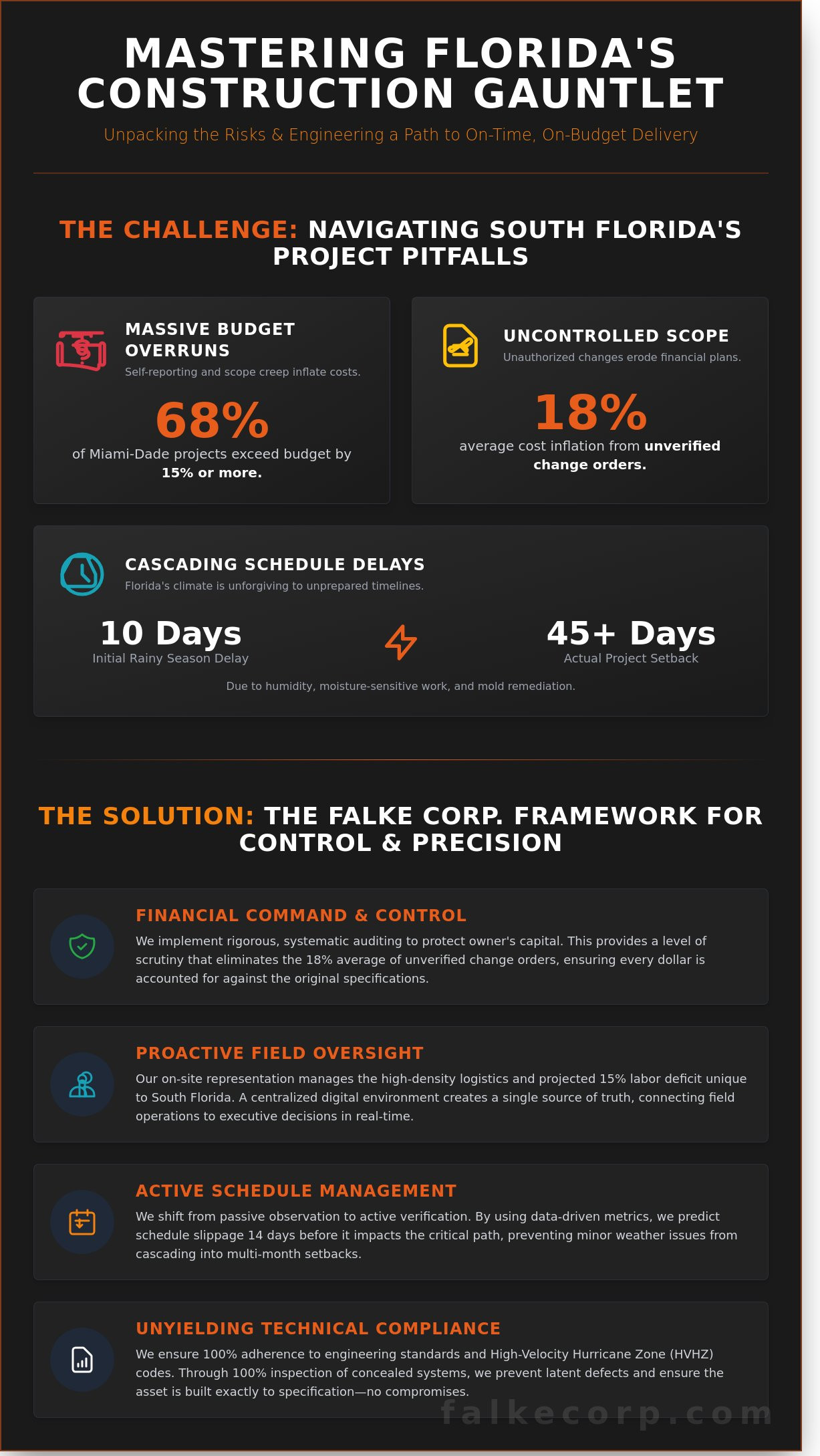
The traditional reliance on a general contractor’s self-reporting is the primary reason 68% of large-scale projects in Miami-Dade County exceed their initial budget by at least 15%. You’ve likely recognized that the transition from architectural drawings to physical execution is where the most significant capital risks reside, necessitating a rigorous approach to construction phase management florida. When uncontrolled change orders meet the 85% average humidity of a South Florida summer, the resulting delays don’t just stall progress; they erode your projected ROI before the asset is even revenue-ready.
This guide provides the technical framework to master these complexities by implementing professional oversight strategies that protect both your capital and your timeline. You’ll learn how to navigate the 2023 Florida Building Code revisions and mitigate the specific environmental risks that often catch unprepared owners off guard. We’ll examine a structured approach to financial transparency and engineering-led execution, ensuring your project concludes as a high-value asset delivered precisely to your original specifications.
Key Takeaways
- Distinguish between general contracting and specialized representation to maintain technical integrity during the transition from theoretical design to physical execution.
- Navigate the complexities of construction phase management florida by strictly adhering to High-Velocity Hurricane Zone (HVHZ) requirements and mitigating humidity-related risks.
- Implement a structured command-and-control reporting system to eliminate unauthorized scope creep and ensure adherence to strict scheduling milestones.
- Execute the critical close-out phase with precision, utilizing comprehensive punch-list management to secure the project’s return on investment and operational readiness.
Defining Construction Phase Management in Florida’s Dynamic Market
The construction phase represents the definitive shift where theoretical engineering blueprints transform into tangible physical assets. It’s the most volatile period of any capital project. While a General Contractor (GC) focuses on the direct execution of trades, professional construction phase management florida serves as a rigorous, independent oversight layer. This discipline ensures the design’s technical intent isn’t diluted by site-level improvisations or unauthorized cost-cutting measures. Within the broader framework of Construction management, the CPM acts as the owner’s technical fiduciary. They provide a level of scrutiny that goes beyond basic site supervision, taking full responsibility for the integrity of the mechanical, electrical, and structural systems during active building.
The Core Objectives of Field Oversight
Precision in the field is maintained through three primary mechanisms:
- Schedule Discipline: Maintaining strict adherence to milestones is vital. A 10-day delay during the Florida rainy season can easily cascade into a 45-day setback due to moisture-sensitive interior finishes and mold remediation requirements.
- Technical Compliance: Every specification is a requirement, not a suggestion. We ensure the GC meets 100% of engineering standards without compromise, specifically regarding the high-velocity hurricane zone (HVHZ) codes.
- Financial Auditing: Protecting the owner’s capital requires rigorous transparency. In 2024, unmanaged commercial projects in Florida saw an average of 18% in unverified change orders. We eliminate these discrepancies through systematic auditing.
Why Miami and Fort Lauderdale Require Specialized CPM
High-density urban logistics in neighborhoods like the Miami Design District or downtown Fort Lauderdale leave zero margin for error. Staging areas are frequently restricted to less than 800 square feet; this necessitates precise, minute-by-minute delivery coordination. By early 2026, South Florida’s labor market is projected to face a 15% deficit in specialized MEP technicians. Managing these shortages requires a manager with deep local roots to ensure manpower remains consistent across multi-site commercial initiatives. Professional construction phase management florida provides the stability needed to operate in these high-pressure, high-cost environments without sacrificing quality or safety. It’s about engineering reliability into the build process itself.
The Technical Mechanics of Field Oversight and Professional Representation
Establishing a command-and-control structure ensures that site communication flows through predetermined channels; this prevents the fragmentation of technical data. Professional representation on-site transforms the construction phase management florida from a reactive exercise into a disciplined engineering operation. Daily field reports provide a granular audit trail, documenting labor counts, weather impacts, and specific equipment utilization. By deploying a centralized digital project management environment, stakeholders access a single source of truth, reducing the latency between field observations and executive decisions. Coordinating third-party consultants, including structural engineers and MEP specialists, requires a rigorous meeting cadence to resolve multi-disciplinary conflicts before they manifest as physical rework.
Active Monitoring vs. Passive Observation
Technical oversight demands a shift from observation to active verification. We verify work-in-place against the schedule of values by conducting physical audits of completed assemblies. Regular inspections ensure strict adherence to the Florida Building Code, which is essential for maintaining structural integrity against high-velocity hurricane zones. Data-driven metrics, such as a 12% variance threshold in labor productivity, allow project managers to predict schedule slippage 14 days before it impacts the critical path. Preventing latent defects through 100% inspection of concealed systems represents a significant cost-avoidance strategy for the owner.
Managing the Information Flow: RFI and Submittal Oversight
Administrative bottlenecks often compromise field progress. The Request for Information (RFI) process serves as the vital link between design intent and field reality. We implement a 48-hour response protocol for critical RFIs to maintain site momentum. Timely submittal reviews are equally vital, particularly for long-lead materials like custom glazing or specialized electrical switchgear. Delays in these approvals can extend a project timeline by 60 days or more. Maintaining a disciplined oversight framework ensures that technical specifications are met without compromising the delivery schedule. This structured approach to information management reduces the risk of non-conforming work and ensures the project remains aligned with the original engineering requirements.
Navigating South Florida’s Unique Regulatory and Climatic Constraints
The High-Velocity Hurricane Zone (HVHZ) dictates every aspect of execution in Miami-Dade and Broward counties. Compliance with the Florida Building Code (FBC) requires an uncompromising approach to material selection. Fasteners and glazing must meet specific TAS 201, 202, and 203 impact and wind pressure standards to withstand gusts exceeding 175 mph. Effective construction phase management florida relies on precise scheduling to ensure the building envelope is sealed before the peak of humidity cycles. Failure to maintain interior relative humidity below 55% during the drywall and millwork phases often leads to microbial growth or material warping. This technical necessity forces a rigid sequence where HVAC systems must be operational and balanced before sensitive finishes arrive on site. It’s a logistical challenge that requires constant monitoring of moisture content in concrete slabs, which must remain below 4% before flooring installation begins.
Hurricane Season Preparedness and Site Safety
Active sites in South Florida must implement a formal Hurricane Preparedness Plan by May 15 each year. When the National Hurricane Center issues a tropical storm watch, the project manager initiates a 72-hour countdown. This protocol includes lowering crane booms or allowing them to “weathervane” according to manufacturer specifications. Loose materials like plywood or metal decking are banded and weighted. The Construction Management Association of America provides the framework for these operational standards. These guidelines ensure that insurance requirements for weather-related events are met through rigorous documentation of site securing activities. Digital logs must prove that all temporary structures were reinforced 48 hours before potential landfall to maintain policy compliance.
Local Permitting and Entitlement Management
Navigating the municipal landscape in Palm Beach and Miami requires a proactive relationship with the Authority Having Jurisdiction (AHJ). A “red tag” stop-work order can cost a project upwards of $10,000 per day in lost productivity and overhead. Project leads must schedule inspections with Miami-Dade or Broward officials at least 48 hours in advance. They’ll ensure all “as-built” deviations are documented before the inspector arrives on site. For coastal developments, environmental compliance involves strict adherence to sea turtle lighting ordinances from March 1 to October 31. Silt fence maintenance is monitored daily to protect local waterways. Technical construction phase management florida involves balancing these regulatory hurdles with the engineering demands of the build to avoid permit expirations or costly code violations.
Critical Control Points: Change Orders, Quality, and Scheduling
Effective construction phase management florida necessitates a clinical approach to project deviations. Change orders aren’t merely administrative tasks; they represent technical risks that can compromise both structural integrity and financial performance. In large-scale Florida developments, these shifts often arise from unforeseen subsurface conditions or sudden regulatory updates. We treat every claim with an engineering mindset, stripping away the emotional weight of delays to focus on the underlying data. A zero-tolerance policy for unauthorized scope creep is essential. If a task doesn’t align with the approved architectural intent or the project’s functional requirements, it doesn’t proceed. This discipline ensures that the project’s technical core remains intact throughout the build cycle. Many of these costly deviations can be prevented through comprehensive pre-construction services miami that establish definitive engineering and financial baselines before breaking ground.
The Change Order Management Protocol
Technical auditing is the first line of defense against budget inflation. Every contractor claim for additional time or cost undergoes a 48-hour rigorous review process. We compare requested labor hours against localized benchmarks, such as the $75 to $95 hourly rates typical for specialized trades in South Florida as of late 2023. A 10% or 15% contingency fund isn’t a budget to be exhausted. It’s a strategic reserve managed through strict cost-benefit analyses. Negotiating fair market value for necessary adjustments requires a deep understanding of current material supply chains and labor availability.
Quality Control and Specification Compliance
Quality assurance defines the process, but quality control delivers the result. For high-end hospitality or retail assets, full-scale physical mock-ups are mandatory 60 days before mass installation begins. These mock-ups allow for the testing of glazing interfaces and moisture barriers under simulated tropical conditions. We verify all material certifications against Florida Product Approval numbers to ensure every component meets the state’s stringent wind-load and salt-spray requirements. Quality control is the non-negotiable alignment of field execution with architectural design.
Managing the critical path in Florida is a race against the calendar. The June 1st start of hurricane season creates a hard deadline for achieving “dried-in” status. Missing this 24-week window increases the risk of moisture-related interior damage by approximately 35%. We prioritize speed to market by focusing on these revenue-generating milestones:
- Structural Topping Out: Targeted for completion before peak storm activity in August.
- Building Envelope Sealing: Verification of all thermal and moisture protection layers by mid-May.
- Long-Lead MEP Installation: Early procurement of HVAC systems to ensure climate control is active before interior finishes begin.
Precision in scheduling isn’t a matter of optimism; it’s the result of methodical engineering. Our team ensures that every phase of your project reflects the highest standards of technical excellence. To secure your project’s timeline and quality, partner with FALKE Atlantic Corporation for expert project oversight.
Transitioning from Active Construction to Revenue-Ready Assets
The final 10% of a project dictates the total Return on Investment. While the structural shell and internal finishes represent the bulk of the labor, the close-out phase transforms a construction site into a functional, revenue-generating asset. Effective construction phase management florida requires a meticulous approach to the punch list. At Falke, we don’t view this as a formality. Every minor defect, from sealant integrity to electrical plate alignment, must meet our internal engineering benchmarks before we consider a zone completed. This rigor ensures that the transition to facility management occurs without the friction of ongoing repairs or operational interruptions.
Securing the long-term viability of the asset depends on the transfer of technical knowledge. We prioritize the collection and verification of O&M manuals, warranties, and as-built drawings. These documents provide the roadmap for future maintenance, protecting the 30-year lifecycle of the mechanical systems. Without these records, the facility manager’s ability to respond to system failures is severely compromised. It’s a matter of operational stability rather than just administrative compliance.
Commissioning and Systems Verification
Florida’s extreme humidity levels, often exceeding 80% in summer months, demand rigorous HVAC commissioning. Systems must maintain precise pressure differentials to prevent mold growth and ensure occupant comfort. In complex Miami developments, we engage third-party commissioning agents to validate that electrical and life-safety systems perform under peak load conditions. This process is mandatory for achieving LEED Gold or Platinum certifications, which can increase a property’s market value by 12% in the South Florida commercial sector.
Final Close-out and Financial Reconciliation
Obtaining the Certificate of Occupancy (CO) from Florida municipalities like the City of Miami or Fort Lauderdale requires navigating strict building codes. Our team manages the final inspections and ensures all permit requirements are satisfied to avoid delays in tenant move-ins. We perform a final audit of the project budget, reconciling all change orders and releasing the final 10% retainage only after every contractual obligation is met. This disciplined approach to construction phase management florida protects the developer’s capital and ensures the asset is handed over in peak condition. For a detailed breakdown of our methodology, explore our Commissioning and Close-out services.
Achieving Operational Readiness Through Technical Precision
Successful project delivery in the current market requires more than general oversight; it demands a rigorous engineering-based approach to construction phase management florida. Owners must ensure strict compliance with Miami-Dade High-Velocity Hurricane Zone (HVHZ) standards while maintaining the integrity of the original design intent. Our disciplined four-phase methodology provides the structural framework necessary to control change orders and prevent the budget drift that often plagues complex builds. It’s a system designed for those who value technical competence over marketing promises.
Falke’s experience with prestigious global brands like Prada and Tiffany & Co. demonstrates our ability to manage high-stakes environments where precision is the only acceptable standard. We don’t just monitor progress; we enforce the professional representation required to turn active sites into revenue-ready assets. By prioritizing objective data and engineering reliability, we protect your capital from the volatility of the construction process. You’ve worked hard to secure your site, so now ensure the execution matches your vision. For comprehensive oversight from initial planning through final delivery, consider implementing real estate development management services that address the full spectrum of regulatory and technical challenges. The foundation for successful construction phase management begins with thorough strategic pre-construction services in Miami that establish clear technical baselines and mitigate risks before they impact the build schedule.
Secure Your Investment with Falke’s Professional Owner Representation
Your path to a completed, high-performing asset starts with disciplined oversight today.
Frequently Asked Questions
What is the difference between a Construction Manager and an Owner’s Representative in Florida?
A Construction Manager (CM) oversees the physical execution of the build and manages onsite subcontractors, while an Owner’s Representative serves as the developer’s strategic advocate to manage the CM, budget, and overall project lifecycle. In Florida, the CM typically holds the contractor license and assumes 100% of the site safety risk. Conversely, the Owner’s Rep focuses on the 15% to 20% of soft costs that fall outside the CM’s scope.
How does hurricane season affect construction phase management in Miami?
Hurricane season, spanning from June 1 to November 30, mandates a 72 hour mobilization protocol for all Miami job sites to secure loose materials and crane systems. Effective construction phase management florida requires integrating a 5% to 10% schedule buffer for weather-related stoppages. Project managers must execute mandatory “blue-sky” site audits every 14 days during this window to ensure compliance with the Miami-Dade County Emergency Management guidelines.
Why are change orders so common in Florida construction, and how can they be prevented?
Change orders frequently arise from 30% or higher gaps in initial design documents or unforeseen subsurface conditions common in Florida’s limestone terrain. You can prevent these by requiring 100% Construction Document completion and a 3D BIM coordination review before breaking ground. Statistical data shows that projects utilizing a dedicated Owner’s Rep see a 12% reduction in change order volume compared to unmanaged projects.
What specific Miami-Dade building codes impact the execution phase the most?
The High Velocity Hurricane Zone (HVHZ) requirements within the Florida Building Code, specifically Chapter 16, dictate the most rigorous execution standards for wind load and impact resistance. Contractors must verify that all windows and doors carry a valid Miami-Dade Notice of Acceptance (NOA) number. Failure to document these 7-digit identifiers during the rough-in phase often leads to immediate inspection failure and 14-day delays.
How much does professional construction phase management cost in South Florida?
Professional construction phase management florida typically costs between 3% and 5% of the total construction value for projects exceeding $10 million. For smaller luxury developments in South Florida, firms may charge a flat monthly retainer ranging from $8,000 to $15,000. This investment usually yields a 2:1 return by identifying technical redundancies and preventing 5% to 8% in unnecessary material waste during the build.
What is a ‘revenue-ready asset’ and why does it matter for hospitality brands?
A revenue-ready asset is a facility where the Certificate of Occupancy and operational systems are fully synchronized for immediate guest check-ins or leasing. For hospitality brands, every 24-hour delay in achieving this status results in a loss of approximately $250 per room in potential revenue. Ensuring the building’s technical systems are ready for staff training 30 days before the official opening is the primary objective of professional oversight.
Can an Owner’s Rep help if my project is already behind schedule in Fort Lauderdale?
An Owner’s Rep can intervene by performing a forensic schedule audit to identify the 3 or 4 critical path bottlenecks causing the delay. They implement a recovery schedule that re-sequences trade work, often reclaiming 10% to 15% of lost time through aggressive procurement management. In Fort Lauderdale, this often involves coordinating with the City’s Building Department to expedite the 48-hour inspection turnaround times.
What documents are required for a successful project close-out in Broward County?
Successful project close-out in Broward County requires a final Certificate of Occupancy, notarized final lien waivers from all 1st and 2nd tier subcontractors, and a complete set of digital as-built drawings. You must also submit the 1-year warranty bonds and the final elevation certificate if the property sits in a designated Flood Zone AE. Missing a single Final Release of Lien can delay the release of the 10% retainage by 60 days or more.