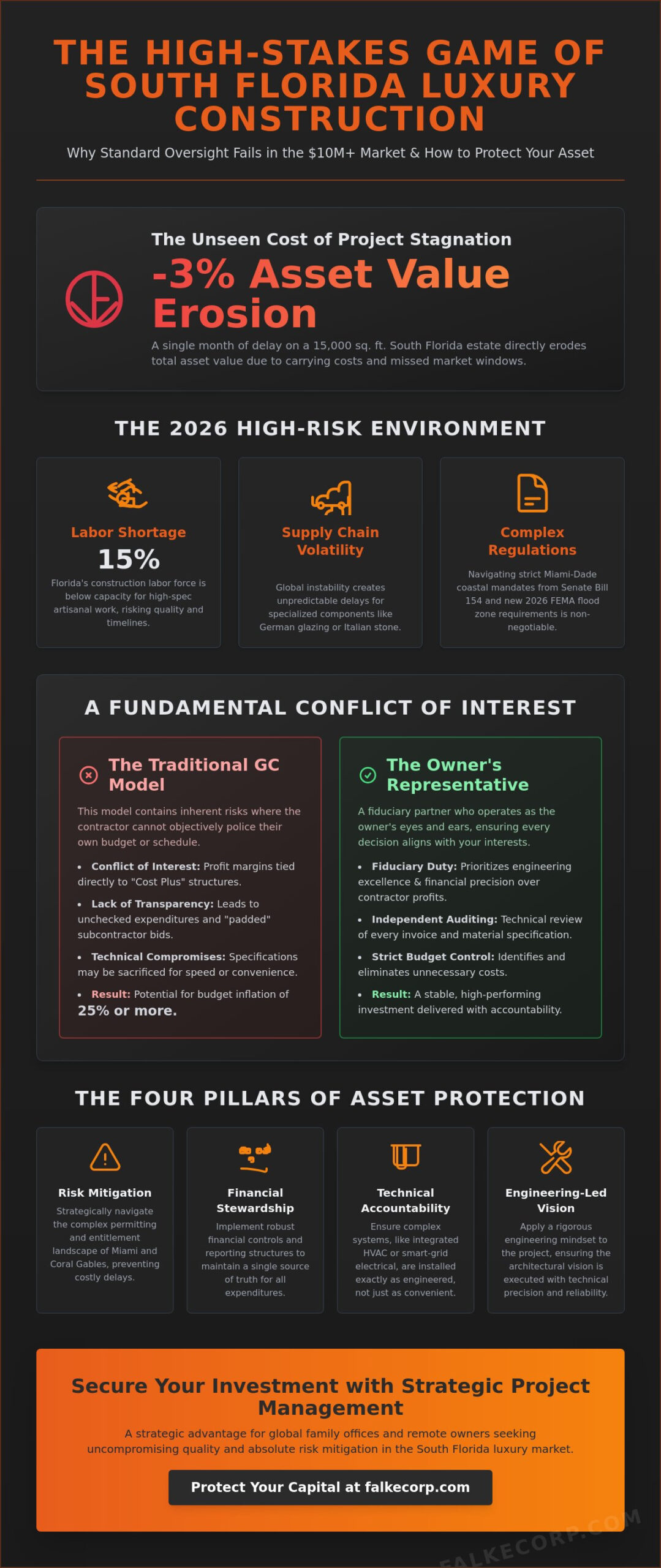
A single month of project stagnation on a 15,000-square-foot South Florida estate translates to a 3% erosion of total asset value when accounting for carrying costs and missed market windows. You likely understand that the South Florida luxury market rewards precision but ruthlessly penalizes the slightest administrative or technical oversight. Managing construction projects for high-net-worth families Miami requires more than aesthetic vision; it demands a rigorous engineering mindset to navigate the 2026 regulatory landscape and its associated environmental complexities.
It’s clear that the volatility of Miami-Dade permitting and the lack of transparency in traditional contractor billing represent the primary threats to your capital preservation. This guide provides a technical blueprint for delivering a move-in-ready asset with absolute financial precision and minimal personal site friction. We’ll examine the specific protocols for owner representation, risk mitigation strategies for coastal environmental regulations, and the implementation of structured vendor coordination to ensure your development remains a stable, high-performing investment. By applying these disciplined oversight methods, you can secure a revenue-ready property that meets the highest standards of engineering reliability and professional accountability.
Key Takeaways
- Understand why $10M+ developments in the 2026 South Florida market necessitate a “Trust, but Verify” oversight model that extends beyond the capabilities of a standard general contractor.
- Learn how a technical Owner’s Representative acts as a fiduciary partner to protect capital and ensure the precise execution of a project’s architectural vision.
- Identify the specific financial controls and reporting structures required for managing construction projects for high-net-worth families Miami to maintain a single source of truth for all expenditures.
- Navigate the complex 2026 permitting and entitlement landscape in the City of Miami and Coral Gables using disciplined coordination and expediting strategies.
- Discover how engineering-led project management provides a strategic advantage for global family offices and remote owners seeking uncompromising quality and risk mitigation.
The Complexity of Ultra-Luxury Construction in South Florida
The Miami luxury real estate market in 2026 has transitioned into a phase where residential assets exceeding $10 million function more like industrial infrastructure than traditional housing. Successfully managing construction projects for high-net-worth families Miami requires a departure from standard residential practices. The technical demands of these estates, often involving complex automation and specialized materials, necessitate a rigorous “Trust, but Verify” approach. Relying solely on a General Contractor (GC) introduces systemic risks that can compromise both the engineering integrity and the financial stability of the project. A professional oversight layer ensures that technical specifications aren’t sacrificed for the sake of convenience or speed.
Current market data from late 2025 indicates that Florida’s construction labor force remains 15% below the required capacity for high-spec artisanal work. This shortage, combined with continued volatility in the global supply chain for specialized components like German-engineered glazing systems or bespoke Italian stone, creates a high-risk environment. Traditional project management often fails in this sector because it lacks the technical depth to audit these complex variables in real-time. Effective oversight must integrate fundamental construction management principles with a focus on risk mitigation and technical precision. Without this, owners face significant delays and “scope creep” that can inflate budgets by 25% or more.
Environmental and Regulatory Hurdles in Miami-Dade
Coastal estates in Miami-Dade now operate under the strict mandates of Senate Bill 154, which was fully implemented by early 2025. This legislation accelerated the recertification timeline from 40 years to 30 years for buildings near the coastline, directly impacting how new foundations and structural envelopes are engineered. FEMA’s updated 2026 flood zone requirements have also forced architectural shifts. In exclusive enclaves like North Bay Village and Star Island, specific mandates for seawall elevations and hydrostatic vent systems are no longer optional additions but core structural requirements. Managing construction projects for high-net-worth families Miami means navigating these localized codes with a level of precision that standard contractors often overlook.
The Limitations of the Traditional General Contractor Model
The traditional GC model contains an inherent conflict of interest; a contractor cannot objectively police their own budget or schedule when their profit margins are tied to the “Cost Plus” structure. This lack of financial transparency frequently leads to unchecked expenditures. In 2026, sophisticated owners are increasingly moving toward the Owner’s Representative model to solve this. This shift provides several key advantages:
- Independent Auditing: Every invoice and material specification undergoes a technical review to ensure it meets the contract’s quality standards.
- Budget Control: A dedicated representative identifies “padding” in subcontractor bids that a GC might otherwise ignore.
- Technical Accountability: Ensuring that complex systems, such as integrated HVAC or smart-grid electrical panels, are installed exactly as engineered.
This model ensures that the owner’s interests are protected by a partner who prioritizes engineering excellence over the contractor’s bottom line. It’s a structured, logical approach to building that treats a luxury home as the significant investment it is.
The Owner’s Representative: Technical Oversight for High-Value Assets
An owner’s representative serves as a fiduciary partner rather than a traditional sub-contractor. While a general contractor manages the labor and materials on-site, the representative operates as the owner’s eyes and ears, ensuring every decision aligns with the client’s financial interests and long-term vision. For those managing construction projects for high-net-worth families Miami, this distinction is critical. A standard project manager in Florida often focuses on the narrow scope of a specific contract; conversely, an owner’s representative oversees the entire ecosystem, from legal compliance to architectural integrity.
The technical complexity of Miami’s 2026 luxury market has increased the demand for owner’s representatives who possess engineering-grade expertise. FALKE Atlantic functions as the central intelligence hub for these complex builds, synthesizing data from architects, engineers, and municipal authorities into actionable insights. This structured approach prevents the fragmented communication that typically leads to cost overruns in high-value residential assets.
FALKE’s Four-Phase Project Management Methodology
The Falke Corp methodology relies on a disciplined, sequential process to maintain project stability:
- Concept and Feasibility: We conduct rigorous site selection and entitlement analysis within the Miami-Dade jurisdiction to identify zoning constraints early.
- Design and Pre-Construction: Our team assembles an “A-Team” of architects and MEP engineers, ensuring technical specifications meet the family’s lifestyle requirements.
- Construction Phase: We implement disciplined oversight of schedules and quality standards, utilizing real-time reporting to maintain transparency.
- Commissioning and Close-out: This final stage ensures the asset is fully operational, whether it’s revenue-ready for the rental market or move-in-ready for the family.
Pre-Construction: Mitigating Risk Before Groundbreaking
Risk mitigation begins long before the first shovel hits the ground. Our team conducts exhaustive site feasibility studies across Broward and Palm Beach counties to evaluate soil conditions, coastal setbacks, and utility infrastructure. These technical audits are essential for managing construction projects for high-net-worth families Miami, where environmental factors can dictate the entire project timeline.
Budget validation is a core component of our pre-construction phase. We identify “hidden” costs in luxury architectural plans, such as specialized glazing systems or custom automation integration, that often go overlooked in initial estimates. By structuring strategic pre-construction services, we establish a firm financial baseline that prevents future delays. This level of engineering-led scrutiny ensures that the final build reflects the original intent without compromising on quality or fiscal responsibility. If you’re planning a complex build, establishing this technical foundation is the most effective way to secure your capital investment.
Financial Stewardship and Cost Control in $10M+ Developments
Managing construction projects for high-net-worth families Miami requires a rigorous engineering approach to capital allocation rather than simple bookkeeping. For developments exceeding the $10,000,000 threshold, the fee structure fundamentally dictates incentive alignment. While percentage-based fees are traditional, monthly retainers often provide a more objective oversight environment. This prevents the inherent conflict of interest where a manager’s compensation increases alongside the project’s total cost. Professional stewardship ensures that every dollar spent is a deliberate investment in the asset’s terminal value.
We establish a “Single Source of Truth” by integrating all expenditures into a centralized digital ledger. This system provides family offices with audit-ready documentation, which is essential for precise tax reporting and long-term asset valuation. In the 2026 Miami market, where ultra-prime residential costs can exceed $4,000 per square foot, professional oversight directly drives ROI. It ensures that the capital invested translates into measurable equity rather than being absorbed by administrative inefficiencies or unverified surcharges. Detailed financial logs allow for a forensic level of transparency that standard general contracting models often lack.
- Retainers vs. Percentage Fees: Fixed monthly fees ensure the project manager’s loyalty remains with the owner, not the budget’s growth.
- Centralized Data: Real-time tracking of every invoice and lien waiver eliminates financial blind spots.
- Family Office Reporting: Detailed cash flow projections and variance reports provide the clarity needed for complex portfolio management.
Preventing Change Order Fraud and Scope Creep
Budget leaks often occur through unvetted change orders. We mitigate this by defining a rigorous approval process where every claim undergoes a technical review. We distinguish between necessary structural adjustments and opportunistic requests from contractors. By implementing construction cost control in Miami through real-time data, we’ve seen projects reduce contingency spend by 12% on average. This methodical verification ensures the owner only pays for documented value added to the site.
Managing the Vendor Ecosystem: Architects, Engineers, and Artisans
High-end developments rely on a fragmented ecosystem of specialized vendors. Coordinating these parties requires a deep understanding of the commercial project management spectrum. We manage the procurement of long-lead items, such as custom glazing or imported stone, which often require 24-week lead times. Delays in these areas can stall an entire site and inflate carrying costs. Our role is to ensure that the design intent provided by architects meets the structural reality of the engineering plans without compromising the project’s financial stability.
Navigating the Miami Permitting and Entitlement Landscape
The 2026 permitting environment in the City of Miami and Coral Gables operates with a level of digital complexity that demands absolute technical precision. For those managing construction projects for high-net-worth families Miami, the “Electronic Plan Review” (ePlan) systems have become the primary bottleneck. In Coral Gables, the Board of Architects maintains a rigorous aesthetic oversight that can stall a project for months if the initial architectural submittals lack granular detail. Success in this phase isn’t about hope; it’s about the technical competence of the documentation provided to municipal officials.
The role of the Permit Expediter has evolved from a simple courier to a strategic technical liaison. A high-performing expediter doesn’t just track files. They understand the specific preferences of individual examiners within the building department. This relationship management ensures that minor technical queries don’t escalate into formal rejections. When waterfront properties are involved, the complexity doubles. Riparian rights and the Coastal Construction Control Line (CCCL) regulations, enforced by the Florida Department of Environmental Protection, dictate exactly where and how a structure can sit on the land. Failure to account for the 50-foot setback requirements or seawall structural integrity standards can lead to total project stagnation.
Strategies for Expediting Approvals in Broward and Palm Beach
Municipal requirements vary significantly as you move north. Fort Lauderdale focuses heavily on maritime engineering and drainage, while West Palm Beach prioritizes historic preservation and neighborhood character. Achieving technical accuracy in the first submittal is the only way to reduce the “Request for Information” (RFI) cycles, which typically add 12 to 16 weeks to a timeline. An Owner’s Rep must act as the lead strategist during public hearings, presenting data-driven arguments to zoning boards to secure variances for height or density. This level of preparation prevents the bureaucratic delays that often plague luxury developments.
Climate Resilience: Building for Hurricane Season and Sea Level Rise
The 2026 Florida Building Code (9th Edition) has introduced more stringent requirements for structural reinforcement. High-impact glazing must now meet increased wind-load pressures, often exceeding 175 mph ratings for coastal estates. We integrate these technical requirements with LEED and sustainable standards to ensure the estate remains viable for decades. Beyond mere compliance, the focus is on engineering reliability. This includes elevated finished floor elevations and redundant power systems that function independently of the municipal grid during tropical events.
Ensure your project meets the highest engineering standards by partnering with experts who understand the technical demands of the Miami market. Secure your project’s future with Falke Corp.
FALKE Atlantic: Strategic Project Management for Discerning Families
FALKE Atlantic operates on the principle that luxury residential construction requires the same level of technical rigor as complex industrial engineering. While high-volume management firms often treat projects as a series of administrative checklists, our boutique approach prioritizes engineering-led precision. This distinction becomes critical when managing construction projects for high-net-worth families Miami, where the architectural complexity and regulatory environment of 2026 demand more than just surface-level oversight. We serve as the primary strategic partner for global family offices and remote owners, providing a disciplined interface between the vision of the architect and the technical execution of the contractor.
Our methodology rejects the “factory” model of project management. By maintaining a limited portfolio, we ensure that every technical detail, from structural integrity to the integration of advanced automation systems, receives direct senior-level scrutiny. This results in assets that aren’t just aesthetically complete but are technically sound and ready for immediate operation. Our experience in delivering high-quality, revenue-ready assets in the Design District demonstrates that a focused, boutique consultancy outperforms large-scale firms by eliminating the communication gaps that typically lead to cost overruns.
Delivering Revenue-Ready Assets and Private Estates
The final phase of a Miami build determines the long-term viability of the investment. We manage the transition from a construction site to a functioning estate through a rigorous commissioning process. This involves the verification of all mechanical, electrical, and plumbing systems to ensure they meet the specific Owner’s Representative Miami standards. Our close-out management includes the systematic collection of warranties, customized O&M manuals, and the finalization of lien waivers to protect the owner from future liabilities. This structured approach ensures that the residence is fully operational from day one.
Securing Your Investment in the Miami Market
Professional oversight provides the necessary stability in the volatile Florida real estate market. The value of a property lies in the quality of its execution and the transparency of its documentation. Managing construction projects for high-net-worth families Miami requires a commitment to disciplined management that extends beyond the ribbon-cutting ceremony. Protecting your legacy involves ensuring that every phase of the project is documented, verified, and optimized for long-term performance. To begin a consultation for your 2026 Miami project and secure the technical integrity of your next investment, contact our team to discuss a customized management strategy.
Securing Your 2026 South Florida Residential Portfolio
The 2026 South Florida development environment requires a level of technical precision that surpasses conventional residential standards. Successfully managing construction projects for high-net-worth families Miami necessitates a rigorous commitment to both financial stewardship and the specific regulatory frameworks of Miami-Dade and Palm Beach counties. Owners must implement a disciplined four-phase methodology to effectively mitigate the inherent risks found in $10M+ developments. This structured approach ensures that every engineering detail and budgetary line item aligns with the family office’s long-term strategic objectives. FALKE Atlantic delivers this specialized oversight through a boutique model that prioritizes technical competence over superficial marketing promises. It’s a methodology rooted in engineering reliability; the complexities of the local permitting landscape are handled with methodical accuracy. We invite you to experience a partnership defined by professional accountability and structured success. Your capital deserves a foundation built on technical excellence and unwavering stability.
Secure your Miami investment with FALKE Atlantic’s expert representation.
Frequently Asked Questions
How does an Owner’s Representative differ from a General Contractor?
An Owner’s Representative serves as a fiduciary advocate for the client, whereas a General Contractor focuses on the physical execution of the build and subcontractor management. The representative provides an independent layer of technical oversight, ensuring the contractor’s work aligns with the project’s engineering specifications and financial constraints. This structure prevents conflicts of interest and ensures that every technical decision prioritizes the owner’s long-term investment rather than the contractor’s profit margins.
What are the typical fees for construction project management in Miami?
Industry data from the Construction Management Association of America suggests that professional representation fees generally range between 3% and 5% of the total construction cost. These figures fluctuate based on the project’s technical complexity and the specific scope of oversight required. For high-end residential assets, this fee structure provides a significant return on investment by identifying cost-saving opportunities through rigorous value engineering and the prevention of expensive structural errors.
Can an Owner’s Rep help with site selection in Palm Beach County?
Yes, an Owner’s Rep provides essential technical due diligence during the site selection process in Palm Beach County by analyzing zoning restrictions and environmental vulnerabilities. They coordinate with civil engineers to evaluate soil density and flood elevations before any purchase agreement is signed. This proactive approach identifies potential 20% or 30% increases in foundation costs early, allowing families to make informed acquisitions based on empirical data rather than aesthetic appeal.
Why is pre-construction the most critical phase for HNW families?
Pre-construction is the phase where 90% of potential budget overruns are mitigated through precise scheduling and detailed material procurement strategies. When managing construction projects for high-net-worth families Miami, this period allows for the synchronization of architectural intent with realistic engineering requirements. It establishes a technical roadmap that prevents the mid-project delays often caused by the region’s specific hurricane season constraints and complex municipal permitting processes.
How do you manage construction projects for families living outside of Florida?
We utilize high-definition site cameras and cloud-based project management software to provide remote owners with real-time transparency and technical updates. Detailed weekly reports translate complex site data into actionable insights, covering budget burn rates and milestone completion percentages. This systematic communication ensures families maintain full control over their Florida assets without the need for frequent travel, relying instead on a structured flow of verified technical information.
What is the “Four-Phase Methodology” used by FALKE Atlantic?
The Four-Phase Methodology consists of Discovery, Design Management, Execution Oversight, and Project Closeout, creating a logical framework for complex builds. Each stage requires the completion of specific technical audits and quality control checklists before the project transitions to the next phase. This disciplined engineering approach ensures that the final delivery meets the exact performance standards established at the project’s inception, leaving no room for operational ambiguity or technical failure.
How do you handle disputes between architects and contractors?
Disputes are resolved through a rigorous technical audit of the original contract documents and architectural specifications to determine the precise root cause of the disagreement. By acting as a neutral expert, the Owner’s Rep enforces the project’s established standards and holds the responsible party accountable. This objective mediation prevents the emotional escalation of conflicts, ensuring the project remains on schedule while avoiding the 15% to 20% cost increases typically associated with legal litigation.
Is an Owner’s Representative necessary for a renovation, or only new builds?
An Owner’s Representative is often more critical for renovations because existing structures frequently hide legacy engineering flaws that can inflate budgets by 25% or more. Managing construction projects for high-net-worth families Miami requires a specialized understanding of how to integrate modern automation and HVAC systems into older coastal properties. A representative ensures that the renovation doesn’t compromise the building’s structural integrity while maintaining strict adherence to the updated 2024 Florida Building Codes.