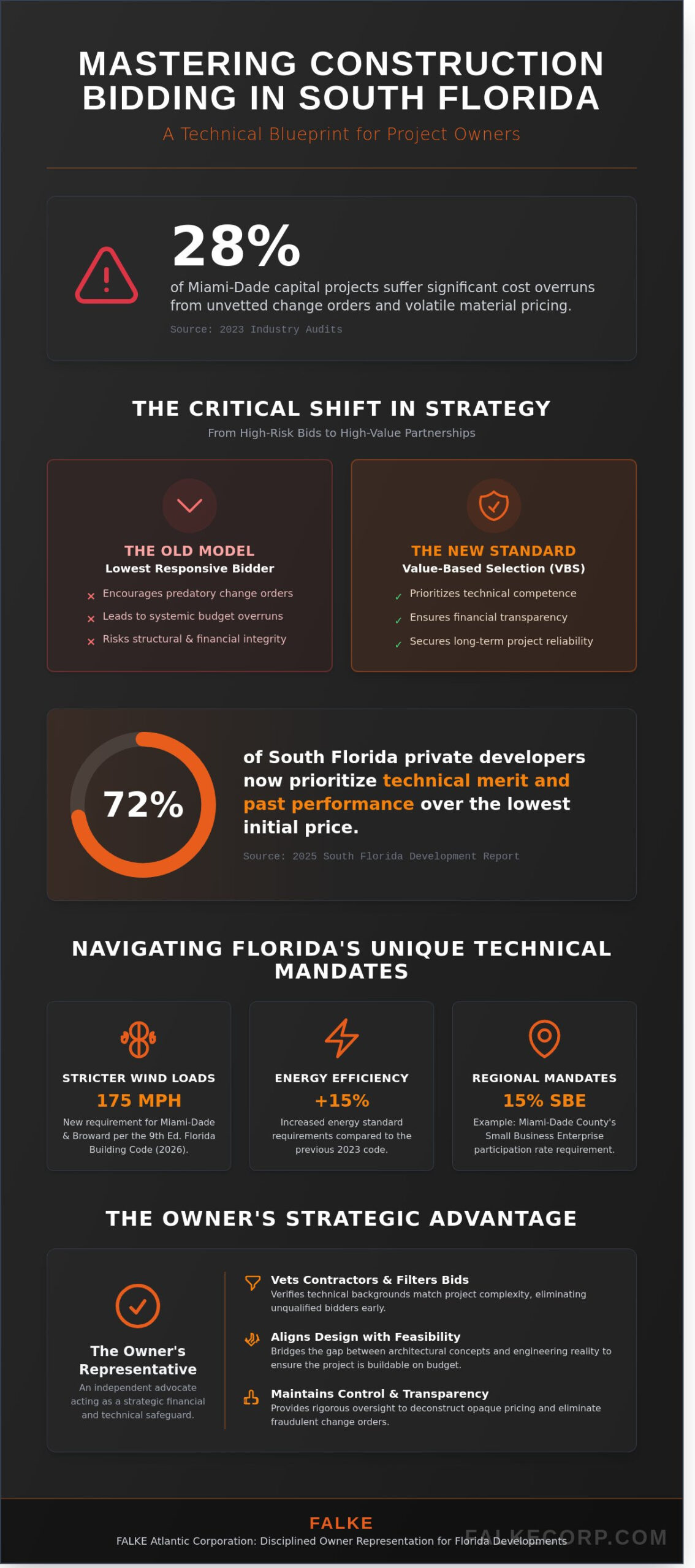
According to 2023 industry audits, nearly 28% of capital projects in Miami-Dade County suffer from significant cost overruns stemming from unvetted change orders and volatile material pricing. You likely recognize that the current South Florida market demands more than just a signature on a contract; it requires a rigorous, technical approach to procurement. Mastering construction bidding florida isn’t about finding the lowest number on a spreadsheet. It’s about establishing a disciplined framework that ensures financial control and absolute project transparency through professional owner representation.
This article provides the technical blueprint you need to secure a predictable project budget and mitigate the legal risks inherent in complex regional building codes. We’ll examine the specific protocols for vetting contractors, deconstructing opaque pricing models, and implementing the oversight necessary to eliminate fraudulent change orders. By applying these engineering-grade standards to your bidding process, you can transform a volatile construction environment into a controlled, high-performance investment.
Key Takeaways
- Navigate the evolving landscape of construction bidding florida by transitioning from high-risk, lowest-bidder models toward value-based selection criteria that ensure structural and financial integrity.
- Establish a disciplined procurement framework through the development of exhaustive Requests for Proposals and the rigorous pre-qualification of contractors based on localized technical expertise.
- Mitigate systemic financial risks by identifying latent scope gaps and labor market volatilities that frequently result in predatory change orders and budget overruns.
- Implement a strategic evaluation matrix that prioritizes technical competence and verified team compositions over deceptive pricing structures to secure project transparency.
- Leverage a comprehensive four-phase methodology for owner representation to maintain absolute control over the project lifecycle, from conceptualization to final commissioning.
Navigating the Florida Construction Bidding Landscape in 2026
Construction bidding in Florida is the formal, technical process of soliciting and evaluating contractor proposals to ensure project alignment with specific engineering and financial requirements. It’s a structured methodology that demands precision from the initial Request for Proposal (RFP) to the final contract award. Understanding the construction bidding process provides a necessary foundation for developers who must manage high-stakes industrial and commercial assets. In the 2026 market, the landscape of construction bidding florida has evolved beyond simple cost estimation into a rigorous assessment of technical competence and long-term reliability.
The industry has seen a decisive shift toward Value-Based Selection (VBS) over the traditional Lowest Responsive Bidder model. Recent data from the 2025 South Florida Development Report indicates that 72% of private developers in Miami and Fort Lauderdale now prioritize technical merit and past performance over the lowest initial price. This change reflects a growing realization that cheap bids often lead to expensive change orders and schedule overruns. Engineering reliability is now the primary metric for success; contractors must demonstrate their ability to handle complex automation and structural requirements before their financial proposal is even considered.
South Florida’s specific environmental challenges necessitate higher pre-qualification standards. The 9th Edition of the Florida Building Code, which became effective in 2026, introduced stricter wind load requirements for Miami-Dade and Broward counties. Bids must now account for 175 mph wind speeds and a 15% increase in energy efficiency standards compared to the 2023 code. Consequently, mastering construction bidding florida requires a granular understanding of these updated technical specifications to avoid non-compliance and future litigation.
Public vs. Private Sector Bidding in South Florida
Public procurement in Florida is governed by the Sunshine Law, specifically Florida Statute 286.011, which mandates total transparency in meetings and record-keeping. This openness provides a clear audit trail but adds layers of administrative complexity. Private owners are increasingly adopting this public-sector rigor to achieve better financial control. Regional nuances remain sharp; for instance, Miami-Dade County often requires a 15% Small Business Enterprise (SBE) participation rate, whereas Palm Beach County focuses heavily on local preference ordinances and diverse vendor certifications. These regional mandates directly impact the competitive landscape and the final selection criteria for any major project.
The Role of the Owner’s Representative in Procurement
An independent advocate is vital before the first RFP is issued. The Owner’s Representative bridges the gap between architectural design and contractor feasibility, ensuring that the project remains grounded in engineering reality. They filter out unrealistic bids and verify that the technical background of a contractor matches the complexity of the task at hand. This expert oversight prevents the common pitfall of selecting a firm that lacks the specialized knowledge for PLC programming or high-voltage electrical design. The Owner’s Representative acts as a strategic financial safeguard, ensuring that technical specifications and budgetary constraints remain aligned throughout the procurement lifecycle.
The Owner’s Framework for Competitive Bidding and Procurement
Successful construction bidding florida requires a structured, engineering-led approach to mitigate the inherent volatility of the local market. The process begins with the development of a technically precise Request for Proposal (RFP). This document serves as the project’s logical foundation. It’s not merely a call for prices but a comprehensive package including general conditions, granular technical specifications, and a milestone schedule that accounts for the 152-day peak hurricane season. When managing public-sector work, owners must strictly adhere to Florida’s competitive bidding laws, which mandate transparency and specific fairness standards for contracts exceeding $300,000.
Pre-qualifying contractors is the second critical phase. Verification of a contractor’s Experience Modification Rate (EMR) is mandatory; an EMR above 1.0 indicates a safety risk that could translate into site delays or insurance complications. In the current 5.5% interest rate environment, financial liquidity is as vital as technical skill. Owners should evaluate audited financial statements from the last 24 months to ensure the General Contractor (GC) can sustain the cash flow requirements of a $10 million plus project in Broward or Miami-Dade County without interruption.
Crafting the Perfect RFP for Miami Projects
Miami’s urban density demands specific logistical planning within the RFP. Effective documents define site access constraints for properties in districts like Brickell or Wynwood, where street closure permits often exceed $500 per day. It’s essential to incorporate noise ordinances and utilize Pre-Construction Services in Miami-Dade to identify utility conflicts before they impact the critical path. Precision in the RFP phase prevents the 18% cost overruns typically associated with scope ambiguity.
Pre-Qualifying Contractors: Beyond the License
Technical competence is measured through 10-year project histories and the strength of established subcontractor networks. A GC’s ability to secure Tier-1 electrical and mechanical subs in South Florida determines the project’s eventual quality and pace. We recommend verifying references for at least three projects of similar complexity completed within the last 36 months. This ensures the team understands the moisture mitigation and structural requirements mandated by the 2023 Florida Building Code.
The procurement framework continues with these systematic steps:
- Structured Pre-Bid Meetings: These sessions allow bidders to query the design team directly, which significantly reduces the volume of post-award Requests for Information (RFIs).
- Systematic Bid Leveling: This involves normalizing all proposals to a common baseline. If one bidder’s structural steel quote is 22% lower than the median, it usually signals a misunderstanding of wind-load requirements.
- Final Negotiation: The award focuses on risk allocation. Contracts must clearly define responsibility for unforeseen subsurface conditions or supply chain disruptions.
Systematic bid leveling is the most reliable method for maintaining budget integrity. It isn’t enough to compare the bottom-line figure; each line item, from concrete yardage to HVAC tonnage, must be cross-referenced against the engineer’s estimate. Correcting these discrepancies before execution ensures the owner isn’t vulnerable to predatory change orders. Using a disciplined project management partner ensures these technical nuances are codified long before mobilization begins on the job site.
Mitigating Financial Risk: Why Florida Bids Require Rigorous Oversight
Financial stability in South Florida projects depends entirely on the technical accuracy of the initial proposal. Developers often face 12% to 18% budget inflation because of overlooked scope gaps. These omissions aren’t always accidental; they frequently serve as a tactical bridge to predatory change orders once construction has commenced. Precise construction bidding florida requires a granular analysis of every line item to ensure that the contractor’s “intended” scope matches the architectural requirements. When a bid lacks detail in structural steel connections or waterproofing transitions, the owner is essentially signing an open-ended check.
Florida’s labor market experienced a 6.2% volatility rate over the last 14 months. Bids that fall 15% or more below the market average usually indicate a failure to secure qualified trades or a fundamental misunderstanding of local code requirements. These “too good to be true” numbers lead to project abandonment or significant litigation. When reviewing construction contracting in the local government setting, the legal and financial stakes of non-compliance become even more apparent. Professional oversight identifies these red flags before the contract is executed.
The “allowance trap” is another primary source of financial erosion. Vague placeholders, such as a $75,000 allowance for “electrical fixtures,” create a vacuum of accountability. We demand specific material counts and unit prices to eliminate these ambiguities. Owner representation typically identifies 5% to 9% in redundant costs during the pre-construction phase alone. This technical auditing makes professional representation a self-funding mechanism through direct cost avoidance and risk transfer.
Cost Control Strategies for the Bidding Phase
Implementing a Guaranteed Maximum Price (GMP) contract provides a financial ceiling that protects the owner, whereas Lump Sum contracts can hide excessive contractor margins. A detailed Schedule of Values (SOV) is mandatory, breaking down costs into at least 25 distinct categories to ensure transparency. FALKE Atlantic Corporation audits these submissions to verify that contractor overhead and profit markups don’t exceed the 10% to 15% regional standard. This structured approach ensures that every dollar allocated is tied to a specific, verifiable project outcome.
Insurance and Bonding in the Florida Market
General Liability and Workers’ Comp premiums in Miami-Dade often sit 45% higher than the national average. Performance and Payment bonds are non-negotiable for projects exceeding $250,000 to protect the owner against subcontractor liens and contractor default. Furthermore, contracts must explicitly define “force majeure” to account for the June-to-November Atlantic hurricane season. We insist on clauses that specify 48-hour pre-storm preparation protocols, ensuring that delay costs and site stabilization expenses are allocated fairly and don’t fall solely on the developer’s balance sheet.
Strategic Bid Evaluation: Beyond the Lowest Price
Selecting a partner based solely on the bottom line often leads to catastrophic project failure. In the context of construction bidding florida professionals recognize that technical competence carries a 60% weight in a balanced scorecard evaluation. High-density urban projects require engineering depth that a low-cost generalist cannot provide. We analyze the contractor’s ability to handle complex MEP (Mechanical, Electrical, and Plumbing) integrations and structural demands. A bid that sits 20% below the median often signals a fundamental misunderstanding of the project’s technical requirements or an intent to recover margins through aggressive change orders later.
The human element remains a critical risk factor. Owners must verify that the “A-team” presented during the interview phase actually manages the job site. It’s common for firms to utilize senior executives to secure the contract and then delegate daily operations to junior staff with less than five years of experience. We require a dedicated project organizational chart with binding resumes for the Lead Superintendent and Project Manager. If the team lacks experience in high-velocity hurricane zone (HVHZ) requirements, the project’s structural integrity and compliance are at risk.
Post-bid interviews serve as the final filter for uncovering hidden assumptions. We probe the contractor’s logic regarding local labor availability and material procurement. For instance, current lead times for custom glazing systems in South Florida often exceed 24 weeks. A contractor who hasn’t accounted for these specific supply chain constraints in their initial logic is likely to face immediate delays. These sessions allow us to verify if the bidder has truly internalized the project’s unique constraints or if they’ve simply applied a generic square-foot cost estimate.
The Bid Leveling Process Explained
Bid leveling is the systematic normalization of data to ensure every contractor bids on the exact same scope. We identify line-item variances that exceed a 15% threshold. This process reveals “front-loading,” where a contractor inflates early-phase costs, such as site clearing or foundation work, to improve their cash flow at the owner’s financial risk. Our team utilizes 15 years of historical data from the Falke Corp portfolio to benchmark costs against current market rates in Miami-Dade and Broward counties. This data-driven approach ensures that the construction bidding florida process remains transparent and mathematically sound.
Schedule and Logistics Analysis
We evaluate the Critical Path Method (CPM) to identify unrealistic timelines that ignore the Miami permitting environment. A schedule that doesn’t account for the 180-day Miami-Dade RER review cycle for complex structural permits is fundamentally flawed. Logistics planning is equally vital in high-density areas like North Bay Village or the Miami Design District. We scrutinize staging plans for crane placement and material delivery windows to prevent municipal fines and site congestion. For more on coordinating these variables, see our guide on Managing Construction in Florida’s Climate.
Effective evaluation requires a shift from price-focused selection to a risk-mitigation model. By prioritizing technical reliability and logistical precision, owners secure the stability of their capital investment. If you require a partner who brings engineering rigor to your next project, explore our comprehensive construction management services to see how we maintain quality standards across complex builds.
FALKE Atlantic: Disciplined Owner Representation for Florida Developments
FALKE Atlantic operates with a methodology rooted in engineering precision. We manage the construction bidding florida landscape through a rigorous four-phase approach. This progression begins at the initial concept and continues through design development, procurement, and final commissioning. We don’t just oversee projects; we engineer the entire development lifecycle to ensure that every technical specification aligns with the owner’s financial objectives. For High-Net-Worth Individuals (HNWIs) and global corporations, this means having a partner who prioritizes data over sentiment. Our process relies on technical competence rather than typical industry promises.
The four phases we implement provide a structured roadmap for complex assets. Phase one involves conceptual feasibility where we analyze 100% of site constraints. Phase two focuses on design integration, ensuring that architectural intent doesn’t bypass engineering realities. The third phase involves the actual construction bidding florida process, where we vet contractors based on their historical performance and financial stability. Finally, phase four covers commissioning. We don’t consider a project finished until every system is tested and the asset is ready to generate revenue. This disciplined cycle eliminates the ambiguity that often plagues South Florida developments.
Our work in Miami’s luxury retail and hospitality sectors demonstrates this discipline. In a 2023 project involving a 15,000-square-foot retail space in the Design District, our bidding management reduced procurement delays by 22% through aggressive vendor vetting. We focus on delivering revenue-ready assets. This requires meticulous attention to the close-out phase. We verify every system, from HVAC balancing to electrical load testing, using a 42-point commissioning checklist. We ensure the facility is operational the moment keys are handed over, protecting the owner’s IRR from day one.
Our Presence in North Bay Village and Beyond
Operating from North Bay Village allows us to maintain a central pulse on the regulatory shifts within Dade and Broward counties. We understand that local zoning codes change frequently; for instance, recent 2024 updates to flood elevation requirements impact every new bid. Our team applies a “cool elegance” to these challenges. We maintain professional detachment to serve the owner’s interests exclusively. If you’re a developer seeking a strategic partner who values technical integrity in Florida, FALKE Atlantic provides the structural oversight necessary for complex builds. We don’t compromise on quality because we understand the cost of failure in the industrial and luxury sectors.
The FALKE Advantage in Pre-Construction
Traditional models often suffer from a built-in conflict of interest between General Contractors and Architects. Architects prioritize aesthetics; contractors prioritize ease of build. FALKE Atlantic eliminates this friction by acting as the technical arbiter. We combine the specialized competence of an electrical engineer with the sharp business acumen of a seasoned developer. We scrutinize every bid for hidden costs and technical gaps before a single shovel hits the ground. Our presence ensures that the owner isn’t caught between competing interests. You can request a consultation for your Florida project to see how our structured approach secures your capital investment through every stage of the build.
Mastering Project Integrity in the 2026 Florida Market
Success in the evolving landscape of construction bidding florida requires more than a simple comparison of bottom-line figures. It demands a rigorous, engineering-led procurement strategy that accounts for the 2026 market’s unique volatility and technical requirements. Owners who implement a structured framework for bid evaluation don’t just save money; they insulate their capital from the 15% average cost overruns typically associated with inadequate oversight. By prioritizing technical competence over the lowest initial price, you ensure that your development’s structural and financial foundations remain unshakeable.
FALKE Atlantic delivers this level of disciplined advocacy through our proprietary four-phase management methodology. We’ve refined this process across high-stakes Miami real estate developments to provide corporations and high-net-worth individuals with absolute transparency. Our role as your strategic representative means we handle the complex technical details so you don’t have to worry about procurement gaps or vendor insolvency. Secure Your Project’s Financial Future with FALKE Atlantic. We look forward to bringing engineering precision to your next landmark development.
Frequently Asked Questions
What is the standard construction bidding process in Florida for private projects?
The standard construction bidding florida process for private projects follows a structured sequence beginning with the issuance of a Request for Proposal (RFP) based on 100% completed construction documents. Contractors submit sealed bids after a 21-day solicitation period, which are then evaluated based on the stipulated sum or guaranteed maximum price (GMP). Owners usually rely on AIA Document A701 to govern the instructions to bidders, ensuring all technical specifications and insurance requirements are met before the final contract execution.
How do I know if a contractor’s bid is too low for a Miami-Dade project?
You can identify an abnormally low bid if the total project cost deviates by more than 15% from the average of all other submissions or the initial independent cost estimate. In the Miami-Dade market, where material volatility often exceeds 5% annually, a bid that fails to account for current Florida Building Code 2023 requirements for High Velocity Hurricane Zones (HVHZ) suggests an omission of critical structural components. We recommend a line-item audit to ensure the contractor hasn’t overlooked necessary permit fees or specialized labor costs.
What are the specific licensing requirements for GCs bidding in Florida?
General Contractors bidding in Florida must hold a valid license from the Florida Department of Business and Professional Regulation (DBPR), specifically a Certified General Contractor (CGC) license for statewide operations. This credential requires the individual to demonstrate 4 years of field experience and maintain a minimum of $300,000 in public liability insurance and $50,000 in property damage insurance. Registered licenses are restricted to specific jurisdictions, so you must verify the contractor’s status via the DBPR portal before the bid opening.
How long does the bidding phase typically take for a commercial project in Miami?
The bidding phase for a commercial project in Miami typically spans 4 to 6 weeks from the initial RFP issuance to the final selection. This window allows 14 days for subcontractor outreach and 7 days for the RFI (Request for Information) process to resolve technical discrepancies in the blueprints. Complex industrial facilities requiring specialized electrical integration or HVAC systems may extend this timeline to 60 days to ensure all technical submittals align with municipal zoning requirements.
What is a ‘bid bond’ and do I need one for my residential development?
A bid bond is a legal guarantee, usually representing 5% to 10% of the total bid amount, that ensures a contractor will honor their price and provide the required performance bonds upon winning. While it’s not legally mandated for small private residential projects, developers of multi-family units exceeding $250,000 in value should require them to mitigate the risk of contractor withdrawal. If the selected bidder fails to execute the contract, the surety company compensates the owner for the price difference between the first and second lowest bids.
How can an Owner’s Representative help during a bid dispute?
An Owner’s Representative mitigates bid disputes by performing a forensic analysis of the bid documents to identify scope gaps or mathematical errors that lead to friction. They provide a neutral, data-driven perspective during negotiations, often resolving 90% of disagreements before they reach formal litigation. By maintaining a rigorous audit trail of all correspondence and RFI responses, the representative ensures that the final award remains compliant with the project’s technical and financial benchmarks.
What are ‘allowances’ in a construction bid and why are they risky?
Allowances are fixed monetary amounts designated for specific project components, such as flooring or lighting fixtures, where the exact specifications aren’t yet determined. They’re risky because they often underestimate the actual market cost by 20% or more, leading to unexpected change orders during the construction phase. For a transparent construction bidding florida experience, we advise limiting allowances to less than 5% of the total contract value to maintain strict budgetary control and minimize financial volatility.
How does the Florida Building Code affect current construction bids?
The 8th Edition (2023) Florida Building Code mandates rigorous structural standards, particularly regarding wind load requirements for the High Velocity Hurricane Zone (HVHZ), which directly increases material costs in current bids. Contractors must factor in specific glazing ratings and reinforced roofing assemblies that weren’t required under older versions of the code. Bids that don’t explicitly reference these 2023 updates are technically deficient and will likely face significant cost adjustments during the permitting process with local building departments.