
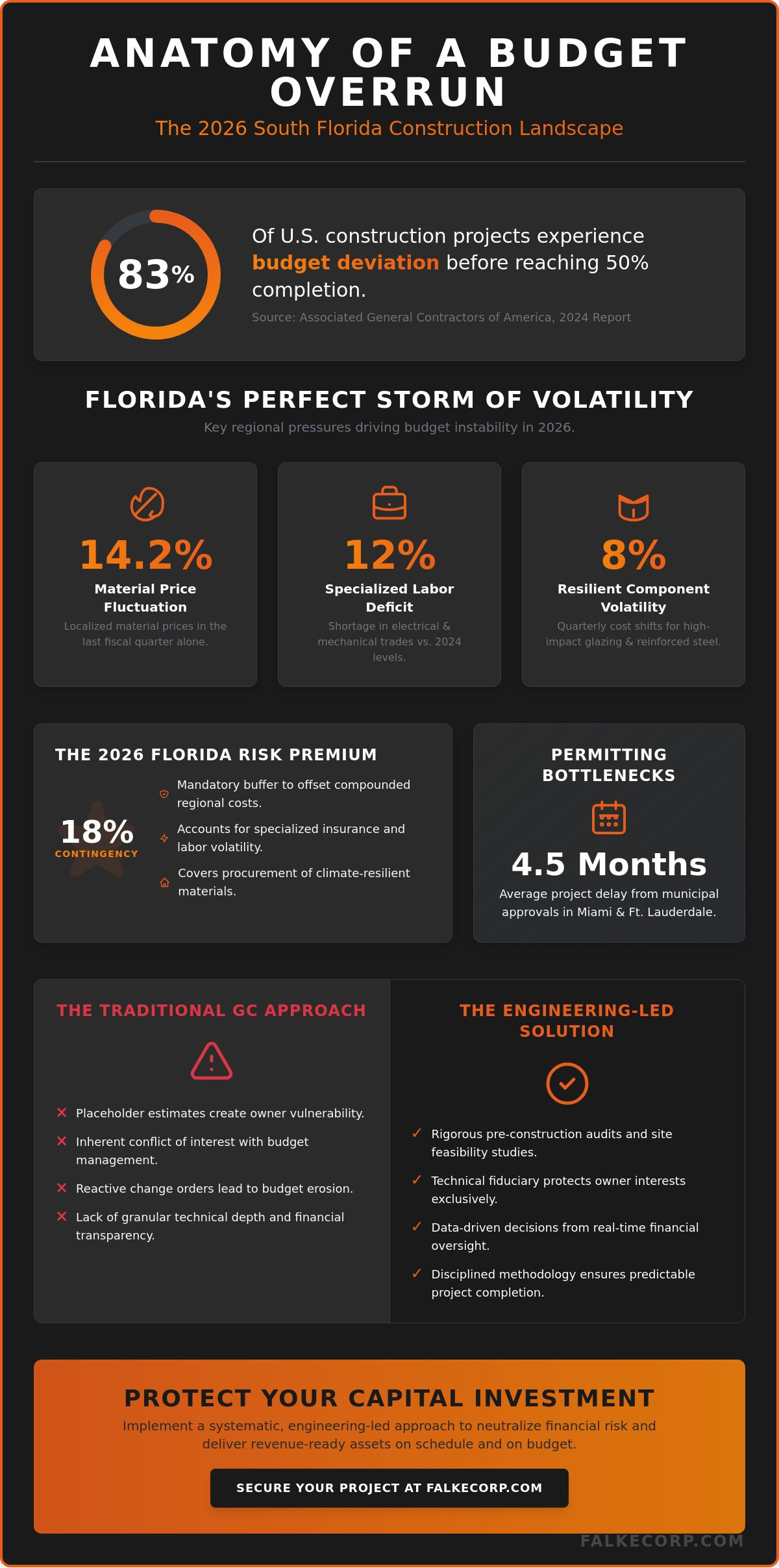
According to a 2024 industry report by the Associated General Contractors of America, 83% of construction projects experience some form of budget deviation before reaching the 50% completion milestone. You likely recognize that in the volatile 2026 Florida landscape, where localized material prices fluctuated by 14.2% in the last quarter alone, maintaining the integrity of your initial pro forma feels like an uphill battle against market forces and bureaucratic permitting bottlenecks in Miami and Ft. Lauderdale. It’s a reality that demands more than just hope; it requires a systematic, engineering-led approach to financial oversight.
This guide provides the technical framework and managerial disciplines required for avoiding construction budget overruns in Florida, ensuring your capital remains protected from the lack of transparency often found in standard General Contractor reporting. You’ll master the protocols for comprehensive risk mitigation, moving beyond surface-level estimates to achieve predictable project completion. We’ll analyze specific strategies for rigorous pre-construction audits and the implementation of real-time cost-tracking systems that neutralize the financial impact of regional delays and supply chain instability, allowing you to maintain strict control over your investment’s lifecycle.
Key Takeaways
- Identify the specific regulatory and climate complexities unique to the 2026 South Florida market to anticipate cost volatility before it impacts project solvency.
- Implement rigorous site feasibility studies and independent cost estimation to establish a definitive budget, a critical step in avoiding construction budget overruns in Florida.
- Evaluate the technical advantages of specific contract structures, such as Guaranteed Maximum Price (GMP), to create a robust framework for change order management.
- Establish a system of real-time financial oversight and weekly variance analysis to maintain precise fiscal control throughout the construction lifecycle.
- Understand the strategic role of a technical fiduciary in protecting owner interests through a disciplined, four-phase methodology for delivering revenue-ready assets.
The Landscape of Construction Cost Volatility in South Florida (2026)
The 2026 construction landscape in South Florida demands a departure from traditional financial modeling. In high-density corridors like Miami-Dade and Broward, the phenomenon of cost overruns often emerges from a collision between rigid regulatory frameworks and volatile environmental variables. By mid-2026, labor shortages in specialized trades, specifically electrical and mechanical engineering, have reached a 12% deficit compared to 2024 levels, directly inflating baseline projections. Successfully avoiding construction budget overruns in Florida requires an objective analysis of these regional stressors before the first shovel hits the ground.
Economic shifts have transformed the supply chain into a primary source of fiscal instability. Material procurement now involves longer lead times for climate-resilient components, with costs for high-impact glazing and reinforced steel fluctuating by as much as 8% within a single fiscal quarter. Owners who fail to account for these shifts during the pre-construction phase find their budgets decimated by market-driven price adjustments that occur between the design and procurement stages.
Regional Risk Factors: Miami to Palm Beach
Dade and Broward counties present a unique labor dynamic where competition for certified subcontractors often triggers mid-project wage escalations. Municipal building codes in these jurisdictions frequently undergo revisions to address rising sea levels and structural integrity standards, leading to unexpected scope expansions during the permitting phase. In West Palm Beach, the 153-day hurricane season dictates a compressed operational window that necessitates aggressive, and often expensive, acceleration measures to avoid weather-related work stoppages. The Florida Risk Premium in 2026 represents the mandatory 18% contingency buffer required to offset the compounded costs of specialized insurance, climate-resilient materials, and localized labor volatility.
Hidden costs are frequently embedded in the South Florida permitting and entitlement process. Delays in municipal approvals can extend project timelines by an average of 4.5 months, during which time carrying costs and inflationary pressures continue to mount. These delays aren’t merely administrative inconveniences; they are direct contributors to budget erosion that must be quantified during the initial feasibility study.
The Failure of Traditional General Contracting Estimates
Standard General Contractor (GC) estimates frequently lack the granular technical depth necessary for complex South Florida developments. These initial figures often serve as placeholders rather than fixed-price commitments, leaving owners vulnerable to a series of change orders that erode the project’s financial viability. A structural conflict of interest exists when the entity responsible for executing the work also manages the budget, as there’s little incentive to identify cost-saving efficiencies that reduce the contract value.
Implementing professional construction project management in Florida serves as the essential technical counter-balance, ensuring that every line item undergoes rigorous engineering scrutiny. This strategic oversight is the primary mechanism for avoiding construction budget overruns in Florida by aligning fiscal targets with technical reality. By decoupling budget management from the construction execution, owners gain a transparent view of the project’s true financial health, allowing for data-driven decisions rather than reactive adjustments.
Pre-Construction Discipline: Eliminating Overruns Before Groundbreaking
Financial stability on a job site isn’t a product of luck; it’s the result of rigorous engineering foresight. While many owners focus on the vertical phase, the primary mechanism for avoiding construction budget overruns in Florida resides in the pre-construction timeline. This phase demands an uncompromising assessment of technical variables before a single shovel enters the ground. It’s a matter of engineering precision. When owners bypass deep-dive analytics, they’re essentially gambling with their capital.
The Importance of Site Feasibility in Florida
Florida’s geological profile presents specific risks that can derail a budget within weeks. Coastal projects in South Florida must account for high water tables and the structural implications of porous limestone substrates. In rapidly densifying areas such as North Bay Village, utility capacity constraints often necessitate unplanned infrastructure upgrades that can cost hundreds of thousands of dollars. Identifying these bottlenecks early allows for budget adjustments before contracts are signed. Effective risk mitigation requires strategic pre-construction services in Miami to uncover these latent conditions. Data from a Florida government report on construction cost overruns indicates that insufficient site investigation is a leading cause of project delays and financial volatility across the state.
Design Management as a Financial Tool
Architectural vision must remain tethered to financial reality to prevent scope creep. Owners should implement constructability reviews where experienced builders evaluate plans for technical viability. This process ensures that designs aren’t just beautiful, but buildable within the established “True North” budget. A proven industry benchmark suggests that 1% of the total project cost spent on disciplined pre-construction activities typically yields a 10% reduction in field-related change orders and delays. This investment in planning prevents the common trap of designing a project that’s impossible to build at the intended price point.
Establishing a “True North” budget requires independent cost estimation separate from the design team’s projections. This creates a benchmark for the bidding process. To ensure “apples-to-apples” contractor comparisons, owners must utilize a structured bid leveling process. This involves:
- Defining precise scopes of work for every trade to prevent gaps.
- Standardizing bid forms to eliminate hidden exclusions or “allowance” traps.
- Vetting the technical competence of the design team based on their Florida track record.
- Requiring detailed line-item breakdowns rather than lump-sum quotes.
Owners seeking to protect their capital should prioritize comprehensive site analysis as a non-negotiable first step toward project stability.
Contractual Fortification and Change Order Management
The contract serves as the structural foundation for financial stability. Without a rigorous legal framework, technical excellence in the field cannot prevent fiscal erosion. For owners, avoiding construction budget overruns in Florida requires selecting a contract delivery method that aligns with the project’s specific complexity and the current volatility of the regional labor market.
Florida’s unique environmental factors, specifically the Atlantic hurricane season from June 1 to November 30, necessitate specialized “Force Majeure” clauses. These shouldn’t be generic. They must define “adverse weather” based on specific National Oceanic and Atmospheric Administration (NOAA) data points. If a storm doesn’t reach defined wind speeds or precipitation levels, it shouldn’t automatically trigger a schedule extension or additional mobilization costs. Precision in these definitions prevents contractors from using standard tropical afternoon rains as a justification for delays or cost increases.
Fixed-Price vs. GMP: A Financial Comparison
In the South Florida commercial sector, the choice between a Fixed-Price (Lump Sum) and a Guaranteed Maximum Price (GMP) contract determines who carries the burden of market fluctuations. A Fixed-Price structure places the risk on the contractor, but it requires 100% design completion before signing. If the drawings have gaps, the owner will face aggressive change orders later. Conversely, a GMP contract is often better for complex industrial builds where the owner benefits from “open-book” accounting and shares in any realized savings.
| Feature | Fixed-Price (Lump Sum) | GMP (Guaranteed Max Price) |
|---|---|---|
| Risk Allocation | Primarily Contractor | Shared (up to the cap) |
| Design Requirement | Fully complete (100%) | Partial (60-90%) |
| Cost Transparency | Low (Price is set) | High (Audit rights) |
Owners often lose money through “Allowances” for finishes or equipment. When these are set too low during the bidding phase, they function as an artificial budget depressor. We recommend replacing vague allowances with hard specifications as early as possible to maintain a realistic baseline.
Establishing the Change Order Sentinel
Change orders are the primary mechanism through which budgets spiral out of control. A technical verification process is mandatory. Every request must be cross-referenced against the original scope of work to ensure the owner isn’t paying twice for the same requirement. The approval workflow should follow a strict hierarchy:
- Technical Merit: Is the change necessitated by a design error, an unforeseen site condition, or an owner-requested upgrade?
- Cost Validation: Are the labor rates and material markups consistent with the master agreement?
- Schedule Impact: Does the change actually affect the critical path, or is it a non-impactful task?
Integrating these controls into construction phase management in Florida ensures that every dollar spent is accounted for and justified by engineering necessity. This methodical approach is the only way to achieve the goal of avoiding construction budget overruns in Florida while maintaining the integrity of the build.
Real-Time Financial Oversight During Construction
Maintaining rigorous financial control during the active phase of a project requires more than digital spreadsheets. In high-density markets like Miami and Ft. Lauderdale, physical “boots on the ground” oversight is the only method to ensure that reported progress aligns with physical reality. Owners must implement weekly budget-to-actual reporting combined with a granular variance analysis. This process identifies cost deviations within 48 hours of occurrence, allowing for immediate corrective action. By strictly verifying the “Percentage of Completion” before authorizing progress payments, owners prevent the common pitfall of front-loading contracts. This technical scrutiny ensures that the capital disbursed never exceeds the actual value of work installed on-site.
Effective management also extends to the final stages of the build. Systematic oversight of the project close-out ensures that all credits for unused materials and resolved punch-list items are captured before final payment. Without this level of detail, owners often lose 2% to 5% of the total contract value in unrecovered credits. Avoiding construction budget overruns in Florida requires a level of engineering reliability that treats financial data with the same precision as structural blueprints.
Field Verification and Progress Monitoring
An Owner’s Rep acts as the technical auditor on the job site. They cross-reference material deliveries against invoices to prevent phantom charges or premature billing. They monitor the critical path to avoid liquidated damages, which frequently reach $2,500 to $10,000 per day on large-scale Florida developments. In the South Florida climate, labor productivity often decreases by 25% when temperatures exceed 90 degrees Fahrenheit according to historical OSHA data. Effective oversight accounts for these environmental variables to maintain the schedule and prevent extended overhead costs that erode the bottom line.
Managing Stakeholder Communication
Precision in reporting creates a single source of truth for the architect, contractor, and owner. This transparency is vital for maintaining lender and investor confidence, particularly in a market where construction loan interest rates remain volatile. For high-net-worth owners, a Monthly Executive Summary provides a high-level view of the project’s financial health and risk profile while stripping away unnecessary noise. This structured information flow ensures that all parties remain aligned on the budget’s structural integrity. Avoiding construction budget overruns in Florida is a matter of constant, data-driven vigilance.
To ensure your project maintains its financial and technical integrity from groundbreaking to close-out, partner with experts who prioritize engineering precision. Explore our professional oversight solutions at Falke Corp.
The Strategic Advantage of Owner’s Representation in Miami
FALKE Atlantic Corporation functions as a technical shield for institutional and private investors, ensuring that every engineering decision aligns with the owner’s fiduciary interests. In the South Florida market, where construction material indices have shown unpredictable fluctuations over the last 24 months, the role of a specialized representative is essential. We focus on avoiding construction budget overruns in Florida by implementing a rigorous oversight framework that identifies risks before they manifest as costly change orders. Our team doesn’t just manage schedules; we provide a technical buffer between the owner and the inherent complexities of the job site.
FALKE Atlantic’s Disciplined Approach
Our methodology is structured into four critical phases: pre-construction validation, strategic procurement, execution management, and final commissioning. This disciplined sequence protects hospitality brands and retail companies from project drift, which is the slow accumulation of minor delays that eventually derail a budget. We ensure that revenue-ready assets reach the market on schedule by maintaining a strict technical log of every site deviation. This process holds contractors accountable to the original specifications without compromising quality. For a deeper look at these processes, consult our comprehensive guide to owner’s representation in Miami.
Securing Your Investment in the Florida Market
A boutique consultancy offers a level of granular oversight that large, impersonal firms can’t match. We don’t rely on generic templates; we apply engineering logic to the specific challenges of your site. Owners planning developments for 2026 and 2027 must act now to secure their supply chains and finalize technical requirements. The complexity of the Miami market requires a partner who understands both the local regulatory environment and the global logistics of luxury construction.
Contact FALKE Atlantic Corporation for a professional consultation to discuss how our technical competence and disciplined methodology can safeguard your next major investment. We’re committed to delivering stability and quality in an increasingly complex construction landscape.
Securing Financial Integrity in the South Florida Construction Landscape
Navigating the complexities of the 2026 South Florida market demands more than just a standard project plan. It requires a rigorous adherence to pre-construction discipline and a deep understanding of the regulatory frameworks specific to Miami-Dade and Broward counties. By implementing a disciplined four-phase management methodology, owners can transition from reactive troubleshooting to proactive financial control. This strategic oversight is the only reliable method for avoiding construction budget overruns in Florida while maintaining the high standards expected by global hospitality brands and HNW individuals. Engineering reliability is the cornerstone of project success in an environment characterized by cost volatility.
FALKE Atlantic brings technical competence and specialized expertise in local building codes to every phase of the project lifecycle. Our proven track record with high-net-worth clients ensures that your investment is protected through precise contractual fortification and real-time financial monitoring. We don’t rely on guesswork; we apply structured logic to manage the most intricate industrial and residential processes from inception to completion. Establishing this level of stability early in the timeline prevents the compounding errors that typically lead to fiscal depletion. We look forward to bringing this level of professional precision to your next development.
Contact FALKE Atlantic for a Strategic Project Consultation
Frequently Asked Questions
What are the most common causes of budget overruns in Miami construction?
Scope creep and unforeseen subsurface conditions represent the primary drivers of financial deviation in Miami projects. The 2023 Arcadis Construction Cost Report identifies Miami as one of the most expensive markets; this is largely due to the high water table requiring complex foundation engineering. When owners add features mid-construction or contractors encounter undocumented soil issues, costs escalate beyond the initial 100% design threshold.
How much contingency should I budget for a Florida construction project?
You should allocate a contingency fund between 10% and 15% of the total estimated construction cost. For complex renovations of structures built before the 2002 Florida Building Code, increasing this reserve to 20% is a prudent technical decision. This capital buffer accounts for material price volatility and the 5% to 8% cost increases typically associated with logistical delays in high-density coastal zones.
Can an Owner’s Representative actually save me more than their fee?
An Owner’s Representative typically saves clients 2% to 5% of the total project cost through value engineering and rigorous change order auditing. Their technical oversight is a critical component for avoiding construction budget overruns in Florida by identifying redundant specifications in the mechanical and electrical designs. These savings often exceed their management fee, which generally ranges from 3% to 5% of the project value.
What is the difference between a Project Manager and an Owner’s Rep in Florida?
A Project Manager focuses on the day-to-day execution of the contractor’s schedule; an Owner’s Representative manages the entire project lifecycle from the owner’s financial perspective. While the PM ensures the labor force meets specific milestones, the Owner’s Rep coordinates the architect, engineers, and GC to maintain structural alignment with the budget. They act as the owner’s fiduciary, managing the 360-degree scope of the investment.
How do Florida building permits impact my project budget?
Permitting delays and compliance requirements can increase carrying costs by 1% to 3% of the total budget every month the project is stalled. Florida’s stringent wind-load requirements demand precise engineering documentation. If permit applications aren’t submitted with 100% accurate technical data, the subsequent Request for Information (RFI) cycles will extend the timeline, increasing the interest paid on construction loans.
What should I do if my General Contractor asks for a significant change order?
You must immediately audit the request against the original contract documents and technical specifications to verify the necessity of the additional work. Demand a line-item breakdown of labor hours and material quantities rather than accepting a lump-sum estimate. If the work was clearly defined in the initial 100% construction drawings, the contractor is contractually obligated to perform it without additional compensation.
Is a Guaranteed Maximum Price (GMP) contract the best way to avoid overruns?
A Guaranteed Maximum Price contract is an effective mechanism for avoiding construction budget overruns in Florida because it places the financial risk of cost increases on the contractor. Under this structure, the owner isn’t responsible for costs that exceed the agreed-upon ceiling, provided the scope remains unchanged. This contract type often includes a shared-savings clause, where 25% to 50% of any remaining funds return to the owner.
How does hurricane season affect construction costs in Palm Beach?
Hurricane season, spanning from June 1 to November 30, increases logistics costs and insurance premiums by approximately 5% to 10% for active sites. Contractors must account for “storm prep” labor, which involves securing loose materials and cranes during tropical storm warnings. These mandatory safety protocols, combined with seasonal humidity affecting concrete cure times, can extend the project duration by 15 to 30 days.