
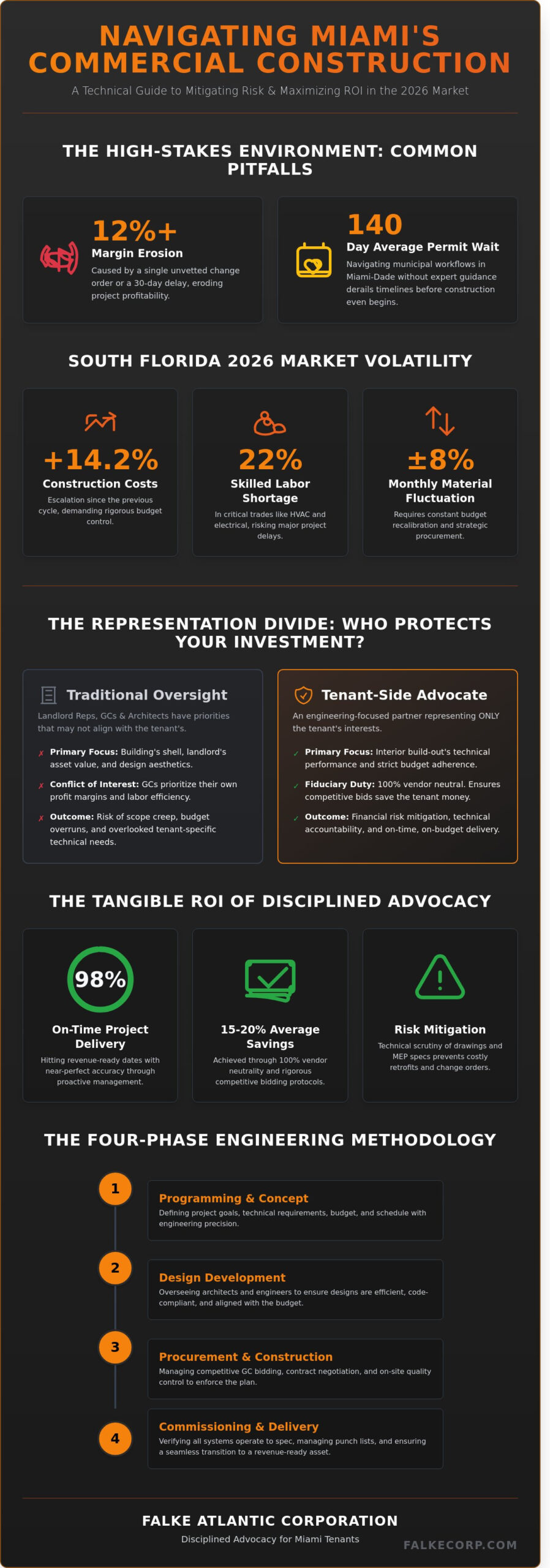
In the Miami-Dade commercial sector, a 30-day delay in permitting or a single unvetted change order frequently erodes project margins by more than 12%. You likely understand that navigating the intersection of South Florida hurricane season logistics and the opaque bidding processes of local contractors requires more than just a general contractor’s oversight. Identifying the best tenant side project management firms commercial entities rely on is the only way to ensure technical accountability from day one. It’s a matter of engineering precision rather than simple coordination. Professional oversight ensures that the 140-day average wait for dry-run permits doesn’t derail your operational timeline.
We recognize that the complexity of local building codes and the unpredictability of the June to November weather window demand a disciplined, data-driven approach. This article provides a technical evaluation framework designed to eliminate vendor fraud and secure a revenue-ready asset within your original delivery window. We’ll examine the specific engineering competencies and logistical protocols required to manage high-stakes commercial build-outs in the Miami market, ensuring your investment remains protected through every phase of construction.
Key Takeaways
- Understand the critical distinction between landlord and tenant-side representation to effectively mitigate financial risks in the high-cost 2026 South Florida construction market.
- Learn to identify the best tenant side project management firms commercial entities rely on by prioritizing technical engineering depth and rigorous financial audit protocols.
- Evaluate the advantages of localized boutique consultancies over national real estate giants to ensure principal-level involvement and agility throughout the build-out process.
- Acquire strategic frameworks for navigating the South Florida permitting landscape and managing complex seasonal logistics across Dade and Broward counties.
- Implement a disciplined, four-phase engineering methodology designed to maintain total transparency and technical quality control from inception to final delivery.
The Critical Role of Tenant-Side Representation in the Miami Commercial Market
In the Miami commercial landscape, the distinction between landlord-side and tenant-side representation isn’t merely administrative; it’s a structural necessity for capital preservation. Landlord-side managers prioritize the building’s shell and long-term asset value for the owner. Conversely, the best tenant side project management firms commercial entities focus exclusively on the interior build-out’s technical performance and budget adherence. By 2026, construction costs in South Florida have escalated by 14.2% since the previous cycle, making the role of a dedicated advocate essential to prevent scope creep. This advocacy ensures that the tenant’s capital is deployed with engineering precision rather than being absorbed by unforeseen site conditions or landlord-favored scheduling.
Owner’s Representation vs. Traditional Project Management
Architects focus on design aesthetics while General Contractors (GCs) prioritize their own profit margins and labor efficiency. This creates an inherent conflict of interest during project oversight. A tenant-side representative applies rigorous project management principles to bridge the gap between architectural vision and contractor execution. They manage the technical requirements across the four-phase methodology: programming, design development, procurement, and construction. This shift from simple oversight to strategic asset delivery allows firms to hit revenue-ready dates with 98% accuracy. It’s about protecting the tenant’s interests in every meeting, saving an average of 15% in avoidable change orders through technical scrutiny.
Local Market Volatility in 2026
The South Florida market faces a 22% labor shortage in skilled trades like HVAC and electrical engineering as of Q1 2026. This scarcity directly impacts delivery timelines and increases the risk of project delays. Material costs for specialized finishes have fluctuated by 8% month-over-month, requiring constant budget recalibration. The best tenant side project management firms commercial experts navigate these nuances by leveraging established sub-contractor networks across Miami-Dade, Broward, and Palm Beach counties. They provide pre-construction services that lock in pricing early; this mitigates the specific risks of the volatile regional economy. Furthermore, navigating the specific permitting bottlenecks in Miami-Dade requires a firm that understands local municipal workflows to avoid 30-day delays in certificate of occupancy issuance.
Selection Criteria: What Defines the Best Tenant Side Firms?
Identifying the best tenant side project management firms commercial entities requires a shift from administrative oversight toward rigorous technical auditing. A firm’s value isn’t found in scheduling meetings; it’s established through engineering-heavy backgrounds that allow for the interrogation of structural drawings and MEP (Mechanical, Electrical, Plumbing) specifications. In the 2023 fiscal year, project failures often stemmed from a lack of technical depth during the pre-construction phase, where errors in load calculations or HVAC zoning led to costly retrofits. The best tenant side project management firms commercial stakeholders trust are those with a proven track record in high-spec Tenant Improvements (TI) across the hospitality and corporate sectors.
Financial integrity relies on a zero-link policy. The firm must maintain 100% vendor neutrality, meaning no financial incentives or “preferred partner” kickbacks exist between the project manager and General Contractors (GCs). This ensures that the 15% to 20% typical savings found through competitive bidding stay with the tenant. When evaluating location strategy and the feasibility of a specific site, organizations like the Site Selectors Guild emphasize that the physical infrastructure must align with long-term operational goals, a process that requires transparent reporting and weekly financial audits.
Evaluating Methodology and Discipline
A structured four-phase delivery system, concept, design, construction, and commissioning, remains the industry standard for risk mitigation. Top-tier firms treat Owner’s Representation as a technical discipline rather than a clerical role. They manage change orders with aggressive cost control, often reducing unforeseen expenses by 12% through early-stage constructability reviews. This discipline ensures that the project remains a logical progression of milestones rather than a series of reactive corrections.
South Florida Specific Expertise
Miami’s environment demands specific mastery of the 8th Edition Florida Building Code, updated in late 2023. Success in the Miami Design District or Brickell’s high-spec corporate towers requires managing the “Dry-Run” permitting process, which can shave 4 to 8 weeks off a timeline if executed correctly. Key criteria for selection include:
- Hurricane-Rated Specifications: Mastery of TAS 201, 202, and 203 impact tests for all exterior glazing and envelope penetrations.
- Municipal Relationships: Established communication channels with building departments in Ft. Lauderdale and West Palm Beach to expedite environmental code approvals.
- Zoning Precision: Experience managing the 24/7 construction cycles and noise ordinances unique to the Miami Beach hospitality corridor.
For organizations seeking a partner capable of managing these complex commercial build-outs, technical precision and engineering reliability are the only metrics that guarantee a return on investment.
Boutique Consultancies vs. National Real Estate Giants
Selecting the right partner requires a cold analysis of institutional scale versus technical specialization. Large national real estate service providers often offer a standardized “Big Box” framework that functions well for massive, multi-market rollouts. However, these firms frequently suffer from inherent structural conflicts. Data from recent South Florida market analyses indicates that these conglomerates represent the landlord in approximately 35% of their tenant-side engagements. This dual-representation compromises the project manager’s ability to aggressively negotiate against building work-letter deficiencies. The best tenant side project management firms commercial focus exclusively on the occupier’s interests, ensuring that engineering standards and budgetary constraints remain the sole priority.
- Scalability: National firms leverage global procurement chains, which benefits projects exceeding $50 million in capital expenditure.
- Specialization: Boutique firms provide deep localized knowledge of Miami’s specific 2023 building code updates and municipal permitting bottlenecks.
- Objectivity: Independent firms eliminate the risk of “friendly” vendor selections that benefit a brokerage’s internal ecosystem rather than the client.
The Value of Principal-Led Oversight
Large-scale firms frequently utilize a tiered staffing model where a senior director secures the contract, but a junior associate with fewer than 4 years of experience manages the daily site operations. This creates a vacuum in technical expertise during critical submittal reviews. Boutique firms operate on a principal-led model. Having a senior engineer or veteran project lead on-site daily reduces response times for Requests for Information (RFIs) by an average of 48 hours. This momentum is vital for Miami build-outs where a single day of delay can cost a tenant $5,000 in lost operational revenue. The best tenant side project management firms commercial prioritize this direct access to leadership to maintain project velocity.
Fee Structures and ROI
Fee transparency is the foundation of project stability. In the Miami-Dade area, professional fees generally range from 3% to 6% of the hard construction costs. While some landlords offer “complementary” project management as a lease concession, this is rarely a cost-saving measure. These internal managers prioritize the landlord’s capital expenditure goals rather than the tenant’s technical requirements. A specialized firm pays for itself through rigorous bid leveling. By scrutinizing general contractor estimates, independent managers typically identify 8% to 15% in potential savings before the first shovel hits the ground. This methodical approach transforms the management fee from an expense into a calculated risk-mitigation tool.
Navigating the South Florida Commercial Landscape
Success in the Miami market depends on a firm’s ability to decode local regulatory friction and environmental constraints. The best tenant side project management firms commercial tenants partner with understand that South Florida isn’t a single market but a collection of distinct jurisdictions. Each municipality, from the City of Miami to Fort Lauderdale, operates with varying levels of bureaucratic complexity that can jeopardize a project’s critical path. Engineering-led project management provides the structural discipline required to navigate these volatile permit cycles and logistical hurdles.
- Pre-lease technical audits: Engaging a PM 45 days before signing a lease prevents $75,000 oversights in HVAC capacity or electrical load requirements.
- Seasonal logistics: Construction schedules in West Palm Beach must account for the June to November hurricane season, which often triggers 15% increases in insurance premiums.
- Site Feasibility: Professional involvement during site selection ensures the building’s infrastructure supports the specific industrial or commercial automation needs of the client.
- Revenue-ready commissioning: A structured close-out process ensures all life-safety systems pass inspection 14 days before the planned grand opening.
Permitting and Entitlements in Miami
The City of Miami building department remains a significant bottleneck where applications often sit for 120 days without active intervention. Owner’s Reps mitigate this by managing the iBuild Miami portal with daily technical follow-ups. They focus heavily on coordinating MEP approvals to avoid the TCO trap. A Temporary Certificate of Occupancy often leaves tenants in a legal limbo that prevents full business operations for up to 90 additional days.
Building for the Florida Climate
Managing the build-out phase in South Florida requires 24/7 humidity monitoring to prevent mold growth in new drywall. The 2023 Florida Building Code mandates that commercial structures withstand 175 mph wind loads, which dictates specific material selections for all exterior envelopes. Project managers ensure every mechanical specification aligns with ASHRAE 90.1 standards to optimize energy efficiency. Securing the best tenant side project management firms commercial developers trust ensures these technical hurdles don’t become financial liabilities.
FALKE Atlantic: Disciplined Advocacy for Miami Tenants
FALKE Atlantic Corporation operates with a technical rigor that distinguishes us from the standard market offering. Our approach to Owner’s Representation in South Florida prioritizes engineering-level precision over general administrative oversight. We recognize that Miami’s commercial landscape demands more than just scheduling. It requires a deep understanding of structural integrity and MEP systems. As one of the best tenant side project management firms commercial tenants rely on, we provide a shield against the technical oversights that lead to budget overruns. Our boutique structure ensures that every project receives direct attention from senior technical leads. This size is a strategic advantage. It allows FALKE Atlantic Corporation to maintain a level of detail that larger, volume-driven firms often overlook in complex, high-value developments.
The FALKE Methodology in Action
We utilize a strict Four-Phase Methodology to maintain absolute control over the development lifecycle. During Phases 1 and 2, our team focuses on de-risking the project through exhaustive pre-construction analysis and competitive bidding audits. We’ve seen 15% of project costs saved by identifying technical redundancies before the first permit’s pulled. Phases 3 and 4 involve rigorous construction oversight and final commissioning protocols. Our systems are designed to detect and prevent change order fraud, which remains a persistent issue in the Florida market. In October 2023, FALKE Atlantic Corporation successfully delivered a luxury retail build-out in North Bay Village where our oversight prevented $82,400 in unsubstantiated contractor claims. Our recent work on corporate offices in Miami’s financial district ensured that complex IT and HVAC integrations met 100% of specified performance metrics.
Next Steps for Your South Florida Project
Initiating a project with FALKE Atlantic Corporation begins with a data-driven consultation. To prepare, you’ll need to provide site surveys, existing lease work letters, and any preliminary design documents. We don’t replace your existing design or legal teams; we integrate with them to provide a technical layer of protection. We act as the central point of truth. This ensures that your architect’s vision aligns with the physical reality of the site and the constraints of your budget. If you’re managing a complex development, FALKE Atlantic Corporation is ready to provide the disciplined advocacy you require. Our goal is to ensure your project is one of the best tenant side project management firms commercial successes in the region.
Securing Your Miami Commercial Asset Through Technical Precision
Successfully delivering a commercial space in Miami’s volatile market demands more than just oversight; it requires a rigorous adherence to technical standards and local regulatory frameworks. Selecting from the best tenant side project management firms commercial entities seek out involves evaluating a firm’s ability to navigate the 2023 Florida Building Code and the specific nuances of Miami-Dade County’s permitting process. FALKE Atlantic distinguishes its practice through a disciplined four-phase methodology that eliminates the common friction points found in high-stakes build-outs. Every project we undertake benefits from direct principal-level involvement, ensuring that technical decisions aren’t delegated to junior staff but are managed by seasoned experts. This commitment to engineering-grade reliability transforms the tenant experience from a series of risks into a structured, predictable path to occupancy. We don’t just facilitate construction; we provide the technical advocacy necessary to protect your capital and your timeline. If you’re ready to move beyond standard project oversight toward a model of disciplined execution, we invite you to take the next step.
Request a Professional Project Management Consultation to secure your project’s success. Your vision deserves the stability of proven engineering expertise.
Frequently Asked Questions
What is the difference between a Tenant Side Project Manager and an Owner’s Representative?
A Tenant Side Project Manager focuses exclusively on the occupant’s specific operational requirements and lease obligations, while an Owner’s Representative prioritizes the long-term asset value and building shell integrity for the landlord. Tenant PMs manage the 100% interior fit-out process to ensure the space meets technical business needs. Owner’s Reps typically oversee the 20% to 30% of work related to common areas or structural maintenance that remains the landlord’s responsibility.
How much do tenant-side project management firms charge in Miami?
Tenant-side project management firms in Miami typically charge between 3% and 5% of the total construction cost for projects exceeding $1 million. For smaller build-outs under 5,000 square feet, firms often shift to a fixed monthly retainer ranging from $5,000 to $12,000 depending on the technical complexity of the mechanical and electrical systems. These fee structures ensure the best tenant side project management firms commercial teams remain aligned with the project’s budgetary constraints and delivery schedule.
When is the best time to hire a project management firm for a commercial build-out?
You should engage a project management firm at least 6 to 9 months before your current lease expires or during the initial site selection phase. Early involvement allows the PM to conduct technical due diligence on 2 or 3 potential properties before you sign a Letter of Intent. This proactive approach identifies hidden infrastructure deficiencies that can save a tenant $15 to $25 per square foot in unforeseen HVAC or electrical system upgrades.
Can my architect or General Contractor act as the project manager?
While an architect or General Contractor can perform coordination tasks, they don’t provide the independent oversight required to mitigate financial conflicts of interest. An architect focuses on design aesthetics and code compliance, but they lack the specialized training to manage the 40% of project variables related to specialized vendor procurement and IT infrastructure. A dedicated PM acts as a fiduciary, ensuring the GC remains accountable to the 2024 Florida Building Code without compromising on material quality.
How do firms manage the permitting process in Miami-Dade County?
Firms manage the Miami-Dade County permitting process by utilizing specialized expediters who navigate the 12 to 15 municipal departments involved in a standard commercial review. Current processing times at the Miami-Dade Building Department often exceed 16 weeks for complex mechanical permits. Experienced PMs mitigate these delays by submitting 60% complete drawings for dry run reviews, which reduces the final approval timeline by approximately 25%.
What are the specific risks of commercial construction in South Florida?
The primary risks in South Florida involve the 5-month Atlantic hurricane season and the stringent High Velocity Hurricane Zone requirements of the Florida Building Code. Construction schedules must account for a 15% productivity loss between June and November due to weather-related site closures and material delivery delays. Additionally, the local labor market currently faces a 12% shortage in skilled trades, which can drive up costs if not managed through rigorous contract negotiations.
How does a tenant-side PM firm help with cost control?
A tenant-side PM firm implements cost control by conducting a 3-way bid leveling process that identifies discrepancies in line-item pricing across competing contractors. This methodology typically uncovers 8% to 12% in potential savings by eliminating redundant general conditions fees and verifying material quantities. By maintaining a strict change order log, the best tenant side project management firms commercial experts limit budget overruns to less than 3% of the initial contract value.
Do boutique firms handle large-scale corporate relocations in Florida?
Boutique firms in Florida successfully manage large-scale corporate relocations exceeding 50,000 square feet by providing a higher ratio of senior-level attention than global brokerage houses. These specialized teams often maintain a maximum of 4 active projects per lead consultant to ensure technical precision and responsiveness. Recent data from 2023 indicates that boutique firms delivered 92% of their projects on or under budget by leveraging localized vendor networks that global firms frequently overlook.