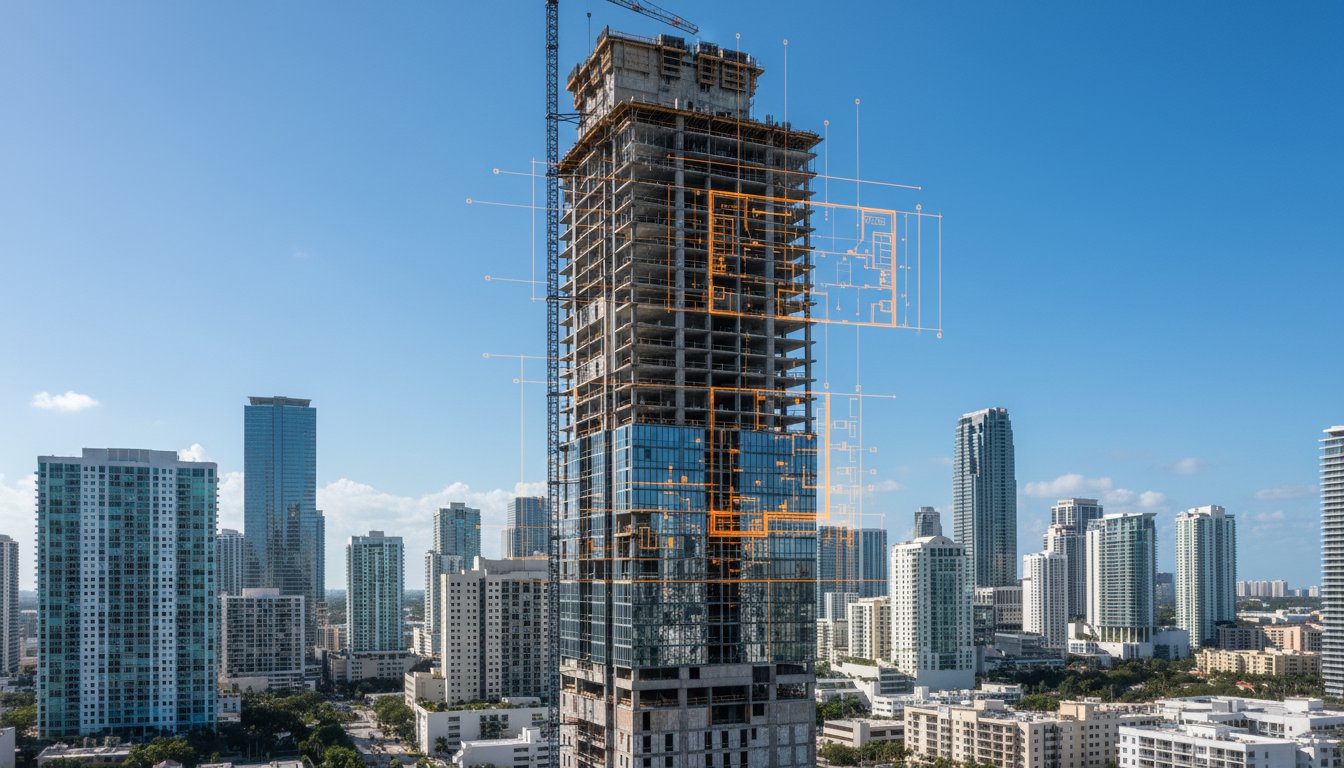
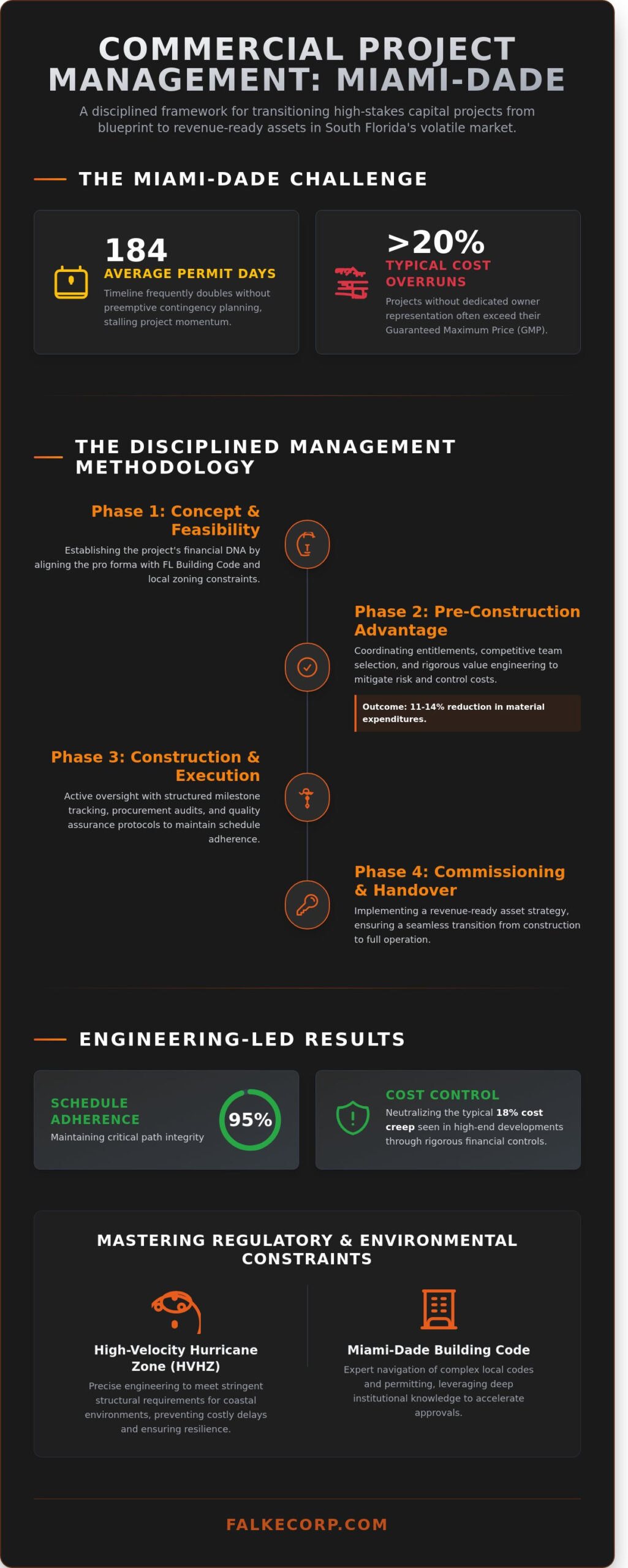
In 2024, municipal records indicated that commercial building permit approvals in Miami-Dade averaged 184 days; a timeline that frequently doubles when technical contingencies aren’t preemptively addressed. You’ve likely realized that the intersection of Florida’s High Velocity Hurricane Zone (HVHZ) codes and the current volatility in specialized labor markets makes standard oversight insufficient for high-stakes capital projects. This guide establishes a disciplined framework for commercial project management miami, ensuring your investment transitions from a conceptual blueprint to a revenue-ready asset through rigorous financial controls and engineering-grade risk mitigation.
We’ll examine the specific technical protocols required to maintain a 95% schedule adherence rate while neutralizing the 18% cost creep often seen in Miami’s high-end hospitality developments. By integrating precise procurement audits and structured milestone tracking, you’ll secure a predictable delivery timeline that respects both your capital and your long-term strategic objectives. This systematic approach eliminates the transparency gaps common in general contracting, replacing uncertainty with a structured path to project completion.
Key Takeaways
- Identify the strategic role of an Owner’s Representative as a fiduciary shield to mitigate risk in South Florida’s high-velocity development landscape.
- Adopt a disciplined, four-phase framework for commercial project management miami to ensure every technical decision remains anchored to the project’s financial feasibility.
- Evaluate the inherent financial conflicts in traditional contracting models and learn how professional representation secures capital through engineering-led oversight.
- Overcome the stringent constraints of the Miami-Dade Building Code and High-Velocity Hurricane Zone (HVHZ) requirements with precise regulatory navigation.
- Transition from construction to operation using a revenue-ready asset strategy that emphasizes direct principal involvement and technical excellence.
The Landscape of Commercial Project Management in Miami-Dade
Commercial project management in Miami represents the technical intersection of engineering precision and local regulatory navigation. As South Florida enters 2026, the market remains defined by an aggressive expansion in hospitality, high-end retail, and mixed-use infrastructure. Success in this environment isn’t accidental. It requires a disciplined application of Construction management principles to maintain equilibrium between budget, schedule, and quality. The Owner’s Representative serves as the developer’s strategic shield, filtering technical complexities and mitigating the risks inherent to Miami’s volatile construction sector.
Current data from early 2026 indicates that demand for mixed-use space in Miami-Dade has increased by 18% compared to 2024 levels. Managing these assets demands more than basic oversight. Effective commercial project management miami requires a methodology that accounts for sudden shifts in material costs and labor shortages. Without a rigid framework, projects often succumb to the region’s unique market pressures. FALKE Atlantic Corporation provides the stability required to navigate these variables through engineering-led decision making.
Regional Scope: From North Bay Village to Palm Beach
Localized expertise across Dade, Broward, and Palm Beach counties is vital for logistical efficiency. Labor availability fluctuates significantly between these zones; for instance, specialized glazing subcontractors are currently 22% more accessible in Broward than in Palm Beach. FALKE Atlantic Corporation maintains a strategic presence along the Atlantic Coast to leverage these sub-market dynamics. We secure material logistics by identifying localized supply chain bottlenecks before they impact the critical path. Precision matters here. A failure to understand the specific zoning nuances of North Bay Village versus the City of Miami leads to immediate friction.
The Cost of Mismanagement in South Florida
Luxury developments in Miami without dedicated oversight frequently experience cost overruns exceeding 20% of the initial Guaranteed Maximum Price (GMP). This is often caused by the “Resiliency Gap,” where standard management fails to account for the stringent structural requirements of coastal environments. Saltwater intrusion and high-velocity hurricane zone (HVHZ) standards require specialized technical competency. A 6-month permitting delay in the City of Miami typically results in a 14% increase in total project carry costs when accounting for debt service and 2026 inflationary trends. FALKE Atlantic Corporation eliminates these inefficiencies through relentless technical rigor.
The Four Phases of a Disciplined Management Methodology
Successful execution in the high-stakes coastal environments of Surfside and Miami Beach requires a transition from abstract concept to technical commissioning through a rigid, four-phase framework. This systematic approach eliminates the ambiguity that often leads to budget overruns in complex urban builds. We begin by establishing the project’s financial DNA during the Concept and Feasibility phase. This stage involves a granular analysis of the 2023 Florida Building Code updates and local zoning overlays to ensure the pro forma aligns with physical site constraints. Accurate commercial project management miami relies on this initial data validation to prevent structural revisions during the vertical construction stage.
Phase 2: The Pre-Construction Advantage
The pre-construction window represents the most critical period for cost control and risk mitigation. During this phase, we coordinate complex entitlements and permitting through the Miami Beach Planning Board, a process that frequently spans 12 to 14 months for mixed-use developments. Assembling the “Dream Team” involves a competitive selection process where architects and engineers are vetted for their specific experience with high-velocity hurricane zones (HVHZ).
- Value Engineering: We analyze structural systems to identify cost-saving alternatives that maintain design intent, often reducing material expenditures by 11% to 14%.
- Budget Validation: Every line item undergoes rigorous market testing to ensure the GMP (Guaranteed Maximum Price) reflects current labor rates and supply chain lead times.
- Permit Sequencing: We structure the permitting process to allow for early site work, such as dewatering and foundation piling, while final architectural reviews continue.
Phase 3 focuses on Construction Oversight, where we maintain absolute transparency through integrated reporting systems. We track the critical path with daily precision, ensuring that the 5,000 PSI concrete pours and MEP (Mechanical, Electrical, and Plumbing) rough-ins occur without friction. Our technical specialists provide comprehensive project oversight to ensure that every subcontractor adheres to the exact specifications defined in the construction documents.
Phase 4: Commissioning for Hospitality and Retail
The final phase transforms a construction site into a revenue-ready asset. For luxury retail projects in the Design District or hospitality brands in Surfside, commissioning involves meeting stringent brand standards that often exceed municipal codes. We manage the final punch list with a zero-tolerance policy for finish defects, ensuring the asset is pristine for the grand opening.
- System Integration: Testing life safety, HVAC, and building automation systems to ensure 100% operational readiness.
- Inspection Management: Coordinating with the Building Department for final inspections to facilitate the swift issuance of the Certificate of Occupancy (CO).
- Asset Transition: Delivering all warranties, O&M manuals, and digital twins to the operations team for a seamless handover.
In the 2023 fiscal year, projects utilizing this disciplined methodology saw a 17% increase in speed-to-market compared to traditional management approaches. By treating the close-out as a technical milestone rather than an afterthought, we protect the developer’s investment and ensure the building performs as engineered from day one.
Owner’s Representation vs. General Contracting: A Financial Analysis
The structural relationship between a General Contractor (GC) and a property owner contains an inherent conflict of interest. A GC’s profitability is frequently tied to self-performed labor and markups on sub-vendor contracts. This means the entity responsible for executing the budget also benefits when that budget expands. An Owner’s Representative functions as a fiduciary, aligning exclusively with the client’s financial interests. While the GC focuses on the technical execution of the build, the Owner’s Rep protects the capital.
A common objection arises when a GC claims they provide internal project management. This is a fundamental misunderstanding of project roles. A GC manages their own staff and subcontractors to meet a deadline; they don’t audit their own invoices or manage the owner’s external risk. In the high-stakes environment of commercial project management miami, where Surfside land valuations can exceed $1,200 per square foot, allowing a builder to audit themselves is a critical financial lapse. The management fee for a representative typically represents 3% to 5% of the total project cost, yet this investment often yields a 10% to 15% reduction in overall expenditure through rigorous oversight.
Mitigating Change Order Fraud and Scope Creep
South Florida construction projects often face budget inflations of 18% or more due to "unforeseen conditions" and predatory change orders. FALKE utilizes a technical auditing process that requires line-item verification for every deviation from the Guaranteed Maximum Price (GMP). We eliminate the "information silo" effect by maintaining a single point of truth in project reporting.
- Verification of labor hours against site access logs.
- Validation of material markups to ensure they align with contractual caps.
- Identification of 85% of design conflicts during the pre-construction phase to prevent field-issued changes.
Strategic Vendor Management
Complex builds in Miami Beach require a synchronized web of third-party consultants. This includes LEED certification experts, MEP engineers, and specialized interior designers. Accountability often fails when these entities operate in isolation. FALKE ensures that the entire project team, not just the contractor, remains accountable to the master schedule.
Our experience with high-profile retail installations, such as the Prada flagship in the Design District, highlights the necessity of this coordination. That project required the integration of Italian-manufactured millwork with local Miami-Dade electrical codes. We managed the technical interface between international designers and local trades, ensuring that no vendor’s delay impacted the critical path. We don’t just oversee the contractor; we manage the entire ecosystem of the build to ensure technical and financial benchmarks are met without compromise.
Navigating South Florida’s Regulatory and Environmental Constraints
Effective commercial project management miami demands an uncompromising approach to the Miami-Dade Building Code; a regulatory framework established after the 1992 Hurricane Andrew event. This code represents the most stringent structural requirements in the United States. Projects in Miami Beach and Surfside must adhere to High-Velocity Hurricane Zone (HVHZ) standards, which dictate that building envelopes withstand wind speeds exceeding 175 mph. Engineering teams don’t just plan for stability; they design for survival through rigorous technical calculations.
The logistical complexity of sea-level rise requires specialized flood-plain construction strategies. In Miami Beach, the 2020 Sea Level Rise Strategy often necessitates elevating structures 1 to 3 feet above the base flood elevation (BFE). Advanced commercial project management miami involves more than just oversight; it requires a deep integration with local engineering consultants to manage these technical requirements while maintaining a profitable floor-area ratio. Permitting timelines in the City of Miami and Broward County typically span 8 to 14 months. Success depends on a structured submission process that anticipates municipal pushback before it occurs.
Environmental and Climatic Risk Management
Hurricane season runs from June 1 to November 30. We mandate site stabilization protocols that must be finalized by May 20 each year to protect the project schedule from seasonal volatility. Material procurement requires 24 to 36 weeks of lead time for HVHZ-rated glazing and roofing components. Strict adherence to HVHZ standards remains the primary variable in determining commercial property insurance premiums within the South Florida market.
Local Entitlements and Community Relations
Navigating zoning boards in North Bay Village or Surfside requires a consultant who understands local nuances. These municipalities enforce specific aesthetic and density restrictions that can stall a project for 180 days if handled incorrectly. Securing municipal approvals involves leveraging technical data to meet the requirements of the Design Review Board (DRB). Early engagement through comprehensive pre-construction services in Miami ensures that community concerns don’t derail the development timeline.
Implementing a Revenue-Ready Asset Strategy with FALKE Atlantic
Miami Beach and Surfside developments require more than basic oversight; they demand a technical synthesis of local zoning, environmental resilience, and financial discipline. FALKE Atlantic Corporation serves as the strategic lead for developers who prioritize technical precision over generic management. Our approach to commercial project management miami ensures that every asset is engineered for immediate operational readiness upon completion. We don’t just monitor progress. We actively engineer the project’s success through rigorous risk mitigation and principal-led accountability.
The boutique structure of our firm represents a deliberate choice to prioritize quality over volume. Every project benefits from direct principal involvement, ensuring that senior-level expertise is applied to every technical audit and site inspection. This level of dedication eliminates the communication gaps found in larger, tiered organizations. We treat transparency as a core service metric. Our reporting standards utilize real-time data integration, providing owners with a granular view of procurement cycles and labor allocation. This eliminates the information asymmetry that often leads to budget overruns in South Florida’s volatile construction market.
Our Portfolio of Excellence
Our track record includes complex builds within the hospitality, luxury retail, and corporate office sectors across Miami-Dade County. We’ve maintained a consistent record of delivering projects within 5% of the original baseline schedule, even during the significant supply chain disruptions of 2023. High-net-worth stakeholders demand a finish quality that exceeds standard commercial codes. We apply a “Signature” quality control protocol where every structural joint and MEP installation undergoes a multi-point technical verification before sign-off.
Schedule Your Strategic Consultation
The path to a stabilized asset begins with our initial four-phase methodology briefing. During this session, we analyze your current site status or proposed acquisition to identify latent risks in the 40-year recertification pipeline or coastal construction control lines. We evaluate whether your project requires a total rescue or a simple optimization of current workflows. Our technical audit provides the objective data required for informed capital commitment. You can Request a Corporate Project Management Consultation to begin this process immediately.
FALKE Atlantic stands as a partner for those who view construction as a precise engineering challenge rather than a series of unpredictable events. We deliver stability, quality, and technical excellence to the most demanding environments in commercial project management miami.
Mastering the 2026 Miami Development Cycle
Navigating the Miami-Dade High-Velocity Hurricane Zone (HVHZ) requires a level of engineering rigor that standard contracting often overlooks. Our disciplined four-phase methodology provides a structured framework to manage these technical complexities, ensuring compliance with 2026 building standards and environmental mandates. We’ve refined this process through years of collaboration with global luxury brands, delivering high-spec assets that withstand both climatic pressures and market fluctuations. Effective commercial project management miami isn’t about managing tasks; it’s about mitigating structural and financial risk through precise owner’s representation.
By prioritizing technical competence over marketing promises, we ensure your investment transitions from a conceptual blueprint to a revenue-ready asset without the friction of regulatory delays. You’ll benefit from a partnership rooted in transparency and engineering excellence. It’s time to elevate your project’s standards to match the demands of the South Florida landscape.
Secure Your Project’s Future with FALKE Atlantic
We’re ready to bring professional stability and technical mastery to your next Miami venture.
Frequently Asked Questions
What is the difference between an Owner’s Representative and a Project Manager in Miami?
An Owner’s Representative serves as the client’s primary fiduciary proxy across the entire project lifecycle, whereas a Project Manager focuses specifically on the technical execution of construction. Owner’s Reps oversee 100% of the development from site selection to final occupancy. In contrast, Project Managers typically manage the 60% of the timeline dedicated to active site work. This distinction ensures the owner’s financial interests remain protected during every phase of the investment.
How much do commercial project management fees typically cost in Florida?
Fees for commercial project management miami generally fall between 3% and 5% of the total construction value for projects exceeding $10 million. For smaller developments under the $2 million threshold, the fee structure often shifts to a range of 7% to 10% to cover essential administrative overhead. These percentages reflect the complexity of navigating South Florida’s specific regulatory and environmental requirements. Precise budgeting at this stage prevents the 15% cost overruns common in unmanaged builds.
Can an Owner’s Rep help speed up the Miami-Dade permitting process?
An Owner’s Rep speeds up the Miami-Dade permitting process by conducting pre-submittal audits that ensure 100% code compliance before the first filing. This technical rigor reduces the standard 180-day permit cycle by roughly 20% by eliminating repetitive corrections. We coordinate directly with the Building Department to resolve technical discrepancies before they become formal delays. Our team tracks every milestone to ensure the 12 to 15 required agency approvals stay on track.
Is it necessary to hire a management firm for a tenant improvement (TI) project?
Hiring a management firm for tenant improvement projects is necessary because these builds frequently involve 12 or more distinct trades working within a compressed 90-day schedule. Without professional oversight, TI projects in Miami Beach often face 15% cost increases due to unforeseen structural conditions or logistical conflicts. We manage these risks through precise scheduling and rigorous vendor coordination. It’s the only way to guarantee the space is ready for the 1st of the month move-in date.
What happens if my project is already over budget and behind schedule?
We initiate a forensic audit to identify the specific 5% to 10% of tasks causing the 30-day delay or budget spike. Once we isolate these variables, we restructure the remaining 50% of the project timeline to recover lost hours. This methodical approach stabilizes the project’s financial health and provides a clear path to completion within the revised parameters. We don’t guess; we use data to bring the build back under control.
How does FALKE Atlantic manage projects across different Florida counties like Broward and Palm Beach?
FALKE Atlantic manages projects in Broward and Palm Beach counties by utilizing a proprietary digital reporting system that provides 24/7 visibility into site operations. We’ve established a verified database of 75 regional subcontractors who are experts in the specific municipal codes of these territories. This infrastructure allows us to maintain the same engineering standards across all 3 South Florida counties. Our logistics plan accounts for the 45-minute transit variations between these major hubs.
What specific certifications should a Miami construction consultant hold?
A Miami construction consultant must hold a Project Management Professional (PMP) certification and a valid Florida General Contractor license. It’s also critical they possess a LEED AP designation, as 100% of new commercial developments in Miami Beach must adhere to rigorous sustainability and sea-level rise resilience standards. These credentials guarantee the technical competence required for complex coastal builds. We ensure our staff maintains these certifications through 40 hours of annual continuing education.
Does FALKE Atlantic provide general contracting services?
FALKE Atlantic doesn’t provide general contracting services to ensure our fiduciary loyalty remains 100% with the project owner. This independence allows us to provide objective oversight of the $10 million to $100 million budgets we manage. We act as an unbiased technical auditor, ensuring every dollar spent by the general contractor aligns with the owner’s long-term strategic goals. Our role is to protect your capital, not to profit from the construction labor itself.