
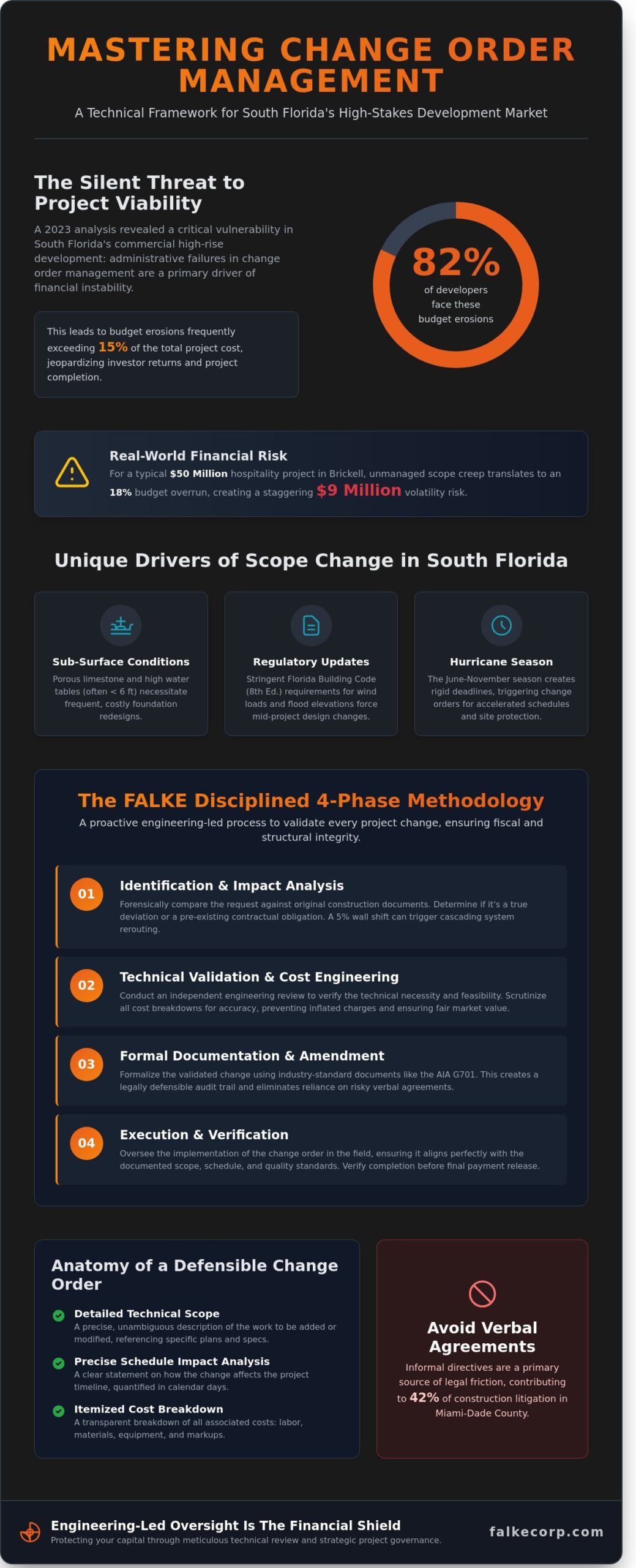
A 2023 analysis of South Florida commercial high-rises found that 82% of developers faced budget erosions exceeding 15% due to administrative failures in construction change order management. You understand that in a market defined by volatile material costs and rigorous municipal inspection cycles, a handshake agreement is a structural liability. Maintaining fiscal control requires more than just a spreadsheet; it demands a systematic engineering approach to scope validation.
We agree that the lack of transparency from general contractors often stems from a breakdown in the technical audit trail rather than simple oversight. This article provides the strategic framework you need to master the discipline of change order oversight, protecting your capital from the compounding costs of Miami’s complex permitting delays. We will detail the exact protocols for validating field directives, aligning design intent with execution, and securing predictable final costs for your development.
Key Takeaways
- Understand the technical parameters of formal contract amendments to mitigate risks inherent in Miami’s high-stakes development environment.
- Implement a proactive four-phase methodology for construction change order management to ensure every modification undergoes rigorous technical validation before financial commitment.
- Develop the analytical skills necessary to differentiate between essential field adjustments and the subtle scope creep that threatens the financial stability of luxury projects.
- Utilize a structured owner’s representative checklist to prioritize project changes based on return on investment, safety protocols, and brand-standard requirements.
- Discover how engineering-led oversight acts as a primary financial shield, protecting capital through meticulous technical review and strategic project governance.
Defining Construction Change Order Management in the Miami Market
Technical precision in the execution of large-scale infrastructure and luxury developments requires a foundational understanding of contractual amendments. At its core, What is a Change Order? It’s a formal, written agreement between an owner and a contractor to alter the original scope of work, contract sum, or project schedule. In the context of construction change order management, these documents serve as the primary mechanism for maintaining the structural integrity of the project’s financial and legal framework. Without a rigorous, engineering-led approach to these modifications, the initial contract quickly loses its relevance as a tool for project control.
Miami’s development sector operates within a high-stakes environment where luxury residential and hospitality assets often command valuations exceeding $2,500 per square foot. This economic reality demands a sophisticated management approach that transcends basic administrative tracking. When scope creep remains unmanaged, it doesn’t merely cause minor delays; it frequently results in budget overruns exceeding 18% of the total contract value. For a $50 million hospitality project in Brickell, this represents a $9 million volatility risk that can jeopardize the entire project’s viability and investor returns.
Effective construction change order management requires a clear distinction between owner-directed changes and contractor-requested adjustments. Owner-directed changes typically involve late-stage design enhancements, such as upgrading mechanical systems or altering interior finishes to meet evolving market demands. Contractor-requested adjustments usually originate from external variables or design omissions. Distinguishing these sources is vital for accurate cost allocation and for ensuring that the party responsible for the deviation bears the associated financial burden, thereby preserving the project’s original pro forma.
The Anatomy of a Miami Construction Change Order
A standardized Miami change order must contain three non-negotiable elements to remain defensible: a detailed technical scope description, a precise schedule impact analysis, and an itemized cost breakdown. In Florida’s commercial sector, the AIA G701 document is the industry benchmark, providing a structured format that ensures all parties acknowledge the change’s impact on the overall contract. Verbal agreements are the primary source of legal friction in South Florida, contributing to approximately 42% of construction litigation in Miami-Dade County. Relying on informal directives instead of documented amendments creates a level of exposure that no professional engineering firm or developer should accept.
Local Drivers of Scope Changes in South Florida
South Florida’s unique geological and regulatory landscape creates specific drivers for scope modifications that aren’t found in other markets. Unforeseen sub-surface conditions, particularly within the porous limestone shelf of coastal Dade and Broward counties, often necessitate foundation redesigns when the water table is found at depths of less than 6 feet. The 2023 Florida Building Code, now in its 8th Edition, has introduced more stringent requirements for wind loads and flood elevations. These updates frequently force mid-construction design changes to ensure compliance. Additionally, the annual hurricane season from June 1 to November 30 dictates a rigid logistical schedule; any delay in the dry-in phase during this period often triggers a cascade of change orders related to accelerated scheduling and temporary site protection measures.
The Disciplined Methodology for Validating Project Changes
Construction projects often lose financial stability when change management remains a reactive administrative task. FALKE Atlantic Corporation replaces this passivity with a four-phase technical oversight methodology designed to protect the project’s structural and fiscal integrity. We treat every request not as a foregone conclusion but as a technical hypothesis requiring rigorous verification. Before any financial commitment occurs, an independent engineering review must validate the necessity and technical feasibility of the proposed deviation. This filter ensures that institutional-grade projects maintain their performance benchmarks regardless of external pressures.
Phase 1: Identification and Initial Impact Analysis
Determining whether a request constitutes a “true” change requires a forensic comparison against the original 100% construction documents. We analyze the request to see if it represents a legitimate deviation or an obligation already scaffolded into the existing contract specifications. A 5% shift in a load-bearing wall’s position can cascade into a complete rerouting of electrical conduits and HVAC ductwork, creating a “ripple effect” that contractors often underestimate in their initial filings. Our engineers map these interdependencies across MEP (Mechanical, Electrical, Plumbing) and structural systems to quantify the total physical impact of the request. The primary metric for evaluating schedule deviations is the Critical Path impact, which dictates whether a specific change will actually delay the project’s final completion date.
To maintain order, we categorize every potential change into three distinct tiers:
- Design Evolution: Refinements that don’t alter the core scope.
- Unforeseen Conditions: Issues like subsurface anomalies discovered during the April 2024 excavation phase.
- Owner-Requested Changes: Strategic shifts in the facility’s end-use requirements.
Phase 2: Technical Auditing and Cost Verification
Effective construction change order management relies on empirical data rather than contractor estimates. We benchmark labor rates against current Q3 2024 Miami market data, where skilled electrical labor currently averages $92 per hour. Our team performs independent quantity take-offs to prevent the 12% to 15% material over-ordering often found in unsolicited claims. We strictly negotiate contractor markups to ensure they align with the 10% overhead and 5% profit caps stipulated in the prime agreement. This process mirrors the standards set by the Federal Acquisition Regulation on Change Orders, which provides the baseline for administrative discipline in complex industrial builds.
For projects exceeding $50 million, FALKE Atlantic Corporation establishes a formal Change Order Committee. This body includes the lead structural engineer, a senior project manager, and a financial auditor who meet bi-weekly to review all pending Change Order Requests (CORs). This protocol ensures that no single individual can authorize a scope shift that compromises the project’s 0.98 cost-performance index. Our technical advisory services provide the objective data needed to make these high-stakes decisions, ensuring that every dollar spent is a dollar justified by engineering reality. We don’t rely on intuition; we rely on the math of the built environment to maintain project stability.
Managing Scope Creep vs. Necessary Field Adjustments
The $3.5 billion luxury development sector in Miami frequently struggles to distinguish between technical field adjustments and insidious scope creep. Scope creep typically manifests as a 15% to 22% inflation of the original contract value, driven by psychological pressures to surpass market competitors. Identifying these hidden changes requires a granular audit of daily field reports. A contractor might label a three-day delay as site stabilization when it’s actually masking a failure to coordinate MEP penetrations. These subtle shifts in project requirements often go unnoticed until the cumulative financial impact threatens the project’s internal rate of return.
Retail projects like the Prada storefront in the Miami Design District demonstrate the need for extreme precision in technical execution. In such environments, a 2mm deviation in stone cladding alignment triggers a cascade of secondary adjustments. Effective construction change order management necessitates a forensic approach to documentation to ensure these refinements don’t evolve into uncompensated labor. While stakeholders often argue that site-specific changes are an inevitable byproduct of complex architecture, 68% of these variances stem from preventable design omissions. Addressing the objection that changes are unavoidable requires a shift toward rigorous accountability during the planning stages.
Following the Best Practices for Change Order Management allows project teams to establish a rigid baseline during the pre-construction phase. This federal guidance from the U.S. Bureau of Transportation Statistics highlights that structured reporting reduces the likelihood of litigation by 45% in complex infrastructure projects. By adopting these standards, developers can separate legitimate field adjustments from elective scope expansion.
Preventing Design Gaps and Omissions
Minimizing future financial friction requires a 100% completion threshold for construction documents before procurement begins. The pre-construction phase must include several critical technical milestones to ensure stability:
- BIM Clashing: A 3D-driven review identifies 92% of potential clashes between structural steel and HVAC ductwork before mobilization.
- Owner Representation: Professional representatives translate architectural vision into executable contractor tasks, maintaining technical boundaries.
- Gap Analysis: Forensic review of specifications ensures that “design-on-the-fly” scenarios, which account for 38% of budget overruns, are eliminated.
Navigating Unforeseen Conditions in South Florida
Miami’s geological profile presents unique challenges that demand disciplined construction change order management protocols. The region’s porous limestone bedrock and a water table often sitting just 30 inches below grade necessitate precise dewatering strategies. Unforeseen subterranean voids can increase foundation costs by $45,000 or more if they aren’t identified in the initial geotechnical survey. Cost spikes during the June to November hurricane season rush often lead to a 13% increase in material lead times. To maintain transparency, all Time and Materials (T&M) tags for emergency repairs must be verified within 24 hours of the event. This prevents retroactive billing inflation and ensures that every dollar spent is accounted for with engineering precision.
The Owner’s Representative Checklist for Change Order Review
Effective construction change order management requires a rigorous, data-driven framework to protect the project’s financial integrity. Owners shouldn’t view change requests as inevitable burdens; they’re technical variables that require precise calibration. A standardized evaluation process ensures that every modification contributes to the project’s lifecycle value rather than just inflating the bottom line. Statistics from the Lean Construction Institute suggest that up to 30% of construction costs are wasted through inefficiencies; a structured review checklist is the primary defense against this erosion of capital.
Prioritizing requests starts with a cold analysis of Return on Investment (ROI). If a proposed change doesn’t yield at least a 12% improvement in operational efficiency or address a critical safety non-compliance, it should be categorized as a secondary priority. Technical representatives must evaluate every request against brand-standard requirements to ensure consistency across the portfolio. Utilizing digital logs, such as Procore or Autodesk Build, creates a single source of truth. This transparency reduces the likelihood of “forgotten” changes that resurface during final closeout, which often account for 5% of total project disputes.
Establishing strict deadlines for review is a legal necessity. We recommend a 72-hour window for initial technical assessment and a 7-day period for final financial approval. This discipline prevents “constructive acceleration” claims, where contractors argue that an owner’s silence forced them to speed up work at a premium cost to meet the original deadline. Clear communication protocols transform a reactive process into a controlled engineering workflow.
For organizations seeking to optimize their technical infrastructure through precise engineering, our professional automation and electrical services provide the stability needed for complex industrial projects.
Administrative and Contractual Compliance
Every change order must undergo a forensic administrative audit before technical review begins. For any scope increase exceeding $50,000, owners must demand updated insurance riders and verified bond adjustments to maintain risk coverage. The representative must verify that all backup documentation, including itemized material quotes and time-stamped site photos, matches the requested amount. No document should move forward without the signature of a pre-authorized representative; unauthorized “field directives” are a primary source of 15% budget overruns in unmanaged projects.
Schedule and Logic Verification
Time is a quantifiable resource that requires Critical Path Method (CPM) verification for every requested extension. When a contractor cites “weather days” in Miami, the owner’s representative should cross-reference the claim against the 61.9 inches of average annual rainfall documented by local meteorological stations. If the rain didn’t impact a critical path activity, the extension is invalid. We look for schedule compression opportunities, such as re-sequencing electrical rough-ins, to offset legitimate delays. This logical scrutiny ensures that the project completion date remains a fixed target rather than a moving goalpost. Precise scheduling prevents the 10% late-delivery penalties common in large-scale industrial developments.
FALKE Atlantic: Protecting Capital Through Strategic Oversight
FALKE Atlantic operates as a technical and financial fortress for developers who prioritize precision over promises. Based in North Bay Village, our consultancy functions as the owner’s primary shield, ensuring that construction change order management doesn’t become a mechanism for budget depletion. We don’t rely on the surface-level reports provided by general contractors; instead, we deploy an engineering-led methodology to dissect every proposed modification. This approach identifies the 15% to 22% of cost inflations typically hidden within complex labor and material markups. By maintaining a honed, objective distance from the construction crews, we provide the cold, analytical oversight necessary to keep capital protected.
The Falke Corp advantage stems from a deep-rooted history in industrial automation and complex electrical systems. We apply the same level of rigor found in PLC programming and switchgear manufacturing to the broader Miami construction landscape. Most general contractors focus on project completion at any cost, which often leads to misaligned incentives. Our role is to realign those incentives by verifying that every change order is technically necessary and priced at fair market value. We’ve found that projects without independent oversight often see a 12% increase in “soft” costs during the final third of the construction cycle. We eliminate this drift through rigid documentation and technical verification of site conditions.
Our Boutique Approach to Miami Development
High-net-worth individuals and global hospitality brands trust our disciplined oversight because we understand the volatility of the local market. Miami-Dade and Broward counties present unique regulatory hurdles, including the stringent 2023 Florida Building Code updates and specific Chapter 8 compliance issues. We act as a local partner that speaks the language of both the engineer and the investor. Our Pre-Construction Services Miami establish a technical baseline that makes future scope creep nearly impossible to justify without clear, empirical evidence. We don’t just manage projects; we protect the integrity of the original investment thesis against the chaos of the field.
- Engineering-led verification of all structural and MEP change requests.
- Direct oversight of North Bay Village and greater Miami-Dade municipality requirements.
- Strict adherence to the 2024 jurisdictional guidelines to prevent permitting delays.
- Detailed cost-benefit analysis for every proposed scope adjustment exceeding $5,000.
Ensuring Revenue-Ready Assets
A development isn’t a success until it’s operational and generating revenue. Close-out friction is the primary reason projects miss their opening day deadlines, often resulting in 30 to 60 days of lost income. This friction usually arises from unresolved change orders and missing documentation at the end of the project. We solve this by implementing a continuous close-out process. Every modification is documented, signed, and integrated into the final as-built drawings in real-time. This eliminates the frantic paperwork scramble during the commissioning phase and ensures that the transition from construction to operations is seamless and predictable. If you’re planning a complex project, Contact FALKE Atlantic for a consultation on your next Miami development to secure your timeline. We bring stability to an inherently unstable process, ensuring your asset is revenue-ready on the exact date promised.
Securing Capital Integrity in the Miami Development Landscape
Effective oversight in South Florida’s complex market demands more than passive observation; it requires a rigorous technical framework to ensure project viability. By implementing a disciplined four-phase methodology, owners successfully differentiate between unavoidable field adjustments and preventable scope creep. This structured approach to construction change order management preserves the original financial baseline while maintaining high-quality engineering standards throughout the build. We apply this level of precision across the Miami-Dade and Broward regulatory landscapes, ensuring every modification is validated against actual site conditions and contract obligations. Our team refined these protocols through the management of high-profile assets, including the 10,000-square-foot Prada flagship in the Design District. This experience allows us to anticipate technical hurdles before they escalate into costly delays. Protecting your capital isn’t about avoiding change, it’s about controlling it through engineering expertise and administrative discipline. Your project deserves a partner who prioritizes structural and financial stability from ground-break to final inspection.
Secure your project’s financial integrity with FALKE Atlantic’s owner representation
Frequently Asked Questions
What is the standard percentage for change orders in Miami commercial construction?
The standard contingency for change orders in Miami commercial projects typically ranges from 5% to 10% for new builds; however, renovation projects often require a 15% to 20% buffer. These figures reflect the volatility of material costs and local labor availability in the South Florida market. Effective construction change order management ensures these percentages don’t exceed the initial project financing limits set by lenders.
How do Florida statutes handle unapproved change orders in public vs. private projects?
Florida Statute § 255.05 dictates that contractors on public projects can’t bill for work outside the original scope without a written, executed amendment. Private projects follow the specific “no oral modification” clauses within the signed contract, which Florida courts strictly enforce under prevailing case law. If you perform work without a signed document, you risk losing the legal right to payment for those additional costs.
Can a contractor stop work in Miami if a change order is not immediately signed?
A contractor’s right to stop work depends on the specific “Disputes” clause in the contract, typically modeled after AIA Document A201 Section 15.1.3. Unless the unsigned change order affects the critical path or site safety, most Miami contracts require the contractor to proceed with undisputed work to avoid liquidated damages. Stopping work prematurely often results in a breach of contract claim from the owner.
What is the difference between a change order and a construction change directive (CCD)?
A change order is a bilateral agreement between the owner and contractor, whereas a construction change directive is a unilateral order issued by the architect or owner. CCDs allow work to proceed immediately when the parties can’t agree on price or time adjustments. This mechanism prevents project stagnation, but it requires meticulous tracking of labor and material costs for later reconciliation during the construction change order management process.
How does hurricane season impact construction change order management in South Florida?
Hurricane season, spanning from June 1 to November 30, triggers specific force majeure clauses that necessitate change orders for time extensions rather than cost increases. Contractors must submit written notices within 7 to 14 days of a storm event to document delays. Proactive management during this period involves securing the site and updating the schedule to reflect mandatory evacuation days and post-storm inspections.
Is it possible to have a ‘Zero Change Order’ project in the luxury Miami market?
Achieving a zero change order project in Miami’s luxury market is statistically improbable, as 98% of high-end residential builds experience scope adjustments during the interior finishing phase. The complexity of custom Italian cabinetry or specialized lighting systems often leads to field revisions. While a fixed-price contract aims for stability, the iterative nature of luxury design makes a 0% change rate a theoretical goal rather than a practical reality.
How should an owner’s representative handle ‘hidden’ costs in a Guaranteed Maximum Price (GMP) contract?
Owner’s representatives manage hidden costs in GMP contracts by exercising “Right to Audit” clauses to verify actual costs against the contractor’s estimates. They must review the Schedule of Values monthly to ensure the contractor isn’t prematurely depleting the project contingency. Precise documentation of man-hours and invoices prevents the contractor from masking profit as a legitimate project expense.
What are the common pitfalls of change order management for hospitality renovations in Ft. Lauderdale?
The primary pitfall in Ft. Lauderdale hospitality renovations is the failure to account for unforeseen structural issues discovered during mandatory 40-year building safety inspections. Contractors often encounter outdated MEP systems that don’t meet current Florida Building Code standards once walls are opened. These discoveries lead to immediate cost surges if the initial survey didn’t include thorough destructive testing or thermal imaging before the project start date.