
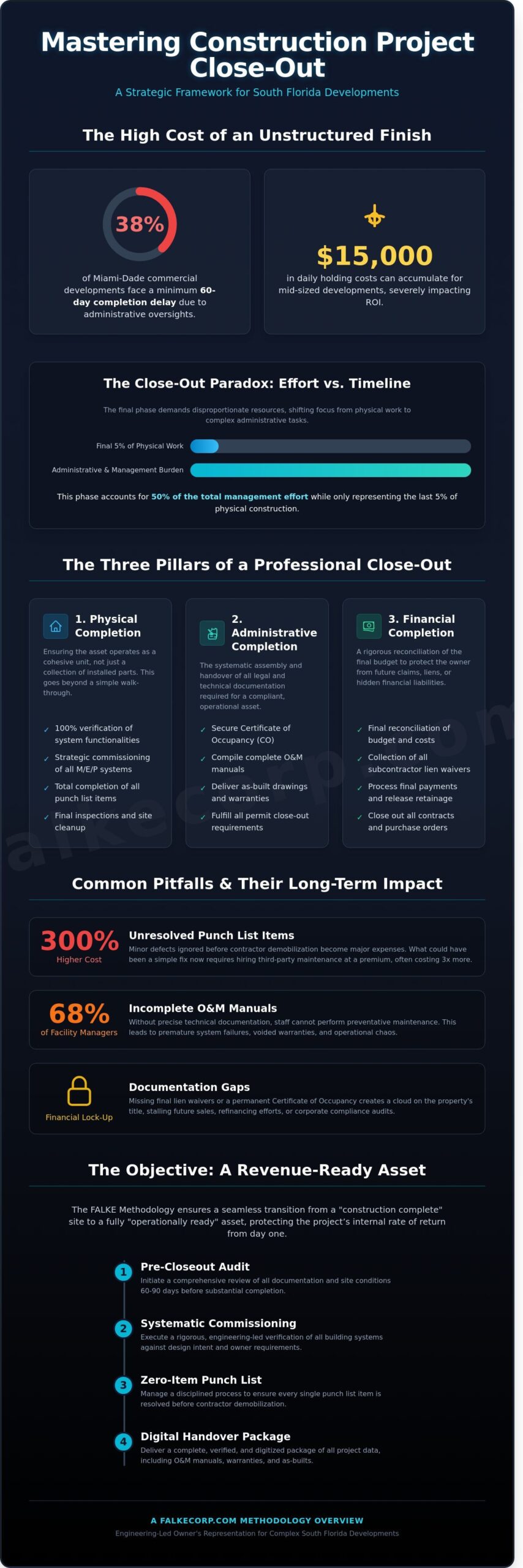
Recent industry data indicates that 38% of commercial developments in Miami-Dade County face a minimum 60-day delay in achieving final completion due to administrative oversights during the construction project close-out. You’ve likely experienced the stagnation that occurs when a project reaches the 95% mark; the initial momentum fades, leaving you with an endless punch list and a building that isn’t yet generating ROI. It’s a critical period where technical precision is the only safeguard against hidden liens or regulatory bottlenecks.
This strategic framework allows you to master the transition by applying a rigorous, engineering-led methodology to the shift from active site to operational asset. We’ll provide the exact protocols required to secure a Certificate of Occupancy in South Florida’s complex regulatory environment while ensuring 100% compliance with current Florida Building Codes. You’ll learn how to execute a total financial release for all subcontractors and transition your facility into a revenue-ready state within a predictable 30-day window.
Key Takeaways
- Learn why the transition from active construction to an operational asset requires a specialized management framework to overcome the disproportionate effort of the final project phase.
- Identify the critical administrative and physical milestones necessary to achieve a seamless legal handover and ensure full operational readiness.
- Navigate the specific regulatory requirements of Miami-Dade and Broward counties to efficiently secure a Certificate of Occupancy while mitigating the risks of temporary permits.
- Protect your investment by mastering the final lien waiver process and financial accounting protocols essential for a secure construction project close-out.
- Discover how the FALKE methodology applies a structured, four-phase approach to ensure the strategic commissioning and long-term stability of complex South Florida developments.
What is Construction Project Close-out and Why is it Critical in Miami?
The construction project close-out phase serves as the definitive engineering and legal bridge between physical assembly and asset utilization. It’s the period where the contractor’s obligations transition into the owner’s operational responsibilities. Industry data from 2023 suggests that while this phase represents the final 5% of the physical work, it accounts for 50% of the administrative and management burden. In Miami’s competitive real estate sector, efficiency during this window is a primary driver of project viability. Delays at the finish line don’t just postpone grand openings; they incur holding costs that can reach $15,000 per day for mid-sized commercial developments. A rigorous Construction management process mitigates these risks by enforcing technical accountability before the final payment is released.
A disciplined close-out prevents the long-term operational headaches that typically surface 12 to 18 months after occupancy. In the humid, salt-heavy environment of South Florida, mechanical and electrical systems face unique stress. If the close-out process doesn’t verify the exact performance specifications of HVAC systems or building envelopes, the owner inherits a liability rather than an asset. Professional management ensures that every technical system, from PLC programming in industrial facilities to fire suppression in high-rises, operates at peak efficiency from day one.
The Objective: A Revenue-Ready Asset
There’s a fundamental distinction between a building that’s “construction complete” and one that’s “operationally ready.” For Miami hospitality and retail brands, the latter is the only metric that matters. A hotel with finished rooms but uncalibrated climate control systems cannot accept guests. Project commissioning is the bridge here; it’s the systematic process of verifying that all building systems perform according to the design intent and the owner’s requirements. FALKE Atlantic ensures transparency during this transition by providing structured data and technical verification. This engineering-led approach guarantees that the facility is ready to generate revenue the moment the keys are handed over, protecting the project’s internal rate of return.
Common Close-out Pitfalls for Florida Owners
Poorly managed transitions often result in “soft” close-outs, where the owner takes possession without formal documentation or completed punch lists. This is a high-risk strategy. Statistics from 2024 indicate that 68% of commercial facility managers struggle with maintenance failures due to incomplete O&M manuals. Common pitfalls include:
- Unresolved Punch List Items: Minor defects that aren’t corrected before the contractor demobilizes often stay broken for years, eventually costing 300% more to fix using third-party maintenance.
- Incomplete O&M Manuals: Without precise technical documentation, staff cannot perform the preventative maintenance required by warranties.
- Documentation Gaps: Missing lien waivers or certificates of occupancy can stall refinancing or future sales of the property.
A structured construction project close-out eliminates these variables. By demanding a complete, digital, and verified package of all project data, owners secure the stability of their investment. This technical precision ensures that the engineering integrity of the build is preserved throughout its entire operational lifecycle.
The Three Pillars of Professional Project Close-out
A successful construction project close-out represents the critical transition from active site operations to long-term facility management. This phase rests on three structural pillars: physical, administrative, and financial completion. Physical completion extends far beyond a cursory final walk-through; it requires a 100% verification of all system functionalities against the original engineering specifications. This stage ensures that the facility operates as a cohesive unit rather than a collection of installed parts. Administrative completion involves the systematic assembly of legal and technical documentation required for a formal handover. Finally, financial completion necessitates a rigorous reconciliation of the final budget, accounting for every change order and contingency fund usage. An Owner’s Representative serves as the lead auditor during this period, synchronizing these three tracks to prevent the 15% project delays that frequently occur during the final 5% of the construction timeline.
The financial pillar demands a meticulous audit of the final ledger. This process involves the reconciliation of all allowances and the strategic release of retainage, which in Florida typically represents 5% to 10% of the total contract value. Understanding the nuances of Florida lien waiver laws is mandatory to ensure that final payments are only issued once every subcontractor and vendor has legally waived their right to claim against the property. This step eliminates the risk of title encumbrances that could otherwise jeopardize the asset’s permanent financing or future sale. Engaging a technical consultant for comprehensive project oversight provides the necessary scrutiny to ensure these three pillars remain structurally sound through the final handover.
Mastering the Punch List Process
Achieving a “Zero Punch List” requires a proactive “rolling punch” strategy that begins well before the 95% completion mark. By identifying minor defects during the 80% completion phase, project teams can reduce the volume of final inspections by nearly 60%. It’s vital to distinguish between owner-requested enhancements, which require separate change orders, and corrective work necessitated by non-compliance with the 2023 Florida Building Code. Modern digital platforms allow for real-time subcontractor accountability, enabling the Owner’s Rep to track the 72-hour window typically allotted for corrective actions. This structured approach ensures that the project doesn’t languish in a state of “almost finished” for months.
The Administrative Handover: O&Ms and As-Builts
In high-velocity hurricane zones like Miami-Dade, As-Built drawings must reflect the exact field conditions with sub-inch precision. These documents are not merely records; they’re the primary tools for future maintenance and renovations. For complex HVAC systems, such as large-scale chiller plants or VRF arrays, Operations and Maintenance (O&M) manuals must be exhaustive. They should include 12-month maintenance schedules, emergency shutdown procedures, and full part lists. Meticulous documentation during this phase secures the owner’s rights under the standard one-year general warranty. It also ensures that specialized 20-year warranties for roofing systems or structural components remain valid and enforceable. Without these records, the facility manager is left to operate a complex machine without an instruction manual.
Navigating Miami-Dade and Broward County Regulatory Requirements
Achieving a Certificate of Occupancy (CO) in South Florida is a technical milestone that validates the engineering integrity of the entire structure. It’s the culmination of a rigorous verification process where the Miami-Dade Building Department or Broward’s ePermits system scrutinizes every system against the 8th Edition of the Florida Building Code. A Temporary Certificate of Occupancy (TCO) offers a functional window for interior fit-outs or early equipment calibration, yet it introduces significant financial risk. TCOs generally remain valid for only 90 days; the failure to transition to a full CO can result in daily fines or the revocation of insurance coverage. Permanent financing transitions usually stall without a final CO, as institutional lenders view the TCO as an unresolved liability that prevents the conversion of construction loans into long-term mortgages.
Coordinating the final inspections requires a methodical approach to technical dependencies. In Miami-Dade, the structural, electrical, mechanical, and plumbing finals must be sequenced to avoid conflicting site access. Fire and Life Safety system certifications are the most critical components of this phase. Under Florida Statute 633, all fire alarm and suppression systems must undergo a 100% functional test. This isn’t a statistical sampling; every individual smoke detector, pull station, and tamper switch must trigger the precise programmed response in the control panel. Adhering to Project closing best practices allows teams to identify these technical bottlenecks early, ensuring that the fire marshal’s walkthrough is a formality rather than a discovery process.
Permit Closure and the Clerk of Courts
A successful construction project close-out depends on administrative finality within the county records. In Miami-Dade, owners must record a Termination of Notice of Commencement with the Clerk of the Courts once the final payment affidavit is processed. This step is vital; an open Notice of Commencement creates a cloud on the property title that can prevent future refinancing or sale. Project managers must also verify that all 27 typical impact fee categories, including road impact and emergency services fees, show a zero balance. Unresolved municipal fees from three years ago can resurface during the final audit, causing 10-day delays in the issuance of the CO.
Environmental and Coastal Compliance
Developments located within 1,000 feet of the Atlantic coastline must satisfy the Coastal Construction Control Line (CCCL) requirements, which involve specific sand compaction and sea-turtle lighting certifications. For projects near Biscayne Bay, drainage systems must demonstrate the capacity to handle a 25-year, 3-day storm event according to South Florida Water Management District standards. Many Miami developments now target LEED Silver or higher to comply with the 2017 Green Building Ordinance. This necessitates the submission of final commissioning reports for HVAC and lighting systems within 60 days of substantial completion. Precision in these environmental filings is mandatory to avoid the 20% penalty fees associated with non-compliance in sustainable building zones.
The complexity of construction project close-out in South Florida demands a partner who understands that technical excellence and regulatory compliance are inseparable. Every permit must be closed, every fee settled, and every system tested to the highest engineering standards. This disciplined approach ensures that the transition from a construction site to an operational asset is seamless, secure, and legally sound.
Financial Risk Mitigation: Lien Waivers and Final Accounting
The financial finality of a construction project close-out represents the most critical phase for an owner’s risk profile. During this stage, the objective shifts from physical assembly to the systematic elimination of potential liabilities. The primary priority remains the protection of the property from construction liens. Failure to secure proper documentation can result in a property owner paying twice for the same work. This risk is particularly acute when dealing with Tier 1 general contractors and Tier 2 subcontractors or material suppliers. To mitigate this, a rigorous collection of Final Lien Waivers is mandatory. Every entity that provided a “Notice to Owner” (NTO) must submit a waiver in exchange for final payment. It’s a binary process; without the waiver, the check stays in the ledger.
Managing the hierarchy of these waivers requires technical precision. We track every subcontractor and supplier who touched the site. If a Tier 2 electrical wholesaler isn’t paid by the Tier 1 electrical sub, they’ve the legal right to lien the owner’s title. This happens even if the owner paid the general contractor in full. We verify that each waiver matches the specific dollar amounts listed in the final billing. This prevents “blind spots” in the accounting that often emerge during the final 5% of the build. A disciplined audit of these documents ensures that the transfer of funds results in a clean title, free of encumbrances.
Strategic deployment of retainage provides the necessary leverage to ensure these documents arrive on time. Typically, owners hold back 5% to 10% of every progress payment throughout the project life cycle. This isn’t a discount; it’s a performance security. Releasing this capital prematurely removes the incentive for the contractor to resolve minor punch list items or provide final submittals. We treat the retainage as a tool for total compliance. Only when the final accounting is verified and all lien releases are in hand do we authorize the release of these withheld funds.
Florida Statutes Chapter 713: A Primer for Owners
Florida Statute 713.06 dictates the legal tempo of the construction project close-out. Owners must understand that an NTO from a supplier creates a direct legal obligation. If the general contractor fails to settle their debts, the owner’s property becomes the collateral. Florida law provides a strict 90-day window from the final furnishing of labor or materials for a lienor to record a claim of lien. We monitor this window with extreme care. If a subcontractor misses this 90-day deadline, their lien rights expire, but we don’t rely on their negligence. We demand proof of payment for every NTO filing to ensure the owner is never exposed to third-party claims.
Final Payment and Retainage Release
Establishing clear milestones is the only way to handle the release of final funds. We don’t consider a project finished until the Owner’s Rep verifies that every line item in the Schedule of Values reached 100% completion. This includes the resolution of disputed change orders, which affect roughly 15% of final accountings. We audit every allowance and contingency spend to ensure the final price reflects actual field conditions. If a change order is disputed, we segregate that specific amount while processing the undisputed portion to keep the project moving. This structured approach prevents legal stalemates and ensures that the final budget reconciliation is based on engineering data rather than negotiation tactics.
Securing your investment requires more than just a finished building; it requires financial closure. To ensure your next project meets these rigorous standards, you can partner with FALKE Atlantic Corporation for expert project management.
The FALKE Methodology: Owner’s Representation in the Final Phase
FALKE Atlantic Corporation operates as a technical vanguard during the most volatile phase of a build. We apply a 4-phase methodology that transforms the chaotic final 10% of a project into a structured engineering hand-off. Phase one involves the rigorous verification of all mechanical, electrical, and plumbing (MEP) systems against the original design intent. Phase two focuses on integrated systems testing; we ensure the fire alarm communicates perfectly with the HVAC and security grids. Phase three is the documentation audit where we verify O&M manuals and as-builts for 100% accuracy. Finally, phase four is the formal transfer of operational control to the owner’s team.
A recent construction project close-out managed by our team in Q3 2023 involved a 15,000-square-foot luxury retail flagship in the Miami Design District. By implementing our proprietary tracking system, we identified 47 critical technical discrepancies in the HVAC balancing reports that the general contractor had overlooked. We resolved these issues 14 days before the grand opening. This intervention prevented a potential $200,000 loss in climate-sensitive inventory and ensured the facility was revenue-ready from hour one. Our role is to act as the strategic closer, providing the technical competence required to move from a construction site to a high-performing asset with absolute confidence.
Post-Occupancy Support and Warranty Oversight
The 11-month warranty walk-through is a mandatory technical audit, not a courtesy visit. We return to the site 330 days after substantial completion to identify latent defects before the builder’s liability expires. Our team mandates 40 hours of on-site training for the facility staff, ensuring they can operate complex PLC-based automation systems without external reliance. We protect your investment by ensuring the facility team is fully equipped to maintain the building’s high-spec infrastructure long after the GC has vacated the premises.
Why Miami Developers Trust FALKE Atlantic Corporation
Miami’s high-velocity hurricane zone (HVHZ) requirements and complex building codes demand a level of precision that standard project management cannot provide. Our sophisticated approach combines high-level strategic oversight with granular engineering knowledge. We navigate the specific bureaucratic hurdles of Miami-Dade and Broward counties with a 98% success rate in first-time permit closures. This technical reliability is why the region’s most prominent developers rely on us to secure their interests during a construction project close-out.
Our commitment to stability and quality ensures that even the most complex industrial or commercial processes remain secure in our hands. We don’t offer generic solutions; we provide engineering-led results that stand up to the rigors of the South Florida market. Consult with our Miami-based experts today for your upcoming project close-out.
Ensuring Operational Readiness Through Technical Precision
The final 5% of a development often dictates the ultimate ROI of the entire investment. Successfully navigating the construction project close-out requires more than just a punch list; it demands a rigorous adherence to Florida Statutes Chapter 713 regarding lien law and the specific Chapter 8 building codes of Miami-Dade County. Owners who fail to secure final affidavits or overlook the strict regulatory windows for permit closures in Broward County risk substantial financial penalties. It’s the difference between a stalled asset and a revenue-generating property.
FALKE Atlantic’s disciplined four-phase methodology provides the technical framework necessary to transition from active construction to a fully operational asset. Our team’s specialized expertise in hospitality and high-net-worth developments ensures that 100% of technical specifications and regulatory requirements are met. By implementing structured owner’s representation, you eliminate the financial ambiguity that often plagues the final accounting phase. We don’t leave your project’s success to chance; we secure it through engineering-grade reliability and 20 years of combined industry experience.
Secure your project’s final phase with FALKE Atlantic’s professional oversight.
Experience the stability that comes from unwavering technical competence and professional accountability.
Frequently Asked Questions
What is the difference between Substantial Completion and Final Completion?
Substantial completion occurs when the architect certifies the project is sufficiently finished for the owner to use the building for its intended purpose, which typically triggers the start of warranty periods. Final completion represents the absolute fulfillment of every contractual obligation, including the rectification of the 45 item punch list and submission of final lien waivers. Under Florida law, substantial completion also marks the beginning of the 10 year statute of repose for construction defects.
How long does the close-out process typically take for a Miami commercial project?
A standard 50,000 square foot commercial project in Miami typically requires 60 to 90 days to finalize all administrative and physical requirements. This timeline accounts for the 30 day window often needed for final inspections by the Miami-Dade Building Department and the subsequent processing of the Certificate of Occupancy. Delays in coordinating specialized subcontractors for system testing can extend this phase by an additional 15 business days.
What happens if a subcontractor files a lien after I have made the final payment?
Your primary defense against a late claim of lien is the Final Contractor’s Affidavit required under Florida Statutes Chapter 713.06. You shouldn’t issue the final check without receiving this notarized document, as it confirms all labor and materials are paid. If the general contractor failed to pay a sub, the owner’s liability is generally limited to the amount of proper payments made before the lien was recorded.
Is a TCO enough to start moving tenants or equipment into a building in Florida?
A Temporary Certificate of Occupancy (TCO) is sufficient for installing furniture or training staff, but it doesn’t permit unrestricted public access or full business operations. Florida building codes typically issue TCOs for 90 days while minor non-safety items are resolved. You’ll need the final Certificate of Occupancy to ensure all life-safety systems are 100% verified and the building’s permanent insurance policy is fully active.
Who is responsible for compiling the O&M manuals and As-Built drawings?
The General Contractor holds the contractual responsibility for compiling the comprehensive O&M manuals and As-Built drawings into a structured digital archive. Subcontractors must provide the technical data sheets and field-verified redline drawings for their specific scopes, such as electrical or HVAC systems. Our engineering standards dictate that these documents must be submitted 14 days before the final inspection to allow for a thorough technical review.
How much retainage is standard to hold until the final punch list is signed off?
Holding 5% to 10% of the total contract value as retainage is the standard practice to ensure the successful execution of the construction project close-out. Since the 2020 update to Florida Statute 255.078, retainage on public projects is capped at 5% for the duration of the job. For private commercial builds, 10% is frequently maintained until the architect signs off on the final 100% of the punch list items.
What is a “Post-Mortem” review and why should an owner insist on one?
A Post-Mortem review is a structured 2 hour technical debriefing where the owner, architect, and contractor analyze the project’s performance against the initial 500-page specification. Owners should insist on this session because it identifies 15 to 20 critical lessons learned regarding system efficiencies and vendor performance. This data-driven approach ensures that the next capital project benefits from a 12 percent reduction in avoidable change orders and schedule slippage.