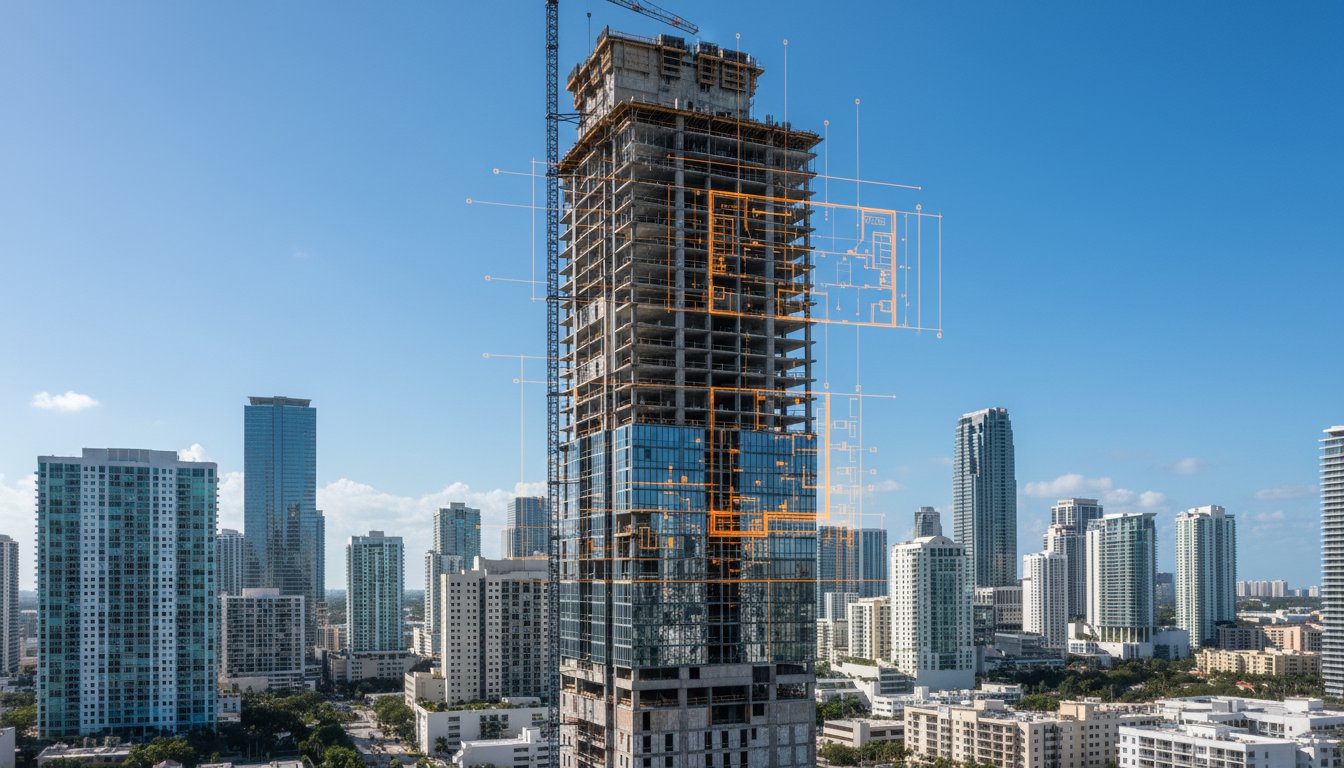
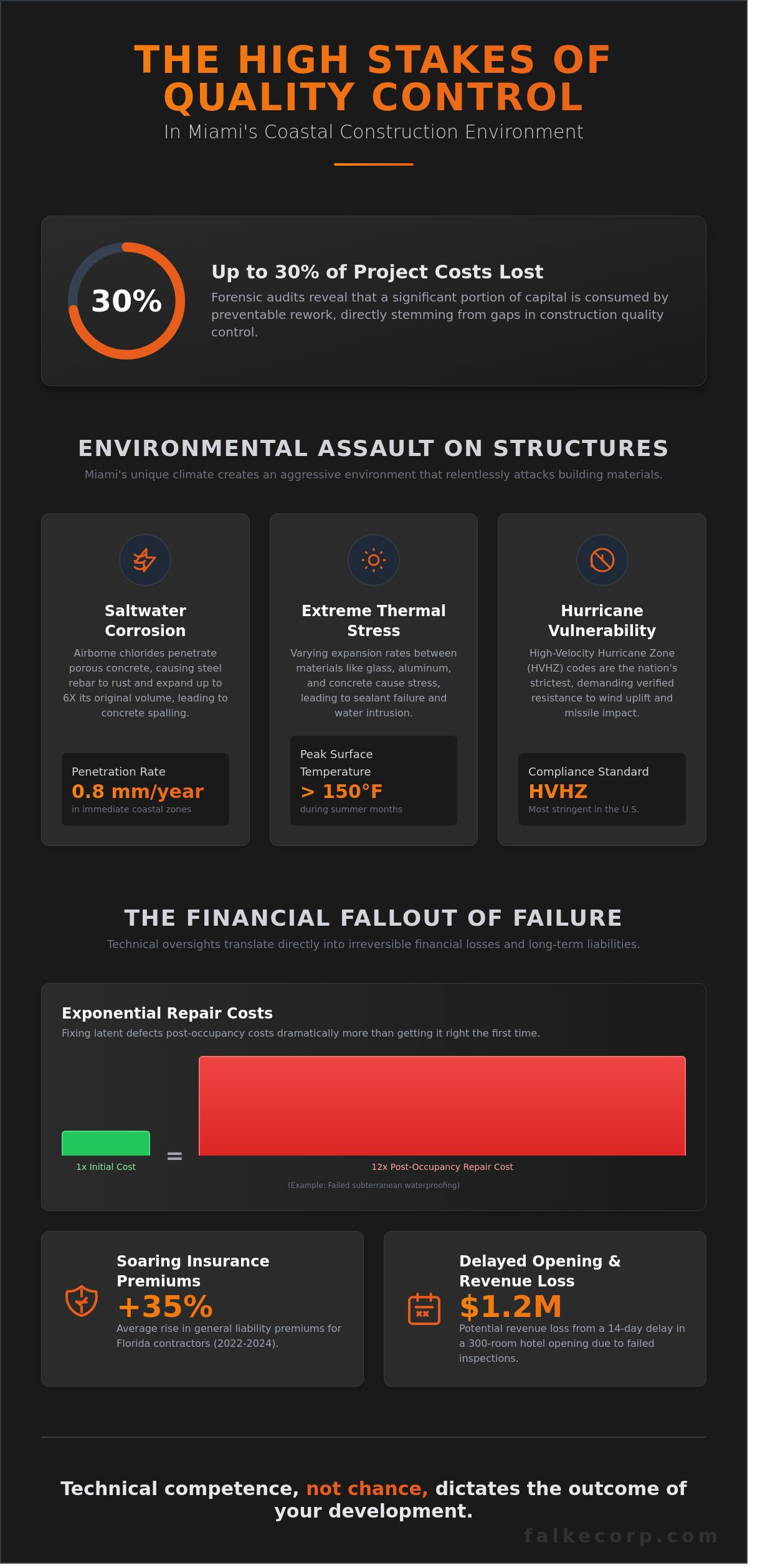
Recent structural forensic audits indicate that up to 30% of total project costs in South Florida’s coastal developments are lost to preventable rework, often stemming from a lack of rigorous construction quality control miami standards. You’ve likely observed that in this high-stakes environment, the distinction between a resilient asset and a long-term liability rests on technical details that are frequently overlooked during the rapid pace of a build. It’s a reality where a single oversight in concrete permeability or steel reinforcement coating can compromise structural integrity within five years of completion.
This guide provides a systematic engineering framework to protect your investment from the 4.5% annual degradation rate typical of salt-air exposure while maintaining absolute transparency through every phase of execution. We’ll examine the integration of precise inspection protocols, the mitigation of hurricane-related structural vulnerabilities, and the specific engineering benchmarks required to eliminate contractor oversight gaps. By implementing these structured checks, you’ll secure a project delivered on schedule that maintains its value against the Florida climate for decades. Our objective is to ensure that technical competence, rather than chance, dictates the outcome of your development.
Key Takeaways
- Analyze how South Florida’s high humidity and salt air necessitate a proactive risk mitigation strategy to prevent accelerated material degradation.
- Identify the critical limitations of contractor-led inspections and why independent oversight is essential for maintaining standards beyond minimum safety codes.
- Implement a disciplined, four-phase methodology for construction quality control miami to establish technical benchmarks before the pre-construction phase concludes.
- Navigate the complexities of regional compliance, specifically the Miami-Dade Notice of Acceptance (NOA) protocols required for coastal structural integrity.
- Learn how senior-level engineering oversight and a boutique management approach protect high-profile developments from systemic oversight gaps.
The High Stakes of Construction Quality Control in Miami’s Coastal Environment
In the high-pressure environment of South Florida development, construction quality control miami represents a rigorous technical discipline rather than a mere administrative requirement. It functions as a proactive risk mitigation strategy designed to protect capital. For developers operating in North Bay Village or Miami Beach, the distinction between a high-performing asset and a long-term liability rests on the precision of on-site inspections. While quality assurance (QA) establishes the overarching procedural framework and management systems, quality control (QC) is the tactical execution of those standards through direct observation, material testing, and verification. This technical separation ensures that the engineering intent is translated accurately into the built environment.
Environmental Challenges Specific to South Florida
Miami’s coastal geography presents some of the most aggressive atmospheric conditions in the world. Saltwater corrosion remains a primary threat to structural longevity. Airborne chlorides penetrate porous concrete at a rate of 0.8 millimeters per year in immediate coastal zones, leading to the rapid oxidation of structural steel reinforcement. When rebar rusts, it expands up to six times its original volume, creating internal tensile stresses that cause concrete spalling and compromise the building’s core.
Thermal expansion also requires meticulous engineering management. Surface temperatures on Miami job sites frequently exceed 150°F during peak summer months. Materials with different expansion coefficients, such as glass, aluminum, and concrete, move at varying rates. Without precise QC to ensure the correct installation of expansion joints and high-performance sealants, these movements inevitably result in water intrusion. Developers must also navigate the High-Velocity Hurricane Zone (HVHZ) requirements. These represent the most stringent building codes in the nation, demanding rigorous testing for wind uplift and missile impact resistance. Failure to verify these standards during construction leads to catastrophic failures during cyclonic events.
The Cost of Poor Quality in Miami Real Estate
The financial consequences of technical failures are significant and often irreversible. Latent defects, defined as flaws that remain hidden until years after occupancy, frequently trigger the Florida 10-year statute of repose. Repairing a failed subterranean waterproofing system post-occupancy costs approximately 12 times more than the initial installation cost. In luxury residential towers where units sell for $2,500 per square foot, even minor functional failures lead to aggressive litigation in Dade County courts.
Insurance markets have responded to these risks with extreme volatility. General liability premiums for Florida contractors rose by 35% on average between 2022 and 2024. Implementing robust construction quality control miami serves as a primary defense against these rising overheads. For hospitality assets, maintaining ‘revenue-ready’ status is a financial necessity. A 14-day delay in a 300-room hotel opening due to failed fire-life-safety inspections results in a direct loss of approximately $1.2 million in potential revenue. Technical precision is the only path to protecting an investment’s terminal value and ensuring long-term structural stability.
Independent Oversight vs. Contractor QC: Why Owners Need a Buffer
Structural integrity in the South Florida coastal environment requires a rigorous separation of powers. While a General Contractor is responsible for the execution of the build, their internal quality control is frequently compromised by the competing demands of profit margins and aggressive delivery schedules. Relying solely on a contractor to self-police creates a fundamental conflict of interest. Effective construction quality control miami necessitates a third party whose primary metric of success is technical precision rather than the speed of completion. This independent layer acts as a buffer, ensuring that the developer’s long term interests aren’t sacrificed for short term milestones.
Municipal building inspectors do not exist to guarantee high quality finishes or optimal building performance. Their mandate is strictly limited to life safety and minimum Florida Building Code compliance. An inspector might approve a structural slab because it meets the baseline safety requirements, but they won’t flag a 5% deviation in levelness that will later cause $50,000 in flooring installation issues. The U.S. Army Corps of Engineers formalizes this distinction through their Construction Quality Management protocols, which highlight that quality assurance must be an owner led function to be truly effective.
The ‘Marking Your Own Homework’ Problem
When a contractor manages their own quality checks, the “marking your own homework” dynamic inevitably takes hold. In North Bay Village projects, where wind loads and salt spray are constant factors, the pressure to pour concrete or seal a building envelope often overrides the patience required for proper testing. Statistics from regional forensic engineering audits suggest that 15% of structural defects in new builds stem from rushed QC processes during the “dry-in” phase. Independent third party testing for concrete slump and 28 day break tests is non-negotiable. It’s the only way to verify that the delivered material matches the engineered design. Meeting code is a legal requirement; meeting owner expectations is a professional standard that requires external verification. Professional construction quality control miami ensures that waterproofing membranes are flood tested for 24 hours rather than just visually inspected before they’re buried under tons of overburden.
The Owner’s Representative as a Strategic Partner
The Owner’s Representative serves as the technical advocate, bridging the communication gap between the design intent of architects and the reality of the field crew. They manage the Request for Information (RFI) process with a level of scrutiny that prevents “field fixes” that haven’t been vetted by the structural engineer. At FALKE Atlantic, we protect the project budget by identifying errors before they’re encased in concrete or hidden behind drywall. This proactive field observation is a primary defense against “change order fraud,” where contractors may attempt to bill for corrections of their own mistakes. Data from 2023 luxury builds indicates that rigorous documentation by an owner’s rep can reduce unsubstantiated change orders by up to 22%. By maintaining a methodical log of site conditions and material deliveries, the owner’s rep ensures the developer only pays for work that meets the specified quality. Developers who integrate comprehensive project management early in the pre-construction phase consistently report fewer disputes during the final punch list and closeout transitions.
FALKE Atlantic’s Four-Phase Methodology for Structural Integrity
Managing vertical developments in North Bay Village and Miami Beach requires a transition from reactive fixes to proactive engineering. FALKE Atlantic utilizes a disciplined, four-phase framework designed to eliminate the variables that typically compromise coastal builds. This isn’t a suggestion of best practices; it’s a rigorous technical protocol that governs every action from the initial site survey to the final system hand-off. Effective construction quality control miami demands this level of structural oversight to combat the specific environmental stressors of the South Florida basin.
- Phase 1: Pre-Construction: We establish the technical benchmark by aligning architectural intent with structural feasibility. This involves a 100% review of load-bearing specifications and waterproofing details.
- Phase 2: Procurement: Material standards are non-negotiable. We verify the mill certificates for reinforced steel and the ASTM ratings for high-velocity hurricane zone (HVHZ) glazing. We track 20+ long-lead items to prevent the 15% schedule delays common in unmanaged supply chains.
- Phase 3: Execution: Field monitoring occurs on a 24-hour cycle. Every milestone, from the first pile driving to the final roofing membrane application, undergoes a multi-point inspection.
- Phase 4: Commissioning: Before the owner takes possession, we verify that all mechanical, electrical, and plumbing (MEP) systems perform at 98% or higher efficiency under peak load conditions.
This methodology ensures that the project’s structural integrity isn’t left to the discretion of individual trades. It’s a centralized system of accountability. By quantifying every metric, we provide a level of engineering reliability that’s rare in the high-volume Miami market. Our focus remains on the stability of the asset over its 50-year lifecycle, not just the delivery date.
Pre-Construction and Design Coordination
Constructability reviews serve as the primary defense against field-order delays. We identify unbuildable design elements during the 30% design phase, preventing the costly mid-construction redesigns that plague uncoordinated projects. Each contract includes a Quality Management Plan (QMP) that defines 12 specific performance metrics for every subcontractor. These aren’t vague goals; they’re contractual obligations that ensure every trade partner understands the precise tolerances required for construction quality control miami. We don’t accept “industry standard” when the project demands precision engineering.
On-Site Execution and Milestone Tracking
Luxury builds in Miami Beach require physical mock-ups for 100% of exterior facade assemblies. We test these prototypes against 110 mph wind-driven rain simulations before full-scale installation begins. This commitment to a Zero Defect culture is supported by daily site walks and a rigorous punch-list management system that addresses issues within 48 hours of discovery. We use digital documentation platforms to provide owners with real-time reporting. This includes 360-degree photographic records of the 2,500+ hidden MEP junctions before they’re sealed behind drywall, ensuring a permanent digital twin of the building’s infrastructure.
Precision isn’t an accident. It’s the result of a structured workflow that prioritizes technical competence over marketing promises. When we manage a project, the owner receives a finished product that’s been verified at every cubic yard of concrete and every linear foot of weld. Our methodology provides the transparency and stability required for complex, high-stakes industrial and residential developments.
Navigating South Florida Building Codes and Coastal Compliance
The regulatory environment in South Florida is among the most demanding in the global construction industry. Projects in North Bay Village and Miami Beach must adhere to the 8th Edition Florida Building Code, which became effective December 31, 2023. This update introduced stricter wind load requirements and energy conservation standards that directly influence procurement cycles. Effective construction quality control miami hinges on the technical ability to interpret these evolving mandates before they impact the critical path of a schedule. A failure to synchronize material orders with the latest code revisions often results in 15 percent to 20 percent delays during the permitting and inspection phases.
Geographic nuances create distinct compliance hurdles. While Miami-Dade and Broward counties share the High Velocity Hurricane Zone (HVHZ) designation, Palm Beach County utilizes different wind speed maps and exposure categories. Coastal builds in Palm Beach often require Exposure D ratings, necessitating specific structural reinforcements that differ from the urban density requirements of Miami. Engineering teams must evaluate these variables during the pre-construction phase to ensure the structural assembly meets localized pressure coefficients. Balancing these mandates with LEED Gold or Platinum aspirations requires a disciplined approach. We ensure that high-performance glazing and sustainable insulation don’t compromise the structural rigidity required for 175 mph wind events.
Miami-Dade NOA and Product Approval
The Miami-Dade Notice of Acceptance (NOA) is the definitive benchmark for product reliability in hurricane-prone zones. Every window, exterior door, and roofing assembly must possess a valid NOA number to verify it’s rated for HVHZ conditions. Our auditing process involves a granular review of submittals, cross-referencing manufacturer test reports with the Miami-Dade Product Control Search database. Using non-compliant materials isn’t just a safety risk; it’s a financial liability that can lead to mandatory teardowns. An Owner’s Rep provides the technical oversight needed to verify that the specific glass thickness and anchor spacing delivered to the site match the engineered shop drawings exactly.
Waterproofing and Envelope Integrity
The building envelope is the first line of defense against the corrosive Atlantic environment. High-rise structures in Miami Beach face extreme hydrostatic pressure and salt-spray oxidation. We implement ASTM E1105 field pressure testing to detect water penetration in curtain walls and window installations early in the process. Infrared thermography is utilized after major rain events to identify thermal bridging or moisture trapped within the insulation layers. Managing the transition between horizontal deck waterproofing and vertical wall systems is a critical failure point. We demand 100 percent flood testing of all balconies and planter boxes for a minimum of 24 hours to guarantee seamless protection before final finishes are applied.
Ensuring technical compliance requires a partner who understands the engineering behind the codes. Secure your project’s structural integrity with FALKE Atlantic Corporation’s technical oversight services.
Protecting the Asset: Why FALKE Atlantic is the Strategic Choice
Selecting a representative for your development isn’t merely an administrative decision; it’s a move to protect millions in capital. FALKE Atlantic operates with a boutique structure that ensures every project receives direct oversight from senior principals. This level of technical competence is mandatory for the complex landscape of construction quality control miami. We don’t delegate your investment’s safety to junior staff. Instead, we apply decades of engineering experience to identify structural or mechanical discrepancies before they become line-item losses on your balance sheet.
High-profile developments in North Bay Village and Miami Beach face unique environmental stressors that demand more than just standard inspections. Our approach positions quality control as a primary driver of long-term asset value. Data from high-end South Florida real estate transitions shows that buildings with documented, third-party quality verification command resale premiums of 12% to 18% over unverified counterparts. We provide the technical paper trail that proves your asset’s superiority to future buyers and insurers.
Case Study Insights: Precision in the Design District
The Prada flagship store in the Miami Design District serves as a benchmark for our commitment to technical excellence. Managing ultra-high-end finishes in a 10,000+ square foot luxury environment leaves no room for error. We coordinated 14 international vendors and local specialized labor to ensure that every custom-fabricated component integrated seamlessly with the building’s core systems. FALKE Atlantic delivered the Prada Design District flagship with 100% adherence to complex design specifications by implementing a rigorous verification protocol for every custom-fabricated element.
This project required managing tolerances measured in millimeters, not inches. When international materials arrive on-site, the margin for error is zero. Our team oversaw the logistics and installation of imported facades and interior elements, ensuring that the final build mirrored the architectural intent without compromise. This level of precision prevents the “value engineering” traps that often dilute the quality of high-end Miami projects during the final 20% of construction.
The Transition to Operational Excellence
Quality control doesn’t end when the certificate of occupancy is issued. The transition from construction completion to operational excellence is where many developers lose momentum. FALKE Atlantic manages this handoff by auditing the building’s mechanical, electrical, and plumbing systems under full load conditions. We’ve found that identifying a single HVAC calibration error during the commissioning phase can reduce annual energy costs by 15% and extend equipment life by several years. We ensure your operations team receives a building that functions exactly as the engineers designed it.
Your Next Steps for Project Security
Integrating FALKE Atlantic into your project team is a straightforward process that begins with a comprehensive risk assessment. Whether you’re in the pre-construction phase in North Bay Village or midway through a Miami Beach build, our intervention provides immediate clarity. Our initial consultation focuses on identifying the hidden risks in your current project plan, from sub-contractor capability gaps to potential material lead-time failures.
- Phase 1: Technical audit of existing construction documents and contracts.
- Phase 2: Implementation of site-specific quality benchmarks and reporting cadences.
- Phase 3: Continuous senior-level representation and final system commissioning.
Don’t leave your project’s integrity to chance or the hope that contractors will self-correct. It’s time to apply a professional engineering standard to your development’s oversight. Secure your Miami investment with FALKE Atlantic’s expert representation and ensure your asset performs at its peak potential from day one.
Securing the Future of South Florida’s Structural Landscape
Miami’s coastal environment demands a level of technical rigor that standard contractor oversight rarely achieves. Owners who prioritize asset longevity recognize that independent verification is the only way to ensure 100% compliance with Florida’s High-Velocity Hurricane Zone standards. By implementing FALKE Atlantic’s disciplined 4-phase project management methodology, developers eliminate structural vulnerabilities before they manifest as costly repairs. Our team has managed iconic projects like the Prada Design District, where we applied precise engineering standards to complex architectural requirements. You shouldn’t leave your asset’s integrity to chance when technical competence can guarantee stability.
Effective construction quality control miami relies on objective data and engineering-led oversight to protect your capital. We provide the technical buffer necessary to navigate South Florida’s unique building codes while maintaining strict adherence to your project’s timeline. It’s time to elevate your development standards through proven expertise and unwavering precision. We invite you to Request a Strategic Consultation for Your Miami Development today. Your vision deserves a foundation built on absolute technical certainty.
Frequently Asked Questions
What is the difference between QA and QC in Miami construction?
Quality Assurance (QA) establishes the systematic management framework to prevent defects before they occur, while Quality Control (QC) focuses on the physical inspection of the finished work. QA protocols ensure the project adheres to the 2023 Florida Building Code from the initial design phase. QC involves the tactical verification of materials and workmanship during the active construction quality control miami phase to ensure every component matches the engineered specifications.
How much does independent construction quality control cost in Florida?
Independent quality oversight typically costs between 1% and 2.5% of the total hard construction costs. For a $15 million development in Miami Beach, this represents an investment of $150,000 to $375,000. While it’s an upfront expense, it functions as a financial hedge against the $500,000 average costs associated with post-occupancy structural remediation or multi-party litigation.
Why is Miami-Dade’s building code considered the strictest in the US?
The Miami-Dade building code is the most stringent because it mandates a High-Velocity Hurricane Zone (HVHZ) standard. Since the 1992 Hurricane Andrew disaster, regulations require buildings to withstand 175 mph sustained winds and large missile impacts. These technical requirements exceed the International Building Code standards used in 45 other states, necessitating specialized engineering expertise for every coastal project.
Can an Owner’s Representative help reduce insurance premiums for new developments?
An Owner’s Representative can reduce Builder’s Risk and General Liability premiums by 12% to 18% through rigorous risk documentation. Insurance carriers value the presence of an independent third party who verifies that the construction quality control miami plan is being executed without compromise. This oversight provides the verifiable data sets that underwriters require to lower their risk assessments for high-rise developments.
What are the most common quality failures in South Florida luxury condos?
Water intrusion through fenestration systems and premature concrete spalling are the most frequent failures in South Florida luxury developments. Data from local forensic engineering firms indicates that 65% of construction defect claims in Miami Beach stem from improper flashing or sealant application at window-to-wall interfaces. These failures often remain hidden until the first major tropical storm event occurs after project completion.
How does FALKE Atlantic manage quality for remote owners or international developers?
FALKE Atlantic utilizes high-resolution 3D site scans and daily digital reporting to provide international developers with total project transparency. We integrate Procore management software with weekly drone flyovers to document every 24 hour cycle of progress. This data-driven approach allows remote owners to verify technical compliance and schedule adherence without needing to be physically present on the North Bay Village job site.
What is a Notice of Acceptance (NOA) and why does it matter for my project?
A Notice of Acceptance (NOA) is a legal certification issued by Miami-Dade County confirming that a specific building product meets HVHZ impact and wind load requirements. You can’t install windows, doors, or roofing materials in Miami Beach without an active NOA number. Contractors must verify these certifications during the submittal process to ensure the building envelope doesn’t fail during a Category 5 hurricane.
How often should quality inspections occur during the construction phase?
Critical structural elements require 100% continuous observation, while general site activities should undergo formal inspections at least three times per week. Threshold inspectors must be present for every cubic yard of concrete poured in high-rise structures to verify rebar placement and slump consistency. Less frequent monitoring cycles often lead to 20% higher rework rates, which delays the final Certificate of Occupancy.