
A construction schedule in the South Florida market is not a mere sequence of events; it’s a complex financial instrument where unmitigated delays represent a direct erosion of owner equity. In a landscape defined by the impending 9th Edition of the Florida Building Code and the logistical intricacies of Miami-Dade permitting, professional construction schedule management miami serves as the primary mechanism for capital protection. You likely recognize that a contractor’s reported progress often masks underlying float manipulation, leaving your investment vulnerable to weather-related Force Majeure claims and the volatile lead times characteristic of the 2026 luxury market.
This guide details the strategic framework required to reclaim transparency and maintain rigorous oversight throughout the development lifecycle. You’ll learn the specific methodologies used to secure a firm opening date while mitigating the financial claims that typically arise from poorly documented delays. We will examine the critical technical benchmarks of the pre-construction and commissioning phases, providing the objective perspective necessary to ensure your asset is delivered as a high-quality, revenue-ready entity.
Key Takeaways
- Understand the critical necessity of professional construction schedule management miami in mitigating the financial risks associated with the 2026 regulatory environment.
- Master the technical application of the Critical Path Method (CPM) to identify float ownership and prevent the manipulation of reported progress.
- Learn how to audit contractor schedules for “front-loading” to ensure that all project milestones are tied to contractually enforceable completion dates.
- Identify the specific logistical strategies required to navigate Miami-Dade permitting cycles and the sequencing challenges of the Atlantic hurricane season.
- Discover how a disciplined four-phase management methodology ensures that the final 10% of construction results in a fully commissioned, revenue-ready asset.
The Strategic Importance of Construction Schedule Management in Miami
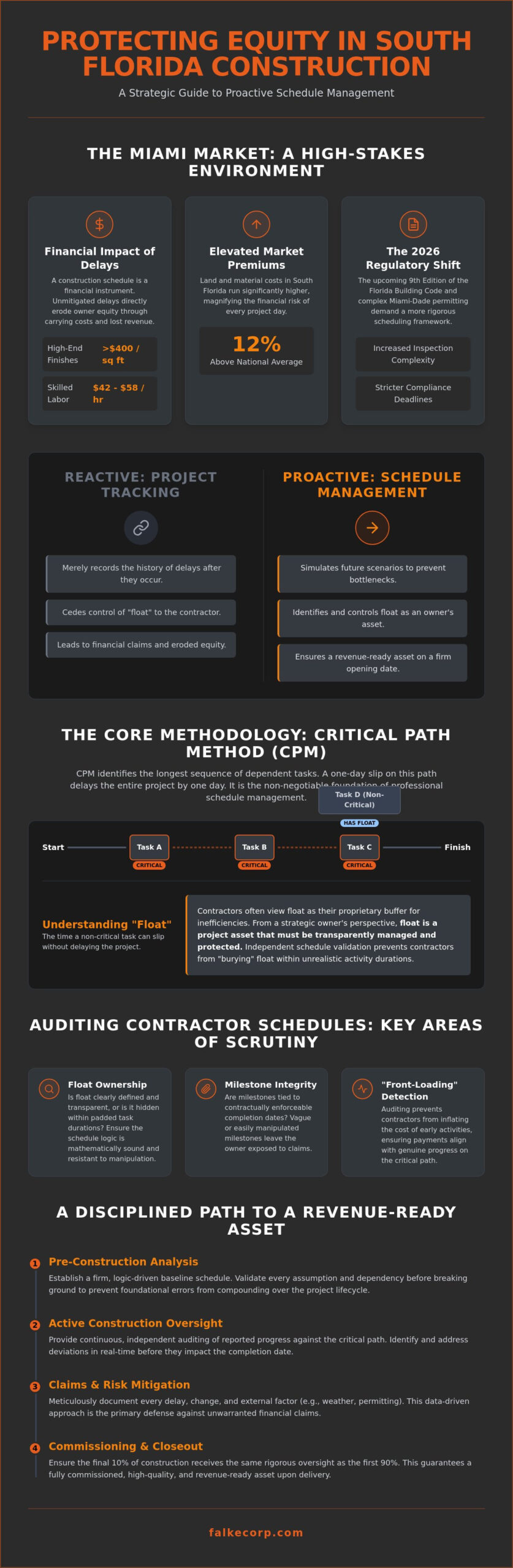
In the volatile 2026 real estate environment, precision in construction schedule management miami represents the difference between a successful asset delivery and a distressed capital position. A construction schedule is not a static document or a simple clerical output; it’s a sophisticated financial and legal safeguard integrated into the owner-contractor agreement. In Miami’s high-stakes market, where land costs and material premiums are 12% above the national average, there’s no margin for the “float” manipulation often found in general contractor reports. True management requires an independent, technical audit of every sequence to protect equity from being eroded by invisible delays. With the 9th Edition of the Florida Building Code taking effect in late 2026, the complexity of technical inspections has increased, making a rigorous scheduling framework vital for long-term stability.
Schedule Management vs. Project Tracking
Most organizations mistake project tracking for management. Tracking is a reactive exercise that merely records the history of delays after they’ve occurred. Professional construction schedule management miami is fundamentally proactive. It uses the Critical Path Method (CPM) to simulate future scenarios and identify bottlenecks before they impact the critical path. As an owner’s representative, FALKE Atlantic provides the objective oversight necessary to ensure the contractor’s logic remains aligned with the owner’s strategic milestones. We don’t just observe the timeline. We enforce a disciplined methodology that prevents delays from compounding into unrecoverable losses by identifying errors in logic early in the pre-construction phase.
The Financial Impact of Time in South Florida
The financial consequences of a 30-day delay in Miami-Dade are profound. Beyond the direct construction labor rates, which currently range between $42 and $58 per hour, owners must account for the staggering carrying costs of debt servicing and lost opportunity. A delay that pushes a project past its intended opening date can miss the peak hospitality or retail seasons, which are critical for the financial modeling of South Florida assets. For luxury developments where interior finishes alone can exceed $400 per square foot, the cost of capital is too high to permit any lack of transparency. Disciplined schedule management ensures that your capital remains productive and that your asset arrives on the market ready to generate revenue exactly when the market demands it.
Core Methodologies: The Critical Path Method (CPM) and Beyond
Achieving structural and financial milestones in the South Florida market requires moving beyond static bar charts. The foundation of sophisticated construction schedule management miami is the Critical Path Method (CPM). This methodology identifies the longest sequence of dependent activities that must be completed on time for the project to meet its deadline. For an owner, understanding the critical path is non-negotiable; if a task on this path slips by a single day, the entire completion date moves accordingly. FALKE Atlantic utilizes this technical rigor to separate essential progress from clerical updates, ensuring that contractor resources are always allocated to high-impact activities. Rigorous construction schedule management miami ensures that the logic behind every sequence is mathematically sound and resistant to manipulation.
A critical component of this methodology is the management of ‘Float’—the amount of time an activity can be delayed without affecting the project finish date. Contractors often view float as their proprietary buffer to manage labor inefficiencies or trade coordination errors. However, from a strategic perspective, float is an owner’s asset. We insist on independent schedule validation because it prevents contractors from “burying” float within unrealistic activity durations. By maintaining a transparent, logic-driven schedule, we ensure that dependencies are clear and that the owner retains control over the project’s most valuable resource: time.
Advanced Scheduling Software Tools (P6 and MS Project)
To manage the complexity of Miami’s 2026 developments, we utilize Primavera P6. This software allows for the integration of cost-loading, which transforms the schedule into a dynamic cash-flow forecasting tool. When every activity is tied to a specific dollar value, the owner gains a “single source of truth” regarding real-time progress versus actual expenditures. This data-driven approach eliminates the ambiguity of percentage-complete reports and provides a clear view of the project’s financial health throughout the construction lifecycle.
The Logic of Pre-Construction Scheduling
Effective management begins long before the first shovel hits the ground. Our methodology links the schedule directly to the pre-construction services Miami phase. This ensures that long-lead procurement items, such as luxury interior finishes that often command a 12% premium in the local market, are integrated into the master timeline. By finalizing the logic during pre-construction, we account for the 3-6 month permitting window typical in South Florida, preventing the “hurry up and wait” syndrome that often plagues unmanaged builds. If you’re seeking to secure your project’s timeline from the outset, partnering with an experienced owner’s representative provides the technical oversight required for success.
Miami-Specific Variables Impacting Project Timelines
Miami’s construction environment is governed by a unique set of geographic and regulatory constraints that necessitate a specialized approach to construction schedule management miami. Projects in South Florida must adhere to the most demanding residential building codes in the United States due to the High-Velocity Hurricane Zone (HVHZ) designation. These requirements, which include impact-rated glass and enhanced structural engineering, aren’t just design hurdles; they’re scheduling criticalities. A failure to account for the extended lead times of HVHZ-compliant materials or the specific inspection sequences they require can trigger cascading delays that jeopardize the entire project timeline. In 2026, with labor rates for specialized trades reaching up to $55 per hour, the cost of these delays is higher than ever before.
Regulatory and Permitting Milestones
The pre-construction phase in Miami-Dade often spans 3 to 6 months, though complex developments frequently exceed a year. Effective construction schedule management miami requires a granular understanding of the “Dry Run” process and the specific review cycles of the Department of Regulatory and Economic Resources (DERM). As of 2026, permit fees have seen an increase of 5% to 12% compared to 2024, reflecting heightened administrative complexity. For example, while the City of Miami utilizes a $184 flat fee for many trade permits, the real cost lies in the time lost to bureaucratic bottlenecks. We mitigate these risks by scheduling for proactive compliance, ensuring all submissions align with the 9th Edition of the Florida Building Code before the December 31, 2026, deadline to avoid late-stage revisions.
Environmental and Climate Contingencies
The Atlantic hurricane season, spanning from June through November, introduces a non-negotiable variable into project sequencing. A disciplined schedule must incorporate a standardized “Weather Day” clause that defines exactly how rain and wind delays are tracked and verified. This is particularly vital in flood-prone areas like Miami Beach, where coastal construction requires precise dewatering sequences and tide-dependent logistics. We optimize these timelines by scheduling high-risk exterior work outside of peak storm months whenever possible. The financial penalty for a site shutdown due to poor environmental planning is too significant to leave to chance. By integrating these local variables into the master logic, we ensure the asset remains on track for its delivery date despite the region’s inherent volatility.
How to Audit a Contractor’s Construction Schedule
Auditing a contractor’s schedule requires a forensic level of technical scrutiny that goes far beyond verifying completion dates. For an owner, the primary objective is to ensure the schedule is a realistic representation of field conditions rather than a document designed to mask inefficiencies. A rigorous construction schedule management miami protocol involves identifying “front-loading,” where a contractor artificially inflates the duration or value of early-stage activities to improve their immediate cash flow. This practice leaves the owner with insufficient leverage during the critical final 10% of the project. We verify that resource loading—the allocation of labor and equipment—aligns with the 2026 market reality, where average hourly trade rates range from $30 to $55. If the contractor’s plan doesn’t account for these labor dynamics, the timeline is fundamentally flawed.
Transparency is maintained through mandatory monthly updates accompanied by detailed narrative reports. These narratives must explain any deviations from the baseline and provide a recovery plan for any activities that have slipped. Without this level of detail, an owner is left with a static data set that fails to predict future risks. We ensure that every milestone is tied to contractually enforceable dates, transforming the schedule from a simple roadmap into a binding legal instrument that protects your capital.
Identifying Red Flags in the Baseline Schedule
A baseline schedule that lacks proper logic ties is a sign of imminent failure. We specifically look for “open ends”—activities that don’t have a predecessor or successor—which prevent delays from flowing through the network accurately. Another critical red flag is the use of excessive constraints, such as “Must Start On” dates, which override the natural logic of the construction phase management Florida plan. These constraints create a false sense of security while hiding the true critical path. A healthy schedule must be dynamic; it should reflect the actual sequence of work while allowing for the mathematical calculation of float and path volatility.
The Role of the Owner’s Representative in Auditing
The owner’s representative acts as an objective “third eye,” providing a technical critique that a general contractor cannot offer internally. We bridge the communication gap between the field team and the owner by translating complex CPM data into actionable strategic insights. This auditing process is essential for validating pay applications. We ensure that progress payments are only issued for work that has been verified against the audited schedule, preventing the owner from overpaying for unearned progress. If you require a higher standard of technical oversight for your development, professional owner’s representation is the most effective way to secure your project’s financial and temporal integrity.
FALKE Atlantic: Delivering Revenue-Ready Assets Through Discipline
The ultimate objective of any development is the realization of a high-quality, revenue-ready asset that meets its financial projections. FALKE Atlantic achieves this through a disciplined four-phase methodology that integrates construction schedule management miami into every stage of the project lifecycle. From the initial conceptual planning through the complex commissioning phase, our approach ensures that every activity is logically sequenced and financially controlled. Our experience in high-stakes environments, such as luxury retail in the Prada Design District and sophisticated hospitality developments, has proven that success is not found in the avoidance of complexity, but in its meticulous management. We act as a strategic partner for owners, providing the technical competence required to navigate the final 10% of construction, where the most significant risks to the opening date reside.
Maintaining momentum during the transition from a construction site to an operational facility requires more than just a general contractor’s oversight. It demands a specialized focus on the integration of all building systems and the final close-out of trade contracts. By aligning your timeline with the principles of Commercial Project Management in Miami, you ensure that the project logic accounts for the specific operational requirements of your asset class. Our methodology treats the schedule as a dynamic instrument that must be refined until the final punch list item is resolved and the asset is fully operational.
The Commissioning and Close-out Phase
Scheduling does not terminate when the building envelope is sealed. The final phase of construction is often where the greatest schedule slippage occurs due to a lack of coordination during system testing and inspections. We manage the punch list with the same technical rigor applied to the foundation work, ensuring that trades remain focused on the finish line. Our team oversees the critical path to achieving the Certificate of Occupancy (CO) on time, mitigating the risk of last-minute regulatory hurdles that could delay the revenue-generation phase. This focus on the final 10% ensures that the asset is delivered without the lingering deficiencies that often plague unmanaged projects.
A Strategic Partnership for Owner Success
FALKE Atlantic functions as your strategic partner, providing an unwavering commitment to transparency and financial integrity. We don’t merely report on the status of your project; we take full responsibility for the technical accuracy of the construction schedule management miami process. This commitment allows owners to focus on their broader investment strategy while knowing that the most complex execution details are under expert supervision. Every update we provide is rooted in data and logic, offering the stability required to manage your most valuable developments with absolute confidence. Contact FALKE Atlantic today to schedule a professional consultation and discover how our disciplined management methodology can protect your next South Florida investment.
Strategic Timeline Oversight for 2026 and Beyond
Mastering the intricacies of South Florida’s construction landscape requires a shift from reactive tracking to proactive, technical management. We’ve examined how rigorous construction schedule management miami protects capital by identifying logic errors and float manipulation before they escalate into unrecoverable financial claims. By accounting for regional variables like the 9th Edition of the Florida Building Code and the unique logistical constraints of the Atlantic hurricane season, owners can maintain the transparency necessary for informed, risk-adjusted decision-making throughout the entire build process.
The transition to a revenue-ready asset depends on a disciplined approach to the commissioning and close-out phases, which often represent the most volatile period of the project lifecycle. FALKE Atlantic Corporation brings a proven track record in high-stakes hospitality and luxury retail developments, including technical oversight for premier projects in the Miami Design District. Our disciplined four-phase project management methodology ensures that your strategic goals are met with technical precision and unwavering professional accountability. Secure your project’s timeline with FALKE Atlantic Corporation’s expert Owner’s Representation. We’re ready to provide the stability and expertise required to bring your vision to completion according to the highest professional standards.
Frequently Asked Questions
What is the difference between a project schedule and a project plan in Miami construction?
A project plan is a broad strategic document that encompasses the entire development framework, including budget, scope, and procurement strategies. In contrast, the schedule is a technical, time-phased execution model that uses the Critical Path Method to dictate the exact sequence of construction activities. Effective construction schedule management miami requires the schedule to be a subset of the plan, providing the mathematical logic needed to meet the owner’s delivery milestones.
How much float should be included in a South Florida construction schedule?
While there’s no universal percentage, a healthy baseline schedule typically maintains a total float of 10% to 15% of the overall project duration. This buffer is essential in Miami to account for unpredictable DERM approval cycles and the 3 to 6 month permitting window. It’s critical that this float is managed as an owner’s asset to prevent contractors from consuming it to hide labor inefficiencies or trade coordination errors.
Can a schedule manager help reduce construction change orders?
Yes, professional schedule management identifies sequencing conflicts and long-lead procurement gaps during the pre-construction phase before they manifest as field issues. By ensuring that the schedule’s logic is sound, you prevent the “hurry up and wait” scenarios that often trigger contractor claims for additional costs. This proactive oversight ensures that the project remains within its original financial and temporal boundaries.
How does hurricane season affect my construction timeline in Miami?
The Atlantic hurricane season, which runs from June through November, requires specific sequencing for exterior building envelope work and site stabilization. Construction schedule management miami must incorporate a standardized “Weather Day” protocol to track rain and wind delays with technical precision. This prevents contractors from making broad Force Majeure claims for minor weather events that didn’t actually impact the project’s critical path.
What is a ‘Critical Path’ and why is it vital for an owner to know?
The Critical Path is the longest sequence of dependent activities that determines the project’s earliest possible completion date. If any task on this path is delayed by one day, the entire project finish date moves by one day. Owners must understand this path to ensure that capital and resources are prioritized for the activities that have the most significant impact on the final delivery date.
How do I handle a contractor who is behind schedule but claiming ‘Force Majeure’?
You must perform a forensic audit of the schedule to determine if the delay occurred on the critical path and if it was truly caused by an external, uncontrollable event. If the contractor was already behind due to labor shortages or poor sequencing, the Force Majeure claim may be invalid. We bridge this gap by providing an objective, third-party analysis of the contractor’s data to protect the owner’s contractual rights.
Why is an Owner’s Representative better at schedule management than a General Contractor?
A General Contractor manages the schedule to protect their own profit margins and labor resources, which can lead to “float” manipulation and lack of transparency. An Owner’s Representative provides an objective “third eye” that prioritizes the owner’s capital preservation and revenue-readiness. This independent oversight ensures that the schedule remains a truthful representation of progress rather than a tool for contractor risk mitigation.
How often should a construction schedule be updated for a Miami high-rise project?
A formal baseline update should be performed monthly to coincide with pay applications and progress reports. However, high-rise developments require weekly “look-ahead” reviews to manage the complex sequencing of vertical trades and technical inspections. This frequency allows the management team to identify and correct logic errors before they compound into unrecoverable delays that could impact the project’s specific opening date.