
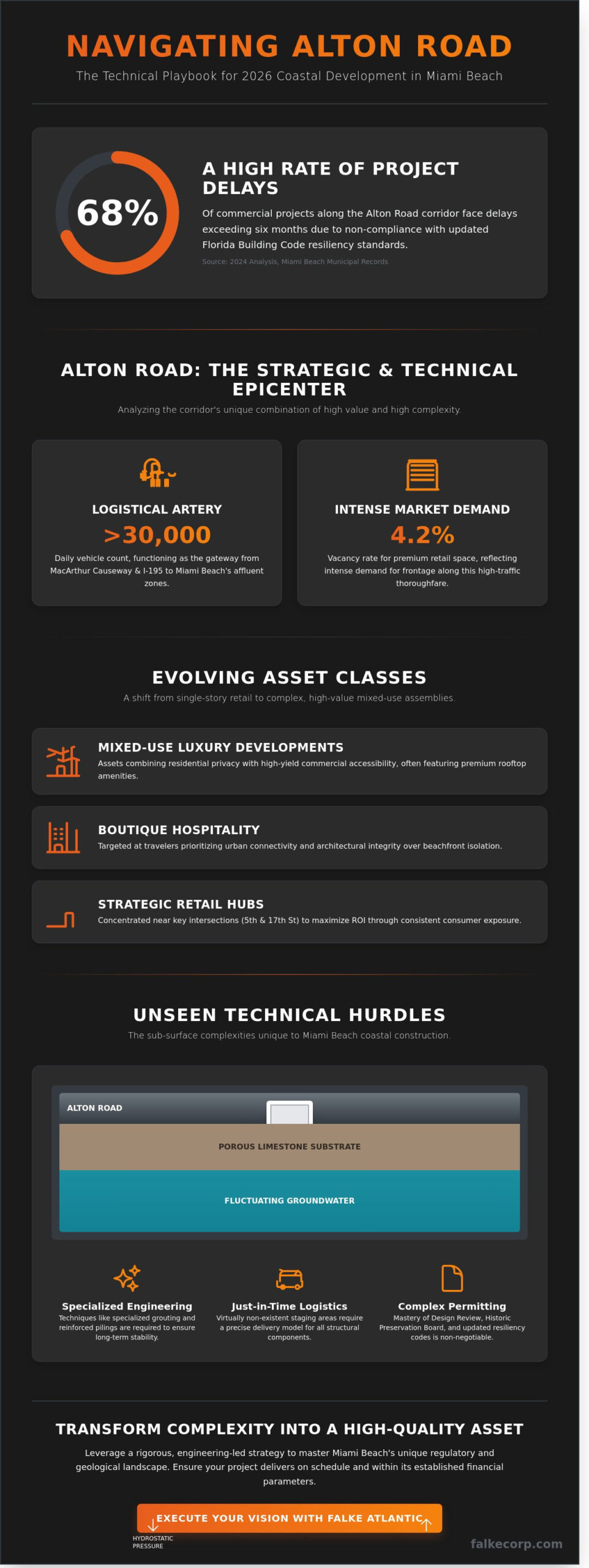
According to a 2024 analysis of Miami Beach municipal records, 68% of commercial projects along the alton road corridor face delays exceeding six months due to non-compliance with updated Florida Building Code resiliency standards. Developing in high-density coastal zones requires a level of technical precision that standard construction models simply cannot accommodate. You recognize that the unique geological and regulatory landscape of Miami Beach demands more than just a standard permit; it requires a rigorous, engineering-led strategy to manage sub-surface complexities and logistical constraints effectively.
This guide provides a technical framework for navigating the specific logistical and structural hurdles of the 2026 development cycle. We’ll examine the integration of advanced infrastructure solutions, the mitigation of unforeseen utility risks, and the optimization of site logistics to ensure your project delivers on schedule and within its established financial parameters. By applying these structured methodologies, you’ll transform complex regulatory requirements into a high-quality asset ready for revenue.
Key Takeaways
- Analyze the strategic real estate trends and infrastructure developments that define the alton road corridor as a primary investment hub in 2026.
- Identify the technical engineering protocols necessary to mitigate geological risks and sea-level rise challenges inherent in modern coastal construction.
- Navigate the complex regulatory landscape by mastering the specific approval requirements of the Design Review and Historic Preservation Boards.
- Minimize financial risk through a disciplined four-phase methodology designed to prevent scope creep and maintain structural integrity throughout the project lifecycle.
- Leverage local institutional knowledge to ensure technical precision during every stage of development, from pre-construction to final commissioning.
Alton Road: The Strategic Corridor of Miami Beach Real Estate
Alton Road serves as the primary logistical and commercial spine of Miami Beach. Its designation as Florida State Road 907 underscores its function as a vital north-south artery. In 2026, the corridor has transitioned from a purely utilitarian transit route into a high-density zone for sophisticated capital deployment. Investors now prioritize the integration of luxury residential units with high-performance commercial spaces. Understanding Alton Road’s role as a strategic corridor requires an analysis of its capacity to handle both local transit and regional connectivity. The market currently exhibits a 4.2% vacancy rate for premium retail space, reflecting the intense demand for frontage along this thoroughfare.
The Economic Significance of the SR 907 Corridor
The corridor functions as the principal gateway for traffic arriving via the MacArthur Causeway and I-195. This connectivity ensures a constant flow of high-net-worth individuals between the mainland and the island’s most affluent pockets. Proximity to the Sunset Harbour district and the South of Fifth neighborhood creates a synergy that drives property valuations upward. The 2026 Miami Beach master plan designates the alton road corridor as a prioritized zone for infrastructure resilience and pedestrian-centric urban densification. This strategic positioning makes the area a focal point for institutional investors seeking stable, long-term yields through technical asset management.
Property Archetypes: From Retail to High-End Residential
Asset classes along the corridor are undergoing a systematic transformation. Developers are moving away from single-story retail structures toward complex mixed-use assemblies. These projects often combine boutique hospitality elements with ground-floor commercial units that leverage high foot traffic volumes. Evaluating site feasibility requires a rigorous assessment of local zoning constraints and the impact of subterranean engineering requirements. The shift toward luxury hospitality reflects a broader trend of densification within the urban core.
- Mixed-use luxury developments: These assets combine residential privacy with high-yield commercial accessibility, often featuring rooftop amenities.
- Boutique hospitality: Targeted at travelers who prioritize urban connectivity and architectural integrity over beachfront isolation.
- Strategic retail hubs: Concentrated near the 5th Street and 17th Street intersections, these locations maximize ROI through consistent consumer exposure.
Sophisticated players must distinguish between the flexibility of designated opportunity zones and the restrictive frameworks of historic preservation districts. While preservation districts offer specific tax incentives, they require a higher level of technical expertise to navigate structural and aesthetic requirements. The high barrier to entry stems from these regulatory complexities and the scarcity of developable land. Success in this market depends on a developer’s ability to execute complex engineering solutions within a constrained urban environment. The alton road market remains a hallowed ground for those who can balance technical precision with the demands of a high-end demographic.
Navigating Technical Complexity: Coastal Construction on Alton Road
Executing a construction project on alton road requires an uncompromising approach to engineering, as the site sits atop a porous limestone substrate that characterizes much of Miami Beach. This geological reality means that groundwater levels fluctuate rapidly with the tides, creating significant hydrostatic pressure on subterranean structures. Developers must move beyond standard foundation designs, utilizing specialized grouting techniques and reinforced pilings to ensure long term stability. The logistical constraints of this narrow urban corridor add another layer of difficulty. With daily traffic counts often exceeding 30,000 vehicles, staging areas are virtually non-existent, requiring a just-in-time delivery model for all structural components.
Technical success in this environment depends on a deep understanding of municipal requirements. Navigating Miami Beach’s permitting process involves more than just administrative compliance; it requires the seamless integration of private site plans with the city’s evolving drainage master plan. Engineers must account for the specific utility corridors that run beneath the pavement, some of which date back several decades. Consulting with experts in complex industrial engineering ensures these technical hurdles don’t compromise the project’s structural integrity or timeline.
Flood Mitigation and Elevation Requirements
Modern projects must align with the 2026 FEMA flood maps, which have shifted base flood elevations (BFE) upward for most of the barrier island. Local zoning now mandates a freeboard of 1 to 3 feet above the BFE to account for projected sea-level rise through 2050. This elevation change forces a redesign of the ground-floor interface, often requiring sophisticated ramping or mechanical lift systems for accessibility. During the excavation phase, a robust dewatering plan is essential to prevent site inundation. The Alton Road pump station upgrades directly dictate the design of private drainage systems, as new developments must now synchronize their outflow rates with the city’s pressurized stormwater network to prevent backflow during king tide events.
Material Selection for the Coastal Environment
The highly corrosive salt air along alton road demands a rigorous material specification strategy that exceeds standard Florida Building Code requirements. Structural steel must be hot-dip galvanized or treated with high-performance epoxy coatings to prevent oxidation. For glazing, the High-Velocity Hurricane Zone (HVHZ) standards require impact-resistant glass capable of withstanding wind speeds of 175 mph. Sustainability also plays a critical role. Achieving LEED certification in this tropical climate involves the use of thermal breaks in aluminum framing and low-emissivity coatings to reduce solar heat gain. These choices aren’t merely aesthetic. They’re calculated engineering decisions designed to lower lifecycle maintenance costs in a punishing maritime environment.
Regulatory Oversight: Permitting and Board Approvals in Miami Beach
Executing a development project on alton road requires precise alignment with the City of Miami Beach Planning Department’s regulatory framework. Success depends on early engagement with municipal staff to identify potential zoning conflicts before they escalate into structural delays. This proactive coordination ensures that the technical specifications of the project meet the city’s high standards for urban density and infrastructure impact. An Owner’s Representative serves as the central coordinator during this entitlement phase, managing the communication between land-use attorneys, architects, and city officials to maintain the project timeline.
Public hearings represent a critical milestone in the approval cycle. Managing neighborhood impact involves more than just meeting minimum code requirements; it requires a structured strategy to address community concerns regarding traffic flow and construction noise. Developers must present data-driven mitigation plans during these sessions to secure the necessary support for project advancement. Failure to provide comprehensive impact studies often results in deferred votes, which can add four to six months to the pre-construction phase.
The Design Review Board (DRB) Process
The Design Review Board evaluates every alton road proposal against the city’s Urban Design Guidelines to ensure architectural excellence and neighborhood compatibility. Common pitfalls in the DRB application cycle include insufficient landscape buffering and failure to respect the pedestrian scale of the corridor. Securing variances for height or setbacks requires a technical demonstration of hardship that doesn’t compromise the city’s master plan. Strategic applicants use three-dimensional massing studies to prove that their design enhances the streetscape while adhering to the strict 2023 zoning updates regarding sea-level rise and drainage.
Historic Preservation and Adaptive Reuse
Many properties along the southern and central portions of the corridor fall within designated historic districts. These legacy structures demand a specialized engineering approach that balances modern functionality with historic integrity. Identifying these constraints early is vital. Utilizing Strategic Pre-Construction Services in Miami provides a necessary tool for early risk assessment, allowing owners to quantify the costs of structural reinforcement and material restoration.
Technical challenges often arise when integrating modern mechanical systems into buildings from the 1930s or 1940s. Additionally, projects must comply with Coastal Construction Control Line (CCCL) requirements, which dictate specific foundation depths and flood elevation standards for properties in proximity to the waterfront. Adaptive reuse isn’t merely an aesthetic choice; it’s a complex engineering task that requires a deep understanding of both the Florida Building Code and the Secretary of the Interior’s Standards for Rehabilitation.
Mitigating Financial Risk: The Necessity of an Owner’s Representative
Projects along the alton road corridor face a unique set of financial pressures that often lead to significant budget erosion. The combination of aging subterranean infrastructure, strict Miami Beach sea-level rise mitigation requirements, and high-density traffic logistics creates a volatile environment for capital expenditures. Scope creep is rarely the result of a single catastrophic event; instead, it manifests through a series of incremental change orders that contractors justify using “unforeseen conditions.” Without a dedicated technical advocate, owners often find themselves approving these costs out of a perceived lack of alternatives.
FALKE Atlantic Corporation implements a structured four-phase methodology to neutralize these risks. This framework ensures that every decision, from the initial concept to final commissioning, is rooted in technical data rather than contractor convenience. The process includes:
- Concept: Validating the project’s feasibility against current Miami Beach zoning and environmental codes.
- Pre-Construction: Establishing a “bulletproof” budget and identifying potential long-lead item delays.
- Execution: Maintaining a presence on-site to verify that work completed matches the billing cycles.
- Commissioning: Ensuring all systems, particularly complex drainage and electrical automation, function at 100% capacity before final payment.
This systematic oversight creates a rigorous audit trail. By maintaining transparency in the ledger, we protect the owner’s interests against vendor conflicts and ensure that the project doesn’t fall victim to the 15% to 22% cost overruns typical of South Florida urban redevelopments.
The Pre-Construction Audit and Bidding Strategy
Financial stability begins with a surgical analysis of the bidding pool. Vetting general contractors for specific Miami Beach experience is mandatory, as those unfamiliar with the local regulatory climate often underestimate the complexity of alton road logistics. We dissect bids to separate “hard costs,” such as raw materials and structural labor, from “soft costs,” which include permitting fees and insurance premiums. This granular approach prevents contractors from hiding inflated margins within generalized line items. For a deeper understanding of these high-level maneuvers, owners should consult this strategic guide for construction project management in Florida.
Construction Phase Oversight and Quality Control
During active construction, schedule mismanagement is the primary driver of financial loss. The City of Miami Beach frequently imposes fines exceeding $500 per hour for unauthorized lane closures or peak-hour traffic disruptions. We manage the master schedule with engineering precision to avoid these penalties while maintaining the “Owner’s Eye” on-site for quality assurance. Our Owner’s Representative Miami services utilize specialized reporting to identify and prevent change order fraud before it impacts the bottom line. This level of technical vigilance ensures that the final build meets the highest standards of durability and compliance.
Executing Your Vision on Alton Road with FALKE Atlantic
Disciplined execution in Miami Beach requires more than just general contracting knowledge. It demands a rigorous adherence to technical standards and a deep understanding of the local regulatory framework. FALKE Atlantic applies an engineering-driven methodology to manage high-complexity developments, ensuring every structural and systems-based requirement aligns with the owner’s long-term objectives. Our approach prioritizes the mitigation of technical risks before they escalate into costly delays during the final stages of the build. This focus on stability ensures that the project remains on schedule despite the unique environmental and logistical challenges of the area.
The transition from a construction site to a revenue-generating asset is a critical phase that requires meticulous planning. We focus on final commissioning and close-out procedures that verify the integrity of every mechanical, electrical, and plumbing system. This ensures the property meets the specific standards expected on alton road. Our team manages the final punch list with a level of precision that guarantees the asset is ready for immediate occupancy. We don’t just finish buildings; we deliver fully operational assets that are prepared for the market.
A Strategic Partnership for Global Investors
Remote owners require a local partner who functions as their technical proxy on the ground. FALKE Atlantic provides this presence, leveraging institutional knowledge of Miami-Dade County’s specific building codes and permit processes. Our experience extends across various asset classes, including high-end retail and hospitality projects similar to those found in the Miami Design District. We act as the bridge between international capital and local execution, providing transparent reporting and data-driven decision support. For a deeper look at our methodology, review our Real Estate Development Management Services in Miami.
Secure Your Investment on Alton Road
Success on alton road begins long before the first shovel hits the dirt. It starts with a comprehensive feasibility study that evaluates zoning constraints, floor area ratio (FAR) limitations, and utility infrastructure capacity. FALKE Atlantic provides the technical due diligence necessary to validate your investment thesis. By identifying potential engineering challenges early, we protect your capital and streamline the path to completion. You can contact FALKE Atlantic Corporation to discuss your Alton Road development and secure a partner dedicated to technical excellence and project stability.
Securing Your Investment Strategy for 2026 and Beyond
Capitalizing on this strategic Miami Beach corridor requires a rigorous approach to the technical and regulatory hurdles inherent in coastal development. Successful execution depends on navigating a landscape where sea-level rise mitigation and stringent Miami-Dade County building codes dictate a project’s long-term viability. Owners must integrate high-level engineering oversight with a meticulous understanding of the Board of Adjustment and Design Review Board protocols to prevent systemic delays. It’s essential to recognize that technical precision in the pre-construction phase determines the financial stability of the entire lifecycle.
FALKE Atlantic utilizes a proprietary four-phase disciplined methodology to manage these complexities for high-end retail and hospitality brands. This structured framework ensures that every technical specification and regulatory requirement is met with engineering-grade accuracy. By leveraging deep expertise in the local regulatory environment, we mitigate financial risks before they manifest on the construction site. Our proven track record with international brands demonstrates that a methodical, data-driven perspective remains the most reliable path to operational success. Partner with FALKE Atlantic for disciplined project oversight on Alton Road. Your vision for a landmark property is entirely achievable through structured, professional management.
Frequently Asked Questions
What are the main challenges of building on Alton Road?
Building on this corridor requires managing high groundwater levels and complex traffic logistics on a primary FDOT-regulated artery. Ground water is frequently encountered at depths of 2 to 3 feet; this necessitates specialized dewatering permits and structural waterproofing. Logistics are equally demanding because Alton Road serves as a critical evacuation route, so lane closures require 30-day advance coordination with state authorities.
Does a project on Alton Road require a Historic Preservation Board approval?
Approval is mandatory if the property falls within the Flamingo Park or Palm View historic districts according to Miami Beach Land Development Code Section 118-501. These zones cover significant portions of the southern and central sections of the road. Owners must present detailed architectural plans to ensure new designs don’t compromise the integrity of existing Art Deco or MiMo structures built between 1920 and 1950.
How long does the permitting process take in Miami Beach for a commercial project?
The standard timeline for commercial permit approval ranges from 6 to 9 months depending on the project’s complexity. Data from the City of Miami Beach Building Department indicates that applications involving the Design Review Board or Planning Board stay in the system longer. You’ll reduce this duration by approximately 20 percent if you utilize the city’s Full Service expedited review program and submit 100 percent complete documentation.
Why do I need an Owner’s Rep if I already have a General Contractor?
An Owner’s Representative acts as an independent technical auditor to ensure the General Contractor adheres to the original budget and specifications. While the contractor manages daily labor, the Rep focuses on protecting the owner’s financial interests and verifying that work meets the 100 percent design intent. Industry data suggests that professional oversight reduces the frequency of avoidable change orders by 15 percent on average.
What is the impact of sea-level rise on new construction on Alton Road?
New developments on alton road must adhere to Ordinance 2017-4104, which mandates higher minimum finished floor elevations to combat rising tides. The city requires designs to accommodate a projected 30-inch sea-level rise over the next 30 years. Developers often move critical electrical and mechanical systems to the second floor or rooftop to prevent damage from the 10 percent increase in annual flood events recorded recently.
Can FALKE Atlantic manage a project on Alton Road if the owner is based internationally?
FALKE Atlantic provides a comprehensive local presence for international clients through structured 48-hour reporting and real-time digital project tracking. We serve as the technical liaison between the owner and local authorities, ensuring that 100 percent of the project’s milestones are met without the client needing to be onsite. This systematic approach allows for seamless decision-making across different time zones while maintaining strict engineering standards.
How does FALKE Atlantic control construction costs in Miami Beach?
We control costs through a rigorous Value Engineering process that analyzes every technical specification for potential savings without sacrificing quality on alton road. By identifying material alternatives and optimizing the construction sequence during the pre-con phase, we typically find 5 to 10 percent in cost efficiencies. Our team monitors the 100 percent execution of the contract to ensure no unauthorized expenses inflate the final project budget.