
A 101-year history in Miami culminates not in a static legacy, but in a multi-phase, 21st-century infrastructure overhaul that redefines institutional standards for private education. Since its founding in 1923, gulliver schools has evolved from a single-campus operation into a complex network of facilities that requires rigorous architectural oversight and strategic planning. Approximately 2,200 students and their families often find the logistical nuances of the Pinecrest and Kendall locations difficult to track, particularly as the institution executes the “Next 100” master plan.
It’s understandable that monitoring the progress of a 60,000-square-foot Center for Student Life alongside simultaneous renovations across multiple sites requires significant effort. This guide provides a technical breakdown of the current development phases, the historical milestones that shaped the school’s mission, and the rigorous engineering standards driving these high-stakes projects. You’ll gain a clear understanding of how the consolidation of campuses into unified hubs ensures long-term operational stability and provides students with facilities designed for the next century of performance.
Key Takeaways
- Understand the institutional evolution of a century-old academy into a globally recognized International Baccalaureate World School.
- Analyze the operational complexities and facility management strategies required for a multi-campus infrastructure across Pinecrest and Kendall.
- Explore the technical specifications of the “Next 100” Master Plan, including the 60,000-square-foot Academic Center transforming gulliver schools.
- Identify the regulatory frameworks and environmental permitting processes essential for navigating large-scale construction in Miami-Dade County.
- Discover how a disciplined, four-phase project oversight methodology ensures the successful delivery of high-value educational developments.
Gulliver Schools: A Century of Academic Excellence in Miami
Gulliver Schools operates as a premier co-educational private day school, delivering a rigorous academic framework to students from PK through grade 12 across several specialized campuses in Miami-Dade County. Since its inception in 1926, the institution has transitioned from a local academy into a globally recognized International Baccalaureate (IB) World School. This year, the school celebrates its Centennial, a milestone representing 100 years of the “Think Boldly” educational philosophy within the South Florida region. Gulliver Schools serves as a fundamental catalyst for the intellectual advancement and long-term economic growth of the Miami metropolitan area by cultivating a highly skilled, future-ready workforce.
Historical Evolution and the 100-Year Legacy
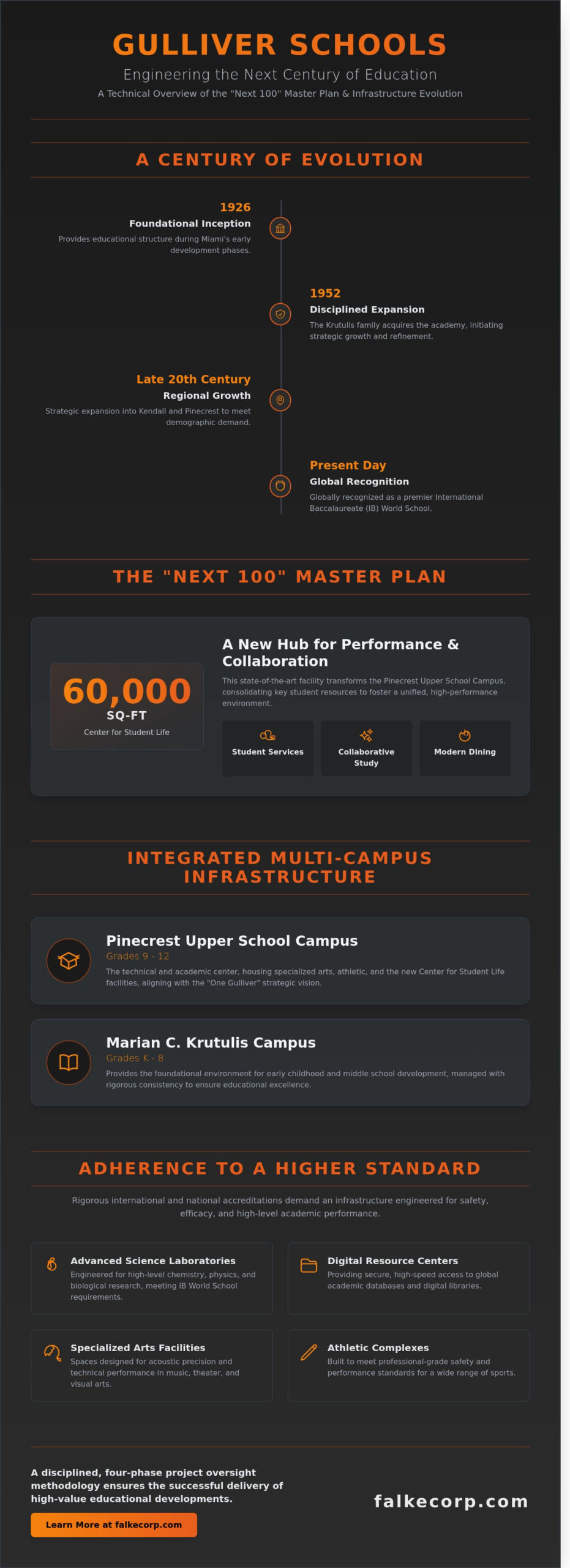
The institutional trajectory began in 1926, providing a foundational educational structure during Miami’s early development phases. A pivotal shift occurred in 1952 when the Krutulis family acquired the academy, initiating a period of disciplined expansion and academic refinement. During the latter half of the 20th century, the school strategically expanded into the Kendall and Pinecrest areas to accommodate the region’s demographic shifts. This growth was not merely internal; it mirrored the rapid urban development of modern Miami. By establishing Gulliver Preparatory School as a multi-campus system, the administration ensured that the infrastructure could scale alongside the city’s increasing demand for high-tier preparatory education.
Accreditations and Academic Framework
The transition to an IB World School status imposed rigorous technical requirements on the physical and pedagogical infrastructure. Adherence to these international standards necessitates advanced laboratory facilities, comprehensive digital libraries, and specialized collaborative spaces. The institution also maintains strict alignment with the standards set by the National Association of Independent Schools (NAIS), which dictates specific infrastructure benchmarks for safety and educational efficacy. These technical specifications contribute directly to the school’s A+ Niche ranking, where the physical environment is evaluated as a core component of student success. Key infrastructure elements include:
- Advanced Science Laboratories: Engineered for high-level chemistry and physics research.
- Digital Resource Centers: Providing students with access to global academic databases.
- Specialized Arts Facilities: Designed for acoustic precision and technical performance.
- Athletic Complexes: Built to meet professional-grade safety and performance standards.
The school’s commitment to these standards ensures a stable and high-quality environment for academic pursuit. This systematic approach to education allows gulliver schools to remain at the forefront of the independent school sector in Florida. By integrating professional-grade facilities with a structured curriculum, the school maintains its reputation for technical competence and academic reliability.
Examining the Multi-Campus Infrastructure of Gulliver Prep
Gulliver Prep functions through a decentralized yet integrated infrastructure model. The institution maintains operations across two primary geographic hubs in Miami-Dade County. This requires a rigorous facility management strategy to ensure consistency in educational delivery. The Marian C. Krutulis K-8 Campus provides the foundational environment for early childhood and middle school development. Meanwhile, the Upper School Campus serves as the technical and academic center for grades 9 through 12. Managing these diverse assets involves navigating the regulatory landscapes of different municipalities, which demands precise logistical coordination and a commitment to engineering excellence across all gulliver schools locations.
The Pinecrest Upper School Campus
Located at 6575 North Kendall Drive, the Upper School Campus functions as a specialized academic hub within a high-density residential zone. The facility layout prioritizes the integration of the Center for Student Life, a 60,000-square-foot facility designed to consolidate student services, dining, and collaborative study areas. This site also houses an extensive athletic complex and dedicated arts facilities. These physical upgrades align with the “One Gulliver” strategic vision, which seeks to unify disparate operations into a cohesive institutional identity. The architectural transition from traditional classrooms to open, collaborative spaces reflects a shift toward modern engineering standards in educational design, ensuring the campus remains a high-performance environment for high school students.
Marian C. Krutulis K-8 Campus Logistics
The K-8 campus infrastructure is engineered specifically for the safety and developmental needs of younger learners. It includes specialized preschool facilities that require strict adherence to building safety protocols and age-appropriate design. Managing traffic flow is a critical operational challenge, as the site sits within one of Miami’s most congested residential corridors. According to Miami-Dade County documents, the school’s master plan involves precise site feasibility studies to optimize urban expansion in Dade County. This data-driven approach ensures that new construction projects, such as the 2019 gymnasium and classroom additions, don’t compromise neighborhood stability.
Infrastructure planning for gulliver schools remains a continuous process of evaluation and refinement. Site administrators must balance the immediate needs of the student body with long-term maintenance cycles for HVAC systems, electrical grids, and digital networks. Professional oversight of such complex infrastructure projects ensures long-term operational viability and safety. The ability to maintain peak performance across multiple sites demonstrates a level of technical competence that is essential for modern educational institutions in South Florida.
The “Next 100” Master Plan: Transforming Educational Spaces
The Next 100 Campaign is a multi-phase capital project structured to consolidate the physical footprint of gulliver schools by 2026. This strategic initiative focuses on the modernization of institutional infrastructure through rigorous engineering standards and architectural efficiency. The centerpiece of this master plan is the 60,000-square-foot new Academic Building, which provides a centralized hub for advanced learning. This facility isn’t merely a classroom block; it’s a technically sophisticated environment designed with future-proof data integration and high-efficiency climate control systems.
Infrastructure upgrades prioritize environmental sustainability through LEED certification protocols, ensuring that the physical plant operates with minimal ecological impact. The school’s $50 million investment in these capital improvements significantly bolsters local Miami real estate values, as the presence of high-tier institutional assets typically drives appreciation in surrounding residential sectors. By 2026, the school’s facilities will reflect a cohesive, technologically advanced environment that supports both academic and operational excellence.
The New Academic and Athletic Centers
The development includes a state-of-the-art gymnasium and a precision-engineered aquatic center. These facilities are built to support the school’s championship-winning athletic programs by providing professional-grade training environments. Within the new building footprints, specialized STEAM labs provide the technical infrastructure required for robotics, engineering, and digital fabrication. These labs don’t just offer space; they provide the specialized power, ventilation, and data connectivity necessary for complex scientific inquiry. Such facilities are essential for maintaining the high standards of gulliver schools in national-merit academic competitions.
Campus Consolidation and Strategic Real Estate
A core component of the master plan involves moving all Upper School students to a unified Pinecrest location. This transition streamlines operational logistics and centralizes administrative resources. Managing student safety during active construction phases requires precise site management and phased execution to ensure educational continuity. The logic behind this consolidation is rooted in long-term asset management. A unified institutional footprint reduces maintenance overhead and optimizes the utilization of every square foot. This strategic move ensures that the school’s real estate portfolio remains a stable, high-value asset for decades to come.
Navigating Institutional Construction Challenges in Miami-Dade
Miami-Dade’s regulatory environment demands a methodical approach to institutional development. Expanding facilities for gulliver schools involves more than just architectural design; it requires a deep understanding of the Florida Building Code’s High-Velocity Hurricane Zone (HVHZ) requirements. These standards dictate specific structural reinforcements and impact-resistant glazing that must withstand wind speeds exceeding 175 mph. Engineering teams must integrate these safety mandates with environmental regulations that protect South Florida’s fragile ecosystem, particularly regarding stormwater management and canopy preservation.
The Permitting and Entitlement Process
Securing approvals in the City of Miami and Pinecrest involves a multi-layered matrix of agency reviews. The process begins with the Department of Regulatory and Economic Resources (DERM), where projects undergo scrutiny for groundwater protection and drainage efficiency. Coordination with the Water and Sewer Department (WASD) and the Fire Marshall ensures that life-safety systems and infrastructure capacity meet the increased density requirements of a modern campus. In Pinecrest, community relations play a decisive role; public hearings are a standard requirement where traffic impact studies and noise mitigation plans undergo rigorous review. Identifying these logistical hurdles early through Strategic Pre-Construction Services in Miami prevents the 6 to 12-month delays often associated with unforeseen site constraints or utility conflicts.
Risk Mitigation and Financial Oversight
Institutional projects require a 50-year building life-cycle perspective, making quality control during the shell and envelope phases paramount. Managing the gulliver schools infrastructure involves mitigating the financial risks of change orders, which can inflate budgets by 15% or more if the scope isn’t strictly defined. Flood zone requirements in Miami-Dade necessitate precise finish floor elevations and, in certain zones, hydrostatic venting to manage hydrostatic pressure during storm surges. Professional Construction Phase Management in Florida ensures that every phase, from the foundation pour to the final MEP (Mechanical, Electrical, and Plumbing) integration, meets the technical specifications required for long-term durability. This disciplined oversight protects the school’s capital and ensures that the facility remains operational immediately following extreme weather events.
Ensure your institutional project meets the highest engineering standards by partnering with experts who understand the Miami-Dade landscape. Contact FALKE Atlantic Corporation for professional project oversight.
Strategic Project Oversight for Miami’s Educational Sector
Institutional owners like gulliver schools manage complex capital improvements that require a level of technical oversight often exceeding the internal capacity of educational leadership. The construction process relies on a delicate architect-contractor-owner triad. Without a dedicated advocate, the owner often lacks the engineering depth to challenge contractor claims or architectural oversights. FALKE Atlantic Corporation addresses this gap by implementing a disciplined four-phase methodology. This systematic approach covers pre-construction, procurement, active construction, and project close-out, ensuring that high-value educational assets remain revenue-ready and structurally superior.
Maintaining financial control is critical when projects are funded through donor-driven capital campaigns. Transparency isn’t just a preference; it’s a fiduciary requirement. When a project experiences a 3% or 5% budget variance, it can jeopardize future fundraising efforts. A professional Owner’s Rep provides the rigorous auditing and reporting necessary to maintain donor trust. They ensure that every dollar spent contributes directly to the project’s quality and schedule. This level of scrutiny prevents the common pitfalls of institutional development, such as unapproved change orders or technical debt resulting from rushed finishes.
Why Owners Representation is Essential for Schools
School boards and administrators possess deep expertise in pedagogy, yet they often lack the technical vocabulary to manage a multi-phase construction site. FALKE Atlantic acts as the primary technical liaison, translating complex structural requirements into actionable business decisions. This oversight protects the institution against scope creep, which frequently occurs when vendors push for upgrades that don’t align with the school’s long-term master plan. By maintaining strict adherence to the initial project charter, an Owner’s Rep ensures the facility meets the exact needs of gulliver schools and its student body. You can learn more about these protective measures in our guide on Owner’s Representative Miami: Protecting Your Real Estate Assets.
FALKE Atlantic’s Approach to Miami Development
Success in South Florida requires deep familiarity with the specific building codes of Dade and Broward counties. FALKE Atlantic leverages local expertise to navigate permitting hurdles that often stall institutional projects for 60 to 90 days. Our management philosophy mirrors the precision required in luxury retail and high-end commercial builds. For example, the sophisticated management techniques applied to the Prada Design District project are the same standards we bring to luxury institutional builds. This ensures that the final asset is not only functional but also reflects the prestige of the institution. It’s about delivering a turnkey environment where students can thrive from day one. Protect your institutional investment with FALKE Atlantic’s Owner’s Representation services.
Elevating Institutional Development Standards in Miami-Dade
The evolution of gulliver schools under the “Next 100” Master Plan marks a pivotal era for Miami’s academic infrastructure. By consolidating operations and introducing facilities like the 60,000 square foot Center for Student Life, the institution sets a high bar for private school development. It’s a process that demands technical competence. Navigating the specific building codes of Pinecrest and Miami-Dade requires a level of professional oversight that ensures these complex projects remain fiscally responsible and logically structured.
Falke Corp provides the engineering reliability and discipline necessary to manage high-value institutional assets. Our team’s expertise in local permitting and Pinecrest building codes allows for seamless execution in challenging environments. We utilize a precise four-phase methodology designed to maintain total financial transparency and project stability. This structured approach protects your investment through every stage of construction. Consult with FALKE Atlantic for your Miami construction project management needs to ensure your next development meets the highest standards of quality and precision. We look forward to securing the future of your most ambitious projects.
Frequently Asked Questions
Where are the Gulliver Schools campuses located in Miami?
Gulliver Schools operates two primary campuses located in the Pinecrest and Kendall areas of Miami. The Marian C. Krutulis PK-8 Campus is situated at 12595 Red Road; meanwhile, the Upper School Prep Campus is located at 6575 North Kendall Drive. These strategic locations allow the institution to serve a broad demographic within the Miami-Dade region while maintaining specialized, high-tech facilities for different age groups and academic requirements.
What is the “Next 100” Campaign at Gulliver Prep?
The “Next 100” Campaign is a comprehensive capital initiative designed to modernize and unify the Gulliver Prep facilities into a single, cohesive campus. This strategic project involves the construction of a 60,000 square foot Center for Student Life and updated athletic facilities. It represents a long-term investment in the school’s physical infrastructure to support evolving pedagogical requirements for the next century of operation and academic excellence.
Is Gulliver Preparatory School an IB World School?
Gulliver Preparatory School is a fully authorized IB World School that’s offered the International Baccalaureate Diploma Programme since 1990. It was the first private school in Florida to receive this designation, providing a rigorous academic framework for students in grades 11 and 12. The program emphasizes critical thinking and global perspectives, aligning with the school’s commitment to high academic standards and comprehensive college readiness.
How does Gulliver Prep manage its ongoing construction projects?
Gulliver Prep manages its ongoing construction through a multi-phase master plan that prioritizes operational continuity and student safety. The administration utilizes professional project managers to oversee technical specifications and timeline adherence for developments like the new 60,000 square foot academic buildings. This structured approach ensures that complex engineering tasks and site logistics don’t disrupt the daily educational environment during the school’s transition to a unified campus.
What grades are offered at the Pinecrest and Kendall campuses?
The Marian C. Krutulis Campus in Pinecrest provides educational services for students from Pre-K3 through Grade 8. Following the completion of the middle school years, students transition to the Prep Campus on Kendall Drive, which serves Grades 9 through 12. This divisional structure allows for age-appropriate facilities and specialized academic programming tailored to the developmental needs of each specific cohort within the established school system.
What are the tuition costs for Gulliver Schools in 2026?
Official tuition rates for the 2026 academic year haven’t been released by the Gulliver Schools administration as of this publication date. Historically, the school publishes updated fee schedules during the preceding enrollment cycle to reflect operational costs and facility investments. Interested parties should consult the school’s financial office for the most current data regarding future enrollment periods and the specific costs associated with their academic programs.
How can an Owner’s Representative help with school construction in Miami?
An Owner’s Representative provides critical technical oversight and financial control during complex school construction projects in the Miami region. They act as a specialized liaison between the school board and contractors to ensure that engineering standards and local building codes are met without compromise. By managing procurement and site logistics, these professionals mitigate risks associated with delays and budget overruns in the high-stakes educational infrastructure sector.
What is the history of Gulliver Preparatory School?
Gulliver Preparatory School was established in 1926 by Arthur Gulliver in Coconut Grove before Marian Krutulis purchased the institution in 1952. Under her leadership, the school expanded from a small local facility into a multi-campus preparatory system with a global reputation. The school’s trajectory has been defined by steady growth and the integration of advanced academic programs, evolving from a single classroom setting to a premier educational institution.