
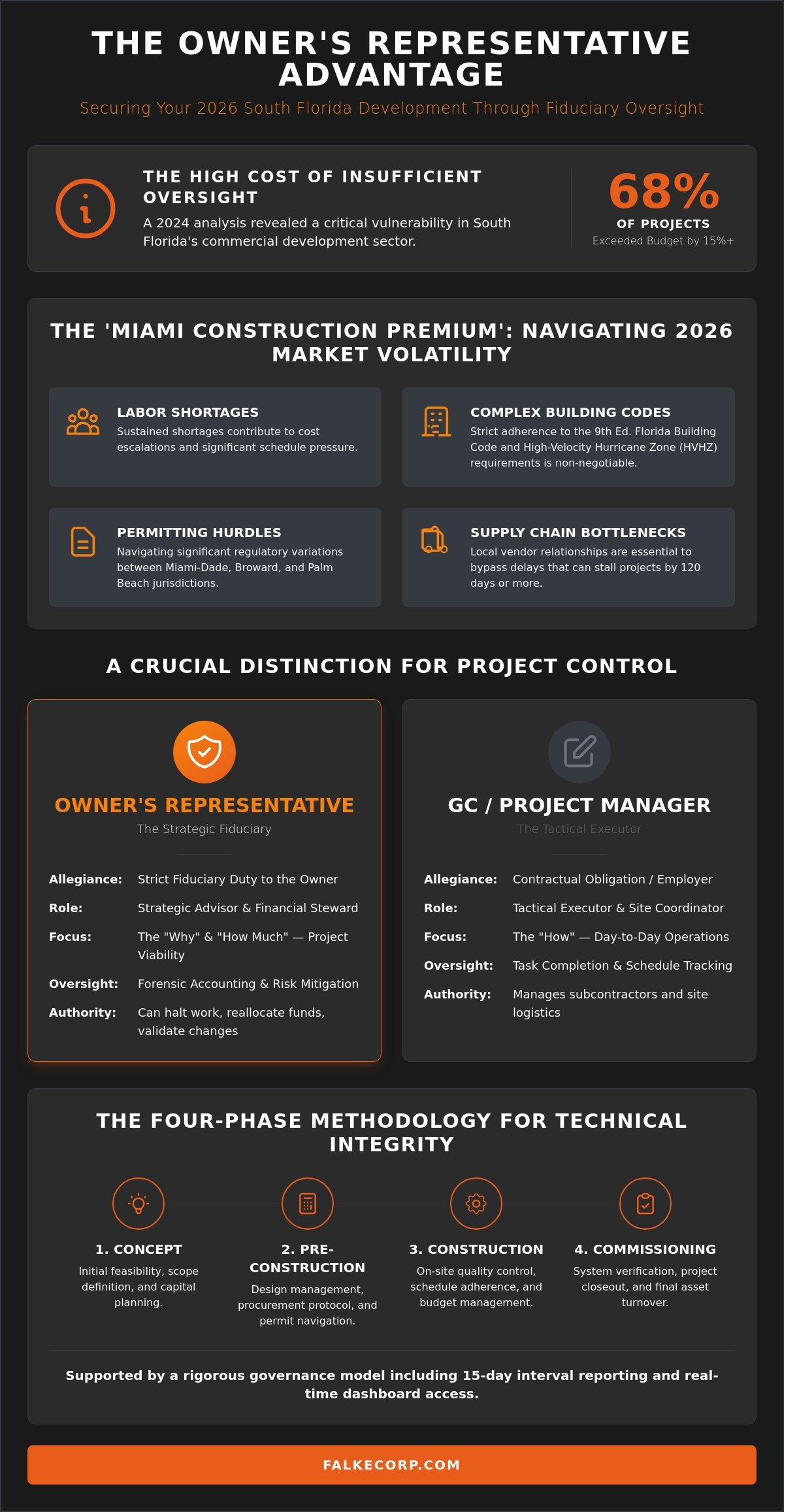
A 2024 analysis of South Florida commercial developments revealed that 68% of projects lacking independent oversight exceeded their initial budget by at least 15%. You likely recognize that the Miami construction landscape is increasingly volatile, where shifting labor costs and complex coastal building codes make financial transparency difficult to maintain. To secure your investment, you’ll need to select owner’s representative partners who possess the technical competence to manage these variables with engineering precision and objective oversight.
This guide provides a strategic 2026 framework to master the technical criteria and local nuances required to hire high-caliber representation. You’ll learn to mitigate Florida-specific construction risks while maintaining complete financial control through structured, data-driven oversight. We’ll examine a comprehensive checklist focused on procurement protocols, South Florida permitting expertise, and the rigorous reporting systems that ensure your asset is delivered on schedule and to your exact specifications.
Key Takeaways
- Analyze the specific 2026 South Florida market conditions that necessitate a fiduciary partner to oversee complex technical, financial, and legal project interests.
- Identify the critical four-phase engineering methodology and advanced cost-control mechanisms essential for maintaining rigorous project discipline.
- Execute a structured five-step framework to select owner’s representative firms with proven experience navigating the unique regulatory landscapes of Miami and Fort Lauderdale.
- Evaluate the strategic advantages of boutique local expertise versus global firms to ensure your development receives senior-level technical oversight.
- Discover how an engineering-led approach to project management mitigates high-stakes risks such as hurricane resiliency and South Florida building code compliance.
The Strategic Necessity to Select an Owner’s Representative in Miami (2026)
To select owner’s representative services in the 2026 South Florida market is to secure a fiduciary partner who operates as the owner’s primary technical, financial, and legal advocate. This selection process establishes a rigorous framework for project oversight, moving beyond simple coordination to a state of total project advocacy. While a General Contractor (GC) is contractually bound to deliver a physical structure, their primary loyalty remains tied to their own profit margins and internal resource management. In contrast, an Owner’s Representative (OR) holds a strict fiduciary duty to the client. This means every decision, from the validation of a change order to the optimization of a procurement cycle, is made solely to protect the owner’s capital and long-term interests.
The 2026 landscape in Miami-Dade and Broward counties presents a unique set of challenges characterized by sustained labor shortages and the full implementation of post-2024 structural safety legislative updates. Without specialized oversight, developers frequently encounter the ‘Miami construction premium.’ This phenomenon often results in unmanaged projects experiencing cost escalations of 15% to 22% due to inefficient sequencing and predatory pricing in a high-demand environment. A strategic selection prevents this fiscal slippage by implementing technical audits and cost-control protocols long before the first shovel hits the ground.
Navigating the Complexity of South Florida Developments
Development in Miami requires a granular understanding of the specific permitting hurdles that vary significantly between Miami-Dade and Broward jurisdictions. The 2026 regulatory environment demands strict adherence to updated sea-level rise mitigation strategies and the 9th Edition of the Florida Building Code. Success depends on deep-rooted local vendor relationships in Palm Beach and Ft. Lauderdale. These connections allow the project team to bypass supply chain bottlenecks that can delay South Florida projects by 120 days or more. Technical competence in these regional nuances is a non-negotiable prerequisite when you select owner’s representative partners for high-stakes developments.
Owner’s Representative vs. Project Manager: A Crucial Distinction
Distinguishing between these roles is essential for maintaining project control. A Project Manager typically functions as a tactical executor, focusing on day-to-day site operations and specific task completion. The Owner’s Representative operates as a strategic advisor who maintains ultimate authority over the master budget and the overarching schedule. While the PM manages the “how” of construction, the OR manages the “why” and the “how much.” This distinction ensures that the owner isn’t merely reacting to field issues but is proactively steering the project’s financial trajectory. For a deeper analysis of these roles, consult The Owner’s Representative in Miami: Navigating South Florida Construction with Precision.
- Scope of Authority: The OR possesses the power to halt work or reallocate funds based on fiduciary analysis.
- Financial Oversight: Detailed forensic accounting of all project expenditures versus tactical budget tracking.
- Risk Mitigation: Identifying legal and technical liabilities before they manifest as schedule delays.
Comparing firms fairly starts with the document you send them, and our guide to what belongs in an owner’s representative RFP covers how to define scope, staffing and fee format so the proposals come back comparable.
Core Technical Competencies to Evaluate During the Selection Process
When you select owner’s representative partners in the 2026 Miami market, the evaluation must prioritize a disciplined, four-phase methodology. This structured framework ensures that the project’s technical integrity remains intact from the initial concept through to final commissioning. A firm’s ability to navigate South Florida’s complex regulatory environment, particularly the stringent high-velocity hurricane zone (HVHZ) requirements, is non-negotiable. Technical competence isn’t a secondary trait; it’s the primary safeguard for your capital investment.
Phase-Based Methodology and Governance
A sophisticated representative operates through a rigorous lifecycle: Concept, Pre-construction, Construction, and Commissioning. The governance model must include 15-day interval reporting and real-time dashboard access for the owner. Effective oversight begins with Strategic Pre-Construction Services in Miami: The Owner’s Guide to Risk Mitigation, where site feasibility and engineering constraints are identified before the first shovel hits the ground. In 2026, this process relies on AI-driven forecasting tools that analyze historical data from over 450 regional projects to predict supply chain disruptions with 93% accuracy. The firm must prove its expertise in specific South Florida asset classes, such as high-density retail or ultra-luxury residential towers, where the engineering tolerances are exceptionally narrow. Final commissioning procedures should be exhaustive, ensuring that all mechanical, electrical, and plumbing (MEP) systems are fully optimized and revenue-ready upon handover.
Financial Control and Transparency Standards
Advanced financial literacy is the cornerstone of risk management. To select owner’s representative firms that truly protect your interests, you must audit their process for change order management and budget reconciliation. The representative’s role is to act as a technical auditor who scrutinizes every line item against the original engineering specifications. This level of oversight involves:
- Implementing “open-book” reporting standards that provide 100% visibility into project ledger entries.
- Managing third-party vendor contracts to eliminate hidden markups, which often saves owners between 7% and 11% on procurement costs.
- Utilizing blockchain-based smart contracts or similar 2026-standard software to automate payment milestones and ensure lien waivers are secured.
- Conducting monthly budget reconciliations that compare actual expenditures against the 30-60-90 day cash flow projections.
This systematic approach to financial transparency prevents the budget creep common in Miami’s high-stakes construction environment. If you require a partner who treats your project budget with engineering-grade precision, you can review our technical advisory services to see how we maintain fiscal discipline across complex builds. The goal is a project delivered on time, within the precise financial parameters established during the feasibility stage.
Comparing Selection Models: Boutique Local Expertise vs. Global Firms
Choosing the right partner requires a rigorous technical audit of their operational structure. When developers select owner’s representative services in Miami, they often weigh the expansive reach of global firms against the concentrated technical focus of boutique agencies. Global entities offer a vast repository of templates and historical data from diverse markets. The primary risk involves the delegation of critical decision-making to junior-level associates who lack the field experience necessary for high-stakes South Florida projects. Large firms often prioritize brand recognition over the granular technical oversight required on-site.
Boutique firms operate with a different structural logic. They provide direct, consistent access to senior principals who manage the engineering and logistical intricacies of the project personally. In high-density regions like the Miami Design District, where architectural precision is non-negotiable, this senior-level oversight ensures that technical standards remain uncompromised. It’s a matter of technical alignment. A boutique firm’s reputation is tied to individual project success, which drives a level of accountability that global corporations often struggle to replicate at the local level.
The Value of Localized Knowledge in South Florida
Technical efficiency in Miami depends on navigating the specific regulatory frameworks of Dade County. Local representatives maintain established professional relationships with municipal inspectors. These connections can reduce permit approval cycles by 15% to 20%. Understanding the specific soil conditions and wind-load requirements in North Bay Village Construction: The Owner’s Guide to Navigating Complex Developments in 2026 is a prerequisite for effective risk mitigation. A representative with deep local roots has already vetted the regional sub-contractor pool, ensuring that only firms with proven reliability in the Florida climate are engaged. They don’t just know the code; they know the people who enforce it.
Fee Structures and Value-Add Analysis
By 2026, the industry has shifted toward fixed monthly retainers to ensure objective oversight and fiscal transparency. When you select owner’s representative partners, you must analyze how their fee structure impacts their loyalty. Percentage-based fees often create misaligned incentives, as the representative’s compensation increases alongside project costs. This is a fundamental conflict of interest.
- Standard 2026 ROI: A high-performing representative should generate a return on investment that offsets their fee by at least 3 to 5 times through hard cost savings.
- Fixed Retainers: These provide budget predictability and ensure the representative focuses on cost reduction rather than budget expansion.
- Red Flags: Be cautious of contracts where the representative receives a commission on change orders. This structure undermines their role in cost control and schedule optimization.
A professional representative acts as a technical buffer. Their value is measured in the hard costs they prevent through proactive sub-contractor management and rigorous schedule discipline. They should provide a clear audit trail for every dollar spent, ensuring that the owner’s capital is protected from the inefficiencies common in complex urban developments.
The 5-Step Selection Framework for Florida Construction Projects
To select owner’s representative partners who can successfully navigate the complexities of South Florida’s regulatory and environmental landscape, developers must adopt a rigorous, engineering-led methodology. The 2026 construction market in Miami demands a level of technical oversight that exceeds traditional project management. This five-step framework ensures that your representative possesses the analytical depth required to protect your capital investment.
- Step 1: Define technical constraints. Establish specific project parameters, including adherence to the 8th Edition of the Florida Building Code and High Velocity Hurricane Zone (HVHZ) resiliency targets.
- Step 2: Shortlist regional specialists. Filter firms based on a proven record within the Miami-Dade and Broward County corridor, focusing on those who’ve managed high-rise or coastal developments within the last five years.
- Step 3: Execute scenario-based interviews. Move beyond credentials to evaluate real-time problem-solving. Focus on “Project Rescue” scenarios where structural or budgetary deviations occurred.
- Step 4: Audit the 2026 technology stack. Ensure the firm utilizes advanced BIM integration, AI-driven scheduling analytics, and real-time telemetry for site monitoring to maintain data transparency.
- Step 5: Conduct rigorous reference audits. Contact past Florida-based clients to verify the representative’s ability to mitigate liquidated damages and manage complex change order negotiations.
The Technical Interview: Questions that Reveal Competence
The interview process must probe the candidate’s analytical capabilities through evidence-based questioning. Ask for documented instances where their value engineering protocols reduced mechanical, electrical, and plumbing (MEP) costs by at least 10% without compromising system longevity. Inquire about their specific strategy for managing a General Contractor who’s fallen 15% behind the critical path. A competent representative won’t offer vague platitudes; they’ll describe resource leveling and logic-tie adjustments. Require a detailed explanation of their crisis management protocols for weather delays, specifically how they document force majeure events to protect the owner from unwarranted claims.
Vetting the Team: Who is Actually Managing Your Project?
Project success depends on the specific individual assigned to the job site, not the firm’s executive leadership. It’s essential to verify that the lead representative holds recognized credentials such as a Professional Engineer (PE) license, a Project Management Professional (PMP) certification, or a Certified Construction Manager (CCM) designation. Confirm that the professional present during the interview is the same person who’ll attend weekly OAC (Owner, Architect, Contractor) meetings. Assess their communication for sobriety and precision. You require a representative who speaks the language of engineering and law, providing objective reports that prioritize technical accuracy over optimistic projections. If the cultural fit doesn’t align with your need for disciplined oversight, the partnership will likely fail during high-pressure phases of the build.
Why FALKE Atlantic is the Logical Selection for South Florida Developments
Miami’s construction environment requires more than just administrative oversight. FALKE Atlantic integrates engineering discipline into the project management lifecycle. Developers who select owner’s representative services from us gain access to a team that understands the structural nuances of South Florida’s unique limestone geology and coastal wind requirements. We maintain deep operational roots in Dade, Broward, and Palm Beach counties. This local presence ensures 100% compliance with evolving 2026 Florida Building Codes and the stringent Miami-Dade Notice of Acceptance (NOA) standards for high-velocity hurricane zones.
Our firm protects high-net-worth and corporate interests by acting as a technical shield. We don’t just report on progress; we audit the engineering integrity and financial validity of every contractor claim. In a market where cost overruns frequently exceed 15%, our disciplined approach keeps projects within the original scope. We utilize advanced 2026 reporting systems that provide real-time financial clarity. This technology allows owners to see live updates on budget burn rates and procurement timelines, eliminating the information lag that often leads to project delays.
The FALKE Atlantic Methodology: Precision in Execution
Our 4-phase system mitigates risk by applying technical scrutiny to every milestone from concept to commissioning. During the pre-construction phase, we focus on aggressive cost-control and value engineering. In a recent case study involving a 150,000-square-foot residential asset in Brickell, our oversight identified a 12% discrepancy in structural steel specifications. This correction saved the client $450,000 before the first pier was poured. We ensure that every technical detail aligns with the owner’s long-term ROI. You can read more about our specific strategies for Residential Construction Owner’s Rep in Miami: Protecting Your South Florida Investment.
Securing Your Investment in the 2026 Market
The complexity of the current market demands a boutique approach. FALKE Atlantic limits its project load to ensure senior-level oversight for every client. When you select owner’s representative partners, you deserve the attention of experienced engineers, not junior associates. This structure guarantees that every decision rests on a foundation of technical competence and professional accountability. We bridge the gap between complex industrial processes and executive-level decision-making.
To begin your project with a foundation of engineering excellence, Consult with FALKE Atlantic for your next Miami development. Our engagement process starts with a comprehensive audit of your existing project plans and a risk assessment of your current contractor agreements. We provide the stability and precision required to deliver South Florida’s most ambitious developments on time and under budget.
Securing Technical Excellence in the 2026 South Florida Market
The evolution of the South Florida construction market through 2026 necessitates a shift from traditional management to high-precision technical advocacy. The preceding analysis demonstrates how a structured 5-step framework and a focus on core technical competencies can eliminate the systemic inefficiencies that often plague large-scale developments. When you select owner’s representative for your next Miami-Dade or Broward county project, the priority remains the integration of engineering reliability with local site realities. FALKE Atlantic delivers this through a disciplined four-phase methodology, ensuring that senior-level oversight isn’t just a promise but a constant presence on every project site.
It’s a level of professional rigor that treats construction as a complex industrial process requiring absolute precision. By choosing a partner with deep roots in Florida’s regulatory environment, you’re investing in a stable foundation that withstands the complexities of modern urban development. This strategic alignment ensures that South Florida developments achieve the highest professional standards from inception to completion. Secure your project’s future with FALKE Atlantic’s expert representation.
Frequently Asked Questions
What is the typical cost of selecting an owner’s representative in Miami?
The cost of professional representation typically ranges from 1.5% to 4% of the total construction value based on industry benchmarks from the Construction Management Association of America. This fee structure fluctuates depending on the technical complexity of the Miami development and the specific level of oversight required during the 2026 calendar year. You’ll find that fixed-fee arrangements are also prevalent for defined pre-construction phases to ensure absolute budget predictability.
Can an owner’s representative help with Miami-Dade building permits?
An owner’s representative facilitates the Miami-Dade building permit process by coordinating with municipal expediters and managing the e-Plan digital submission system. They ensure that all technical documentation complies with the Florida Building Code’s 8th Edition requirements. By conducting thorough pre-submittal reviews, they reduce the probability of “Requests for Information” that frequently delay South Florida projects by 30 to 60 days.
How early in the project should I select an owner’s representative?
You should select an owner’s representative during the conceptual or pre-design phase to maximize their influence on budget optimization and site feasibility. Engaging a consultant at this stage allows for a rigorous value engineering process before the 100% construction documents are finalized. Early involvement ensures that the project’s technical requirements align perfectly with the initial financial constraints and the owner’s long-term operational goals.
Is an owner’s representative necessary for a high-end residential renovation in Palm Beach?
Professional representation is essential for high-end residential renovations in Palm Beach, particularly for projects exceeding a $2 million valuation. These coastal developments must adhere to strict “Coastal Construction Control Line” regulations and specific local zoning ordinances. A representative manages the intricate logistics of luxury finishes and specialized subcontractors, ensuring the architectural intent is realized without compromising structural integrity or local compliance.
What is the difference between an owner’s rep and a construction manager?
The primary difference is that an owner’s representative acts as the owner’s fiduciary advocate across all project phases, while a construction manager focuses on site execution and subcontractor coordination. When you select an owner’s representative, you’re hiring a professional to oversee the entire lifecycle, including the performance of the construction manager. This hierarchical structure ensures that technical decisions prioritize the owner’s interests rather than short-term site convenience.
How do I verify the local experience of a Miami owner’s representative?
Verify local experience by requesting a portfolio of completed projects within Miami-Dade County that have successfully obtained Certificates of Occupancy within the last 24 months. You should also cross-reference their professional credentials with the Florida Department of Business and Professional Regulation to confirm active licensure. A qualified representative will provide specific case studies demonstrating their ability to navigate the unique geological and regulatory challenges of the South Florida environment.
Will an owner’s representative replace my architect or general contractor?
An owner’s representative doesn’t replace the architect or general contractor but instead functions as the central point of integration for these technical teams. They manage the contractual obligations of all parties to ensure that the project adheres to the established technical specifications and the master timeline. This oversight prevents communication silos and ensures that the engineering requirements of the owner are consistently met throughout the construction process.
What happens if I select an owner’s representative after construction has already started?
Selecting a representative after construction has commenced shifts their primary role to project recovery and forensic auditing of the existing progress. They’ll immediately conduct a comprehensive gap analysis of the current schedule and budget to identify deviations from the original project plan. While late integration is less efficient than early involvement, it’s necessary for stabilizing projects that are experiencing a 15% or greater cost overrun.