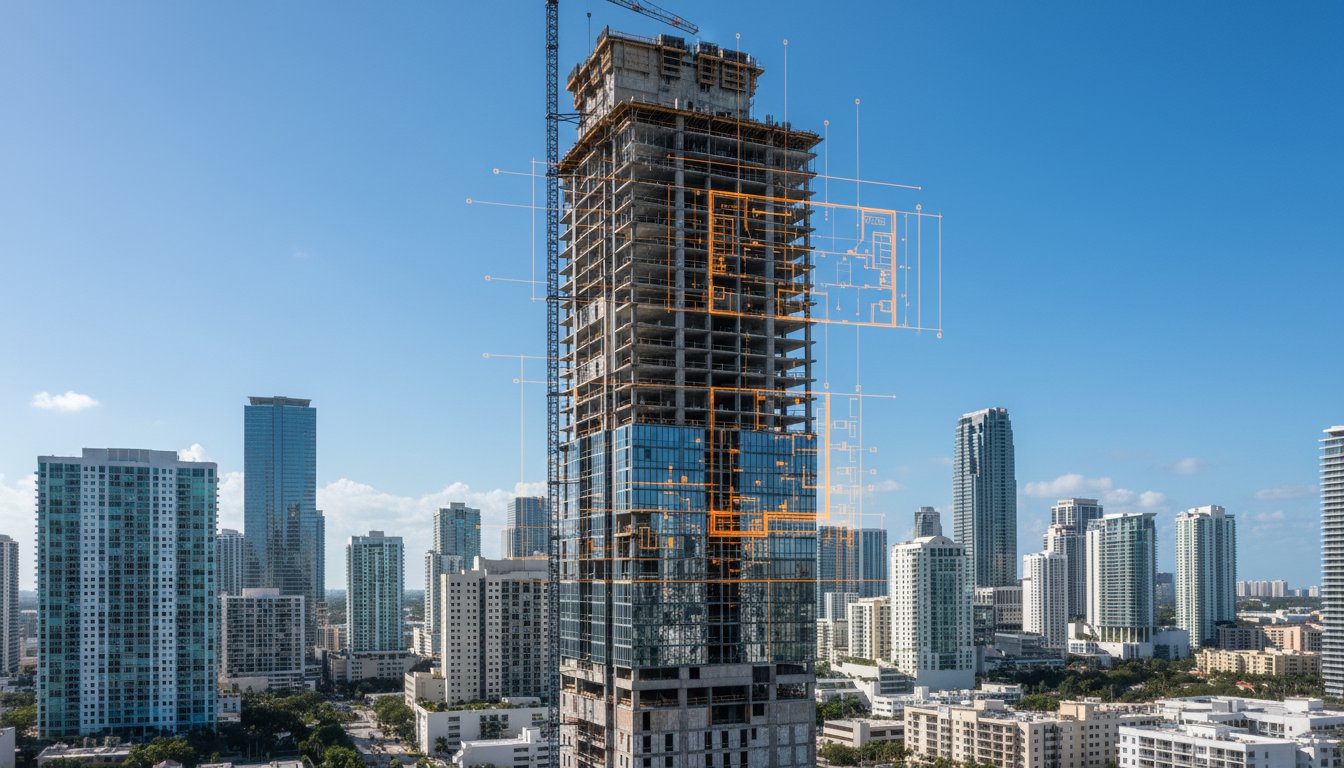
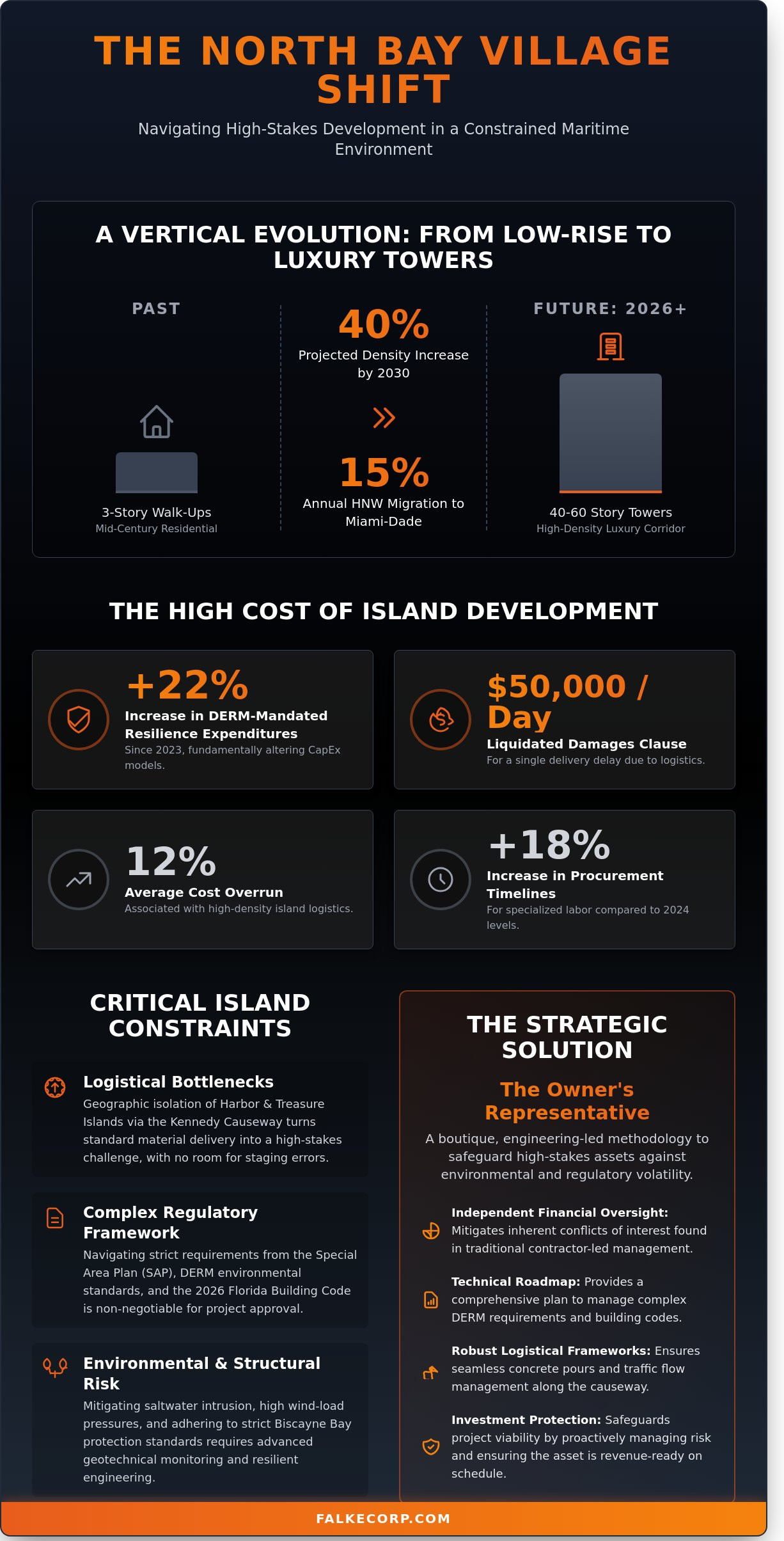
A 22% increase in DERM-mandated resilience expenditures since 2023 has fundamentally altered the capital expenditure models for waterfront developments. You’re likely aware that the geographic isolation of the Kennedy Causeway transforms standard logistics into a high-stakes engineering challenge where a single delivery delay can trigger a $50,000 daily liquidated damages clause. Managing North Bay Village construction requires more than just a general contractor; it demands a precise understanding of the 2026 Florida Building Code and the specific density allowances within the Special Area Plan (SAP) zoning framework.
We provide the technical roadmap required to maintain transparent project oversight while mitigating the risks inherent in these constrained maritime environments. You’ll gain a comprehensive understanding of how to manage complex DERM requirements and streamline logistics on the 79th Street Corridor to ensure your asset is revenue-ready on schedule. This analysis explores the integration of resilient structural engineering with the latest regulatory mandates to protect your investment’s long-term viability.
Key Takeaways
- Understand how the Special Area Plan (SAP) facilitates the transition from low-rise structures to 40-story luxury towers, fundamentally altering project density and height permissions.
- Navigate the technical complexities of North Bay Village construction by aligning development strategies with the latest Florida Building Code updates and DERM environmental standards.
- Evaluate the critical necessity of an Owner’s Representative to provide independent financial oversight and mitigate the inherent conflict of interest found in traditional contractor-led management.
- Develop robust logistical frameworks to manage the unique constraints of Harbor and Treasure Islands, ensuring seamless concrete pours and traffic flow along the Kennedy Causeway.
- Implement a boutique, engineering-led methodology to safeguard high-stakes hospitality and retail assets against the environmental and regulatory volatility of the South Florida market.
The Landscape of North Bay Village Construction in 2026
The structural evolution of North Bay Village, Florida represents a calculated shift from mid-century low-rise residential zoning to a high-density, vertical luxury corridor. This transition, formalized through the 2020 Special Area Plan (SAP), allows developers to achieve height and density metrics that were previously impossible on these three islands. By 2026, the local skyline is defined by 40 to 60-story towers, a massive departure from the three-story walk-ups that characterized the area for decades. This surge in North Bay Village construction isn’t merely a trend; it’s a response to the 15% annual increase in high-net-worth migration to Miami-Dade County recorded since 2021. Managing these projects requires a technical precision that differs from mainland developments, primarily because of the logistical constraints of the John F. Kennedy Causeway and the specific environmental protocols governing Biscayne Bay. Owners can’t rely on standard mainland staging strategies when every cubic yard of concrete must cross a single transit artery.
The 2026 Development Pipeline
Current data indicates that 8000 East Drive serves as the anchor for this new era. This 4.12-acre redevelopment project, designed by Arquitectonica, integrates 600 luxury units across towers reaching heights of 550 feet. These Tier-1 architectural interventions demand a rigorous engineering approach to mitigate wind-load pressures and saltwater intrusion. The local infrastructure, originally calibrated for a population of 8,000, now must accommodate a projected density increase of 40% by 2030. This reality necessitates complex utility upgrades and specialized foundation work that must be synchronized with the Village’s master plan. The concentration of high-rise permits on Harbor Island alone has created a competitive environment for specialized labor, driving up procurement timelines by an average of 18% compared to 2024 levels.
Economic Implications for Owners
The SAP framework mandates that owners provide specific public benefits, such as waterfront promenades or transit improvements, in exchange for increased Floor Area Ratio (FAR). Balancing these requirements against a target ROI requires a deep understanding of the 2026 cost-per-square-foot metrics, which have risen 22% since 2023. At heights exceeding 500 feet, structural risk profiles shift significantly. Professional oversight is mandatory to manage the 12% average cost overrun associated with high-density island logistics. In this environment, staging areas are limited and delivery schedules are dictated by bridge traffic and marine weather conditions. Technical competence in North Bay Village construction means more than just following a blueprint; it involves managing the intersection of private investment and public infrastructure requirements without compromising the project’s financial stability.
Success in this specific geography depends on a management approach that prioritizes stability and technical reliability. The complexity of building on a 4.12-acre island site, surrounded by protected waters, leaves no room for the trial-and-error methods often seen in less regulated markets. Owners must account for:
- Strict adherence to the SAP public benefit agreements to avoid costly permitting delays or litigation.
- Advanced geotechnical monitoring to ensure foundation stability in high-density waterfront clusters.
- Logistical synchronization of material deliveries to minimize the impact on the Causeway’s limited capacity.
- Environmental mitigation strategies that meet the stringent 2026 Biscayne Bay protection standards.
The role of the Owner’s Rep has evolved from a simple project monitor to a strategic partner who understands these engineering and economic nuances. As the Village continues its vertical ascent, the margin for error shrinks. Only a structured, logical approach to project management can ensure that these 40-story luxury towers deliver the promised value to their stakeholders while meeting the rigorous demands of the North Bay Village regulatory environment.
Navigating the Regulatory Framework: SAPs, DERM, and Building Codes
North Bay Village construction projects demand a granular understanding of the Special Area Plan (SAP) to unlock maximum asset value. A Special Area Plan is a regulatory zoning instrument that grants developers flexibility in density and height requirements in exchange for delivering specific public benefits to the municipality. This isn’t a simple trade; it’s a technical negotiation where the developer aligns their commercial objectives with the village’s master plan. By utilizing an SAP, you can negotiate unified site plans that consolidate multiple smaller parcels into a single, cohesive development footprint. This strategic consolidation allows for the efficient distribution of square footage, often resulting in a 15% to 20% increase in usable floor area compared to standard zoning constraints.
The SAP Process as a Strategic Tool
The success of an SAP hinges on the ability to demonstrate tangible community improvements, such as the expansion of the 1.5-mile waterfront promenade or the integration of advanced transit infrastructure. Owners must provide detailed architectural renderings and impact studies that justify the requested deviations from the base code. Negotiating these plans requires a representative who understands how to balance the cost of public benefits against the long-term ROI of increased density. It’s a process of technical precision where every square foot of public space provided must be leveraged to secure maximum vertical potential.
Permitting and Environmental Oversight
Compliance with the Florida Building Code 8th Edition, which became effective on December 31, 2023, is a fundamental requirement for all current projects. This update introduced more stringent wind load requirements and energy efficiency standards that directly impact structural engineering costs. We’re already looking toward the 2026 updates, which will likely focus on increased flood mitigation and sea-level rise resilience for coastal municipalities. Managing these transitions requires a forward-thinking approach to engineering and design.
Permitting for waterfront properties involves multiple layers of county and municipal jurisdiction. Miami-Dade County’s Department of Environmental Resources Management (DERM) oversees the critical aspects of paving, drainage, and seawall integrity. Every square foot of non-permeable surface undergoes intense scrutiny. If a project exceeds the allowable permeability coefficient, developers face mandatory redesigns or significant mitigation fees. Managing these technical submissions requires a deep familiarity with Class VI permits for drainage and Class I permits for any work involving the shoreline or seawall restoration. A complete permit package must include certified plot plans, drainage calculations, and environmental impact assessments to avoid the typical 60-day delay associated with incomplete submissions.
North Bay Village also enforces strict operational constraints that impact the project timeline and budget. Construction hours are limited to 8:00 AM through 6:00 PM on weekdays and 10:00 AM through 4:00 PM on Saturdays. Violations aren’t taken lightly; fines start at $250 for the first offense and escalate to $500 or more for subsequent infractions, often accompanied by immediate work stoppages. Furthermore, any North Bay Village construction project exceeding three stories must hire off-duty police officers for traffic control during heavy equipment movement or material deliveries. This is a fixed operational cost that must be integrated into the initial pro forma to prevent budget overruns during the vertical phase of construction.
The complexity of these regulatory layers demands a partner with deep technical competence. FALKE Atlantic Corporation’s engineering-first approach ensures that every permit package meets the exact specifications of the Building and Zoning Department on the first submission. This level of precision is essential for maintaining the project’s critical path and ensuring that environmental and municipal requirements don’t become bottlenecks for development.
The Strategic Role of an Owner’s Representative in NBV
The Florida construction market distinguishes the Owner’s Representative from a project manager through the lens of fiduciary duty. While a project manager often operates within the hierarchy of a general contracting firm or an architectural practice, an Owner’s Rep functions as an external auditor. This distinction is critical in North Bay Village construction, where the 2023 Miami-Dade building code updates have increased the technical complexity of high-rise foundations. A General Contractor cannot provide independent financial oversight because their profit margins often rely on the execution of change orders. Data from the 2022 Construction Management Association of America report indicates that projects lacking independent oversight experience 12% higher costs due to scope creep. An Owner’s Rep mitigates this risk by validating every line item against the original contract documents.
Technical coordination involves managing a diverse array of third-party vendors. In a typical high-rise development, the Rep oversees architects, MEP engineers, and LEED consultants simultaneously. Since North Bay Village incentivizes sustainable building through its Green Building ordinance, the Rep ensures the project hits the 40-point Silver certification threshold. Failing to meet these specific environmental benchmarks can result in municipal penalties exceeding $100,000. By centralizing communication, the Rep prevents the “silo effect” where design intent and mechanical requirements conflict; this proactive stance saves time during the critical path of the build.
Owner’s Rep vs. General Contractor
Independence remains the primary asset of an Owner’s Rep. They report exclusively to the developer; this ensures that technical decisions aren’t compromised by the build team’s internal profit motives. Financial control involves a rigorous audit of pay applications and lien waivers. For a $50 million high-rise, a 10% retainer management strategy protects the owner’s liquidity while ensuring subcontractors remain motivated. Quality assurance bridges the gap between the architect’s 3D models and field execution. The Rep verifies that the 5,000 PSI concrete specified in the structural drawings is exactly what arrives on the pump truck, preventing future structural liabilities.
The Four-Phase Methodology
The methodology begins with Concept and Feasibility. This involves analyzing the North Bay Village Unified Land Development Code to maximize floor area ratios and density bonuses. Pre-Construction follows; here, the Rep manages the bidding process across 4 to 6 vetted contractors to ensure competitive pricing. It’s during this phase that cost control is most effective. During the Construction Phase, the Rep utilizes Critical Path Method (CPM) scheduling to track daily progress. A 48-hour delay in vertical forming can cost $20,000 in labor overhead. Finally, Commissioning and Close-out ensure all 150+ life-safety permits are closed before the asset generates revenue.
Fraud mitigation requires a granular approach to documentation. In high-density environments, “ghost” change orders for sub-surface conditions are common. An Owner’s Rep demands geotechnical proof and site photos before approving a $50,000 contingency spend. They act as the technical buffer, ensuring that every dollar spent on North Bay Village construction translates directly into equity. This level of oversight isn’t a luxury; it’s a structural requirement for any developer aiming to deliver a project on time and within the original 2024 budget projections.
Managing Risk: Environmental Resilience and Island Logistics
North Bay Village construction presents a unique set of engineering and logistical challenges that mainland projects rarely encounter. Because the Village consists of Harbor Island, North Bay Island, and Treasure Island, every piece of heavy equipment and every cubic yard of concrete must traverse the John F. Kennedy Causeway. This 1.3-mile stretch of State Road 934 serves as the sole artery for over 8,000 residents and commuters daily. Managing a 400-cubic-yard concrete pour for a 43-story residential tower requires a level of precision that goes beyond standard site supervision. It involves a calculated synchronization of transit mixers to avoid bottlenecking at the 79th Street Bridge or the West Treasure Drive intersection. An Owner’s Rep ensures that the General Contractor’s Maintenance of Traffic (MOT) plan isn’t just a permit requirement, but a functional strategy that prevents costly idling fees and municipal fines.
The technical complexity of these projects is compounded by the limited physical footprint of the islands. Staging areas are virtually non-existent, meaning logistical failures result in immediate work stoppages. We analyze the contractor’s procurement schedule to ensure that vertical construction doesn’t outpace the arrival of critical components, such as custom-fabricated curtain wall systems or high-efficiency HVAC units. In an environment where salt spray and humidity accelerate equipment degradation, the timing of installation is as important as the quality of the components themselves. Our oversight ensures that materials aren’t left exposed to the elements, preserving the structural integrity of the build from day one.
Logistics and Site Access
The 1666 Kennedy Causeway corridor offers zero margin for error regarding staging. With site footprints often occupying 90% of the lot, there’s no room for on-site material storage. Deliveries must arrive “just-in-time,” a process that requires constant communication with the Village’s Public Works Department. High-wind protocols are equally critical. In a waterfront environment where gusts frequently exceed 20 knots, crane operations must be monitored against real-time anemometer data to ensure the safety of the surrounding high-density residential units. We manage these risks by implementing the following protocols:
- Strict Delivery Windows: Scheduling heavy arrivals outside of the 7:00 AM to 9:00 AM peak traffic hours to maintain community relations.
- Off-Site Marshalling: Coordinating with mainland staging areas to queue trucks, ensuring only one vehicle occupies the limited site entrance at a time.
- Anemometer Integration: Automating crane lockdowns when wind speeds hit predetermined safety thresholds to prevent catastrophic failures.
Resilience and Sustainability Standards
The Village’s 2023 Stormwater Master Plan necessitates a seamless integration between private drainage systems and municipal infrastructure. New developments must often elevate seawalls to 5.0 feet NAVD88 or higher to combat projected sea-level rise through 2050. An Owner’s Rep verifies that these elevations are met with surgical precision, preventing future flood insurance surcharges. We also monitor the transition between private property lines and ADA-compliant sidewalk improvements to ensure the finished product meets the North Bay Village Resilience Update mandates. This level of oversight protects the asset against substandard work that leads to long-term safety issues, such as structural spalling or foundation erosion due to improper drainage. Proper execution of these environmental standards is a prerequisite for project longevity in South Florida’s volatile climate.
For expert oversight that ensures your project meets these rigorous technical standards, consider how our comprehensive construction management services can secure your investment.
Partnering with FALKE Atlantic for North Bay Village Projects
FALKE Atlantic Corporation applies a boutique methodology specifically engineered for the high-stakes environment of South Florida’s luxury and commercial sectors. Our firm avoids the generalized approach of larger consultancies; we focus on a limited portfolio of complex developments to ensure every technical detail receives expert scrutiny. For North Bay Village construction, the logistical challenges of island-based development require a heightened level of coordination. We provide disciplined oversight that translates into total transparency for the owner. Our role is to maintain the project’s financial stability by implementing rigorous cost-control measures and verifying every line item against the established budget. We protect the owner’s interests by acting as a technical shield, ensuring that the final structure reflects the intended quality and functionality from the first day of site preparation to the final handover.
Our Local Expertise
Technical proficiency in Miami-Dade County requires more than just a passing familiarity with building codes; it demands a deep understanding of the specific municipal nuances that govern North Bay Village. FALKE Atlantic’s experience includes managing high-complexity retail assets, such as the Prada flagship store in the Miami Design District. This project demanded 100% precision in material application and structural integration. We bring this same level of engineering-led focus to every site. As the owner’s eyes and ears, we monitor the 12 to 18 distinct trades typically present on a high-end job site. Our team interprets complex architectural plans and ensures that field execution matches the engineering specifications exactly, preventing costly re-work. We navigate the specific North Bay Village construction requirements regarding coastal resiliency and flood elevation with a data-driven approach that minimizes regulatory friction.
Securing Your Investment
Operational risk in construction often stems from fragmented communication and inadequate vendor oversight. We mitigate these risks through a structured management system that prioritizes accountability at every tier. Our firm manages the procurement process with surgical precision, ensuring that all vendors meet the 100% compliance standards required for insurance and bonding. By adhering to a strictly monitored 24-month or 36-month timeline, we protect the project’s internal rate of return and prevent the 15% to 20% budget inflation common in unmanaged projects. We don’t offer vague promises of success; we deliver measurable results through technical competence and unwavering attention to detail. This disciplined oversight extends to hospitality assets where operational readiness is critical for a timely opening. To stabilize your next development and secure your capital, you can schedule a consultation with FALKE Atlantic Corporation today.
Mastering the 2026 North Bay Village Development Cycle
Success in the shifting landscape of North Bay Village construction depends on an owner’s ability to integrate technical precision with rigorous regulatory compliance. As 2026 approaches, the complexity of SAP and DERM protocols requires a disciplined framework to ensure projects stay on schedule. FALKE Atlantic utilizes a structured four-phase project management methodology to oversee every detail, from environmental resilience planning to the final delivery of high-end hospitality and retail assets. By leveraging our proven track record in Miami-Dade regulatory navigation, we eliminate the technical ambiguity that often stalls island developments. It’s essential to have a partner who understands that island logistics require specific engineering solutions rather than generic management. We manage these intricate site constraints with a focus on stability and long-term quality. Our team’s expertise in specialized commercial sectors ensures your project meets the highest professional standards. We’re ready to bring this level of engineering reliability to your next venture. Consult with FALKE Atlantic on your North Bay Village project to secure a path toward a successful project delivery.
Frequently Asked Questions
What is the role of an Owner’s Representative in North Bay Village construction?
An Owner’s Representative serves as the principal technical fiduciary, overseeing every phase of North Bay Village construction to ensure adherence to engineering specifications and budget constraints. They manage the critical interface between the developer, architects, and general contractors. This role involves rigorous schedule auditing and change order validation. By providing independent oversight, they prevent cost overruns that typically average 12% to 15% on unmanaged South Florida high-rise projects.
How does the Special Area Plan (SAP) affect building height in North Bay Village?
The North Bay Village Special Area Plan, updated in 2020, permits building heights to reach 240 feet in the T6-24 zone and up to 340 feet in the T6-30 zone through public benefit bonuses. These regulations replaced the previous restrictive zoning to encourage vertical density on the 525-acre island chain. Developers must provide specific community benefits, such as workforce housing or baywalk improvements, to access these maximum height allowances for their projects.
What are the current Florida Building Code requirements for Miami-Dade high-rises?
High-rises must comply with the 8th Edition (2023) Florida Building Code, which mandates High Velocity Hurricane Zone (HVHZ) standards for all structures in Miami-Dade County. This requires glass and glazing systems to withstand wind speeds of 175 mph and large missile impacts. Structural designs must also incorporate the latest ASCE 7-22 standards for wind load calculations. These technical requirements ensure the building’s integrity during extreme weather events common to the Atlantic coast.
Do I need an Owner’s Rep if I already have a Project Manager?
You need an Owner’s Rep because their scope extends beyond the Project Manager’s daily site execution to focus on the owner’s long-term financial and strategic goals. While a Project Manager employed by the contractor focuses on delivery logistics, the Owner’s Rep audits those very processes for efficiency and compliance. They provide an objective layer of technical scrutiny. This separation of duties is vital for projects exceeding $10 million to ensure no conflict of interest exists.
How are construction logistics managed on Harbor and Treasure Islands?
Managing North Bay Village construction logistics requires coordinating access via the 79th Street Causeway, which handles approximately 30,000 vehicles daily. Since this is the only access point for Harbor and Treasure Islands, contractors must schedule heavy equipment deliveries during off-peak windows to avoid traffic penalties. Staging areas are extremely limited on these islands. Precise scheduling of concrete pours and crane operations is mandatory to maintain the project timeline without disrupting the local residential flow.
What are the allowable construction hours in North Bay Village?
Permissible construction hours in North Bay Village are 8:00 AM to 6:30 PM on weekdays and 10:00 AM to 4:00 PM on Saturdays. Code Section 99.04 strictly prohibits work on Sundays and federal holidays unless the Building Official grants a specific variance for emergency repairs. Noise levels shouldn’t exceed 65 decibels at the property line. Adhering to these windows prevents costly municipal fines and maintains positive relations with the surrounding community residents.
How does DERM review impact waterfront construction permitting?
DERM review is a mandatory prerequisite for waterfront construction to ensure compliance with Chapter 24 of the Miami-Dade County Code regarding coastal protection. This process involves evaluating the impact on the Biscayne Bay Aquatic Preserve, including turbidity control and manatee protection protocols. Approval typically takes 90 to 120 days depending on the project’s complexity. Construction can’t proceed until the Class I permit for work in tidal waters is officially issued by the county.
What is the typical fee structure for development management services?
Development management services typically utilize a fee structure ranging from 3% to 5% of the total construction cost. For larger projects, a fixed monthly retainer based on the anticipated 24 to 36-month duration is often more transparent for the developer’s cash flow. These fees cover comprehensive services from pre-construction bidding to final close-out. Investing in this professional oversight usually results in a 10% reduction in overall project waste through better resource allocation.