
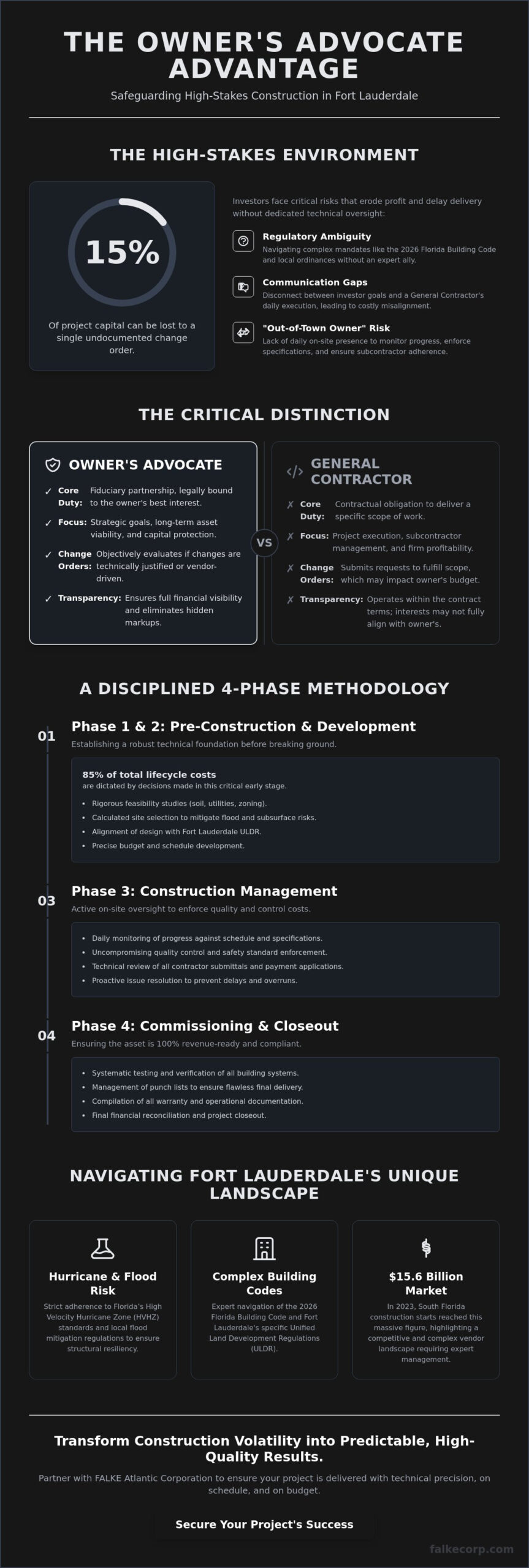
In the high-stakes environment of South Florida real estate, a single undocumented change order can erode up to 15% of a project’s total capital before the first certificate of occupancy is even filed. You likely recognize that managing a large-scale development in Broward County requires more than just a signed contract; it demands constant vigilance over technical specifications and local mandates that often shift mid-cycle. As an investor, you’ve likely felt the friction of communication gaps with general contractors or the anxiety of navigating a complex regulatory landscape without a dedicated technical ally. This is where the specialized role of an owner’s advocate for construction projects Fort Lauderdale becomes an essential component of your risk management strategy.
This article demonstrates how a professional representative employs a disciplined, engineering-led methodology to enforce full financial transparency and ensure your asset adheres strictly to the 2026 Florida Building Code. By integrating technical oversight with rigorous cost control, we eliminate the ambiguity that leads to budget overruns and project stagnation. You’ll discover the specific protocols used to bridge the gap between your strategic investment goals and the general contractor’s daily execution, ensuring your asset is revenue-ready and delivered precisely on schedule. We’ll examine the structural frameworks that transform construction volatility into predictable, high-quality results.
Key Takeaways
- Understand how a professional owner’s advocate for construction projects Fort Lauderdale acts as a fiduciary partner to safeguard your capital and distinguish your interests from those of general contractors.
- Learn to establish a robust technical foundation during the pre-construction phase through disciplined feasibility studies and precise site selection within Broward County.
- Discover the rigorous oversight protocols required to maintain uncompromising quality control and safety standards during active construction and final commissioning.
- Navigate the specific complexities of the Florida Building Code and local environmental regulations to ensure structural resiliency against regional hurricane and flood risks.
- Explore a structured, four-phase methodology that provides the technical competence and high-level attention necessary for managing complex, large-scale developments.
The Role of an Owner’s Advocate in Fort Lauderdale’s Construction Landscape
The construction environment in South Florida, particularly within the high-density corridors of Fort Lauderdale, presents a level of technical complexity that demands more than traditional project management. An owner’s advocate for construction projects Fort Lauderdale functions as a fiduciary partner, a role distinct from the vendors and contractors who execute the physical work. While a General Contractor focuses on the direct delivery of the structure, the advocate prioritizes the owner’s financial and strategic interests throughout the project lifecycle. This distinction is critical in a market where 2023 construction starts in South Florida reached approximately $15.6 billion, involving sophisticated coastal engineering and stringent municipal codes.
The advocate mitigates the “out-of-town owner” risk that’s prevalent in South Florida real estate. Investors based in different geographic regions frequently lack the local presence required to monitor daily progress on sites along the New River or the beach. Professional oversight ensures that local subcontractors adhere to the specific engineering requirements dictated by Florida’s High Velocity Hurricane Zone (HVHZ) standards. This level of oversight aligns with the rigorous standards of Construction management, where the representative ensures that every technical decision serves the long-term viability of the asset.
Fiduciary Duty vs. Contractual Execution
A General Contractor operates under a contractual obligation to deliver a scope of work within a specific budget; however, their primary loyalty is to their own firm’s profitability. In contrast, an owner’s advocate maintains a fiduciary duty to the client. This means they’re legally and ethically bound to act in the owner’s best interest. When a contractor submits a change order for a foundation adjustment, the advocate doesn’t simply pass it through. They apply objective expertise to evaluate whether the request is technically justified or a result of poor initial planning by the vendor. The advocate serves as the owner’s technical eyes and ears on-site.
The Value Proposition for High-Net-Worth and Corporate Clients
For hospitality and retail developments in Fort Lauderdale, maintaining brand standards is paramount. Corporate clients can’t afford deviations from architectural specifications that define their global identity. A professional advocate ensures that every finish and structural element meets these exacting benchmarks. This process relies on professional fee structures that foster financial transparency, removing the hidden markups often found in traditional turnkey arrangements. For those seeking a broader understanding of regional requirements, our guide on Construction Project Management Florida provides additional strategic context. This structured approach allows high-net-worth individuals to deploy capital with the confidence that their owner’s advocate for construction projects Fort Lauderdale is prioritizing stability and quality over vendor convenience.
Phase 1 & 2: Pre-Construction and Development Management
The conceptual phase of a high-stakes development in Broward County dictates approximately 85% of the total lifecycle costs. A professional owner’s advocate for construction projects Fort Lauderdale ensures that the technical foundation is established with engineering precision long before the first shovel hits the ground. This involvement begins with rigorous feasibility studies that examine soil composition, utility capacity, and the specific constraints of the Fort Lauderdale Unified Land Development Regulations (ULDR). Site selection isn’t merely a logistical choice; it’s a calculated risk management exercise where an advocate evaluates subsurface conditions and historical flooding data to prevent unforeseen remediation costs that often plague coastal projects.
Navigating the entitlement process requires a methodical approach to the preliminary permitting strategy. The advocate coordinates directly with the City of Fort Lauderdale’s Development Review Committee (DRC) to streamline approvals and ensure compliance with local ordinances. This proactive engagement reduces the likelihood of costly design revisions during the later stages of development. By maintaining a firm grip on the technical requirements of the Florida Building Code, the advocate protects the project’s structural and financial integrity from the outset.
Strategic Team Assembly and Vetting
Selecting the right partners requires more than reviewing aesthetic portfolios. It demands a technical audit of vendor capabilities and historical performance. An advocate manages the Request for Proposal (RFP) process by establishing objective criteria for architects, structural engineers, and MEP specialists. This ensures that every bid is transparent and comparable across all technical metrics. For developers expanding their footprint across South Florida, utilizing Strategic Pre-Construction Services in Miami provides a proven template for mitigating risks through high-level technical vetting. Competitive bidding under professional oversight prevents the entry of unqualified vendors who rely on change orders to achieve profitability.
Budget and Schedule Validation
A primary failure point in commercial construction is the passive acceptance of contractor cost assumptions. An advocate performs a line-by-line validation of the budget to identify “red flags” such as mobilization timelines that ignore South Florida’s hurricane season or unrealistic lead times for specialized electrical components. Value engineering is applied not as a simple cost-cutting measure, but as a method to optimize design intent through technical innovation. By identifying alternative materials or structural systems that offer identical performance at lower price points, the advocate preserves capital without sacrificing quality. If you’re initiating a complex project, engaging with Falke Corp’s technical advisors during the planning stage provides the stability required for sophisticated industrial or commercial developments.
Phase 3 & 4: Construction Phase Management and Commissioning
The construction phase in South Florida demands a presence that prioritizes engineering integrity over contractor convenience. When a project moves into active execution, the owner’s advocate for construction projects Fort Lauderdale acts as the technical filter through which all field activity passes. This oversight isn’t merely observational; it’s a rigorous application of quality control protocols designed to identify deviations before they become embedded structural or financial liabilities. Falke Corp maintains a disciplined site presence to ensure that every cubic yard of concrete and every linear foot of conduit aligns with the approved engineering specifications.
Effective management during this stage focuses on the mitigation of risk through data-driven reporting. We don’t rely on verbal assurances from general contractors. Instead, we verify progress through physical inspections and technical documentation. This structured approach ensures that the capital invested is protected against substandard workmanship or unauthorized material substitutions that could compromise the building’s 50-year lifecycle.
Technical Oversight and Field Reports
Site inspections occur on a disciplined schedule, typically involving daily logs and weekly comprehensive technical reviews. These reports document labor force counts, equipment utilization, and adherence to the critical path schedule. Managing the change order process remains a primary defensive task for an owner’s advocate for construction projects Fort Lauderdale. Without a structured approval workflow, scope creep can easily inflate budgets by 12% to 18% during the mid-stages of a build. We analyze every change request against the original contract documents to determine if the cost is justified or if it results from a contractor’s oversight. For a deeper technical breakdown of these workflows, consult the Owner’s Guide to Construction Phase Management.
Commissioning and Revenue Readiness
The final 10% of a project often determines its long-term operational success. Commissioning involves the systematic verification of every building component under load. HVAC systems, electrical distribution grids, and life-safety protocols must perform to the exact parameters defined in the design phase. We manage the punch-list with a zero-tolerance policy for incomplete items, ensuring that 100% completion is reached before final retainage is released. This phase is critical for transitioning the site from a construction zone to a revenue-generating asset. The close-out process includes several non-negotiable steps:
- Finalizing all municipal permits and securing the permanent Certificate of Occupancy.
- Transferring comprehensive warranty documentation and digital O&M manuals to the facility team.
- Verifying that all final lien waivers are executed to protect the owner’s title from future claims.
- Conducting systems training for onsite staff to ensure immediate operational efficiency.
This methodical transition ensures the asset is ready for its intended commercial or residential use without the lingering “day-two” issues that often plague poorly managed handovers. We treat the commissioning phase as a bridge to profitability, where technical precision meets business readiness.
Fort Lauderdale Specifics: Navigating Local Regulations and Risks
Fort Lauderdale’s construction landscape requires more than general project management; it demands a deep understanding of the 8th Edition (2023) and upcoming 2026 Florida Building Code revisions. An owner’s advocate for construction projects Fort Lauderdale acts as the technical bridge between architectural intent and municipal reality. Within Broward County, projects must adhere to rigorous flood zone management protocols and environmental protections that govern the delicate balance of the Atlantic coastal ridge. These regulations aren’t merely administrative hurdles. They’re structural imperatives that define the long-term viability of your capital investment.
Managing high-density developments in districts like Las Olas introduces operational friction that can derail a budget. Noise ordinances and restricted staging areas require a logistical strategy that prevents stop-work orders or costly neighbor disputes. Waterfront properties face even tighter constraints. Marine construction involves complex permitting through the U.S. Army Corps of Engineers and the Florida Department of Environmental Protection, where technical precision in the initial filing determines the project’s momentum.
Permitting Strategy in the City of Fort Lauderdale
The City of Fort Lauderdale Building Department has signaled a shift toward mandatory digital BIM integration for 2026 submissions. Technical accuracy in these models reduces review cycles by approximately 30%. The advocate coordinates with Florida Power & Light and local water utilities to ensure infrastructure capacity exists before the first shovel hits the ground. This proactive coordination prevents the common 6-month delays associated with utility easements and transformer placement.
Climate Risk and Resilience
Project schedules must account for the 122-day peak of the Atlantic hurricane season. During this window, mobilization costs can spike due to emergency securing procedures. Sea-level rise mitigation now dictates finished floor elevations that often exceed previous benchmarks by 12 to 24 inches. The 2026 Florida Building Code will mandate enhanced wind-load pressure ratings for all coastal glazing systems, directly impacting procurement lead times and structural design requirements.
Retaining a qualified owner’s advocate for construction projects Fort Lauderdale provides the technical oversight necessary to verify that subcontractors implement these resiliency standards without compromising the budget. It’s about ensuring that every engineering decision serves the owner’s interest rather than the contractor’s convenience. Precision at this stage eliminates the need for expensive retrofitting in the future.
Ensure your project meets the highest standards of technical compliance by partnering with a professional owner’s advocate at Falke Corp.
FALKE Atlantic: A Disciplined Approach to Owner Representation
FALKE Atlantic operates with a technical rigor that transcends standard project management. Our firm functions as a specialized owner’s advocate for construction projects Fort Lauderdale, prioritizing engineering precision over generalist coordination. We understand that capital protection in the South Florida market requires more than just oversight; it demands a proactive defense against technical errors and budget drift. By maintaining a boutique consultancy structure, we ensure that every complex development receives high-level attention from senior engineers who possess the authority to make critical decisions in real time. This approach eliminates the communication gaps often found in larger, more diluted firms.
The FALKE Methodology: A Strategic Advantage
Our four-phase methodology provides a structured framework for project success. It begins with rigorous pre-construction feasibility audits and extends through design, execution, and final commissioning. This engineering-led mindset differs from standard management by focusing on the underlying technical integrity of the build. We implement strict transparency protocols and financial controls to eliminate hidden costs or unauthorized change orders. Our experience includes protecting interests in high-stakes hospitality and retail developments where schedule delays can result in significant revenue loss. For projects requiring regional expertise beyond Broward County, our Owner’s Representative Miami Services offer the same level of asset protection across the South Florida corridor.
Our technical audits frequently reveal discrepancies that others overlook. In a recent retail redevelopment, our engineers identified a 12% variance in material specifications that would’ve compromised the building’s long-term structural durability. By addressing these issues during the design phase, we prevent the compounding costs of mid-construction corrections. Our commitment to transparency ensures that owners have a clear view of their capital allocation at every stage.
- Phase 1: Technical feasibility, risk identification, and budget validation.
- Phase 2: Procurement strategy, design coordination, and contract negotiation.
- Phase 3: Active site oversight, quality assurance, and schedule management.
- Phase 4: Systematic close-out, punch-list resolution, and asset handover.
Next Steps for Your Project
Initiating a partnership with FALKE Atlantic begins with a comprehensive technical assessment. We don’t offer generic solutions. Instead, our team conducts an initial consultation to define your specific project goals and risk profiles. We establish a fee structure that aligns directly with owner success, ensuring our incentives are tied to the delivery of a high-quality, cost-efficient project. If your development requires a disciplined owner’s advocate for construction projects Fort Lauderdale, we invite you to contact us for a professional evaluation. We’ll analyze your current project status and provide a roadmap for safeguarding your capital through every remaining phase of the construction lifecycle.
Maximizing Project Stability Through Technical Oversight
Success in South Florida’s high-density development sector depends on a rigorous commitment to engineering-led oversight and data-driven decision-making. It’s not enough to monitor progress; stakeholders must employ a disciplined four-phase methodology that integrates technical expertise into every stage of the development lifecycle. This structured approach mitigates the risks associated with Fort Lauderdale’s specific regulatory environment and environmental constraints. By securing an owner’s advocate for construction projects Fort Lauderdale, developers gain a partner capable of maintaining capital integrity through precise technical engineering and commissioning standards. This level of professional representation ensures that complex industrial and residential projects move from pre-construction to final delivery without compromising on quality or structural stability. It’s the most effective way to safeguard your investment against the volatility of the modern construction landscape. We look forward to establishing a partnership that prioritizes technical excellence and long-term asset performance.
Contact FALKE Atlantic Corporation for a professional consultation on your Fort Lauderdale project.
Frequently Asked Questions
What is the difference between an owner’s representative and a project manager in Florida?
An owner’s representative serves as a fiduciary advocate for the client, while a project manager typically focuses on the tactical execution of the general contractor’s scope. In Florida, this distinction is critical because the representative oversees the entire project lifecycle, including site selection and financial auditing. They ensure the technical requirements of the Florida Building Code are met without the conflict of interest inherent in managing the labor force directly.
How does an owner’s advocate save money on a construction project?
An owner’s advocate for construction projects Fort Lauderdale reduces costs by identifying technical inefficiencies during the value engineering phase. Industry data suggests that professional advocacy can reduce change order expenses by 15% to 20% through rigorous contract review and schedule optimization. This systematic approach prevents budget overruns before the first concrete pour occurs on the job site.
Does a Fort Lauderdale project require a local owner’s representative?
Local expertise is essential in Fort Lauderdale because projects must comply with High Velocity Hurricane Zone (HVHZ) requirements and specific Broward County drainage regulations. A representative familiar with the 2023 Florida Building Code, 8th Edition, navigates these technical hurdles more efficiently than an out-of-state consultant. This proximity allows for immediate site inspections and direct coordination with municipal reviewers when technical anomalies arise during the structural phase.
When is the best time to hire an owner’s advocate for a new development?
The optimal time to engage an owner’s advocate is during the conceptual or pre-design phase, ideally before the architect is selected. Research from the Construction Industry Institute indicates that 80% of a project’s final cost is determined during the first 20% of the timeline. Early involvement ensures that the project’s technical specifications align with the budget from the start, preventing expensive redesigns later in the development cycle.
Can an owner’s representative help with Broward County permitting issues?
An owner’s representative streamlines the Broward County permitting process by managing the ePermits portal and coordinating with municipal reviewers. They track the status of environmental, structural, and electrical permits to ensure the 30-day review cycles don’t stall the construction schedule. By verifying that all technical documentation meets the 2024 Broward County Administrative Code, they eliminate common filing errors that cause 45% of permit rejections.
How are owner’s representation fees typically structured in 2026?
In 2026, owner’s representation fees are structured as either a fixed monthly retainer or a percentage of the total construction value, typically ranging from 3% to 6%. Some firms utilize a cost-plus model for high-complexity industrial projects where technical oversight is more intensive. These structures provide transparency and align the advocate’s incentives with the project’s financial stability and technical integrity.
What industries in Fort Lauderdale benefit most from owner representation?
The hospitality and maritime sectors in Fort Lauderdale see the highest return on investment from specialized owner representation. With a 12% increase in luxury hotel developments projected for 2026, these complex projects require rigorous technical oversight to manage intricate MEP systems and coastal environmental regulations. Industrial facilities along the Port Everglades corridor also benefit from this engineering-focused management to ensure operational continuity during expansion.