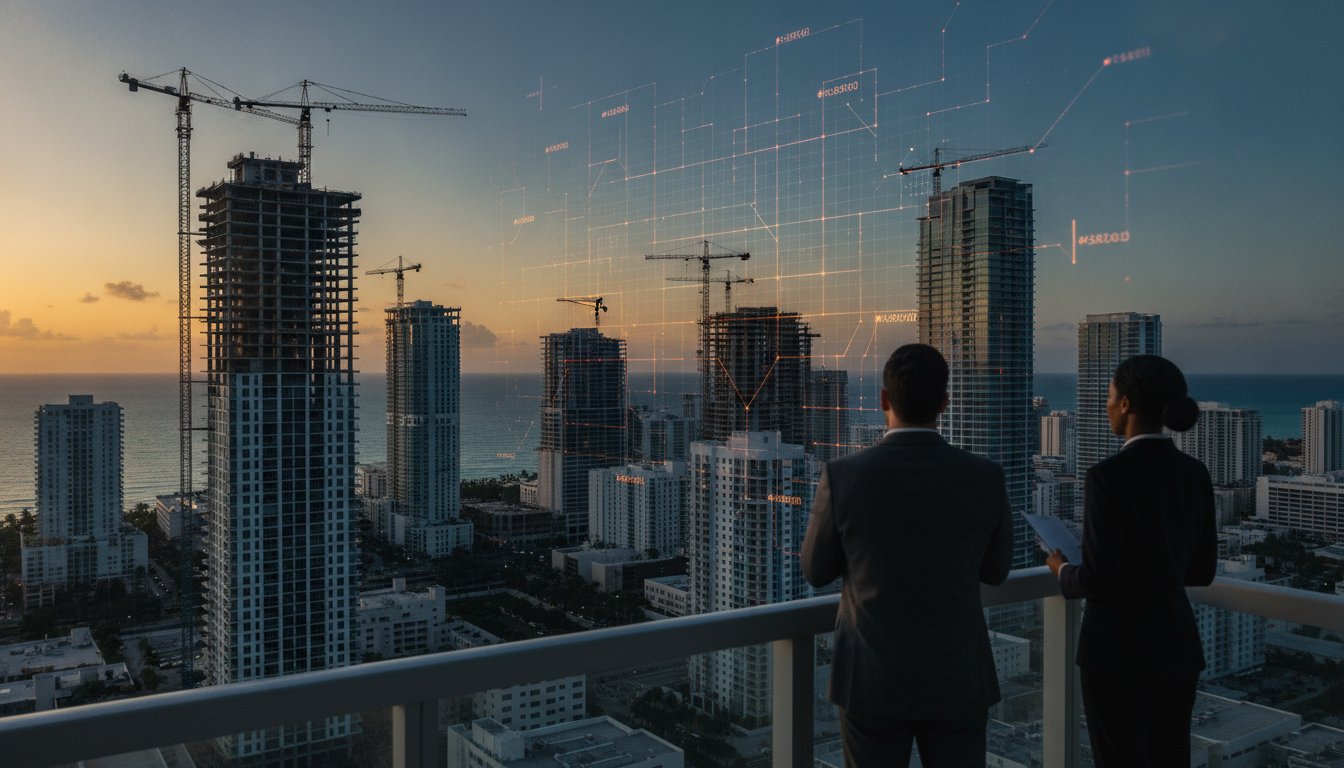
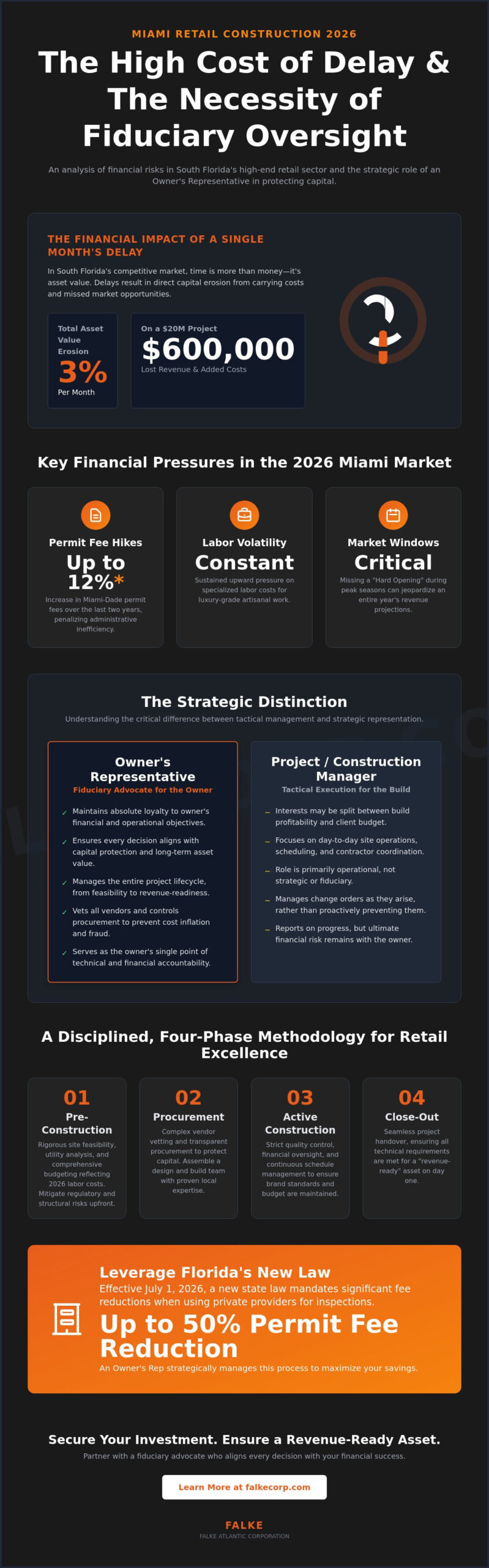
A single month of project delay on a high-end retail asset in South Florida results in a 3% erosion of total asset value when accounting for carrying costs and missed market opportunities. In 2026, with Miami-Dade permit fees having increased by up to 12% over the last two years, the financial penalty for administrative inefficiency is higher than ever. You’ve likely seen how unpredictable permitting timelines and cost overruns in luxury finishes can derail a project’s viability. Engaging a specialized owner’s rep for retail construction projects in Miami is no longer a luxury; it’s a technical necessity for protecting your capital and ensuring brand standards remain uncompromised.
This strategic guide details how professional representation ensures a seamless project handover through strict financial control and rigorous technical oversight. You’ll discover how to leverage the new Florida law effective July 1, 2026, which mandates permit fee reductions of up to 50% when using private providers for inspections. We provide a structured analysis of vendor transparency and the specific engineering-grade expertise required to mitigate Miami’s unique construction risks, ensuring your asset is revenue-ready on schedule.
Key Takeaways
- Identify the technical necessity of a fiduciary advocate to maintain financial stability amid Miami’s 2026 retail market volatility.
- Examine how a specialized owner’s rep for retail construction projects in Miami coordinates complex procurement and vendor vetting to protect your capital investment.
- Distinguish between tactical project management and strategic owner representation to ensure every construction decision serves your specific brand standards.
- Navigate the distinct regulatory requirements of the City of Miami and Miami Beach, including specialized protocols for DERM compliance.
- Implement a disciplined, four-phase methodology to mitigate pre-construction risks and secure a predictable path to a revenue-ready asset.
The Strategic Necessity of an Owner’s Rep for Retail in Miami (2026)
An owner’s representative functions as a fiduciary advocate, maintaining absolute loyalty to the stakeholder’s financial and operational objectives throughout the project lifecycle. Unlike traditional construction management where interests might be split between the build’s profitability and the client’s budget, the rep ensures every technical decision aligns with the owner’s capital protection. In the 2026 Miami market, where administrative permit fees have surged by 12% and labor volatility remains a constant variable, engaging a specialized owner’s rep for retail construction projects in Miami is the only mechanism to prevent systemic budget erosion. This role isn’t merely advisory; it’s a technical safeguard for complex assets.
A retail asset is not merely a completed structure; it’s a “revenue-ready” machine. Every day of delay doesn’t just incur carrying costs. It results in lost sales velocity and market irrelevance. Current data indicates that a single month of delay in South Florida can erode 3% of the total asset value. For a $20 million boutique build-out, that represents a $600,000 loss before the first transaction occurs. The owner’s rep bridges the gap between uncompromising luxury brand standards and the practical realities of local construction, ensuring that the final delivery matches the architectural intent without exceeding the financial envelope.
Retail vs. General Commercial: Why the Stakes are Higher
High-end retail requires a level of precision that standard commercial projects don’t demand. Specialized lighting systems, custom millwork, and high-performance glass must meet Florida’s stringent building codes without sacrificing the international brand’s aesthetic. Missing a “Hard Opening” date during Miami’s peak seasonal shopping windows, such as the winter luxury season, can jeopardize an entire year’s revenue projections. A dedicated owner’s rep for retail construction projects in Miami manages these international requirements within the local regulatory framework, preventing the technical friction that typically causes delays.
Protecting Capital in a High-Cost Construction Market
Projects in Miami-Dade and Broward counties often harbor hidden costs in the form of municipal impact fees and utility connection delays. An owner’s rep prevents common change order fraud, a frequent issue in luxury build-outs where contractors might inflate the cost of premium materials or specialized labor. By implementing rigorous financial controls and technical vetting of all local vendors, the rep maximizes ROI. They provide the technical oversight necessary to ensure that every dollar spent contributes directly to the asset’s quality and long-term stability.
Core Responsibilities: How an Owner’s Rep Manages the Retail Lifecycle
The lifecycle of a high-end retail asset requires a methodical transition from conceptual design to operational readiness. An owner’s rep for retail construction projects in Miami provides the technical continuity required to maintain project integrity across four distinct phases: pre-construction, procurement, active construction, and close-out. This structured approach ensures that the engineering requirements of the brand aren’t sacrificed to local logistical constraints. The representative doesn’t just monitor progress; they engineer the workflow to prevent the friction that typically leads to budget inflation.
Pre-Construction and Strategic Planning
Technical success begins with a rigorous evaluation of site feasibility. In high-density corridors like Wynwood or Lincoln Road, utility capacity and load-bearing specifications for historic or repurposed structures often present unforeseen challenges. The rep develops a comprehensive budget that reflects Miami’s 2026 specialized labor costs, which have seen sustained upward pressure due to the demand for luxury-grade artisanal work. By assembling a design team that possesses a deep understanding of both international brand aesthetics and Florida’s High Velocity Hurricane Zone (HVHZ) requirements, the rep mitigates structural and regulatory risks before a single contractor is mobilized. They ensure the architectural vision remains viable within the local building envelope.
Construction Oversight and Quality Control
During the build, the representative maintains a constant presence on-site to enforce adherence to the approved schedule and technical specifications. They provide daily management of third-party vendors and general contractors, ensuring that “Miami-Modern” finishes or intricate millwork installations meet the brand’s luxury standards. Implementing rigorous construction phase management in Florida protocols allows for the immediate identification of deviations, preventing the costly rework that often plagues unmonitored sites. This oversight isn’t merely about checking boxes; it’s about maintaining the technical precision required for high-performance retail environments.
The rep’s involvement in procurement is equally critical. They vet local Miami vendors for financial stability and past performance, while managing the logistical complexities of high-end material sourcing from international suppliers. This oversight prevents the common “local vendor transparency” issues that often plague South Florida projects. By centralizing communication, the rep ensures that long-lead items, such as specialized Italian marble or custom German lighting systems, arrive exactly when the project schedule demands them. For stakeholders seeking this level of technical precision, engaging a strategic technical partner ensures the asset is delivered without compromise.
As the project nears completion, the focus shifts to the close-out phase. This involves managing the delicate transition from a construction site to a luxury environment. It includes punch-list resolution, commissioning of complex building systems, and ensuring all municipal certificates of occupancy are secured in a timely manner. The rep coordinates the final inspections and ensures all warranties and manuals are delivered to the operations team, providing a seamless handover that allows the store to begin generating revenue immediately upon completion.
Owner’s Rep vs. Project Manager: Understanding the Retail Distinction
A Project Manager (PM) typically operates within a defined tactical scope, focusing on the “how” of execution. Conversely, an owner’s rep for retail construction projects in Miami functions as a strategic extension of your executive team, addressing the “why” behind every capital allocation. Their primary loyalty remains with the stakeholder, not the construction firm or the architectural practice. This distinction is critical in high-stakes environments where General Contractors (GCs) might prioritize their own profit margins or schedule convenience over the owner’s long-term asset quality. The rep acts as a fiduciary advocate, ensuring that the technical integrity of the build serves the owner’s business objectives without compromise.
Fiduciary Advocacy vs. Tactical Management
While a PM manages the day-to-day mechanics of a site, the owner’s rep possesses the authority to navigate complex disputes between architects, GCs, and landlords. In specialized environments like the Miami Design District or Bal Harbour Shops, tenant-landlord coordination involves intricate technical requirements and strict delivery windows. The rep provides independent and unbiased advice, resolving conflicts by referencing the original strategic intent. They don’t just solve problems. They prevent the misalignment of interests that lead to litigation or project stagnation. This ensures that the brand’s vision isn’t diluted by the tactical shortcuts often preferred by build-only teams.
Holistic Budget Oversight
Holistic budget oversight represents another major divergence. A project manager’s focus is often limited to hard construction costs. An owner’s rep manages the entire financial spectrum, including “soft costs” such as permitting, legal fees, and the procurement of Furniture, Fixtures, and Equipment (FF&E). Applying a structured approach to commercial project management in Miami requires oversight of these variables to prevent budget creep. By implementing disciplined contingency management, the rep preserves the bottom line and ensures that the final retail asset remains a viable investment. This comprehensive financial authority allows for a more accurate projection of total project costs and a more stable ROI. It’s a level of fiscal control that a standard PM doesn’t typically provide, as their visibility is restricted to the construction contract alone.
In the 2026 Miami market, where permit fees have risen by up to 12%, managing these soft costs effectively isn’t optional. The owner’s rep identifies these financial risks early in the pre-construction phase. They ensure that the 1% to 3% fee paid for representation is recovered multiple times over through the elimination of redundant expenses and the prevention of fraudulent change orders. This methodical approach to financial management provides the stability required for large-scale retail developments.
Navigating Miami-Specific Hurdles in Retail Construction
Miami’s retail sector operates within a fragmented regulatory framework where municipal boundaries dictate project velocity. An owner’s rep for retail construction projects in Miami must navigate the distinct procedural variations between the City of Miami and Miami Beach. While the former has transitioned to digital permitting systems to manage the 5% to 12% fee increases observed in 2026, Miami Beach maintains more stringent historic preservation and aesthetic reviews. This divergence requires a technical representative who doesn’t just track applications but understands the engineering logic behind municipal objections. Failure to anticipate these local nuances often results in administrative gridlock that no general contractor can resolve through labor alone.
The Miami Permitting Maze
Effective July 1, 2026, Florida law mandates that local agencies reduce permit fees by 25% to 50% when private providers are utilized for plan reviews and inspections. A technical representative leverages this legislation to accelerate timelines while maintaining strict compliance. Beyond building departments, retail expansions often trigger complex requirements from the Water and Sewer Department (WASD) and the Department of Environmental Resources Management (DERM). DERM oversight is particularly critical for retail spaces incorporating food service or specialized drainage systems. Improper filing with these agencies can lead to multi-month stop-work orders. Success requires established municipal relationships to ensure technical submittals don’t languish in administrative queues due to minor clerical oversights.
Logistics in High-Density Retail Corridors
Execution in premier districts like the Miami Design District or Bal Harbour Shops demands precise logistical coordination. These areas enforce strict noise ordinances and specific delivery windows that significantly compress active construction hours. Managing a Tenant Improvement (TI) project within these luxury corridors requires constant liaison with landlord representatives to ensure work doesn’t disrupt neighboring high-value tenants. The rep coordinates vertical transportation for materials and manages the “just-in-time” delivery of high-end finishes to avoid site congestion in limited urban footprints.
Climate and seasonal events introduce further variables that require engineering-grade foresight. South Florida’s hurricane season requires rigorous site stabilization protocols and contingency scheduling. Additionally, global events such as Miami Art Week in early December create logistical “dead zones” where heavy equipment movement is restricted and labor availability fluctuates. A professional owner’s rep for retail construction projects in Miami anticipates these disruptions, integrating them into the master schedule to protect the revenue-ready date. For developers requiring this level of localized technical foresight, consult with a specialized retail representative to secure your project’s timeline and budget.
The FALKE Atlantic Corporation Methodology: Delivering Retail Excellence
FALKE Atlantic Corporation employs a disciplined, four-phase methodology designed to eliminate the technical and financial ambiguities inherent in South Florida’s development sector. This structured framework ensures that every owner’s rep for retail construction projects in Miami remains focused on the engineering logic of the build rather than mere administrative tracking. By integrating technical competence with rigorous fiduciary oversight, we transform the construction process into a predictable, manageable industrial flow. Our approach prioritizes the stability of the asset and the protection of the owner’s capital through every milestone of the project lifecycle.
Phase 1 and Phase 2 focus on initial concept validation and pre-construction risk mitigation. During these stages, we identify potential structural constraints and municipal bottlenecks before they manifest as costly delays. We move into Phase 3 with a focus on rigorous construction oversight and absolute financial transparency. This involves real-time monitoring of site activities and the enforcement of technical specifications. Finally, Phase 4 encompasses commissioning and close-out. We ensure that all building systems are fully operational and all regulatory certifications are secured, confirming the asset is revenue-ready for immediate market entry.
Transparency and Financial Control
FALKE Atlantic Corporation utilizes data-driven reporting to keep stakeholders informed of project health without the noise of typical marketing-heavy updates. We mitigate the “Miami Premium,” a common trend of localized cost inflation, through aggressive vendor vetting and technical auditing of all line items. This precision is detailed further in our Owner’s Representative Miami pillar, which outlines our broader strategy for protecting real estate assets in 2026. By maintaining strict control over the “soft costs” and hard construction expenses, we ensure the project’s financial integrity remains uncompromised by market volatility.
Your Strategic Partner in South Florida
Global brands and high-net-worth individuals choose FALKE Atlantic Corporation because we provide the technical depth required for complex environments like the Miami Design District. Our case studies in these high-density luxury corridors demonstrate an ability to manage intricate millwork, specialized lighting, and landlord-tenant coordination without sacrificing the project timeline. We don’t just manage a site; we take full responsibility for the technical outcome. It’s a partnership rooted in professional humility and engineering-grade reliability. To secure the success of your next venture, schedule a consultation for your 2026 retail project and experience a methodology built on precision.
Securing Your Retail Asset in the 2026 Miami Market
Maintaining a competitive advantage in South Florida’s retail sector requires more than tactical site management. It demands a technical integration of regulatory foresight, logistical precision, and unwavering financial advocacy. As market conditions in 2026 continue to evolve, the distinction between a standard build and a strategically managed asset becomes evident in the final ROI. Engaging a specialized owner’s rep for retail construction projects in Miami ensures that the complex interplay of municipal codes and brand requirements results in a stable, high-performing asset. This level of technical oversight is necessary to prevent the common pitfalls of urban development.
This disciplined approach to capital protection is the foundation of long-term success in high-stakes environments. We invite you to Secure Your Retail Investment with FALKE Atlantic Corporation’s Owner’s Representation Services. Entrusting your project to a partner who takes full responsibility for the technical outcome is the most effective method for navigating the inherent risks of the Miami market. We remain committed to delivering professional excellence and engineering reliability without compromise, ensuring your project reaches completion with absolute precision.
Frequently Asked Questions
What exactly does an owner’s rep do for a retail project in Miami?
An owner’s rep functions as a technical fiduciary who manages the project’s budget, schedule, and vendor procurement while remaining solely loyal to the stakeholder’s interests. They bridge the gap between architectural intent and local construction realities. Engaging an owner’s rep for retail construction projects in Miami provides the necessary oversight to prevent cost overruns and ensure that the build aligns with complex brand standards.
How much does it cost to hire an owner’s representative for retail construction?
Fees typically range from 1% to 3% of the total project cost, depending on the complexity and duration of the build. For a $20 million retail project in South Florida, this amounts to an investment between $200,000 and $600,000. These costs are frequently recovered through the mitigation of fraudulent change orders and the elimination of administrative inefficiencies during the permitting phase.
Why can’t my General Contractor act as my owner’s representative?
General Contractors have a direct financial stake in the construction costs and the profitability of the build, which creates a fundamental conflict of interest. An owner’s representative maintains an independent position and answers only to the owner. This separation ensures that technical decisions prioritize long-term asset quality and financial protection over a contractor’s profit margins or schedule convenience.
How does an owner’s rep help with Miami-Dade building permits?
The representative navigates the 2026 permit fee increases, which rose by up to 12% in Miami-Dade County, by utilizing technical relationships and legislative knowledge. Effective July 1, 2026, they leverage new Florida law to secure fee reductions of 25% to 50% when private providers are used for inspections. This proactive management accelerates timelines and reduces the risk of administrative gridlock.
When is the best time to hire an owner’s rep for a new store build-out?
Engagement should occur during the pre-construction phase, ideally before site selection or design team assembly. Early involvement allows the representative to conduct site feasibility studies in high-traffic areas like Wynwood or Lincoln Road. Identifying structural or utility constraints at this stage prevents the technical friction that often delays project commencement and increases initial budget projections.
Can an owner’s rep help with retail projects in Fort Lauderdale or Palm Beach?
Specialized representation extends across Miami-Dade, Broward, and Palm Beach counties to manage their distinct regulatory and permitting workflows. Each municipality maintains unique fee structures and code requirements. A professional owner’s rep for retail construction projects in Miami coordinates these regional differences to ensure consistent delivery and quality standards across a broader South Florida retail portfolio.
How does an owner’s rep ensure brand standards are met by local contractors?
The representative enforces brand standards through rigorous technical auditing and on-site quality control during the active construction phase. They vet local vendors for past performance and manage the procurement of specialized international materials. This oversight ensures that custom finishes and intricate lighting systems meet the luxury aesthetic without succumbing to the shortcuts often taken by unmonitored labor.
What is a ‘revenue-ready’ asset in the context of Miami retail?
A revenue-ready asset is a property that is fully commissioned, permitted, and operational exactly on the scheduled opening date. Since a single month of project delay results in a 3% erosion of total asset value, achieving this status is critical for maintaining ROI. It signifies that the transition from construction site to luxury store is seamless, permitting immediate sales activity.