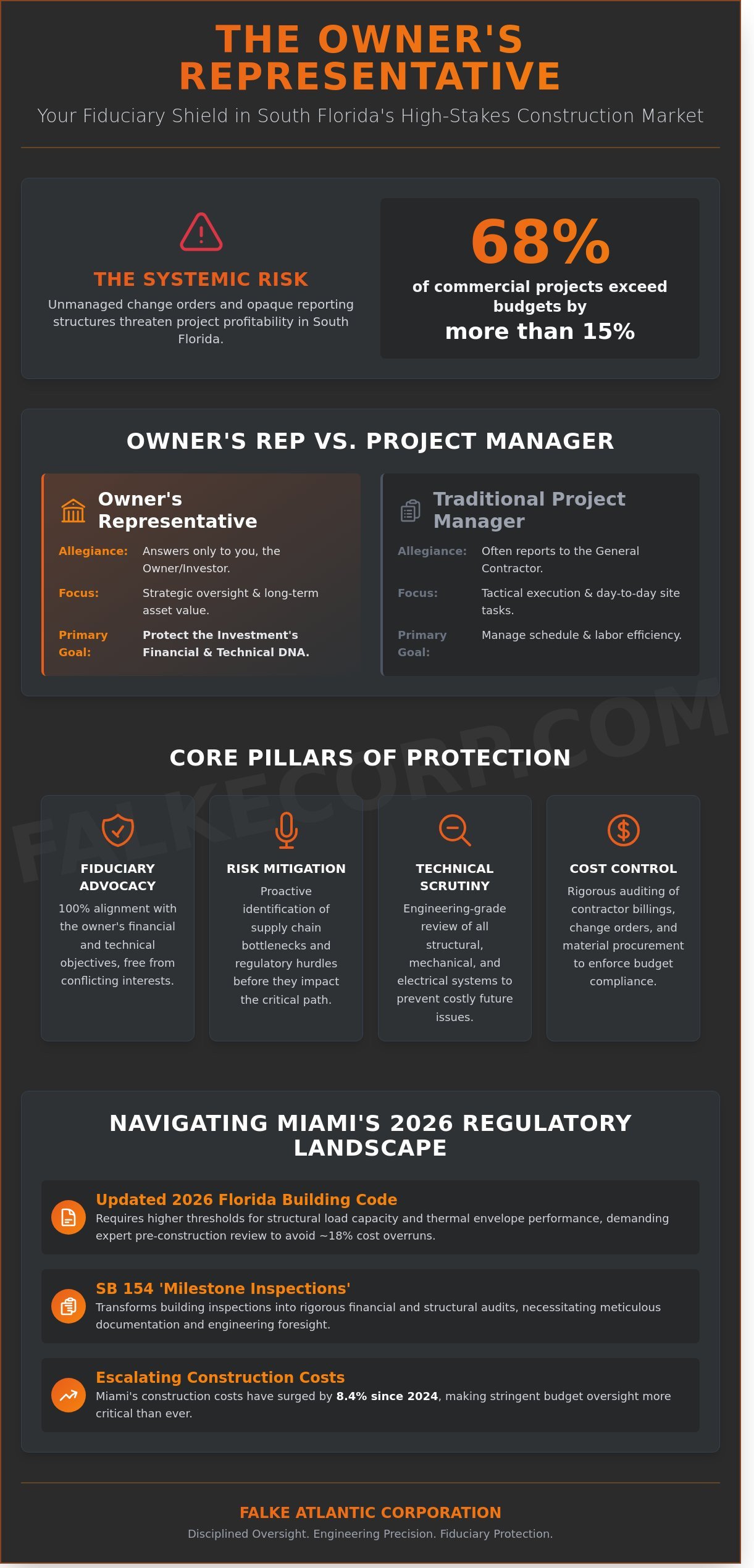
Recent 2025 industry reports indicate that 68% of commercial construction projects in South Florida exceed their initial budgets by more than 15% because of unmanaged change orders. You’ve likely experienced the frustration of Miami-Dade permitting delays or the opaque reporting structures that many general contractors utilize to mask project inefficiencies. It’s a systemic issue that threatens the internal rate of return for even the most well-capitalized developments. Securing a specialized owner’s representative Miami is no longer a secondary consideration; it’s a structural necessity for asset protection in a volatile market.
This article provides a blueprint for managing these complexities through a disciplined, four-phase methodology designed to enforce financial transparency and engineering precision. You’ll learn how to eliminate information asymmetry and mitigate the risks that typically lead to schedule slippage. We’ll examine the specific protocols needed to transform a chaotic construction site into a revenue-ready asset that meets every technical requirement by your 2026 deadline. This approach replaces hope with a structured framework for project success.
Key Takeaways
- Distinguish between traditional project management and the technical advocacy required for fiduciary protection in complex Florida developments.
- Navigate the 2026 Florida Building Code updates and the mandatory Milestone Inspection process with engineering-led precision and foresight.
- Utilize a disciplined, four-phase methodology led by an Owner’s representative Miami to ensure project feasibility and rigorous bidding standards.
- Identify and mitigate systemic financial risks, including change order fraud, through structured oversight and comprehensive cost-benefit analysis.
- Leverage a boutique strategic partnership to maintain complete control over the technical and financial DNA of high-end hospitality and residential assets.
Defining the Owner’s Representative in the Miami Market
An owner’s representative Miami serves as the technical and financial proxy for the developer, investor, or asset holder. This role is defined by a strict fiduciary duty, meaning the representative operates solely in the client’s interest. They don’t have a vested interest in the contractor’s profit margins or the architect’s design ego; their focus remains on the project’s bottom line and structural integrity. In the complex environment of 2026, where Miami’s construction costs have escalated by 8.4% since 2024, this oversight is no longer a luxury. It’s a baseline requirement for risk mitigation.
The core mission of the representative involves three pillars: transparency, quality, and financial accountability. They act as a translator between the technical jargon of the job site and the business objectives of the boardroom. By 2026, South Florida’s regulatory landscape has become increasingly dense. New sea-level rise ordinances and updated 2025 Florida Building Code requirements demand a level of scrutiny that most owners cannot provide personally. The representative ensures that every dollar spent aligns with the approved project scope and that the quality of work meets the high standards expected in the South Florida luxury and commercial sectors.
While Construction management focuses on the tactical execution of the build and the coordination of subcontractors, the owner’s representative maintains a strategic view of the entire asset lifecycle. They aren’t just managing the schedule; they’re protecting the investment’s long-term value. This distinction is vital for owners who need to ensure that the technical competence of the general contractor matches the financial projections of the initial pro forma.
Owner’s Rep vs. Project Manager: Key Distinctions
A traditional project manager often reports to the general contractor, focusing on day-to-day site tasks and labor efficiency. In contrast, the owner’s representative Miami answers only to you. This independence is critical for unbiased decision-making. FALKE Atlantic bridges the gap between the architect’s design vision and the harsh realities of construction. We move beyond tactical site management to provide strategic oversight, ensuring that the project’s technical specifications don’t compromise the owner’s financial goals or the building’s eventual operational efficiency.
The Value Proposition for High-Net-Worth and Corporate Clients
For remote owners in North Bay Village or Palm Beach, the representative acts as a professional buffer. High-net-worth individuals often face “luxury surcharges” in negotiations; a professional representative eliminates this by using data-driven cost analysis. Corporate clients, such as hospitality brands scaling into the South Florida market, utilize our services to maintain brand consistency across multiple sites. We provide the psychological peace of mind that comes from knowing a technical expert is scrutinizing every change order and inspection report. This level of professional distance ensures that negotiations remain objective and focused on the project’s success rather than interpersonal friction.
- Fiduciary Advocacy: 100% alignment with the owner’s financial and technical objectives.
- Risk Mitigation: Identification of potential 2026 supply chain bottlenecks before they impact the critical path.
- Technical Scrutiny: Engineering-grade review of all structural and mechanical systems to prevent future litigation.
- Cost Control: Rigorous auditing of contractor billings and material procurement to ensure budget compliance.
Navigating Miami-Specific Construction Hurdles in 2026
The 2026 Florida Building Code updates demand a higher threshold for structural load-bearing capacity and thermal envelope performance. Developers must integrate these technical requirements into the pre-construction phase to avoid the 18% cost overruns typically seen when compliance is treated as an afterthought. An Owner’s representative Miami provides the technical oversight necessary to bridge the gap between conceptual design and the stringent realities of South Florida’s regulatory environment. It’s no longer sufficient to rely on standard architectural sets; projects now require a granular review of structural connections and energy-efficient glazing systems to meet the state’s 2026 sustainability mandates.
Florida’s SB 154 legislation has transformed the ‘Milestone Inspection’ process for condos and commercial high-rises into a rigorous financial and structural audit. By 2026, the backlog for qualified structural engineers in Miami-Dade has increased lead times for these inspections by 14 weeks. Managing this process requires a systematic approach to document review and physical testing. An Owner’s representative Miami coordinates with engineering teams to ensure that the Structural Integrity Reserve Study (SIRS) is not just a checkbox, but a roadmap for long-term asset preservation. Failure to align these inspections with capital expenditure plans can lead to emergency assessments that devalue the property overnight.
Permitting in Miami-Dade and Broward counties has become a primary bottleneck, with 2026 data showing a 22% increase in review times for high-density residential projects. Acceleration strategies must focus on the “Dry Run” process and pre-submittal meetings with municipal department heads. It’s essential to utilize electronic plan review systems with a level of precision that eliminates the “Request for Additional Information” (RAI) cycles that often stall projects for 60 to 90 days. Professional oversight ensures that the technical documentation is flawless before it hits the reviewer’s desk.
Climate resiliency is the defining technical challenge for South Florida real estate in 2026. Hurricane-grade specifications now mandate impact-resistant glazing capable of withstanding 175 mph wind loads in High-Velocity Hurricane Zones (HVHZ). Flood zone compliance involves navigating the 2025 FEMA Flood Insurance Rate Map updates, which elevated base flood elevations in 35% of Miami’s coastal districts. Implementing sea-level rise mitigation strategies, such as elevated mechanical rooms and advanced waterproofing membranes, is a requirement for securing institutional financing in the current market.
Regulatory Compliance: Beyond the Building Permit
Navigating the 40, 50, and 60-year recertification requirements for existing structures involves more than just a visual check. It requires a deep dive into the building’s historical load-testing data and electrical load calculations. Coordination with municipal departments in the City of Miami and Fort Lauderdale demands a structured approach to entitlement management. You’ve got to ensure all zoning variances and land-use entitlements are secured before the first excavator arrives on site to prevent a 120-day stop-work order. If you’re managing a portfolio in this environment, a consultation on technical risk mitigation can prevent costly structural delays.
South Florida Supply Chain and Labor Dynamics
The 2026 labor market in Dade and Broward counties shows a 14% deficit in specialized trade subcontractors, particularly in the MEP (Mechanical, Electrical, and Plumbing) sectors. This shortage directly impacts the critical path of any high-rise project, making early procurement of long-lead items like custom switchgear and HVAC chillers mandatory. According to the Construction Managers Occupational Outlook, the demand for high-level oversight is growing as project complexity increases and labor pools shrink. Local market volatility in 2026 is defined as the 6.2% fluctuation in quarterly material pricing indices coupled with a 4.5% year-over-year increase in unionized labor rates across South Florida.
The Four-Phase Methodology for Disciplined Project Oversight
Executing a high-cap residential or commercial development in South Florida requires a rigid, four-phase technical framework to mitigate risk. A professional Owner’s representative Miami doesn’t just observe; they engineer the project’s success through a sequence of controlled milestones. This methodology ensures that the initial vision translates into a high-performing asset without the common 15% to 20% budget overruns seen in unmanaged regional projects. By following the standards established by the Construction Management Association of America, we provide a structured layer of protection between the owner and the complexities of the job site.
- Phase 1: Concept and Feasibility – We define the project’s financial DNA by validating pro forma assumptions against 2026 market costs and local zoning restrictions.
- Phase 2: Pre-Construction – This involves assembling the design team and conducting a rigorous bidding process that goes beyond the bottom-line price.
- Phase 3: Construction Phase Management – Our team maintains on-site quality and schedule control through daily technical audits and 48-hour reporting cycles.
- Phase 4: Commissioning and Close-out – We manage the transition from a construction site to a revenue-ready asset, ensuring all TCO (Temporary Certificate of Occupancy) requirements are met by the 2026 deadline.
Pre-Construction: The Foundation of Success
Success in the Miami market starts months before the first shovel hits the dirt. We conduct site feasibility studies that account for South Florida’s unique porous limestone and high water tables. Our team vets architects and engineers based on their specific experience with Miami-Dade’s 2024/2025 building code updates. We develop a Master Budget that includes a mandatory 12% contingency for Florida-specific variables like seasonal labor shortages and hurricane-related supply chain disruptions. This level of preparation ensures the Owner’s representative Miami can defend the project’s bottom line against early-stage design creep.
Active Construction: Maintaining the ‘Single Source of Truth’
During the active build, we implement a communication protocol that eliminates data silos between the general contractor and the owner. We don’t rely on self-reported progress from vendors. Instead, we use independent field reporting and quality control audits to verify every slab pour and MEP (Mechanical, Electrical, Plumbing) installation. This “single source of truth” prevents the 10% to 15% cost inflation typically caused by unverified change orders. Our approach relies on milestone-based payment verification; funds aren’t released until our engineers confirm that the work meets the technical specifications outlined in the contract. This discipline keeps the project on a predictable trajectory.
Managing third-party vendors requires a firm hand to prevent scope overlap. We’ve seen projects where lack of oversight led to 25-day delays simply because the elevator contractor and the electrical subcontractor weren’t synchronized. We eliminate these friction points through weekly coordination meetings and real-time schedule tracking. It’s not about being “involved” in the project; it’s about maintaining absolute control over the variables that impact the owner’s ROI. By the time we reach the commissioning phase, the asset is ready for immediate operation, free of the lingering punch-list items that often plague Miami developments for months after completion.
Financial Control: Mitigating Risk and Maximizing ROI
Construction financial management requires a level of forensic precision that most developers simply don’t have the capacity to execute daily. An owner’s representative Miami acts as the lead financial auditor, ensuring every line item in the G703 Schedule of Values reflects actual physical progress on the job site. Change order fraud is a recurring issue in South Florida, where contractors might inflate labor hours or material quantities to recover losses from unrelated projects. We stop this by requiring detailed backup for every request, including original invoices and verified man-hour logs from the 2025-2026 labor cycles.
Strategic procurement adds another layer of asset protection. By 2026, localized inflation for specialized glazing and high-efficiency HVAC systems in Miami is projected to hit 9% annually. We use our established Florida vendor relationships to negotiate early-buy programs. This locks in 2025 pricing and secures production slots 14 months in advance. It’s about eliminating the uncertainty that leads to 15% budget overruns in the final quarter of construction.
Insurance and bonding protocols serve as the final safety net for the capital stack. Contractor insolvency rates in Florida rose by 12% in the last fiscal cycle, making rigorous vetting essential. We mandate performance and payment bonds that exceed the standard 100% of contract value when dealing with high-risk sub-trades. If a contractor fails, a properly structured bond ensures the project continues without the typical 20% cost spike associated with emergency replacement firms.
The ROI of Owner Representation
Data from 2024 luxury developments shows that professional oversight reduces total project costs by an average of 10.4%. These savings stem from aggressive bid leveling and the elimination of redundant mobilization fees. In a recent case study from the Miami Design District, a high-end retail build-out saved $1.2 million by identifying structural clashes during the 90% CD phase, well before the first concrete pour. Schedule slippage is the silent killer of ROI; a 30-day delay on a $50 million asset equates to roughly $225,000 in additional interest and lost revenue-readiness.
Contractual Safeguards and Audit Trails
We utilize modified AIA documents, specifically the A101 and B101, tailored for the unique regulatory environment of Florida. These aren’t just templates; they’re technical shields. Every pay application undergoes a three-tier audit before a single dollar is moved. We ensure all partial and final lien waivers are collected and verified against the sub-contractor list. This rigorous process guarantees that all warranties, including 10-year structural and 2-year mechanical guarantees, are legally binding and fully transferable upon project close-out. Technical competence in the office is just as vital as expertise on the scaffolding.
FALKE Atlantic: Your Strategic Partner in South Florida
FALKE Atlantic operates as a boutique consultancy designed for the rigorous demands of complex real estate development. Our methodology rejects high-volume, surface-level management in favor of a granular, engineering-led approach. We specialize in high-stakes sectors including hospitality, luxury retail, and high-end residential estates where the margin for error is non-existent. Our commitment to professionalism is rooted in technical competence; we don’t rely on emotional persuasion but on the strength of empirical data and structural reliability. This ensures that every asset remains protected against the fiscal and environmental volatilities projected for the 2026 Miami market.
The FALKE commitment focuses on three pillars: technical precision, unwavering fiduciary trust, and a hovels-to-high-rises understanding of the construction lifecycle. We maintain a hűvösen elegáns—coolly elegant—professionalism that removes marketing noise from the decision-making process. By prioritizing the owner’s interests through every phase of the project, we ensure that stability and quality remain the primary metrics of success. Our team takes full responsibility for the final outcome, acting as a disciplined extension of your executive office.
Localized Expertise from North Bay Village to West Palm Beach
Our strategic presence in North Bay Village provides a central hub for overseeing developments across the entire Atlantic Coast corridor. We’ve established deep roots within the Florida construction community over the last 15 years, allowing us to navigate the specific regulatory and logistical hurdles of the region. Our portfolio includes 24 iconic projects delivered for world-class brands that demand uncompromising standards. As a specialized Owner’s representative Miami, our engineering background serves as our primary differentiator. We don’t just manage schedules; we analyze the mechanical, electrical, and plumbing (MEP) systems to identify potential failures before they manifest as costly delays.
- Technical Auditing: We conduct rigorous reviews of architectural plans to ensure structural feasibility and code compliance.
- Vendor Vetting: Our team utilizes a proprietary database of contractors who have met our 98% reliability threshold on previous South Florida builds.
- Risk Mitigation: We implement 2026-ready climate resilience strategies for all coastal properties to preserve long-term asset value.
Start Your Miami Project with Confidence
Confidence in a development project is earned through meticulous preparation. We initiate every partnership with a comprehensive feasibility review and site analysis that covers 18 distinct risk factors. This process identifies hidden liabilities in soil composition, zoning restrictions, or utility infrastructure early in the pre-construction phase. Our role as an Owner’s representative Miami involves seamless integration with your existing legal and financial teams. We provide the technical data required for accurate pro-forma updates and contract negotiations, ensuring your capital is deployed with maximum efficiency.
We invite you to schedule a project consultation at our North Bay Village office to discuss the specific technical requirements of your upcoming development. Our structured approach ensures that from the first site visit to the final certificate of occupancy, your investment remains secure. We don’t offer generic solutions; we provide a customized roadmap built on engineering logic and disciplined project management. Secure your investment with FALKE Atlantic Corporation today.
Securing Project Integrity in the 2026 South Florida Market
Success in the 2026 South Florida real estate sector demands technical precision rather than simple oversight. The regulatory landscape across Miami-Dade and Broward counties has reached a point where 100% compliance with updated structural codes is the only way to safeguard your capital. By applying our disciplined four-phase methodology, we eliminate the common 15% budget variances that often plague unmanaged developments. Selecting a specialized Owner’s representative Miami provides the engineering-led professional oversight necessary to maintain strict control over every technical milestone. This systematic approach ensures your assets remain protected against volatile market shifts and complex construction hurdles. We prioritize stability and measurable results over industry trends. Our team manages the intricate details of electrical design integration and systems automation so you don’t have to worry about technical failures. Take the next step in fortifying your investment’s lifecycle. Schedule a strategic consultation with FALKE Atlantic Corporation to align your project with our high-performance standards. We’re ready to bring engineering reliability to your next major development.
Frequently Asked Questions
What is the difference between an owner’s rep and a general contractor in Miami?
An owner’s representative Miami acts as your fiduciary advocate, whereas a general contractor is a service provider focused on physical execution. While the contractor manages sub-trades and daily labor, the representative oversees the entire project lifecycle to ensure your 100% financial and strategic interests remain protected. This distinction eliminates conflicts of interest; the representative audits every $1,000 spent without being tied to the contractor’s profit margins.
How much does an owner’s representative cost in South Florida?
Fees for an owner’s representative in South Florida typically range from 3% to 5% of the total construction budget. On a $10,000,000 commercial development, this translates to a $300,000 investment that frequently yields a 15% reduction in change orders. We structure these costs as a fixed monthly retainer or a percentage based on the project’s complexity and the anticipated 24 month duration.
When is the best time to hire an owner’s rep for a Miami development?
You should engage an owner’s representative during the site selection or feasibility phase, ideally 12 months before construction begins. Early involvement allows the expert to influence 80% of the project’s total cost during the design stage. By establishing a rigorous baseline before the first shovel hits the ground, you’ll prevent the 20% budget overruns common in unmanaged Miami developments.
Do I need an owner’s rep for a residential project in Ft. Lauderdale?
Hiring a representative is highly recommended for any residential project in Ft. Lauderdale exceeding $2,500,000 in value. High-end builds involve complex coastal regulations and specialized sub-contractors that require professional oversight to maintain quality standards. We manage the integration of smart home systems and hurricane-rated glazing to ensure the structure meets 175 mph wind load requirements without compromising the architectural vision.
How does an owner’s rep handle Miami-Dade permitting delays?
We mitigate Miami-Dade permitting delays by implementing a dual-track submission strategy that targets both municipal and county reviewers simultaneously. This methodology can reduce the standard 6 month approval window by 30% through constant technical coordination with department heads. Our team tracks 45 distinct permit milestones to ensure that missing documentation doesn’t stall the $50,000 per day mobilization of heavy machinery.
Can an owner’s rep help with the 40-year building recertification process?
An owner’s representative Miami manages the entire 40 year building recertification process, now governed by the stricter SB-4D legislation passed in 2022. We coordinate the structural and electrical engineering inspections required to certify the safety of your asset for the next 10 year cycle. Our team oversees the $500,000 or more in necessary remediation work, ensuring all repairs comply with the latest Florida Building Code updates.
What specific qualifications should a Miami owner’s representative have?
A qualified representative must possess a degree in civil engineering or architecture and at least 15 years of local experience. They should hold a Project Management Professional (PMP) certification and demonstrate a track record of managing $50,000,000 portfolios. Deep knowledge of South Florida’s unique oolitic limestone soil conditions and high-velocity hurricane zones is essential for making technically sound decisions on your behalf.
How does FALKE Corp manage remote owners who are not based in Florida?
FALKE Corp utilizes 3D laser scanning and weekly 4K drone surveys to provide remote owners with a digital twin of their construction site. You’ll receive a detailed technical report every Friday at 4:00 PM EST, outlining progress against the master schedule with 98% accuracy. This transparent data stream allows international investors to make informed decisions from any time zone without needing to be physically present in Miami.