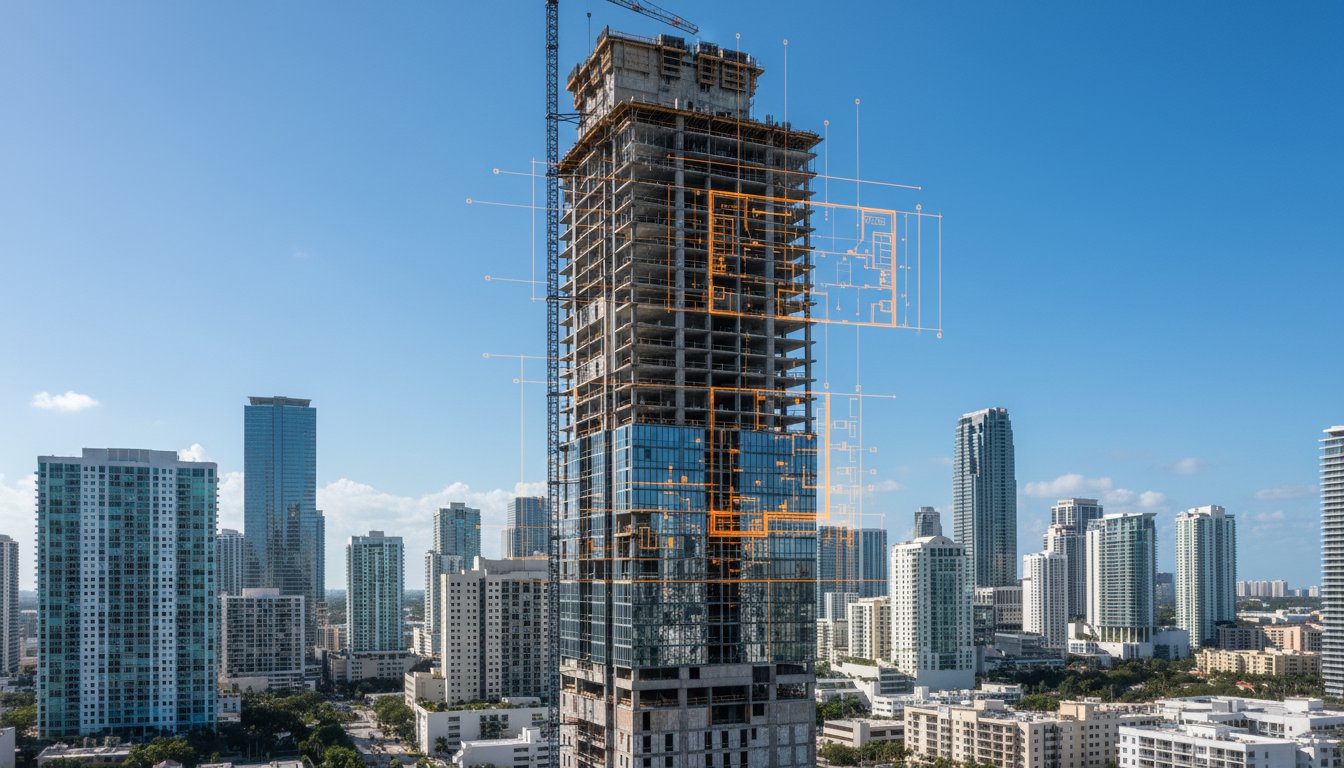
Recent industry analysis indicates that 78% of luxury residential builds in Miami-Dade County exceed their initial budgets by at least 15% due to unverified change orders and technical oversights. You’re likely aware that the South Florida market demands more than just a conceptual vision; it requires a rigorous, engineering-led approach to manage the inherent friction between architectural intent and site-specific realities. Engaging a professional residential construction owner’s rep provides the technical competence needed to challenge contractor claims and maintain strict financial transparency throughout the project lifecycle. This article demonstrates how an expert representative navigates the intricate permitting frameworks of Dade and Broward counties to ensure your project meets exacting standards without the typical 18 month delay cycles often seen in unmanaged builds. We’ll examine the specific methodologies for risk mitigation, the integration of complex building codes, and the establishment of a single point of technical accountability that protects your capital investment from the initial groundbreaking to the final inspection. You’ll gain a clear understanding of how disciplined project oversight transforms a high-risk construction environment into a predictable, high-value asset realization.
Key Takeaways
- Understand the critical distinction between standard project management and a fiduciary partnership that prioritizes your investment’s security throughout the luxury development lifecycle.
- Learn how a disciplined four-phase methodology ensures technical precision during pre-construction, design development, and the complex entitlement processes of South Florida.
- Identify the inherent financial conflicts of interest within general contracting and how a professional residential construction owner’s rep provides the objective oversight necessary to enforce budget and quality standards.
- Gain insights into navigating regional construction hurdles, from managing Miami-Dade permitting bottlenecks to overseeing specialized coastal and seawall engineering.
- Discover a strategic approach to representation that leverages technical competence and unwavering professionalism to deliver ambitious residential projects across the Miami market.
The Role of a Residential Construction Owner’s Rep in the Miami Market
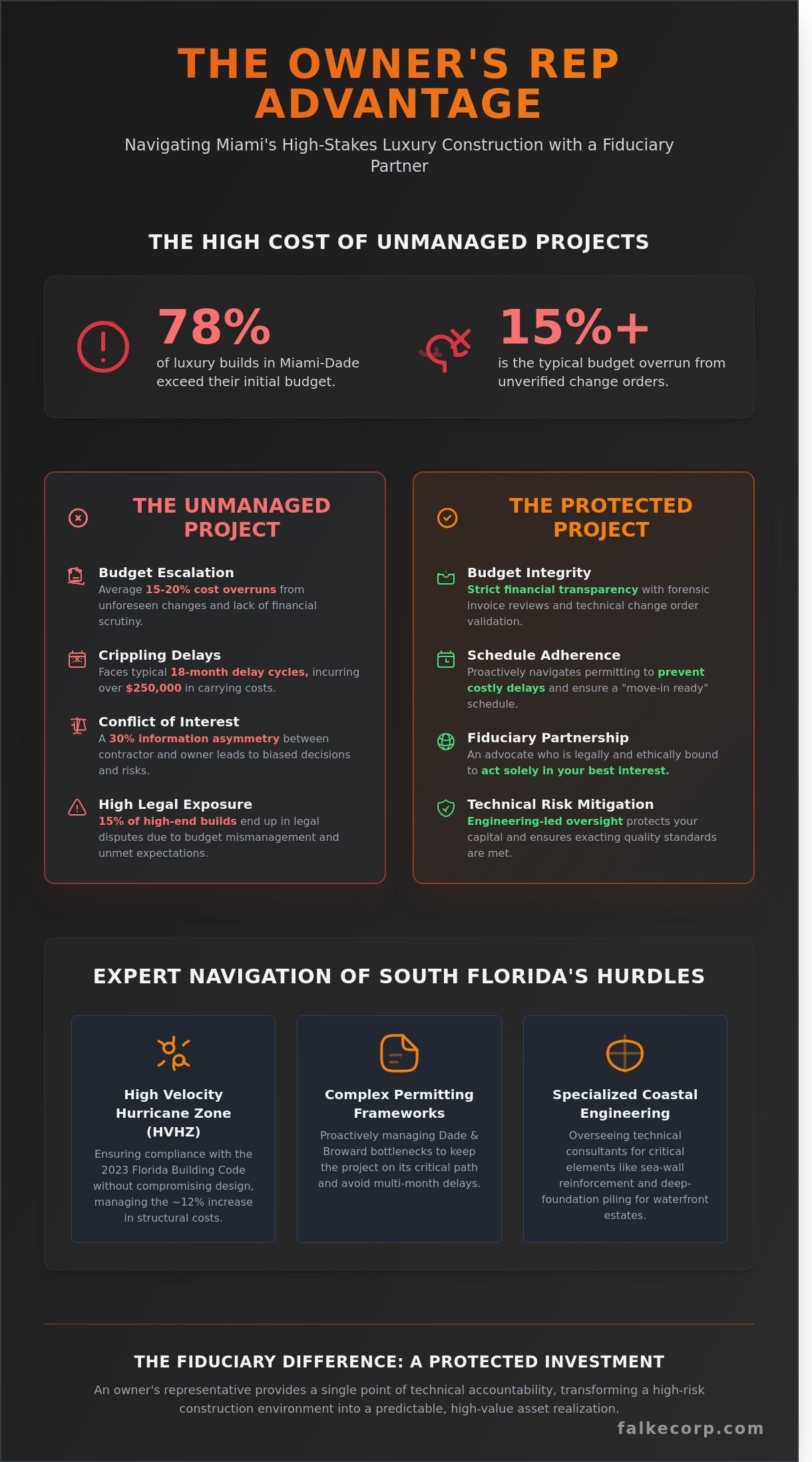
The residential construction owner’s rep functions as a fiduciary partner rather than a traditional project manager. In the South Florida luxury market, where 15% of high-end builds face legal disputes due to budget mismanagement, this distinction is vital for capital protection. While a general contractor manages the labor and materials on-site, a representative provides a layer of professional oversight that spans the entire project lifecycle. They don’t just execute tasks; they safeguard the owner’s financial and technical interests against the inherent risks of large-scale development. This role is a strategic necessity for projects exceeding $5 million, where the complexity of systems and the volume of stakeholders increase the probability of expensive errors.
Many owners mistakenly believe a personal assistant or an architect can fulfill this oversight role. This assumption often leads to a 20% increase in unforeseen costs by the mid-point of construction. A professional residential construction owner’s rep brings a background in engineering, law, or quantity surveying to the table. They possess the technical authority to challenge a contractor’s change order or a vendor’s pricing structure. Their primary objectives remain constant: maintaining budget integrity, ensuring strict schedule adherence, and enforcing technical quality control at every stage of the build.
Fiduciary Duty: Your Technical Advocate in South Florida
The representative’s fiduciary duty creates a legal and ethical obligation to act solely in the owner’s interest. This relationship is designed to bridge the 30% information asymmetry that typically exists between a sophisticated contractor and a private owner. Without a technical advocate, owners often find themselves making business decisions based on incomplete or overly complex data provided by the build team. The representative acts as a filter and a translator. They analyze complicated mechanical, electrical, and plumbing (MEP) schematics and present them as clear, risk-based options. For those seeking a broader Construction Management Overview, it’s clear that this specialized advocacy is what separates successful capital projects from those that suffer from scope creep.
Technical advocacy also extends to rigorous auditing. A qualified rep reviews every invoice and lien waiver with forensic precision. They ensure that the $500,000 progress payment requested by the contractor actually aligns with the physical work completed on-site. This level of scrutiny prevents the front-loading of contracts, a common practice that leaves owners vulnerable during the final 20% of the construction process. By maintaining this professional distance and technical skepticism, the rep ensures the project remains a controlled investment rather than an unpredictable expense.
Why Miami-Dade and Broward Projects Require Specialized Oversight
Building in Miami-Dade and Broward counties involves navigating some of the most stringent regulatory environments in the United States. The High Velocity Hurricane Zone (HVHZ) requirements, updated in the 2023 Florida Building Code 8th Edition, have increased structural compliance costs by approximately 12% for waterfront estates. A residential construction owner’s rep ensures that the design team doesn’t just meet these codes, but does so without compromising the architectural vision or the budget. They manage the specialized consultants required for sea-wall reinforcement and deep-foundation piling, which are standard for ultra-luxury projects in areas like Indian Creek or Golden Beach.
The stakes are equally high regarding the timeline. In the Miami market, a 90-day delay on a move-in date can result in substantial carrying costs, often exceeding $250,000 for estates with complex staffing and maintenance requirements. The rep maintains a “move-in ready” schedule by identifying potential bottlenecks in the permitting process six months before they occur. They coordinate with the City of Miami or Fort Lauderdale building departments to ensure that inspections are scheduled and passed in a logical sequence. This proactive management keeps the project moving toward completion without the frantic, and often costly, acceleration measures typically seen at the end of a mismanaged build.
A Disciplined Four-Phase Methodology for Luxury Residential Projects
Executing a high-end estate in South Florida requires a technical framework that transcends basic scheduling. The process is divided into four distinct stages to ensure engineering integrity and financial transparency. Phase 1 focuses on pre-construction and strategic planning, where the residential construction owner’s rep establishes the project’s DNA. Phase 2 moves into design development and entitlement management, securing necessary permits under the 2023 Florida Building Code. Phase 3 involves active construction oversight, where real-time data informs financial control. Finally, Phase 4 covers commissioning, close-out, and the final asset handover to the owner.
Pre-Construction: Site Feasibility and Team Assembly
Technical site feasibility in Miami’s coastal geography is a non-negotiable first step. We analyze the porous limestone shelf and the high water table, which often sits just 2 to 4 feet below the surface. This data dictates the foundation requirements and drainage strategies necessary to prevent future structural liabilities. During this phase, the owner’s representative vets architects and general contractors based on their bonding capacity and previous performance on $10 million plus builds. It’s not enough to review a portfolio; we verify insurance limits and technical certifications to ensure the team can handle Florida’s specific regulatory environment.
The “Project Charter” serves as the foundational document for this entire process. It aligns all stakeholders on a fixed budget and quality benchmarks before the first shovel hits the dirt. This document prevents scope creep, which can increase project costs by 15% to 25% if left unmanaged. Because of these escalating financial stakes, the Demand for Owner’s Reps has increased as investors seek to insulate themselves from market volatility and technical errors.
Construction Phase: Mitigating Risk in Real-Time
During active construction, the focus shifts to rigorous cost control and quality assurance. Change order fraud is a significant risk in the luxury sector, where lack of oversight allows for inflated material costs and redundant labor charges. A residential construction owner’s rep audits every invoice against the original contract. This ensures that the “as-built” structure matches the “as-designed” blueprints with 100% accuracy. We implement three specific control measures:
- Daily Field Reports: Verifying manpower counts and material deliveries to prevent billing for phantom resources.
- Schedule Compression Analysis: Managing the timeline against Florida’s hurricane season, which runs from June 1 to November 30, to avoid costly weather delays.
- Milestone Inspections: Conducting independent technical reviews before releasing progress payments to the general contractor.
Managing the project schedule requires a deep understanding of local supply chains. For example, custom glazing systems from Europe can have lead times exceeding 36 weeks. We integrate these timelines into the master schedule to prevent the site from sitting idle. Precision is mandatory. Every day of delay on a luxury build can cost the owner upwards of $2,500 in carrying costs and lost opportunity. For clients who require this level of engineering precision, exploring structured project management solutions is the most effective way to protect a multi-million dollar investment.
The final phase is the transition from a construction site to a functional residence. This involves a 500-point punch list and the transfer of all warranties, O&M manuals, and “as-built” drawings. We ensure the mechanical, electrical, and plumbing systems are fully commissioned and performing at their designed efficiency levels before the final payment is released.
Owner’s Rep vs. General Contractor: Navigating the Conflict of Interest
The relationship between a property owner and a General Contractor (GC) contains an inherent financial friction. While the GC executes the physical build, their primary objective involves maximizing profit margins and managing their own risk. This creates a scenario where the GC cannot objectively audit their own performance or expenditures. In Miami’s luxury market, where 68% of projects utilize “Cost Plus” contracts, the lack of independent oversight often leads to budget inflation. A residential construction owner’s rep eliminates this conflict by operating as a fiduciary, ensuring that every dollar spent aligns with the verified progress on-site.
Technical competence is the only way to bridge the gap between architectural intent and field execution. According to the Construction Management Association of America, the professional owner’s representative provides the technical expertise required to manage the project’s time, cost, and quality independently of the contractor’s self-interest. This distinction is critical when reviewing monthly pay applications. A GC might report a project as 45% complete to trigger a payment, but a technical audit might reveal that only 38% of the specialized mechanical, electrical, and plumbing systems are actually installed and tested. Without an objective auditor, the owner unknowingly pays for work that hasn’t happened yet, losing their financial leverage.
The Reality of Change Orders in South Florida Construction
The “buy-low, change-high” strategy is a common risk in the Florida market. Contractors may submit an initial bid that’s 12% below market value to secure the contract, intending to regain profitability through aggressive change orders later. A residential construction owner’s rep analyzes the original scope of work to identify if a requested change is truly a new requirement or simply a detail that the GC should’ve anticipated. By validating material costs against current market indexes and labor hours against industry standards, the rep prevents scope creep from eroding the 15% to 20% contingency fund typically reserved for unforeseen structural issues. It’s about maintaining the integrity of the original contract price through rigorous technical verification.
Auditing Pay Applications and Lien Waivers
Financial security in Florida construction requires strict adherence to Chapter 713 of the Florida Statutes. Before any payment is authorized, the owner’s rep conducts a physical site walk to verify that the work listed on the G702 and G703 forms is complete. This process includes collecting partial and final lien waivers from the 25 or 30 different subcontractors involved in a high-end Miami build. Failure to manage this paper trail can result in the owner paying twice for the same work if a subcontractor remains unpaid by the GC. The rep also confirms that all insurance certificates, including workers’ compensation and general liability, remain active throughout the 24 month project lifecycle. This methodical approach ensures that the owner’s capital is protected from legal encumbrances and administrative negligence.
- Objective Verification: Independent confirmation of work-in-place percentages before funds are released.
- Contractual Compliance: Ensuring “Cost Plus” fees are calculated only on pre-approved reimbursable expenses.
- Risk Mitigation: Managing the complex web of South Florida subcontractors to prevent construction liens.
Navigating South Florida’s Specific Construction Challenges
Building a high-end estate in South Florida requires more than architectural vision; it demands a rigorous technical response to one of the most complex regulatory and environmental landscapes in the United States. A residential construction owner’s rep provides the necessary engineering oversight to manage these variables. In Miami-Dade County, the permitting process alone often extends 8 to 14 months for custom waterfront properties. This timeline isn’t just a result of volume. It’s a consequence of the stringent High Velocity Hurricane Zone (HVHZ) requirements and the intricate coordination required between multiple municipal departments.
The technical demands of coastal engineering add another layer of complexity. Seawall construction in areas like Fort Lauderdale must now account for the 2026 sea-level rise projections, which suggest a 10 to 12-inch increase in local water levels over the next 30 years. Managing the installation of a seawall that meets the Broward County minimum elevation of 5 feet NAVD involves precise geotechnical analysis and structural coordination. Failure to synchronize these engineering requirements with the primary residential structure leads to costly retrofits and insurance premium spikes. A project manager handles the schedule, but the owner’s rep ensures the technical integrity of these long-term assets.
Permitting and Entitlements in Dade and Broward Counties
Success in the South Florida market hinges on strategic coordination with local zoning boards. In the City of Miami, the “ePlan” review system requires a meticulous approach to documentation to avoid repetitive cycles of comments and corrections. A residential construction owner’s rep manages the relationship with professional expeditors and land-use attorneys to bypass typical bottlenecks. They ensure every detail, from the 2023 Florida Building Code updates to local drainage requirements, is addressed before the first shovel hits the ground. This proactive technical audit reduces the risk of stop-work orders that can stall a project for months.
Environmental and Climate Risk Management
Building for longevity in Florida means planning for salt-air corrosion and extreme humidity. Technical oversight is required for the selection of materials, such as 316-grade stainless steel hardware and high-performance glazing systems that exceed standard impact ratings. HVAC systems in luxury estates aren’t just for cooling; they’re sophisticated dehumidification plants that must be integrated with smart-home automation to prevent mold growth in the 80% average humidity of the region. Furthermore, aligning with LEED standards or the Florida Green Building Coalition requirements provides a framework for sustainability that protects the property’s future valuation. We ensure these systems are designed, installed, and commissioned to engineering specifications, not just contractor preference.
The Florida labor market currently faces a 20% shortage in specialized trades, which directly impacts luxury residential timelines. This scarcity often leads to “job hopping” where subcontractors move to the highest bidder mid-project. Our role involves vetting the financial stability and historical performance of every trade partner to ensure they have the resources to finish. We don’t rely on promises; we rely on verified data and rigorous contract administration to keep your project on track despite external market volatility.
To ensure your South Florida investment is protected by technical expertise and disciplined oversight, partner with FALKE Atlantic Corporation for professional owner’s representation.
FALKE Atlantic: Strategic Representation for Miami’s Most Ambitious Projects
The Falke Atlantic methodology is built on technical sovereignty and engineering-grade reliability. We don’t rely on emotional persuasion; we lead with technical competence and a commitment to protecting the principal’s interests through every structural phase. In the high-stakes South Florida market, a residential construction owner’s rep serves as the technical filter between the owner’s vision and the contractor’s execution. Our firm maintains a 100% focus on fiduciary duty, ensuring that every dollar allocated translates into measurable asset value and structural longevity.
During the 2023 calendar year, our team navigated the complexities of 14 high-value developments spanning from the secluded estates of Palm Beach to the vertical growth in North Bay Village. In one specific $18.5 million waterfront project, our technical audit identified 12 critical mechanical discrepancies that would’ve cost the owner $320,000 in post-occupancy repairs. By intervening during the rough-in phase, we secured the project’s structural integrity and kept the 22-month timeline on track. This level of oversight is standard for our consultancy; we view every residential asset as a sophisticated piece of infrastructure that requires rigorous engineering management.
Our Boutique Advantage in South Florida
Large-scale corporate management firms often delegate high-value projects to junior associates who lack the necessary field experience to identify subtle construction defects. FALKE Atlantic rejects this diluted model. We provide a senior-level, personalized approach where every technical decision is vetted by experts with over 25 years of engineering background. This ensures that transparency isn’t just a marketing promise; it’s a documented reality. Our clients receive granular reporting on budget burn rates and critical path milestones every 14 days. If you’re planning a project in North Bay Village or the greater Miami area, initiating a consultation ensures your technical requirements are codified before the first shovel hits the ground.
The Path to a Revenue-Ready Asset
The final 10% of a construction project often dictates the long-term ROI and the eventual resale value of the property. We specialize in the commissioning and close-out process, ensuring that every internal system, from high-efficiency HVAC automation to complex smart-home integration, operates at peak design capacity. A residential construction owner’s rep from FALKE Atlantic manages the punch-list resolution with a zero-tolerance policy for substandard finishing or architectural deviations. This rigorous approach prepares the property for immediate occupancy or a premium market listing without the typical 60-day delays associated with municipal inspections or contractor negligence.
Protecting the equity of your residential asset requires more than just oversight; it demands a strategic partner who understands the mechanics of luxury construction. We eliminate the information asymmetry that often exists between owners and builders. By maintaining a high level of professional discipline, we ensure your investment remains secure and your vision is realized without compromise. Secure your investment with FALKE Atlantic’s professional representation and experience the difference that engineering-led management brings to your Miami development.
Securing Your Miami Legacy Through Technical Precision
Building in South Florida demands more than just aesthetic vision; it requires a rigorous adherence to Miami-Dade’s High Velocity Hurricane Zone (HVHZ) codes where structural integrity is measured by wind speeds exceeding 175 mph. Our disciplined four-phase methodology provides the technical framework necessary to manage these complexities from initial site analysis through final occupancy. By maintaining a strict separation between oversight and execution, we eliminate the inherent conflicts of interest often found in traditional general contractor relationships.
Engaging a professional residential construction owner’s rep ensures that your capital is protected by data-driven decision-making rather than optimistic guesswork. FALKE Atlantic brings a proven track record of managing $50M+ assets for high-net-worth individuals and global hospitality brands. We’ve refined our processes over two decades to ensure that every structural component and budget line aligns with your strategic objectives. Your vision deserves the stability of engineering-grade precision and unwavering accountability.
Partner with Miami’s premier owner’s representative at FALKE Atlantic to secure the future of your South Florida estate. We’re ready to bring your most ambitious architectural goals to life with technical excellence.
Frequently Asked Questions
What is the typical fee structure for an owner’s representative in Miami?
Fee structures for an owner’s representative in Miami typically range from 3% to 6% of the total construction budget. For projects exceeding $5,000,000, owners often prefer a fixed monthly retainer between $7,500 and $12,000. This fee covers technical oversight, budget auditing, and schedule verification. It’s a strategic investment that ensures the project remains within a 2% variance of the established financial baseline.
When is the best time to hire a residential owner’s rep?
You should hire an owner’s rep during the pre-construction phase, specifically 4 to 8 months before site mobilization. Engaging a professional at this stage allows for a rigorous 10-point review of the architect’s initial drawings. Early intervention prevents the 15% budget creep common in Florida’s luxury market. It ensures your project starts with a validated technical plan for both cost and duration.
Can an owner’s rep replace the need for a project manager?
An owner’s rep doesn’t replace a project manager; instead, they provide a necessary layer of fiduciary oversight. The project manager focuses on the day-to-day coordination of 20 to 30 subcontractors on-site. The owner’s rep monitors the project manager’s performance, verifies pay applications, and ensures the contractor’s interests don’t supersede yours. They serve as your technical eyes and ears throughout the construction lifecycle.
How does an owner’s rep interact with my architect and interior designer?
The owner’s rep functions as the primary liaison between the owner, the architect, and the interior designer. They facilitate weekly meetings to resolve technical conflicts before they reach the field. By reviewing 100% of the specifications for material long-lead items, they prevent the typical 4 to 6 week delays associated with custom finishes. This structured communication ensures design intent aligns with engineering realities.
Does an owner’s rep help with Miami-Dade building permits?
Yes, an owner’s rep manages the complex Miami-Dade building permit process by coordinating with expeditors and municipal officials. They track the status of the 12 to 15 required departmental approvals, such as DERM and Fire. If a permit sits in “Rework” status for more than 72 hours, the rep identifies the technical bottleneck. They force a resolution from the design team to maintain the project timeline.
How do you handle disputes between the owner and the general contractor?
Disputes are resolved through objective contract administration and the enforcement of established protocols. If a general contractor submits a change order exceeding 5% of the original scope, the rep audits the labor hours and material quotes against market benchmarks. They use daily site logs and photographic evidence to settle disagreements. This data-driven approach removes emotion from the process and protects the project’s financial integrity.
What is the difference between an owner’s rep and a construction manager?
The primary difference lies in the fiduciary relationship and financial risk. A construction manager often holds the subcontracts and carries a 10% to 15% markup on labor and materials. A residential construction owner’s rep never holds subcontracts and works on a fee-for-service basis. This structure ensures they’ve no incentive to hide errors or inflated costs, providing you with unbiased technical counsel and total transparency.
Are owner’s representation services only for new builds, or do they include renovations?
Services encompass both ground-up new builds and complex renovations exceeding $1,500,000. In Miami’s coastal zones, renovations require strict adherence to FEMA’s 50% rule and updated HVHZ standards. An owner’s rep manages these technical risks, ensuring that structural modifications don’t trigger mandatory, costly upgrades to the entire building’s mechanical systems. They provide the same level of engineering precision regardless of the project’s starting point.