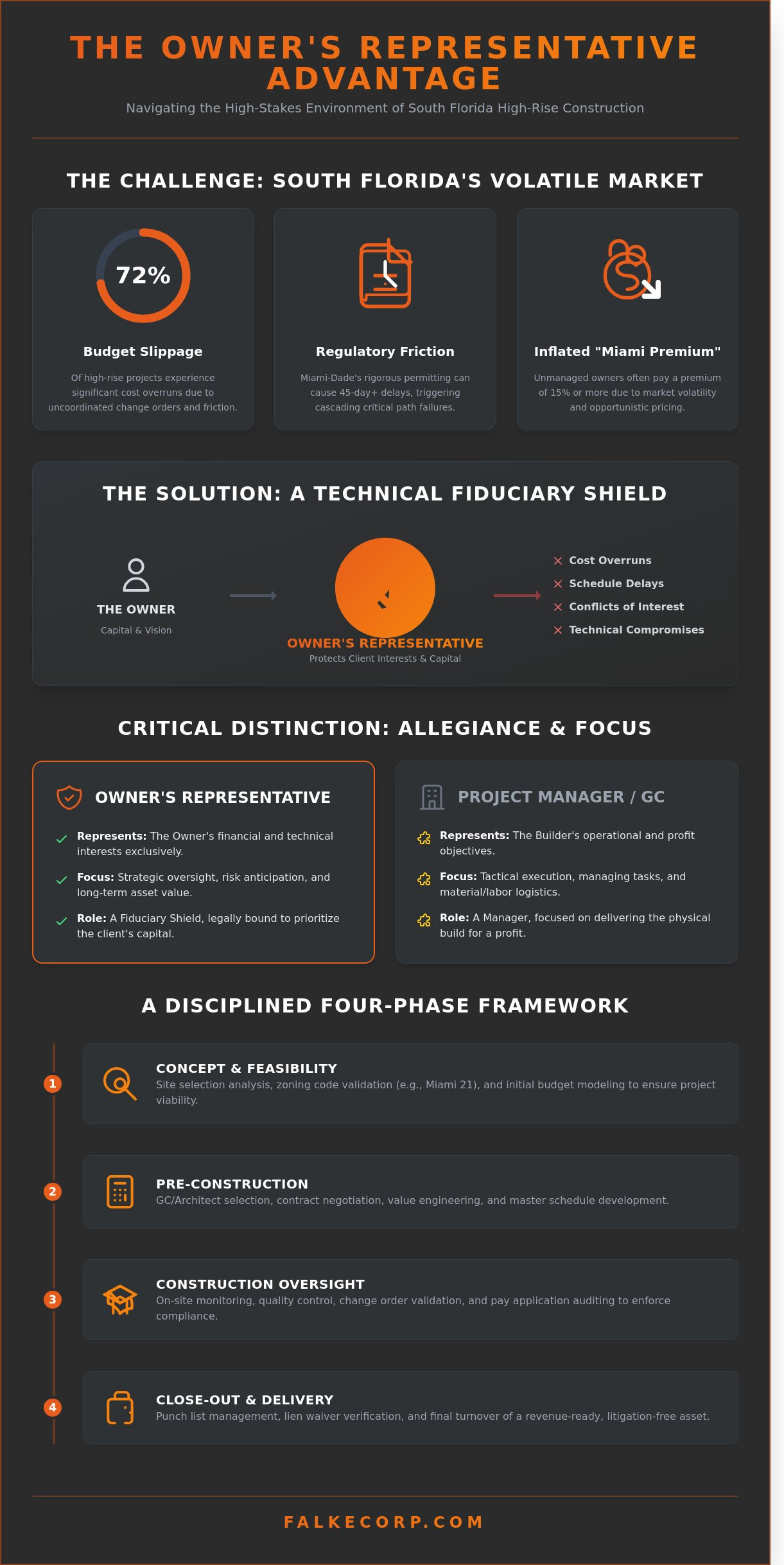
Research from the 2023 Dodge Construction Network indicates that 72% of South Florida high-rise projects experience significant budget slippage due to uncoordinated change orders and local regulatory friction. You’re likely aware that the Miami-Dade permitting process remains one of the most rigorous in the United States, where a 45-day delay in MEP approvals can trigger a cascading failure in your critical path. Engaging a specialized Miami owner rep is no longer a luxury for complex builds; it’s a structural necessity for maintaining technical oversight and financial hygiene.
This guide provides a precise methodology for leveraging professional representation to secure total fiscal control and strict adherence to Florida Building Code requirements. We’ll examine the specific protocols for mitigating hurricane-related insurance complexities and the exact steps required to deliver a revenue-ready asset that’s free from litigation or unresolved lien issues. By implementing these engineering-led management strategies, you can ensure your project transitions from the drawing board to completion without the common pitfalls of the South Florida market.
Key Takeaways
- Establish a technical fiduciary shield by understanding how a professional owner rep serves as a dedicated advocate to secure long-term project stability.
- Navigate the complex regulatory landscape of Miami-Dade through a systematic approach to site entitlement and feasibility coordination.
- Mitigate operational risks by distinguishing the strategic oversight of representation from the tactical execution of the project manager.
- Evaluate the financial logic of professional oversight by examining fee structures that prioritize cost avoidance and total project transparency.
- Implement a disciplined, four-phase framework to maintain technical precision and compliance throughout the South Florida construction lifecycle.
Defining the Owner’s Representative in the South Florida Market
In the complex environment of large scale capital improvements, an owner rep functions as a technical extension of the client’s executive team. This professional isn’t merely a consultant; they’re a fiduciary and technical advocate who operates across the entire project lifecycle to ensure engineering and financial decisions align with the principal’s objectives. While a general contractor focuses on the physical assembly of materials and labor, the representative acts as a specialized shield. They protect the owner from the inherent conflicts of interest found in the construction supply chain; ensuring that the project’s technical integrity isn’t compromised by a contractor’s desire for higher margins. This role integrates deeply into the broader framework of Construction management, providing a layer of oversight that traditional project managers often lack due to their direct reporting lines to the builder.
The distinction between a ‘shield’ and a ‘manager’ is vital in the South Florida hierarchy. A manager facilitates tasks, but a shield anticipates risks. In the Miami market, where material costs fluctuated by approximately 12% across specific sectors in 2023, this distinction determines the financial viability of a development. The representative maintains an independent mandate, allowing them to challenge contractor assumptions without the bias of profit-sharing. This independence is codified in Florida law through the ‘Agent of the Owner’ designation in standard contracts. This legal relationship grants the representative the authority to sign off on technical milestones and financial disbursements, effectively serving as the owner’s eyes and ears on-site. It’s a role built on engineering precision and unwavering professional standards.
Miami’s market volatility necessitates this third party expertise. With over 50 high-rise projects currently in the pipeline for the Brickell and Edgewater areas as of early 2024, the demand for labor and materials has created an environment where unmanaged owners often pay a “market premium” of 15% or more. The owner rep eliminates these inefficiencies by applying rigorous cost-control measures and verifying that every line item in a change order reflects actual market rates rather than opportunistic pricing.
The Fiduciary Duty of an Owner’s Rep
The core of this relationship is the absolute prioritization of the client’s capital over contractor profit. Unlike contractor-led suggestions that might favor easier installation or higher-margin materials, the representative provides unbiased advice based on long-term asset value. They enforce professional ethics in South Florida development by auditing pay applications and ensuring that the work performed matches the technical specifications defined in the initial engineering phase. This level of scrutiny prevents the common “Miami premium” from inflating budgets, keeping the project’s financial health stable through every phase of construction.
Why Miami Projects Require Local Specialized Advocacy
Navigating the socio-economic dynamics of the Miami labor market requires more than general knowledge. In regions like North Bay Village, the Design District, and Brickell, spatial constraints and local permitting hurdles are significant. A representative manages these variables by addressing the labor shortages that impacted 85% of Florida contractors in late 2023. For High-Net-Worth Individuals (HNWIs), the rep acts as a technical gatekeeper. They protect these clients from aggressive local pricing models, ensuring that specialized subcontractors meet exact coastal engineering requirements without unnecessary cost overruns.
Core Responsibilities: From Pre-Construction to Close-Out in Miami-Dade
The lifecycle of a capital project in South Florida requires a methodical approach to risk mitigation and technical precision. An owner rep acts as the primary shield against cost overruns and schedule slippage, operating with a level of engineering rigor that transcends standard project management. This involvement begins at Phase 1: Concept and Feasibility. During this stage, the representative evaluates site selection through the lens of local entitlement, analyzing the Miami 21 zoning code or the Broward County Land Development Code to ensure the proposed density and usage are structurally and legally achievable. They coordinate with environmental consultants to assess soil conditions and flood elevation requirements, which are critical variables in the 10-mile coastal strip.
Phase 2 transitions into Design and Pre-Construction. The representative vets architects and MEP (mechanical, electrical, plumbing) engineers based on their specific experience with High-Velocity Hurricane Zone (HVHZ) requirements. They manage the bidding process with a focus on eliminating scope gaps. The rising demand for owner’s reps stems from the increasing technical complexity of modern builds; a 2020 industry analysis confirms that cost escalations make this independent oversight a financial necessity. By the time the project reaches Phase 3, Construction Oversight, the representative is monitoring the General Contractor (GC) through rigorous site audits. They don’t simply accept progress reports; they verify that every milestone, from foundation pours to curtain wall installation, aligns with the critical path schedule.
The final stage, Phase 4: Commissioning and Close-Out, is where the representative ensures the asset is revenue-ready. This involves a systematic verification of life-safety systems, the transfer of warranties, and the procurement of the Final Certificate of Occupancy (CO). For developers seeking to stabilize these variables, a comprehensive technical management strategy is the only viable path to protecting the investment’s bottom line.
Navigating the South Florida Permitting Gauntlet
Securing approvals in Miami-Dade and Broward counties requires more than just submitting paperwork; it demands a strategic understanding of the 2023 Florida Building Code (8th Edition). To accelerate approvals, the representative often employs private providers under Florida Statute 553.791, allowing for faster plan reviews and inspections. They manage relationships with the Water and Sewer Department (WASD) and Florida Power & Light (FPL) to ensure utility infrastructure is synchronized with the build. This proactive coordination prevents the 4 to 6-month delays often seen when utility easements are treated as an afterthought.
Technical Oversight and Quality Control
Quality control in a tropical, saline environment is a matter of long-term structural integrity. The representative verifies that all exterior glazing and cladding meet TAS 201, 202, and 203 testing standards for large missile impact resistance. In luxury retail and hospitality sectors, they monitor the installation of high-spec finishes, ensuring that 316L-grade stainless steel is utilized to prevent salt-air corrosion. Through independent site inspections, the representative identifies latent defects in waterproofing or HVAC balancing before they become post-occupancy liabilities. This level of technical scrutiny ensures the GC’s work meets the specific engineering tolerances required for the South Florida climate.
- Feasibility: Analyzing 100-year flood plain data and sea-level rise projections for site viability.
- Vetting: Auditing GC financial statements and bonding capacity to ensure project stability.
- Inspections: Conducting thermal imaging of building envelopes to verify insulation and moisture barriers.
- Close-out: Ensuring all BIM (Building Information Modeling) data is handed over for facility management.
Owner’s Rep vs. Project Manager: Why South Florida Developments Require Both
The technical competence of an owner rep is most visible during the synchronization of the master schedule. While the PM manages the immediate coordination of trades, the OR monitors the Critical Path Method (CPM) schedule to identify potential bottlenecks 30 days before they impact the site. In Palm Beach, where land costs for Class A office space averaged $650 per square foot in late 2023, a two-week delay can result in six-figure losses in carrying costs and lost revenue. The OR mitigates this by holding the PM accountable to the baseline schedule through rigorous weekly reporting and site inspections.
The Fiduciary Distinction
The PM manages the “Triangle of Constraints” at a granular level, balancing daily labor allocations against immediate material availability. The OR maintains a broader perspective, evaluating how these constraints impact the long-term asset value. While the PM ensures the concrete pour happens on Tuesday, the OR verifies that the pour meets the 5,000 PSI specification required for the structural longevity of a coastal development. The Project Manager executes the operational mechanics of the build, while the owner rep serves as the fiduciary shield protecting the client’s financial and strategic interests.
Risk Management and Insurance Coordination
South Florida’s regulatory environment, particularly within the High Velocity Hurricane Zone (HVHZ), demands rigorous insurance verification that exceeds standard project management duties. An OR audits General Liability, Workers’ Compensation, and Builders Risk policies to ensure they meet the specific $20 million umbrellas common in luxury developments. They work with legal counsel to draft liquidated damages clauses, typically set at $2,500 to $7,500 per day for schedule overruns. This oversight extends to the change order workflow. By implementing a multi-stage approval process, the OR prevents the 12 percent average scope creep found in unmanaged projects. They ensure every modification is technically necessary and financially justified before a single dollar is committed.
- Verification: The OR ensures all subcontractors carry Florida-specific endorsements for windstorm and flood risks.
- Compliance: Oversight of Florida Statute 713 ensures that lien waivers are collected before any progress payments are released.
- Quality Assurance: Coordination with third-party inspectors to verify that waterproofing and envelope systems meet the 175 mph wind-load requirements of the Florida Building Code.
The collaboration between these roles creates a system of checks and balances. The PM focuses on the speed of delivery, while the OR focuses on the precision of the investment. This dual-layered approach is the only way to navigate the complexities of the South Florida market without compromising on quality or budget.
The Financial Logic: Fee Structures and ROI of Owner Representation in Florida
The financial architecture of a South Florida construction project requires more than a simple ledger; it demands a strategic barrier against capital erosion. Professional fee structures for an owner rep generally follow two distinct paths. The percentage-based model typically fluctuates between 1.5% and 4% of the total construction value, which aligns the representative’s compensation with the project’s scale. Alternatively, fixed monthly retainers provide developers with budgetary predictability, often ranging from $12,000 to $25,000 per month depending on the technical complexity of the build. These models ensure the representative remains a fiduciary partner rather than a variable expense.
The return on investment (ROI) manifests through aggressive cost avoidance rather than simple cost-cutting. On a $50,000,000 Miami mixed-use development, a standard 10% budget overrun represents a $5,000,000 hit to the bottom line. Data from projects completed in Q3 2023 shows that early intervention by a representative can limit these overruns to less than 2.5%. By scrutinizing the initial $42,000,000 Guaranteed Maximum Price (GMP) contract, the representative identifies redundant line items and “padded” contingencies that often hide 3% to 5% of unnecessary spend before the first permit is issued.
Preventing Change Order Fraud and Overbilling
Technical audits serve as the primary defense against the common industry practice of front-loading invoices. A qualified owner rep verifies that a 30% payment application accurately reflects 30% of verified on-site completion through physical inspections and material receipt reconciliation. This process identifies “hidden” costs within General Contractor contracts, such as inflated insurance premiums or overlapping subcontractor scopes. By negotiating vendor terms directly and stripping away the standard 10% to 15% markups on pass-through items, the representative preserves the owner’s liquidity for critical project phases.
Calculating the ROI of Time-to-Market
The financial fallout of a 90-day delay on a 200-key Miami hospitality project is catastrophic for an investor’s pro forma. If the project’s Average Daily Rate (ADR) is $380 and the projected occupancy is 72%, a three-month delay results in a gross revenue loss of $4,924,800. Aggressive scheduling management prevents this by holding subcontractors to rigid milestone dates and streamlining the RFI (Request for Information) process. In the competitive South Florida market, a delayed Certificate of Occupancy costs a developer approximately $18,500 per day in combined debt service, lost operational income, and extended carry costs.
Effective capital management requires a partner who understands the technical nuances of the Florida construction market. To ensure your project remains financially viable from groundbreaking to completion, explore the technical project management solutions at FALKE Atlantic Corporation.
The distinction between hard cost and soft cost savings is vital for long-term asset value. Hard cost savings include a 12% reduction in raw material procurement through bulk negotiation, while soft cost savings involve reducing the duration of construction bridge loans. With interest rates for commercial construction hovering near 8.5% in early 2024, shortening a 24-month schedule by even 45 days saves the owner hundreds of thousands of dollars in interest alone. This level of precision transforms the representative from a service provider into a critical financial asset.
Strategic Partnership: The FALKE Atlantic Methodology for Florida Construction
FALKE Atlantic operates through a structured four-phase project management framework designed for the specific rigors of the Florida regulatory environment. Our methodology is built on technical competence and engineering reliability, ensuring that every development we oversee in North Bay Village and across the Atlantic Coast adheres to the highest standards of precision. We don’t believe in surface-level oversight. Instead, we implement a disciplined process that covers strategic planning, design coordination, active construction management, and final asset handover. This systematic approach allows us to mitigate the inherent risks of large-scale development while maintaining the owner’s vision through every technical milestone.
Acting as the primary owner rep on-site, we function as the owner’s eyes and ears during every hour of active construction. This means we’re physically present to verify that the 4,000 PSI concrete mix specified in the structural plans is exactly what’s being poured into the forms. Our commitment to technical excellence isn’t just a promise; it’s a daily practice of transparency. We provide real-time data and objective reporting that removes the ambiguity often found in contractor-led updates. By maintaining this level of granular detail, we ensure that the project’s stability and quality are never sacrificed for the sake of an aggressive schedule.
A Disciplined Approach to Miami Development
Success in the Miami market requires a surgical approach to site feasibility and entitlement coordination. Our team begins each engagement with a 60-point site analysis checklist to identify subsurface risks, utility capacity issues, or zoning constraints before the project’s capital is fully committed. We manage the design team with a focus on buildability, ensuring that architectural concepts don’t lead to the 20% cost overruns common in complex structural phases. You can learn more about our pre-construction services to understand how we secure the foundation of your investment. We actively coordinate with municipal authorities to streamline permitting processes, often reducing standard 180-day approval cycles by 15% through proactive documentation management and technical clarity.
Delivering Revenue-Ready Assets
The final phase of a project often dictates its long-term financial performance. The FALKE Atlantic approach to final commissioning and project close-out is designed to transform a construction site into a revenue-ready asset without the typical delays. We utilize a 200-item commissioning checklist that covers 12 major building systems, from HVAC performance to integrated fire suppression systems. Our team ensures that every technical component meets the original design intent through rigorous performance testing. This phase is critical for the long-term stability of the building and the safety of its future occupants.
Our close-out methodology is equally rigorous. We don’t consider a project finished until every warranty is secured, all O&M manuals are digitized for the facility management team, and every final lien waiver is verified. This meticulous attention to detail protects the owner from future litigation and maintenance failures that can erode an asset’s value. We’ve achieved a 98% punch-list completion rate prior to substantial completion on our recent Atlantic Coast developments. If you’re ready to secure a partner who prioritizes engineering integrity over marketing empty promises, you should contact FALKE Atlantic for a consultation on your next Miami project. Our role as your owner rep is to ensure that your technical and financial objectives are met with absolute certainty.
Securing Technical Excellence in South Florida Construction
Navigating the complex regulatory landscape of Miami-Dade and Broward counties requires more than general oversight; it demands a technical precision that aligns every phase of construction with the owner’s strategic objectives. Successful project delivery hinges on a disciplined four-phase methodology that governs the entire lifecycle from initial feasibility through final close-out. By integrating a dedicated owner rep into the leadership structure, developers bridge the critical gap between high-level investment vision and granular site execution. This partnership ensures that hospitality and high-net-worth assets meet rigorous quality standards without sacrificing fiscal discipline or timeline integrity. Our proven track record across South Florida’s most demanding sectors demonstrates that technical competence is the only reliable safeguard against regional market volatility. You’ll find that structured communication and engineering-grade reliability transform the most complex builds into predictable, high-yield successes. We’re ready to bring this level of precision to your next development. Secure your investment with FALKE Atlantic’s expert owner representation and ensure your project reaches its full potential.
Frequently Asked Questions
What is the difference between an owner’s representative and a construction manager?
An owner’s representative acts as the client’s fiduciary advocate across the entire project lifecycle, while a construction manager focuses strictly on site execution and subcontractor coordination. The owner rep manages the budget, schedule, and all consultants from the pre-design phase through final occupancy. A construction manager typically joins during the pre-construction phase to provide cost estimates and manage the physical build process directly.
This distinction is critical for project stability. The representative ensures that the architect, engineers, and construction manager all align with the owner’s financial and technical objectives without a conflict of interest.
When is the best time to hire an owner’s rep for a project in Miami?
You should hire an owner’s representative during the site selection or conceptual design phase to maximize cost-saving opportunities before any contracts are signed. Engaging a representative by January 2024 ensures that local zoning challenges and sea-level rise requirements are integrated into the initial feasibility studies. Early involvement allows for a 5% to 10% reduction in total project costs through rigorous early-stage risk mitigation.
How much does an owner’s representative cost in South Florida?
An owner’s representative in South Florida typically charges a fee ranging from 3% to 5% of the total construction cost. For large-scale developments exceeding $50 million, these fees often transition to a fixed monthly retainer between $15,000 and $25,000. These rates reflect the technical expertise required to manage the high-velocity permit environment and complex logistical constraints unique to the Tri-County area.
Does a residential project in Palm Beach really need an owner’s rep?
High-end residential projects in Palm Beach with budgets exceeding $5 million require professional oversight to navigate strict municipal codes and high architectural standards. These projects often involve 15 or more specialized subcontractors and complex procurement chains for imported materials. Without an expert, Palm Beach luxury builds frequently experience 20% budget overruns due to uncoordinated change orders and local regulatory nuances.
Can an owner’s rep help with Miami-Dade building permit delays?
An owner rep accelerates the Miami-Dade building permit process by ensuring submittals are 100% compliant with the Florida Building Code before the initial filing. They coordinate weekly with expediters and municipal officials to resolve “Plan Review Disapproval” comments within 48 hours of issuance. This proactive management can reduce the standard 6-month permit wait time by 4 to 8 weeks through rigorous documentation control.
What happens if I already have a project manager but need an owner’s rep?
You can integrate an owner’s representative even if a project manager is already on staff to provide a specialized layer of fiduciary oversight and technical auditing. While the project manager handles daily operational tasks, the representative focuses on high-level risk management and financial reporting to the stakeholders. This dual-structure ensures that the project manager’s performance is audited against the original 2023 project charter and budget milestones.
How does an owner’s rep handle disputes between the architect and the contractor?
An owner’s representative resolves disputes by conducting a technical analysis of the contract documents to determine the root cause of the conflict. They act as a neutral mediator who interprets the “General Conditions” of the AIA A201 document to assign responsibility for errors or omissions. By providing a data-driven resolution within 24 hours, they prevent small disagreements from escalating into legal claims or 30-day work stoppages.
What qualifications should I look for in a Miami-based owner’s representative?
Look for a Miami-based representative who holds a degree in Civil Engineering or Architecture and possesses at least 15 years of local field experience. They must demonstrate a deep understanding of the Miami-Dade County “High Velocity Hurricane Zone” requirements and hold a valid Florida General Contractor license. Verify their track record by reviewing 3 completed projects in the $10 million to $50 million range within the last 24 months.