With construction price inputs rising at a 12.6% annualized rate during the first two months of 2026, the margin for error in South Florida capital projects has effectively vanished. You’ve likely realized that traditional reliance on a general contractor’s self-reporting is an insufficient strategy for protecting my investment during construction, particularly when faced with systemic lack of transparency in vendor billing and the persistent threat of change order fraud. Sophisticated owners understand that financial stability isn’t a byproduct of good intentions; it’s the result of rigorous, technical competence applied to every disbursement and project milestone.
We agree that the complexities of South Florida permitting management and the 30% projected increase in umbrella liability insurance for 2026 demand a more structured approach to risk mitigation. This guide provides the disciplined methodology used by institutional developers to mitigate financial exposure and ensure project quality through professional oversight. We will analyze a four-phase strategic framework, ranging from pre-construction services to final commissioning, designed to deliver a high-quality asset that’s ready for revenue on schedule and within the established budget.
Key Takeaways
- Master the disciplined methodology required to balance cost, schedule, and quality within the unique constraints of the South Florida labor market.
- Discover how professional oversight bridges the technical gap between stakeholders to ensure every decision serves your specific financial interests.
- Identify why the pre-construction phase is the most critical period for protecting my investment during construction through site feasibility and entitlement reviews.
- Establish a structured audit process for reviewing pay applications and verifying physical work to maintain total transparency in disbursements.
- Secure the final value of your asset by implementing a professional commissioning process that verifies all mechanical, electrical, and plumbing systems meet design specifications.
Identifying the Core Risks to Your Construction Capital
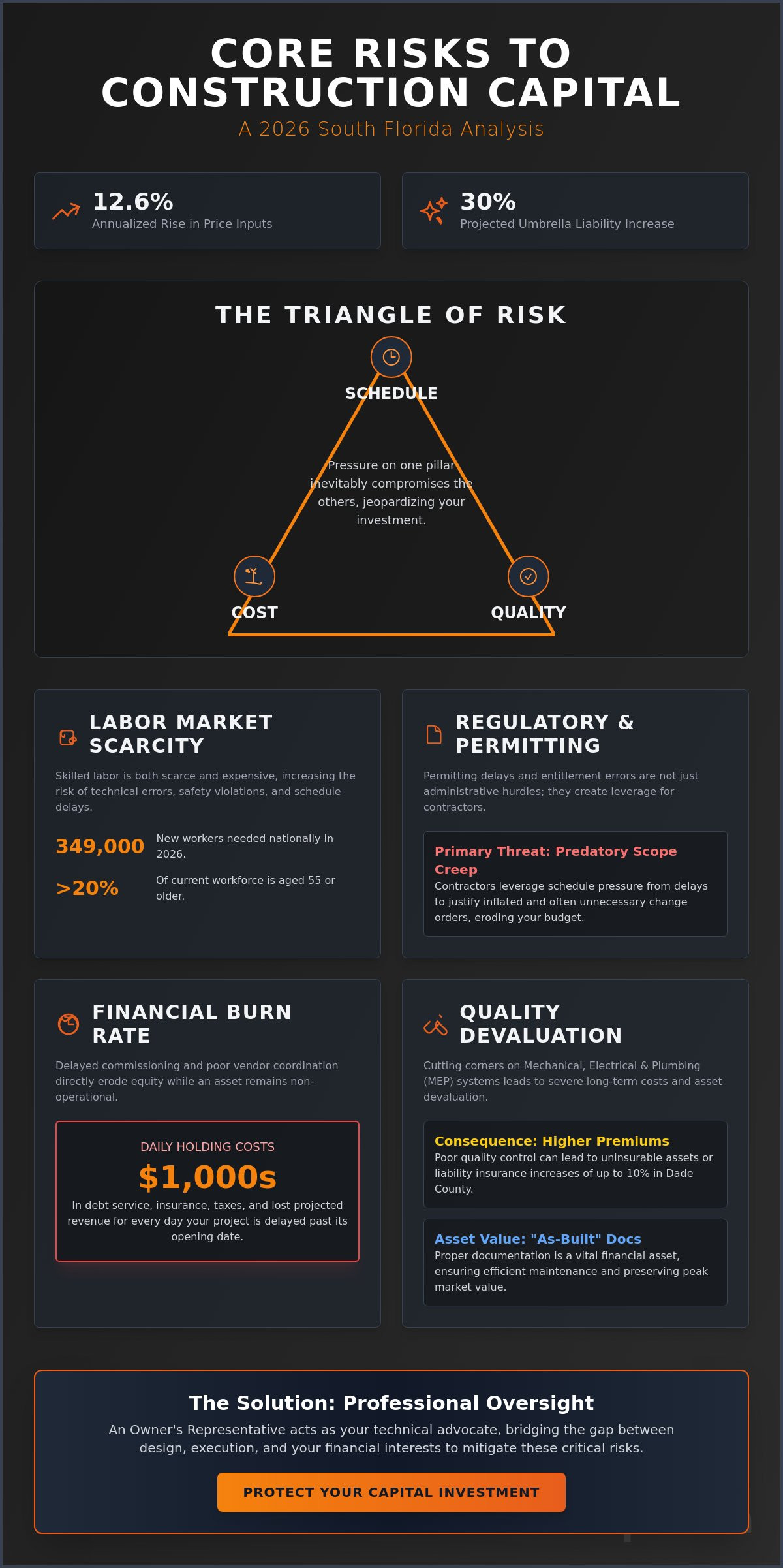
Safeguarding a capital project in 2026 requires more than a standard contract; it demands a technical understanding of the “Triangle of Risk,” which represents the constant tension between cost, schedule, and quality. When material inputs rise at a 12.6% annualized rate, any deviation in one of these pillars inevitably compromises the others. For many owners, the challenge of protecting my investment during construction begins with identifying where these pressures originate. Professional Construction Management methodologies prioritize the stabilization of these variables through disciplined oversight, yet South Florida presents unique variables that can undermine even the most robust plans.
The local labor market and climate create specific financial exposures. With the industry needing 349,000 new workers in 2026 and over 20% of the workforce aged 55 or older, skilled labor is both scarce and expensive. This shortage often leads to the use of inexperienced crews, increasing the likelihood of technical errors and safety violations. Furthermore, South Florida’s regulatory environment and hurricane-driven building codes necessitate precise permitting management. Entitlement errors or delays in municipal approvals aren’t just administrative hurdles; they’re “soft” risks that lead to predatory scope creep, where contractors leverage schedule pressure to justify inflated change orders.
The Financial Impact of Delayed Commissioning
Precision in the final phases of a project is as critical as the foundation. In the context of hospitality or commercial development, the burn rate is defined as the total daily financial loss incurred while an asset remains non-operational, encompassing debt service, property taxes, insurance, and lost projected revenue. For a mid-scale commercial asset in Miami, this daily cost can reach thousands of dollars. These holding costs frequently dwarf the initial fees of professional project management. A delayed opening caused by poor vendor coordination or failed inspections represents a direct erosion of your equity and a failure in protecting my investment during construction.
Quality Devaluation: When “Finished” Isn’t Revenue-Ready
Technical competence is most visible in the execution of Mechanical, Electrical, and Plumbing (MEP) systems. Cutting corners on these complex components might offer minor short-term savings, but the long-term cost of quality devaluation is severe. In Dade County, where general liability insurance is projected to increase by up to 10% in 2026, poor quality control can lead to even higher premiums or uninsurable assets. We view “as-built” documentation as a vital financial asset. It serves as the definitive engineering record of the building’s systems, ensuring that future maintenance is efficient and that the asset maintains its peak market value during a sale or refinancing. High-end property owners, such as those working with DeFeo Luxury Properties on Florida’s Gulf Coast, rely on this level of detail to justify premium valuations during a transaction.
The Role of an Owner’s Representative in Safeguarding Capital
An Owner’s Representative serves as a specialized consultant who functions as the technical extension of the owner’s interests throughout the project lifecycle. Unlike a general contractor whose primary focus is on execution and profit margin, the representative operates with a fiduciary duty to the owner, ensuring that every engineering decision and financial disbursement aligns with the long-term investment strategy. This professional independence is a cornerstone of The Owner’s Role in Project Risk Management, as it provides an objective filter for information flowing from the architect and the general contractor. Without this oversight, owners often find themselves caught in the technical gap between design intent and physical reality, where miscommunications frequently lead to costly delays or structural compromises.
Consider a high-end retail development in Miami where a lack of coordination between the electrical design and the tenant’s specialized lighting requirements threatened a 20% budget overrun. By intervening during the submittal phase, a professional representative identified the discrepancy before procurement, protecting my investment during construction by enforcing a value-engineering solution that maintained the design aesthetic without the projected cost increase. This level of advocacy is essential when dealing with the material price volatility seen in early 2026, where construction inputs rose at a 12.6% annualized rate. It ensures that the owner is not merely reacting to market shifts but is strategically insulated from them through expert technical analysis.
Project Management vs. Owner’s Representation
While internal project management focuses on the daily mechanics of a build, an external Owner’s Representative Miami offers a higher tier of strategic consulting. This distinction is critical in South Florida’s high-velocity market, where regulatory freezes and labor shortages complicate standard workflows. A dedicated representative provides the technical competence to audit contractor claims and verify that work in place matches the high standards expected by sophisticated investors. For those looking to secure their capital, engaging a partner for Owner’s Representation ensures that complex industrial and commercial processes remain under control.
Establishing Professional Transparency
Transparency is the antidote to the anxiety that often accompanies complex builds. We establish this through a rigorous Project Charter, which defines communication protocols and decision-making hierarchies from the outset. By implementing real-time reporting systems, we provide High-Net-Worth Individuals (HNWIs) and corporate boards with precise data on financial disbursements and schedule adherence. This structured information flow ensures that stakeholders are never operating in a vacuum. It provides the unwavering trust necessary to manage large-scale capital investments effectively, allowing owners to focus on their primary business objectives while we maintain technical control of the site.
Strategic Pre-Construction: Protecting Your Investment Before Breaking Ground
The financial viability of a capital project is rarely determined during the vertical build; it’s established during the pre-construction phase. This period represents the owner’s primary opportunity for protecting my investment during construction by eliminating technical ambiguities before they manifest as costly field changes. We approach this phase as a methodical risk-mitigation exercise, where site feasibility and entitlement reviews serve as the first line of defense. In municipalities like Ft. Lauderdale, “zoning surprises” regarding setbacks or drainage requirements can stall a project for months, incurring significant interest carry. A disciplined owner doesn’t leave these variables to chance but instead insists on a rigorous technical audit of all site constraints before committing capital.
Assembly of the design team requires a similar level of engineering scrutiny. While the impulse to select the lowest bidder is common, this strategy often introduces the highest long-term risk. A design that lacks technical precision inevitably leads to gaps in the scope of work, which contractors will exploit through change orders later. Protecting the project’s Pro Forma requires accounting for the 12.6% annualized rise in construction price inputs recorded in early 2026. A realistic budget must also factor in the 5% to 30% projected increase in umbrella and excess liability insurance. We ensure that every financial projection is rooted in these current market realities rather than outdated historical averages.
The Disciplined Bidding and Procurement Process
Our approach to procurement follows a strict three-step protocol to ensure financial stability. First, we prequalify vendors based on their specific performance history within the Florida market, focusing on their ability to manage the current labor shortage of 349,000 workers. Second, we perform a comprehensive “bid leveling” to ensure an apples-to-apples comparison of every scope item, preventing hidden exclusions. Finally, we negotiate contracts that prioritize the owner’s protection, including clearly defined liquidated damages. Engaging strategic pre-construction services in Miami allows owners to establish these safeguards early, creating a transparent framework for all future disbursements.
Permitting and Entitlement Strategy
Navigating the regulatory hurdles of the City of Miami and Miami-Dade County requires more than simple administrative follow-up. While many owners rely on permit “expediters,” true investment protection comes from professional oversight that understands the technical nuances of the 2025 California Building Standards Code (Title 24) and similar local equivalents. A single “Stop Work Order” due to a permitting oversight can derail a schedule and trigger default clauses in financing agreements. By managing the entitlement process with engineering-level precision, we ensure that the transition from design to physical execution is seamless and legally compliant.
Active Construction Oversight: Managing Change Orders and Quality
Effective oversight during the vertical build requires a shift from theoretical design to the physical verification of engineering standards. This is the most vulnerable period for an owner’s capital. Protecting my investment during construction at this stage involves a rigorous audit of monthly pay applications, where each dollar requested must be reconciled against verified work in place. While fund control services act as neutral intermediaries, a professional representative provides the technical judgment to determine if the installation actually meets the design specifications. We distinguish clearly between Quality Assurance (QA), the proactive management of processes to prevent defects, and Quality Control (QC), the reactive inspection of completed work.
Managing the project schedule is equally vital for preventing cascading cost escalations. A delay in one trade often triggers a domino effect, leading to increased interest carry and extended general conditions. We maintain a critical path analysis to ensure that every milestone is met with precision. This disciplined approach prevents the schedule from slipping into a state of “catch-up” where quality is sacrificed for speed.
Defending Against Change Order Fraud
Predatory change orders often hide within inflated labor hours or material surcharges that exceed the 12.6% annualized rate of construction input growth recorded in early 2026. We implement a strict Change Order Protocol that requires every request to be justified by a technical necessity rather than a contractor’s oversight during the bidding phase. Auditing “General Conditions” is a specific focus; we ensure owners don’t pay for contractor overhead twice through redundant billing of site management or shared equipment. For owners seeking a structured approach to field execution, our construction phase management in Florida provides the necessary technical barriers against financial misappropriation.
Risk Mitigation in South Florida’s Climate
The South Florida climate introduces unique variables that require specialized hurricane season protocols. These aren’t merely safety measures; they’re financial protections that safeguard the physical asset and the project timeline. Coordination of insurance is paramount, especially with umbrella and excess liability premiums projected to rise by up to 30% in 2026. We verify that all third parties maintain compliant coverage to prevent the owner from assuming liability for site accidents. We also rigorously analyze “Force Majeure” claims to ensure that weather events aren’t used as a pretext for unfair delay claims or cost increases. If you require a technical partner to oversee your field operations and maintain financial transparency, engage Falke Corp for professional construction phase management.
Commissioning and Close-Out: Securing the Final Asset Value
The “last mile” of a capital project is often the most technically demanding phase. It represents the critical transition from a controlled construction site to a fully operational, revenue-generating asset. For owners, protecting my investment during construction concludes with professional commissioning. This process isn’t a mere visual inspection; it’s a rigorous engineering verification that all complex Mechanical, Electrical, and Plumbing (MEP) systems perform according to the original design specifications. If the building’s automation systems or electrical switchgear aren’t perfectly synchronized, the asset isn’t truly finished. We ensure that the final 2% of the work, often captured in a detailed punch-list, is completed to the highest professional standards before the release of final retention.
Handover protocols must also include the transfer of all intellectual property. This includes updated Building Information Modeling (BIM) files, comprehensive warranties, and operation manuals. Without these digital assets, the owner faces increased maintenance costs and potential operational downtime. We manage this transfer with the same precision applied to the initial foundation; it’s essential that the facility staff is fully trained to operate the new infrastructure. Protecting my investment during construction means ensuring the owner isn’t left with a technically superior building that no one knows how to maintain.
Financial Close-Out and Lien Releases
Securing the final asset value requires a meticulous reconciliation of the project budget. In the Florida legal landscape, obtaining a “Final Waiver of Lien” from every vendor and subcontractor is the most critical step for investment protection. This document ensures that the property is shielded from future legal claims or encumbrances. We oversee the reconciliation of all subcontracts and the verification of final pay applications to ensure that no financial loose ends remain. This disciplined approach is essential for securing the Certificate of Occupancy (CO) without the last-minute administrative delays that often plague unmanaged builds.
The Long-Term Value of a Managed Project
A project delivered through a disciplined methodology carries a higher market premium. In the Miami real estate market, a well-documented asset with a complete “Owner’s Manual” and verified as-built records significantly increases appraisal and resale value. It transforms the building from a simple structure into a transparent, high-quality asset with predictable maintenance cycles. Professional oversight doesn’t just manage the build; it creates a lasting strategic advantage for the owner. If you’re preparing for your next capital project, Contact FALKE Atlantic Corporation for a consultation on your next South Florida development to ensure your investment is protected by engineering excellence.
Strategic Technical Control for Capital Certainty
The stability of a South Florida capital project depends on the transition from reactive management to technical foresight. We’ve analyzed how a disciplined 4-phase methodology mitigates risk, from identifying entitlement hurdles in Broward County to the rigorous verification of MEP systems during commissioning. Protecting my investment during construction isn’t a passive state; it’s a continuous application of engineering competence that prevents predatory scope creep and schedule slippage. By establishing a rigorous Project Charter and maintaining objective oversight, owners can ensure their capital remains insulated from market volatility.
FALKE Atlantic Corporation provides this level of unwavering trust through deep expertise in Miami-Dade and Broward regulations. Our experience managing high-profile assets, such as the Prada Design District store, ensures that your project meets the highest professional standards without compromise. You can Secure Your Investment with FALKE Atlantic Representation to gain full transparency over your financial disbursements and project quality. We invite you to partner with a team that takes full responsibility for delivering a high-quality asset ready for occupancy. Your vision deserves the precision of a professional expert.
Frequently Asked Questions
Is an Owner’s Representative the same as a General Contractor?
An Owner’s Representative is not a General Contractor; they are a consultant with a fiduciary duty to the owner. While the GC manages the labor and physical execution, the Rep provides technical oversight to ensure the GC’s decisions align with the owner’s financial goals. This independence is vital for protecting my investment during construction because it removes the conflict of interest inherent in contractor self-reporting.
How much does professional owner representation typically cost in Florida?
Fees for professional owner representation in Florida are typically structured as a percentage of the total construction cost or a fixed monthly retainer. These costs are generally offset by the savings generated through bid leveling, value engineering, and the prevention of predatory change orders. In a market where construction inputs rose at a 12.6% annualized rate in early 2026, the cost of oversight is a minor fraction of the potential losses from unmanaged risks.
Can I hire an Owner’s Rep after construction has already started?
You can engage an Owner’s Representative at any stage of the project, including after vertical construction has commenced. While early involvement during pre-construction offers the highest ROI, a representative can be brought in to perform a technical audit or “rescue” a project facing significant delays or budget overruns. We often step in to stabilize communication protocols and verify work in place when an owner loses confidence in the contractor’s reporting.
What is the most common way construction investments are lost?
Construction investments are most frequently eroded by cascading schedule delays and unmanaged scope creep. When a project misses its critical path milestones, the daily burn rate of interest carry and lost revenue can quickly exceed the original contingency fund. Protecting my investment during construction requires a disciplined approach to schedule management to ensure the asset reaches its revenue-ready state without unnecessary holding costs.
How does an Owner’s Rep protect against change order fraud?
A representative protects against change order fraud by performing a technical audit on every request to verify its engineering necessity. We compare the requested labor and material costs against the original contract scope and current market rates to identify inflated claims. By enforcing a strict Change Order Protocol, we ensure that contractors don’t use design ambiguities to extract additional profit from the owner.
Do I need an Owner’s Rep for a luxury residential renovation in Miami?
High-end luxury renovations in Miami often involve complex MEP systems and automation that require professional oversight. If the project involves sophisticated structural changes or high-value materials, a representative ensures that the technical execution matches the design intent. This is particularly important in Dade County, where permitting management and hurricane-code compliance introduce significant regulatory risk to the owner’s capital.
What documents are most important for protecting my investment at project close-out?
The Final Waiver of Lien is the most critical document for legal protection at the conclusion of a project. Other essential records include the Certificate of Occupancy, professional commissioning reports, and as-built documentation. These files serve as a definitive engineering record, which is necessary for future maintenance and for maintaining the asset’s appraisal value during a sale or refinancing.
How does South Florida climate impact my construction investment risk?
The South Florida climate necessitates specific hurricane season protocols and moisture control strategies that impact the project’s financial risk profile. Beyond physical protection, these factors influence insurance premiums, with umbrella liability projected to rise by up to 30% in 2026. A managed approach ensures that the project remains compliant with local regulations and that the physical asset is resilient against regional environmental stressors.