Did you know that 30% of commercial project delays in South Florida result from a lack of integrated technical oversight during the pre-construction phase? For property owners, restoring a heritage asset in Miami is a high-stakes fiduciary responsibility where the margin for error is razor-thin. You likely recognize that balancing the stringent requirements of the Miami Historic Environmental Preservation (HEP) Board with the financial realities of modern construction is a complex, often volatile endeavor. This guide demonstrates how a qualified owner’s rep for historic building restoration Miami ensures your project remains a revenue-ready asset by maintaining strict financial control and regulatory alignment. We’ll examine the critical intersection of milestone inspections, High-Velocity Hurricane Zone (HVHZ) compliance, and the strategic oversight necessary to mitigate the 12% rise in skilled labor costs projected for the South Florida market. By the end of this article, you’ll understand how to leverage professional project management to transform a complex restoration into a stable, high-value investment.
Key Takeaways
- Distinguish between standard renovation and historic restoration to navigate the specific technical requirements of the Miami-Dade Historic Preservation Board.
- Learn how engaging an owner’s rep for historic building restoration Miami serves as a fiduciary safeguard, coordinating specialized consultants to ensure regulatory and financial alignment.
- Identify the structural risks unique to South Florida’s coastal climate and the specialized technical oversight required to address aged masonry and historic material matching.
- Explore a disciplined four-phase framework that bridges the gap between initial site feasibility and final commissioning to deliver a revenue-ready asset.
- Discover how integrated project management and pre-construction services mitigate financial volatility while ensuring seamless permitting and milestone inspection compliance.
The Complexity of Historic Building Restoration in Miami
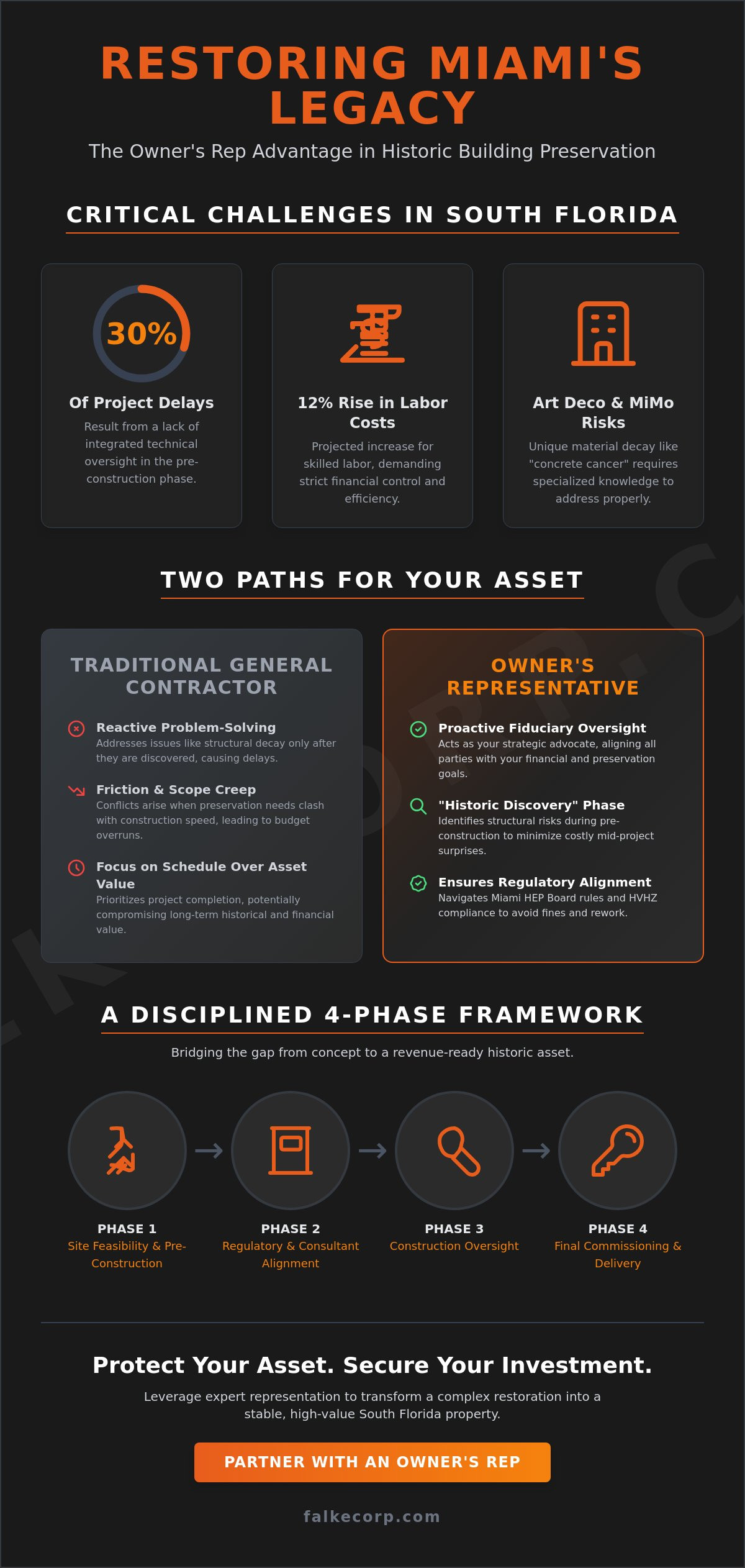
Restoring a historic structure in Miami isn’t a standard renovation. While a renovation typically focuses on updating a property for modern utility, restoration demands a rigorous adherence to the building’s original architectural intent and material integrity. This process is governed by a technical and legal framework that traces its origins to the National Historic Preservation Act of 1966. For a property owner, this creates a complex fiduciary duty. You must preserve the asset’s historical value while ensuring it remains a viable, revenue-generating property in a market where skilled labor costs are projected to rise by 12% over the next 18 months. Achieving this balance in South Florida’s volatile construction environment requires a level of technical oversight that traditional general contracting rarely provides.
Miami’s Architectural Heritage: Art Deco and MiMo Challenges
Miami’s architectural identity is defined by its 1920s Art Deco and 1950s MiMo (Miami Modern) styles. These structures present unique material challenges that modern building teams often misunderstand. Early 20th-century concrete often lacks the chemical resistance found in modern mixes. Decades of exposure to high humidity and salt-laden air cause carbonation and chloride-induced corrosion, commonly known as “concrete cancer.” When internal steel reinforcement oxidizes and expands, it compromises the structural envelope. Adhering to the Secretary of the Interior’s Standards for the Treatment of Historic Properties means you can’t simply replace these elements with modern equivalents. You must match original textures, colors, and aggregate compositions. Without an expert owner’s rep for historic building restoration Miami, these technical nuances often lead to failed inspections, regulatory fines, and costly rework.
Why Traditional Project Management Often Fails Historic Assets
Traditional project management models frequently collapse when applied to historic assets. General contractors prioritize schedule and budget based on known quantities. However, historic projects are defined by the unknown. Scope creep happens the moment a contractor opens a wall and discovers non-compliant electrical systems or structural decay that wasn’t visible during the initial walkthrough. A general contractor’s primary goal is to finish the job, which can lead to friction when preservation requirements conflict with construction speed.
An owner’s representative serves as a strategic advocate who understands both preservation and profitability. They manage the “historic discovery” phase during pre-construction to minimize surprises. This oversight is vital. A 2024 analysis indicated that 30% of commercial project delays in South Florida stem from a lack of integrated technical oversight. By hiring an owner’s rep for historic building restoration Miami, you ensure that the project is managed with a systems-thinking approach, where every technical decision is weighed against its impact on the final asset value and long-term compliance.
Strategic Role of an Owner’s Representative in Preservation
In the specialized sector of Miami real estate, where historic property values have historically outperformed non-historic districts by nearly double, the role of an advocate is not merely administrative; it’s fiduciary. Historic restoration introduces a layer of technical and regulatory volatility that standard construction management isn’t equipped to absorb. An owner’s rep for historic building restoration Miami acts as the central node in a complex network of architects, preservation consultants, and specialty contractors. Their primary function is to align these disparate parties with the owner’s financial objectives while maintaining strict compliance with the Miami-Dade Historic Preservation Board’s standards.
Financial control in this environment requires more than simple bookkeeping. It demands proactive change order management and meticulous budget oversight. Because historic structures often reveal hidden defects mid-construction, a representative must establish a disciplined framework for “historic discovery.” This ensures that unforeseen structural issues don’t lead to unchecked scope creep. By implementing rigorous pre-construction services, the representative identifies potential risks before they impact the critical path of the project schedule. This level of oversight is particularly vital given that owner’s representative fees for such complex projects typically range between 3% and 5% of the total budget, reflecting the depth of expertise required.
Owner’s Rep vs. Project Manager: The Fiduciary Difference
While a project manager typically focuses on the tactical execution of a defined scope, an Owner’s representative Miami serves as a strategic advisor. This distinction is critical for complex capital improvements. The representative doesn’t just manage the “how” of the construction; they safeguard the “why” of the investment. When conflicts arise between a preservation architect’s vision and a contractor’s logistical constraints, the representative provides the technical mediation necessary to protect the owner’s interests. They ensure that every dollar spent contributes to the asset’s long-term value and revenue readiness.
Selecting the Right Team for Historic Restorations
Assembling a team for a 1930s Art Deco hotel or a MiMo-era mid-rise requires a specialized procurement strategy. A standard bidding process often fails to account for the technical expertise needed for historic masonry or specialized glazing. The representative leads the procurement phase by evaluating vendors based on their specific preservation portfolios and technical competence. They ensure the bidding process reflects fair market value while accounting for the 12% rise in skilled labor costs currently affecting the South Florida market. This disciplined approach to team assembly ensures that the project benefits from artisans who respect the structure’s past and engineers who understand its future use. For those seeking to stabilize their investment through professional oversight, exploring strategic development management is a logical next step.
Navigating Miami’s Historic Preservation Regulations
Achieving regulatory approval in Miami-Dade County requires a sophisticated understanding of the Historic Environmental Preservation (HEP) Board’s protocols. For any developer, the primary hurdle is securing a Certificate of Appropriateness (COA), which validates that proposed work aligns with the district’s architectural standards. Major structural modifications or additions necessitate a Special COA, a process that involves public hearings and rigorous scrutiny of technical specifications. An owner’s rep for historic building restoration Miami serves as the technical liaison during these proceedings, translating complex preservation requirements into actionable construction phases. They manage the delicate balance between community stakeholder expectations and the developer’s operational needs, ensuring that the project narrative presented to city staff is both technically sound and strategically aligned.
The Permitting Labyrinth in South Florida
The permitting process in South Florida is notoriously non-linear. Traditional building permits, which typically cost between 1.5% and 3% of the declared project value, can’t be finalized until the historic certificates are fully executed. A professional representative synchronizes these timelines to prevent the ‘Stop Work Order’ that often occurs when field conditions deviate from approved preservation plans. This coordination is especially vital for projects within the High-Velocity Hurricane Zone (HVHZ). Every roofing material or glazing system must be cross-referenced with the Miami-Dade Notice of Acceptance (NOA) database while simultaneously meeting aesthetic material-matching requirements. By maintaining a proactive dialogue with city preservation staff in jurisdictions like the City of Miami or Miami Beach, the representative facilitates expedited reviews and ensures the design team’s output remains compliant throughout the entitlement phase.
Incentives and Ad Valorem Tax Exemptions
Financial viability is often bolstered by local and federal incentives that reward the stewardship of historic fabric. Property owners of designated historic assets may qualify for ad valorem tax exemptions for qualifying restoration and rehabilitation work. In Miami-Dade, this requires a new application to be submitted annually by the March 1st deadline. The representative’s role is critical in this phase. They provide the meticulous documentation and technical reporting required to verify that the work adheres to the Secretary of the Interior’s Standards. Beyond local tax relief, they assist in navigating federal preservation tax credits, which can provide a 20% credit for the certified rehabilitation of income-producing historic structures. Strategic use of these credits significantly offsets the premium costs associated with specialized labor and the structural integrity reserve studies (SIRS) now required under Florida’s 2026 milestone inspection laws.
A Disciplined Framework for Restoration: Concept to Commissioning
Successful restoration of a historic asset requires a methodological lifecycle that transitions from theoretical vision to technical reality. This framework begins with Phase 1: Initial Concept and Site Feasibility. During this stage, the owner’s rep for historic building restoration Miami evaluates the structure’s physical constraints against the intended modern use. This alignment is critical to ensure the project’s financial viability before significant capital is committed. Phase 2 moves into Pre-Construction and Design, where the representative manages the entitlement process with the HEP board and coordinates the bidding phase to capture fair market value. This is especially important in a market where labor costs are rising by 12%. Phase 3 focuses on construction phase management florida expertise. This is where the technical preservation standards meet the logistical demands of the site. Finally, Phase 4 covers Commissioning and Close-out. This ensures that every system, from the HVHZ-compliant roof to the historic glazing, functions as intended and that all documentation is ready for the asset to be revenue-ready.
Pre-Construction: Risk Mitigation in the Design Phase
Risk mitigation during the design phase is the most effective way to prevent the 30% of commercial project delays common in South Florida. Site feasibility studies must go beyond surface-level inspections to uncover hidden structural decay or non-compliant materials that could trigger costly change orders later. A disciplined owner’s rep for historic building restoration Miami develops a realistic budget that incorporates a ‘historic contingency’ fund. This fund reflects the technical complexity of the building’s age and the specific requirements for material matching. This phase concludes with construction drawings that satisfy both the owner’s ROI goals and the HEP board’s aesthetic mandates, ensuring a seamless transition to the permitting stage.
Construction Oversight and Quality Control
Daily oversight during the construction phase ensures that contractors don’t cut corners on preservation standards or safety protocols. When unforeseen conditions arise, such as the discovery of compromised masonry behind a facade, the representative provides immediate technical mediation. They validate contractor pay applications by ensuring that the work completed matches the approved budget and quality benchmarks. This rigorous control protects the owner from financial leakage and ensures the project remains on the critical path. Furthermore, the representative ensures that all structural repairs align with the requirements for milestone inspections and structural integrity reserve studies. For owners seeking this level of technical precision, our development management services provide the necessary strategic oversight to protect the asset’s long-term value.
FALKE Atlantic: Protecting Assets through Expert Representation
FALKE Atlantic provides a specialized management layer designed to absorb the technical and financial volatility inherent in South Florida’s historic districts. We operate with a singular commitment to delivering high-quality, revenue-ready assets that honor their architectural lineage while meeting modern performance standards. As an experienced owner’s rep for historic building restoration Miami, we prioritize absolute financial control and transparency. Our clients, ranging from institutional investors to high-net-worth individuals, require a fiduciary partner who understands that a historic structure is both a cultural landmark and a sophisticated financial instrument. By maintaining a disciplined oversight of every technical detail, we transform the inherent risks of preservation into a stabilized, long-term investment.
The FALKE Methodology: A Fiduciary First Approach
Our four-phase approach is essential for construction project management Florida, specifically within the context of aged structural envelopes. We manage the delicate interface between third-party vendors, including preservation architects and specialty contractors, to eliminate the operational friction that typically leads to delays. By acting as the primary point of contact, we ensure that the design team’s vision remains aligned with the owner’s budgetary constraints. Our methodology has been applied to complex developments in Miami’s most prestigious districts, where we have successfully mitigated the impact of rising labor costs and stringent milestone inspection requirements. We don’t merely observe the process; we take full responsibility for the technical and administrative coherence of the project from the initial feasibility study to the final close-out.
Partner with FALKE Atlantic for Your Next Restoration
Engaging a boutique consultancy with deep local expertise provides a level of precision that larger, generalized firms often lack. We understand the specific nuances of Miami-Dade’s regulatory landscape, from the High-Velocity Hurricane Zone (HVHZ) requirements to the tax exemption deadlines that can significantly impact your ROI. As your owner’s rep for historic building restoration Miami, we ensure your property remains a viable, high-performing asset that is fully compliant with the latest Florida building laws. Our strategic oversight allows you to focus on your broader investment portfolio while we handle the complexities of the construction site. We invite you to contact FALKE Atlantic for a strategic consultation to discuss how our disciplined management framework can secure the future of your Miami development.
Securing the Future of Miami’s Historic Assets
Restoring a historic structure is a high-stakes fiduciary challenge that requires more than just standard project management. It demands a systems-thinking approach where technical preservation, regulatory compliance, and financial control converge. By utilizing a disciplined four-phase methodology, you ensure that every stage of the lifecycle, from initial site feasibility to final commissioning, is managed with technical precision. Engaging a qualified owner’s rep for historic building restoration Miami provides the strategic oversight necessary to mitigate operational risks and navigate the complex requirements of the Miami-Dade HEP board. This level of professional advocacy ensures that your investment results in a revenue-ready asset that maintains its historical integrity and long-term market value. You can move forward with confidence knowing that your capital is protected through expert representation and rigorous quality control.
Contact FALKE Atlantic for expert Owner Representation in Miami to ensure your next restoration project meets the highest professional standards of stability and quality.
Frequently Asked Questions
What is the difference between an Owner’s Rep and a General Contractor in historic restoration?
An Owner’s Rep acts as a fiduciary advocate for the property owner, whereas a General Contractor is a vendor responsible for the physical execution of the build. The representative provides technical oversight across all project participants, including the contractor, to ensure the project remains aligned with the owner’s financial and strategic goals. This creates a necessary system of checks and balances that prevents the conflict of interest inherent when a contractor self-polices their own quality and schedule.
How much does an Owner’s Representative cost for a Miami restoration project?
Industry standards for professional oversight fees in the Miami restoration sector are typically structured to reflect the project’s technical complexity and the representative’s fiduciary responsibility. These costs are often calculated as a percentage of the total construction budget, although some firms utilize fixed-fee or hourly models for specific pre-construction phases. The investment in expert representation is designed to be offset by the mitigation of project delays and the avoidance of costly regulatory fines.
Why is a Certificate of Appropriateness (COA) required in Miami historic districts?
A Certificate of Appropriateness is a mandatory regulatory instrument that ensures any proposed modifications to a designated property align with Miami’s historic preservation standards. This process protects the architectural integrity of districts like Art Deco or MiMo by requiring that materials, scales, and finishes match the original structure. Without a COA, an owner cannot secure traditional building permits, which often leads to project halts and significant legal liabilities during the construction phase.
Can an Owner’s Rep help with historic tax credit applications in Florida?
Yes, an owner’s rep for historic building restoration Miami facilitates the rigorous documentation process required for both local ad valorem tax exemptions and federal historic preservation tax credits. They ensure that all restoration work adheres to the Secretary of the Interior’s Standards, which is a prerequisite for eligibility. By coordinating with preservation consultants, the representative ensures that technical reports are submitted before the annual March 1st deadline to maximize the project’s ROI.
How does an Owner’s Rep manage budget overruns in old buildings?
Budget overruns in aged structures are managed through a disciplined “historic discovery” phase during pre-construction and the establishment of dedicated contingency funds. The representative utilizes technical oversight to identify hidden structural defects, such as chloride-induced corrosion in masonry, before they trigger unchecked change orders. By validating every pay application against the actual work completed, the representative maintains strict financial control and prevents the scope creep that often plagues unmonitored restoration projects.
What are the most common mistakes in Miami historic building restorations?
One of the most frequent mistakes is the failure to integrate technical oversight during the pre-construction phase, which contributes to 30% of commercial project delays in South Florida. Other errors include using materials that don’t meet High-Velocity Hurricane Zone (HVHZ) standards or neglecting the specific material-matching requirements of the HEP board. These oversights often result in expensive rework, failed milestone inspections, and the loss of potential historic tax incentives that are critical for asset stabilization.
How long does the historic permitting process take in Miami-Dade County?
The permitting timeline for historic properties in Miami-Dade County is non-linear and can range from several months to over a year depending on the project’s complexity. This duration is influenced by the requirement for public hearings before the HEP board and the synchronization of historic certificates with traditional building permits. A qualified representative expedites this process by maintaining proactive communication with city staff and ensuring that all technical submittals are compliant upon first review.
Does an Owner’s Rep manage the architect and design team as well?
An owner’s rep for historic building restoration Miami serves as the primary point of contact and manager for the entire design team, including architects and engineers. They ensure that the design professionals remain focused on the owner’s strategic objectives while adhering to the technical constraints of the historic structure. This management layer eliminates operational friction and ensures that construction drawings are both buildable and compliant with preservation mandates before the bidding process begins.