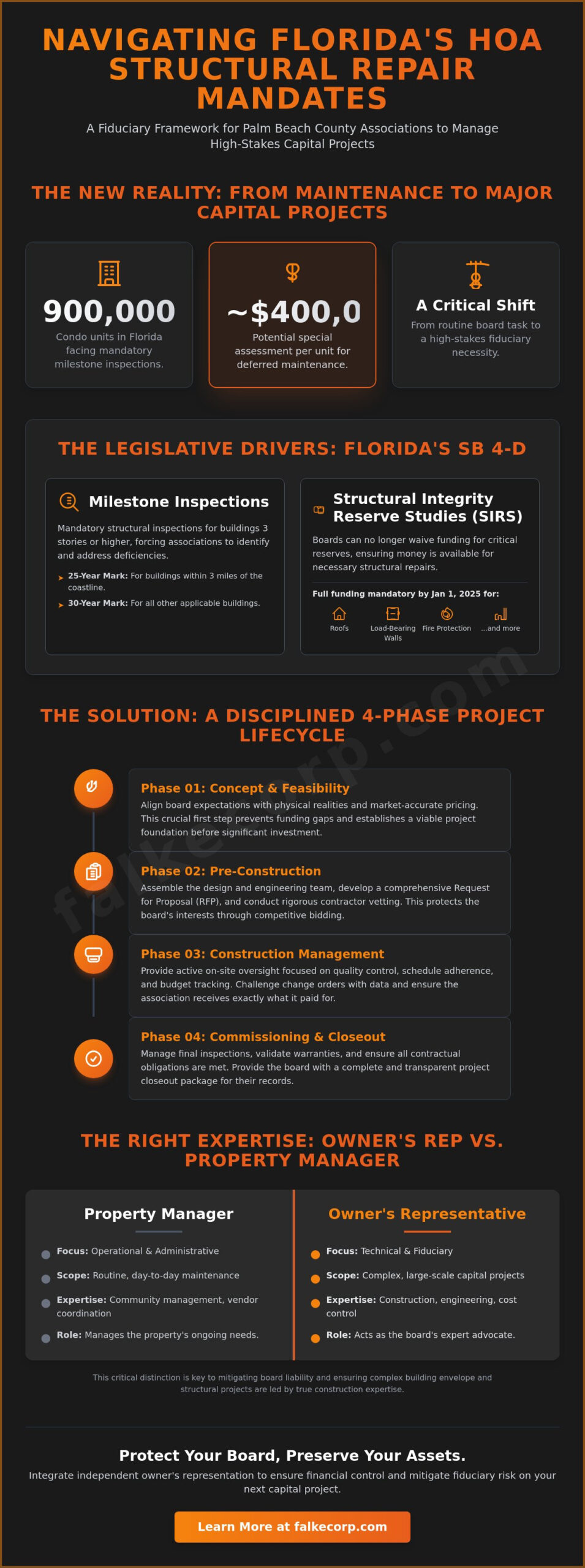
With 900,000 condominium units across Florida facing mandatory milestone inspections, some associations are confronting individual unit assessments as high as $400,000 to address long-deferred maintenance. For volunteer boards, the technical burden of managing large-scale HOA repairs in Palm Beach County has transitioned from a routine maintenance task into a high-stakes capital development project. You likely recognize that relying solely on a general contractor often leads to unchecked change orders and significant financial exposure. It’s a precarious position where independent technical oversight is no longer optional but a fiduciary necessity.
This guide provides a professional framework to execute complex structural repairs while shielding the board from liability and ensuring absolute fiscal transparency. We’ll detail the precise mechanisms of owner’s representation, from pre-construction services to the final commissioning phase. By implementing structured project management and rigorous financial controls, your association can satisfy mandatory Structural Integrity Reserve Study (SIRS) requirements while maintaining the long-term stability of your community’s assets.
Key Takeaways
- Understand how Florida’s evolving structural integrity laws and mandatory reserve funding (SIRS) necessitate a shift from reactive maintenance to rigorous capital planning.
- Discover the specific methodology for managing large-scale HOA repairs in Palm Beach County, focusing on aligning board expectations with technical feasibility and market-accurate cost projections.
- Learn the critical distinction between operational property management and technical project oversight to ensure complex building envelope and structural projects are led by construction expertise.
- Establish rigorous financial controls through the systematic separation of hard and soft costs, enabling the board to challenge contractor change orders with data-driven authority.
- Identify strategies to mitigate fiduciary risk and board liability by integrating independent owner’s representation into every phase of the construction lifecycle.
The Landscape of Large-Scale HOA Repairs in Palm Beach County
Large-scale repairs in Palm Beach County encompass critical structural interventions such as concrete restoration, comprehensive roof replacements, and building envelope waterproofing. These aren’t minor maintenance tasks; they represent complex capital improvements that demand a sophisticated level of technical oversight. A Homeowner association must recognize that the coastal environment of South Florida significantly accelerates the degradation of structural components. Salt air intrusion and high humidity levels lead to rebar oxidation and concrete spalling, making the process of managing large-scale HOA repairs in Palm Beach County a matter of structural survival. The days of deferring these projects are over, as the legislative environment has shifted from permissive to strictly mandatory.
Florida’s Senate Bill 4-D has fundamentally altered the operational requirements for condominiums and cooperatives. The introduction of Structural Integrity Reserve Studies (SIRS) means boards can no longer waive the funding of critical reserves for structural components. As of January 1, 2025, full funding is mandatory for items like roofs, load-bearing walls, and fire protection systems. This regulatory shift forces a transition from reactive, “patch-and-repair” mentalities to disciplined construction project management. Boards are now required to maintain a higher standard of technical competence to ensure their buildings remain compliant with evolving safety standards.
Regulatory Pressures in South Florida
The legislative mandate for milestone inspections is particularly acute for Palm Beach properties. Buildings three stories or higher must undergo inspections at the 25 or 30-year mark depending on their distance from the coastline. Local building departments in West Palm Beach and Boca Raton have intensified their scrutiny of major permits, often requiring detailed engineering reports before any work begins. Navigating these municipal requirements demands a high degree of technical precision. Board members hold a fiduciary duty to address these structural mandates. Failure to act doesn’t just risk building safety; it creates significant legal exposure for the board itself.
Financial Implications for Community Associations
Executing multi-million dollar repairs often necessitates significant special assessments. These financial demands can cause friction within the community if not handled with transparency. Boards must balance the optics of these costs with the reality of construction inflation, as construction input prices rose approximately 5% year-over-year in 2026. Successfully managing large-scale HOA repairs in Palm Beach County requires a clear distinction between reserve funding and external construction financing. Cost overruns are the primary driver of community-wide legal disputes. Without professional oversight to manage the “hard costs” of materials and “soft costs” of design, associations risk exhausting their credit lines before project completion.
A Disciplined Methodology for Managing HOA Capital Projects
Executing high-stakes capital improvements requires a linear, four-phase lifecycle that prioritizes technical accuracy over administrative convenience. The process begins with Phase I: Concept and Feasibility. During this stage, we align the board’s expectations with the physical realities of the structure and current market pricing. This prevents the common error of initiating a project based on outdated reserve studies, only to face a funding gap once the true scope of concrete restoration or envelope waterproofing is revealed. Managing large-scale HOA repairs in Palm Beach County demands this initial rigor to ensure the project’s financial viability before the first permit is pulled.
Phase II involves Pre-Construction, where the focus shifts to design team assembly and the development of a comprehensive Request for Proposal (RFP). This is the stage where the board’s interests are protected through competitive bidding and rigorous contractor vetting. In Phase III, Construction Phase Management, the emphasis moves to quality control and schedule adherence. Given that Florida’s construction industry is forecasted to grow by 8.2% through 2026, competition for Tier-1 labor is intense; active oversight ensures your project remains a priority. Finally, Phase IV: Commissioning and Close-out involves the meticulous collection of lien releases and warranty documents, ensuring the association isn’t left with lingering legal or technical liabilities.
Pre-Construction: Setting the Foundation for Success
The transition from a conceptual plan to an active job site occurs during the pre-construction phase. The methodologies utilized in strategic pre-construction services in Miami translate directly to the Palm Beach market, where vetting general contractors for financial liquidity is vital. Under the governance of Florida Statutes Chapter 720, boards must demonstrate due diligence in their selection processes. A robust RFP doesn’t just ask for a price; it demands a detailed logistics plan and a verifiable local track record to ensure the contractor can handle the specific demands of a multi-story residential environment.
Active Oversight: The Owner’s Representative on Site
Once work commences, the owner’s representative acts as the board’s technical eyes and ears, monitoring daily progress to prevent unauthorized scope creep. We establish a strict communication protocol that filters technical data from the contractor into actionable reports for the board. Field reports act as the board’s primary defense against fraud by providing a contemporaneous record of materials used and milestones achieved. This level of professional construction phase management is essential for maintaining the project’s integrity. By identifying deviations from the design specifications early, we mitigate the risk of costly rework and ensure the building’s long-term stability remains the central focus of the intervention.
Owner’s Rep vs. Property Manager: Differentiating Technical Oversight
A frequent misconception among board members is that their existing property management firm possesses the technical infrastructure required for managing large-scale HOA repairs in Palm Beach County. While a Licensed Community Association Manager (LCAM) is indispensable for administrative compliance and day-to-day operations, their expertise rarely extends to the granular complexities of a multi-million dollar construction site. Construction project management is a distinct discipline that requires an understanding of structural engineering, critical path scheduling, and the rigorous verification of submittal logs. Relying on an operational manager to supervise a building envelope restoration risks a disconnect between the design intent and the field execution.
Independent representation is vital because it eliminates the inherent conflicts of interest that can arise when management firms attempt to oversee vendors they also hire for routine services. An Owner’s Representative provides a layer of technical advocacy that is strictly aligned with the board’s fiduciary interests. This involves evaluating schedule logic to ensure the contractor isn’t artificially inflating durations and scrutinizing complex change orders that lack empirical justification. Under Florida statutory requirements for HOA maintenance, boards are obligated to maintain accurate records and ensure the structural integrity of the common elements, a task that becomes exponentially more difficult without professional oversight during active construction.
The Limitations of Standard Association Management
Property managers are trained to handle the ‘now’, which includes tenant relations, vendor payments, and administrative filings. Conversely, an Owner’s Representative handles the ‘build’, focusing on the technical lifecycle of a capital improvement. Most standard property management agreements explicitly exclude the oversight of major construction due to the liability involved. When an LCAM ‘rubber-stamps’ a contractor’s invoice without technical verification of the percentage of work completed, the association faces immediate financial exposure. This lack of technical depth often results in the board paying for materials not yet on-site or labor that hasn’t met the quality standards defined in the specifications.
When to Engage an Owner’s Representative
Associations should establish clear thresholds for engaging professional oversight. Projects involving structural complexity, budgets exceeding $500,000, or durations longer than six months typically require a dedicated project manager. An Owner’s Rep doesn’t replace the property management team; instead, they complement them by absorbing the technical burden that would otherwise overwhelm an administrative staff. For a deeper understanding of how these roles differ across markets, reviewing the framework of an Owner’s Representative Miami: Protecting Your Real Estate Assets in 2026 provides valuable comparative context for Palm Beach boards. This strategic partnership ensures that operational needs and construction goals remain distinct yet synchronized throughout the project’s duration.
Financial Control and Risk Mitigation in HOA Construction
Managing large-scale HOA repairs in Palm Beach County requires a dual-track financial strategy that distinguishes between ‘hard costs’ and ‘soft costs’. Hard costs represent the tangible construction expenses, such as concrete, roofing materials, and labor. Soft costs include the necessary but non-physical expenses: engineering fees, municipal permit costs, and specialized project management. An association’s budget often fails because it focuses exclusively on the contractor’s bid while neglecting the 15-20% of the total project cost typically consumed by soft expenses. By establishing a comprehensive budget early, boards can avoid the technical insolvency that occurs when a project’s scope exceeds its funding capacity.
A disciplined owner’s representative utilizes the AIA G702 and G703 payment application process to maintain fiscal control. This standardized system requires contractors to provide a detailed schedule of values, breaking down the project into granular milestones. Payment is only authorized for work that’s been verified on-site, preventing the association from ‘front-loading’ the contract or paying for materials that haven’t been delivered. This level of scrutiny is the primary defense against the financial depletion of reserves, especially in an environment where construction input prices have risen approximately 5% year-over-year in 2026. To secure your association’s financial future, it’s vital to consult with a professional owner’s representative who understands these technical nuances.
Budget Integrity and Cost Control
Maintaining budget integrity involves more than just tracking expenses; it requires proactive change order management. We challenge every cost escalation by demanding empirical proof of necessity and market-accurate pricing before approval is granted. As detailed in our overview of construction project management in Florida, this phase is where the most significant financial leakage occurs if left unchecked. We also implement value engineering, which is a systematic method to reduce project costs through material or process substitution without sacrificing structural quality or building performance. This ensures the association receives the highest ROI on its capital assets while maintaining a healthy contingency fund for unforeseen conditions.
Mitigating Board Liability
Board members are often concerned about personal liability when overseeing multi-million dollar projects. Utilizing professional oversight is a critical step in satisfying the ‘Business Judgment Rule’ in Florida, which protects directors who make informed, good-faith decisions. We document every technical decision, change order, and site inspection for the board’s permanent record, providing a clear audit trail. This transparency is also essential for protecting individual unit owners under Florida’s Construction Lien Law. By ensuring all partial and final lien releases are collected before payments are issued, we prevent subcontractors from placing legal encumbrances on the properties of residents who’ve already paid their assessments.
Why FALKE Atlantic is the Strategic Partner for Palm Beach HOAs
FALKE Atlantic operates as a specialized technical extension of the board, providing a level of precision that standard management firms cannot replicate. When managing large-scale HOA repairs in Palm Beach County, the stakes extend beyond simple aesthetics; they involve the preservation of multi-million dollar assets and the mitigation of significant legal risks. Our boutique model focuses on high-visibility residential projects where the complexity of the building envelope or structural system requires unwavering attention to detail. We understand the specific pressures of the South Florida market, from the coastal requirements in Jupiter to the luxury high-rise standards in Boca Raton. This geographic expertise allows us to anticipate local building department nuances and labor market fluctuations that often derail less experienced teams.
Our commitment to transparency functions as a bridge between the association board and the construction entities. We translate technical data into actionable intelligence, ensuring that stakeholders with high-net-worth expectations receive the level of reporting they demand. By maintaining a strictly objective stance, we ensure that every dollar of the association’s capital is deployed effectively, according to the highest professional standards. This unwavering focus on the board’s fiduciary interests is what defines our role as a strategic partner rather than a mere service provider.
The FALKE Advantage in Residential Reconstruction
The technical rigor we apply to commercial project management in Miami provides a robust framework for residential reconstruction at scale. In an HOA environment, the ‘Owner’ is a collective body with shared fiduciary responsibilities. We protect this collective interest by managing the complex logistics of active residential sites, where construction must proceed without compromising the safety or privacy of the residents. Our experience in managing revenue-ready assets ensures that the project lifecycle is optimized for both speed and structural quality, preventing the common pitfalls of deferred maintenance.
Securing Your Association’s Future
Professional oversight is a strategic investment in the community’s future. Beyond satisfying the immediate demands of Florida’s structural compliance landscape, high-quality restoration directly correlates with increased property values and reduced long-term insurance premiums. As associations prepare for the next decade of mandatory inspections and reserve funding, having a partner who understands the evolution of the Florida Building Code is essential. We invite you to request a consultation to discuss your association’s upcoming capital improvement needs and how our disciplined methodology can secure your community’s structural and financial integrity. By partnering with FALKE Atlantic, you’re choosing a path of technical competence and long-term stability.
Securing the Structural and Financial Integrity of Your Association
The landscape of South Florida construction has reached a point where passive oversight is no longer a viable strategy for volunteer boards. Successfully managing large-scale HOA repairs in Palm Beach County requires a rigorous adherence to a four-phase project methodology that prioritizes technical accuracy and fiscal transparency. By separating operational management from technical construction oversight, associations can bridge the gap between complex engineering requirements and the board’s fiduciary responsibilities. Our deep expertise in South Florida structural compliance ensures that your community navigates evolving regulations without the risk of unchecked change orders or compromised building safety.
Protecting your association’s assets begins with a dedicated focus on owner-side financial protection and disciplined project management. With the right technical advocacy, your board can transform a mandatory structural repair into a strategic enhancement of property value. Take the first step toward a predictable, transparent construction experience.
Protect your association’s assets—Schedule a strategic consultation with FALKE Atlantic
Frequently Asked Questions
What is the difference between an Owner’s Representative and a General Contractor for an HOA?
An Owner’s Representative acts as a technical advocate for the association, whereas a General Contractor is the entity responsible for the physical execution of the work. The representative provides independent oversight to ensure the contractor adheres to the design specifications and budget. This relationship eliminates the inherent conflict of interest that occurs when a contractor self-polices their own progress, quality standards, and billing cycles.
Does our HOA property manager’s license cover construction project management?
A Licensed Community Association Manager (LCAM) is qualified for administrative and operational governance, but their license doesn’t typically encompass construction project management. Most property management agreements explicitly exclude the supervision of major capital improvements due to the technical complexity and liability involved. Managing large-scale HOA repairs in Palm Beach County requires a distinct set of engineering and construction management credentials to protect the board’s fiduciary interests.
How much does an Owner’s Representative typically cost for a Palm Beach HOA project?
The fee structure for an Owner’s Representative is typically determined by the project’s complexity and total construction budget. While specific costs vary based on the required scope of services, associations generally find that professional oversight pays for itself through the mitigation of unauthorized change orders and the avoidance of costly rework. Boards should view this as a necessary soft cost within the overall capital improvement budget.
What is a Structural Integrity Reserve Study (SIRS) and how does it affect our repairs?
A Structural Integrity Reserve Study (SIRS) is a mandatory evaluation of a building’s structural components, including the roof, load-bearing walls, and building envelope. As of January 1, 2025, Florida law requires associations to fully fund reserves for these items without the possibility of an owner waiver. This study dictates the timing and financial scope of necessary repairs, forcing boards to confront long-deferred maintenance through disciplined project management.
Can an Owner’s Representative help our board with the bidding process in Florida?
Yes, an Owner’s Representative manages the entire procurement phase, from developing a detailed Request for Proposal (RFP) to bid leveling and contractor vetting. This process ensures the association receives accurate comparisons between bids. We verify the financial stability and local track record of bidders to ensure the board selects a partner capable of meeting the specific demands of a multi-story residential environment.
How does an Owner’s Rep prevent construction delays in Palm Beach County?
An Owner’s Rep prevents delays by monitoring the critical path schedule and identifying procurement bottlenecks before they impact the job site. Given that construction input prices rose approximately 5% year-over-year in 2026, time is a significant financial factor in project success. We maintain constant communication with the design team and contractor to resolve technical discrepancies that would otherwise stall progress and inflate labor costs.
What happens if our HOA doesn’t comply with the new Florida structural repair laws?
Failure to comply with Florida’s structural integrity laws can result in significant legal exposure for board members and the potential loss of property insurance coverage. In extreme cases, buildings that miss milestone inspection deadlines or fail to address structural deficiencies may face condemnation by municipal building departments. Proactive oversight ensures the association remains compliant with the 25 or 30-year inspection requirements mandated by recent legislation.
How do we explain the need for an Owner’s Rep to our residents?
Residents should understand that an Owner’s Representative serves as a technical insurance policy for their collective capital investment. By ensuring technical accuracy and financial transparency, the representative prevents the waste of special assessment funds. When managing large-scale HOA repairs in Palm Beach County, professional oversight is the most effective way to protect individual property values and ensure the long-term structural stability of the community.