
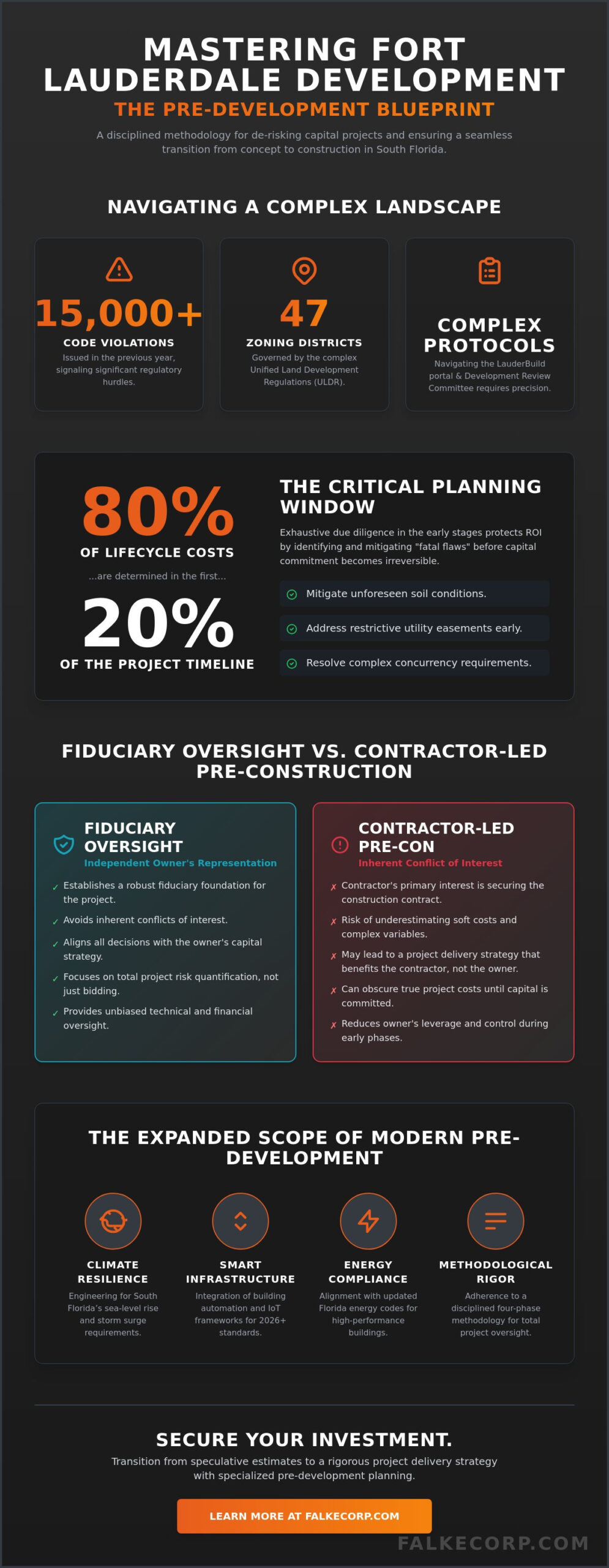
In the South Florida development landscape, the margin between a viable asset and a distressed project is often defined by the technical rigor applied during the initial site assessment and entitlement phases. Professional pre-development planning services Fort Lauderdale provide the necessary analytical framework to navigate these complexities, ensuring that every variable is quantified before significant capital is committed. You’re likely aware that the LauderBuild portal and the intricate permitting protocols of Broward County can introduce significant delays if they aren’t managed with precision. The concern regarding budget overruns during the design phase is a rational response to a market where over 15,000 code violations were issued in the previous year alone.
This article provides a comprehensive roadmap for mastering the critical early stages of development, focusing on feasibility, entitlements, and the mitigation of technical risks. We’ll examine how structured preliminary budgets and a disciplined approach to the Development Review Committee process create a predictable path for project delivery. By aligning your strategic objectives with the regulatory requirements of the Unified Land Development Regulations, you can secure a seamless transition from concept to construction.
Key Takeaways
- Establish a robust fiduciary foundation for your capital project by leveraging specialized pre-development planning services Fort Lauderdale to navigate local market complexities.
- Recognize the structural necessity of independent Owner’s Representation in early planning to avoid the inherent conflicts of interest found in contractor-led pre-construction.
- Develop a technical understanding of the Development Review Committee (DRC) protocols and the LauderBuild portal to ensure precise regulatory compliance and record management.
- Transition from speculative estimates to a rigorous project delivery strategy through a disciplined methodology that integrates site feasibility with accurate preliminary budgeting.
The Strategic Role of Pre-Development Planning Services in Fort Lauderdale
Successful capital deployment in Broward County necessitates a departure from speculative planning toward a structured fiduciary foundation. Professional pre-development planning services Fort Lauderdale serve as the technical gatekeeper, ensuring that conceptual visions are stress-tested against regulatory and financial realities. This phase isn’t merely a precursor to construction; it’s the period where the project’s risk profile is most effectively managed and where the owner’s primary objectives regarding budget, schedule, and quality are codified into a viable execution plan.
The transition from a conceptual vision to a revenue-ready asset roadmap requires the establishment of rigorous parameters. Fort Lauderdale’s market, governed by the Unified Land Development Regulations (ULDR) and its 47 distinct zoning districts, demands a level of local expertise that generic planning cannot provide. Integrating these variables into the real estate development process ensures that the final asset is not only revenue-ready but also operationally sustainable and compliant with the city’s evolving urban revitalization goals.
Why Early-Stage Planning Dictates Project ROI
Industry data consistently indicates that approximately 80% of a project’s total lifecycle costs are locked in during the initial 20% of the timeline. This critical window requires exhaustive due diligence to identify potential “fatal flaws” before capital commitment becomes irreversible. Utilizing professional pre-development planning services Fort Lauderdale allows owners to identify issues such as unforeseen soil conditions, restrictive utility easements, or complex concurrency requirements early. By addressing these factors during the feasibility stage, owners can protect their return on investment and avoid the compounding costs of late-stage design modifications or construction delays.
Defining the Scope of Pre-Development in 2026
As we move into the 2026 development cycle, the scope of pre-planning has expanded to include sophisticated technological and environmental mandates. Modern development management must now integrate the following technical components:
- Climate Resilience: Engineering strategies specifically designed for South Florida’s sea-level rise and storm surge requirements to ensure long-term asset viability.
- Smart Infrastructure: The integration of building automation systems and IoT frameworks that meet 2026 connectivity standards.
- Energy Compliance: Alignment with updated Florida energy codes that prioritize high-performance envelopes and sustainable HVAC configurations.
- Methodological Rigor: Adherence to a disciplined four-phase methodology encompassing Concept, Pre-Construction, Construction, and Close-out to maintain total project oversight.
This comprehensive approach ensures that every technical detail is vetted, providing a stable platform for the subsequent execution phases. It transforms the development process from a series of reactive decisions into a proactive, data-driven strategy.
Core Components of Professional Development Management
Professional professional development management necessitates a shift from reactive estimation to proactive risk quantification. While many stakeholders view pre-construction as a simple bidding exercise, true pre-development planning services Fort Lauderdale involve the systematic alignment of physical site realities with the owner’s long-term capital strategy. This phase demands a rigorous assessment of all technical variables, from utility capacity to architectural feasibility, ensuring that the project’s delivery model is optimized for both speed and fiscal stability.
Owners must move beyond “ballpark” estimates to maintain fiduciary control. A disciplined approach integrates market data, historical cost benchmarks, and real-time supply chain analysis to establish a total project budget. This comprehensive financial model accounts for soft costs, such as legal fees, permit costs, and environmental assessments, which often represent a significant percentage of the total investment but are frequently underestimated in early stages. By quantifying these variables, the management team creates a realistic framework for design development.
Site Feasibility and Real Estate Strategy
Determining the highest and best use of a parcel in Fort Lauderdale requires more than a cursory review of the Unified Land Development Regulations. A technical site feasibility study florida evaluates subsurface conditions, existing infrastructure capacity, and specific zoning incentives for high-density or mixed-use developments. These assessments identify constraints that could impede vertical progress, such as drainage requirements or concurrency mandates, before the owner commits to a specific design path. This level of diligence ensures the chosen real estate strategy is physically and legally achievable.
Master Planning and Needs Assessment
The master planning phase translates operational requirements into a spatial reality. It’s during this period that facility programming ensures the final structure aligns with the owner’s functional goals, whether the project is a corporate headquarters or a hospitality asset. Effective master planning facilitates structured dialogue between leadership and community stakeholders, ensuring that the proposed density and use-case are socially and legally viable. This alignment prevents costly redesigns and ensures the building serves its intended operational purpose upon completion.
Managing the assembly of the design team and third-party vendors is equally critical. By establishing clear technical benchmarks and accountability frameworks early, an owner’s representative ensures that architects and engineers remain focused on the established budget and schedule. For owners seeking to secure their project’s success through disciplined oversight, engaging in strategic development management provides the necessary technical barrier against project drift.
Fiduciary Oversight vs. Contractor-Led Pre-Construction
Contractor-led pre-construction is often positioned as a streamlined cost-saving measure, yet it frequently introduces a fundamental conflict of interest that can compromise an owner’s capital position. A General Contractor (GC) has a primary obligation to their own operational efficiency and profit margins, which may not always align with the owner’s long-term fiduciary interests. Utilizing independent pre-development planning services Fort Lauderdale ensures that the project’s technical specifications and procurement strategies are vetted by a party with no financial stake in the construction contract itself. This structural separation is essential for maintaining total transparency during the bidding phase and ensuring that the owner receives the most competitive market value for every line item.
The presence of an independent expert shifts the project dynamic from reactive to proactive. When a GC leads the early planning stages, they often steer design choices toward their preferred subcontractors or familiar construction methods to mitigate their own risk. In contrast, professional oversight ensures that the design team remains strictly accountable to the established budget without sacrificing the project’s architectural integrity. This level of technical supervision prevents the development of a “change order culture” later in the project, where gaps in early planning are often exploited to increase construction costs during the execution phase.
The Owner’s Representative as a Strategic Partner
An independent fiduciary acts as the owner’s technical eyes and ears, managing the architect and engineer with a singular focus on constructability and cost-efficiency. This role is particularly critical in the high-stakes South Florida market where regulatory and environmental variables are volatile. Engaging owner rep services allows for a disciplined, multi-disciplinary review of design documents, identifying potential conflicts before they reach the field. This strategic partnership ensures that every decision made during the early stages is backed by objective data and is perfectly aligned with the owner’s overarching financial objectives.
Value Engineering Without Quality Sacrifice
True value engineering is a technical discipline, not a cost-cutting exercise. It involves a rigorous analysis of alternate materials and construction methodologies to achieve the same functional outcome at a lower cost or within a shorter timeframe. Professional pre-development planning services Fort Lauderdale facilitate this by validating vendor bids and subcontractor qualifications against industry benchmarks. This process ensures that value engineering doesn’t result in “cheapening” the project, but rather in optimizing the allocation of capital. The manager’s role is to provide a comprehensive audit of all proposals, ensuring the owner isn’t overpaying for brand-name specifications when technically equivalent alternatives are available.
Navigating Fort Lauderdale’s Regulatory Landscape
The regulatory environment in Broward County represents one of the most significant technical hurdles for capital projects. Professional pre-development planning services Fort Lauderdale act as a specialized interface between the owner’s vision and the City’s Development Services Department. In 2025 alone, the city issued 15,200 code violations, many resulting from unpermitted tenant improvements or failures to adhere to the Unified Land Development Regulations (ULDR). Navigating this landscape requires a disciplined approach to the Development Review Committee (DRC) process and a technical mastery of the LauderBuild portal, which serves as the digital record for all project entitlements and permit tracking.
Strategic planning must also account for regional infrastructure impacts governed by Broward County. Concurrency and impact fees for roads, schools, and parks are collected during the submission of construction plans, and these costs must be accurately modeled in the preliminary budget. Managing the vacation of easements or rights-of-way requires early coordination with utility providers and city engineers to prevent schedule slippage. Owners who fail to integrate these regulatory variables into their early-stage strategy often face unexpected delays in a process that typically spans 3 to 8 months for DRC approval.
The DRC Process: Level II, III, and IV Site Plans
The DRC review is categorized by the project’s scale and impact, ranging from Level II administrative reviews to Level IV approvals requiring City Commission involvement. A preliminary development meeting, which carries a $500 fee, is a mandatory step for projects exceeding 10,000 square feet. This meeting establishes the ground rules for the formal application, where fees can range from $5,000 to $15,000. Managing the feedback loop between city planners and the design team is essential to ensure that technical comments are addressed in a single iteration, thereby accelerating the entitlement timeline.
Permitting and Community Engagement
Administrative reviews offer a pathway for site plan extensions or specific affordable housing incentives, but they require precise documentation to avoid rejection. Building alignment with community stakeholders is equally critical to mitigate opposition during public hearings for Level III or IV plans. By preparing for miami building permits and their Broward equivalents simultaneously, owners can ensure a seamless transition from the entitlement phase to active construction. To secure your project’s regulatory standing, engage our team for a comprehensive regulatory audit before submitting your formal application.
FALKE Atlantic Corporation: Disciplined Pre-Development Management
FALKE Atlantic Corporation operates on the principle that technical competence and unwavering transparency are the primary drivers of project success. Our pre-development planning services Fort Lauderdale are structured to provide sophisticated owners with a disciplined framework for capital deployment. We don’t merely consult; we take full responsibility for the project’s trajectory from the earliest conceptualization to final commissioning. This methodological rigor ensures that every variable is quantified and every risk is mitigated before significant capital is committed to the field.
The FALKE Atlantic Corporation four-phase methodology provides a comprehensive roadmap for complex developments. During the Concept phase, we stress-test the initial vision against market and regulatory realities to ensure fundamental viability. The Pre-Construction phase involves rigorous cost quantification, design management, and the establishment of a fiduciary foundation. As the project moves into the Construction phase, our oversight ensures that physical execution aligns perfectly with established benchmarks. Finally, the Close-out phase guarantees that the asset is revenue-ready, operationally stable, and fully compliant with all jurisdictional requirements.
Our Approach to Owner’s Representation
Total financial control is the cornerstone of our service model. By maintaining absolute project transparency, FALKE Atlantic Corporation eliminates the information asymmetry that often leads to budget drift in large-scale developments. Our experience managing complex, high-stakes projects, such as the Prada Design District store, demonstrates our ability to coordinate multi-disciplinary teams while adhering to rigid quality standards. We manage all third-party vendors with technical precision, ensuring that architects, engineers, and consultants operate within a unified strategic framework. This level of oversight is essential for hospitality, retail, and corporate developments where the margin for error is non-existent.
Securing Your Project’s Future
The first 90 days of a development typically define its ultimate financial and operational success. Decisions made during this period regarding site feasibility, entitlement strategy, and team assembly have compounding effects throughout the project lifecycle. FALKE Atlantic Corporation provides the professional service and technical precision required to navigate these high-stakes moments. Our commitment to a strategic partnership means we’re invested in the long-term viability of your real estate assets, ensuring that every project is delivered as a high-quality, revenue-ready asset. To secure the stability of your next capital project, schedule a consultation for your Fort Lauderdale development and establish a robust foundation for your investment.
Securing Project Viability Through Technical Rigor
The transition from a conceptual site plan to a revenue-generating asset requires a level of technical discipline that extends beyond basic pre-construction. By prioritizing pre-development planning services Fort Lauderdale, owners establish a robust fiduciary foundation that mitigates the inherent conflicts of interest found in contractor-led models. The integration of site feasibility, master planning, and regulatory coordination during the initial project phases ensures that capital is deployed with maximum efficiency and minimal operational risk.
FALKE Atlantic Corporation utilizes a disciplined four-phase methodology to navigate the specific complexities of the South Florida regulatory environment. This fiduciary-first approach to owner representation provides the transparency and technical precision necessary for high-stakes developments. To ensure your capital project is positioned for long-term stability and success, Contact FALKE Atlantic Corporation for Expert Pre-Development Planning. Establishing this strategic partnership early allows you to maintain total control over your project’s trajectory and financial outcome.
Frequently Asked Questions
What are pre-development planning services?
These services encompass the technical and financial due diligence required to establish a project’s fundamental viability before design or construction begins. Professional pre-development planning services Fort Lauderdale provide the analytical foundation for capital projects by quantifying risks and identifying regulatory constraints. This phase ensures that the owner’s strategic objectives are technically achievable before significant capital is committed to the site.
How long does the pre-development phase usually take in Fort Lauderdale?
The pre-development phase in Fort Lauderdale typically requires 3 to 8 months for completion, depending on the project’s scale. This duration is largely dictated by the complexity of the project and the specific requirements of the City’s Development Review Committee. Factors such as site plan level and regional infrastructure impacts from Broward County can further influence this timeline, necessitating disciplined schedule management.
Do I need a pre-development consultant if I already have an architect?
Engaging a specialized consultant is essential even with an architect on board to ensure objective fiduciary oversight. While architects focus on design and spatial programming, a development manager provides technical supervision over the entire project lifecycle. This independent perspective prevents design drift and ensures that the architect’s vision remains strictly aligned with the owner’s established budget and operational goals.
What is the Development Review Committee (DRC) in Fort Lauderdale?
The Development Review Committee is a multi-disciplinary body within the City of Fort Lauderdale that evaluates project applications for compliance with the Unified Land Development Regulations. It consists of representatives from various departments, including planning, engineering, and fire safety. Passing this review is a mandatory step for securing the entitlements and site plan approvals necessary for vertical construction.
How much do pre-development planning services cost?
The cost of pre-development planning services Fort Lauderdale is determined by the project’s scale and the technical complexity of the required due diligence. While city-mandated fees, such as the $5,000 to $15,000 formal application cost, are fixed by the municipality, professional management fees are structured to reflect the level of oversight required. These costs are a strategic risk-mitigation investment that prevents much larger losses during construction.
Can pre-development services help with brownfield or contaminated sites?
Pre-development planning is critical for brownfield sites as it facilitates the early identification and quantification of environmental liabilities. Professional managers coordinate specialized environmental assessments to determine the extent of contamination and the required remediation strategies. This proactive approach allows owners to factor remediation costs into the total project budget before committing to site acquisition or construction phases.
What is the difference between pre-construction and pre-development?
Pre-development focuses on the strategic feasibility and legal entitlements of a project, whereas pre-construction is the tactical phase where bidding and scheduling occur. While pre-construction is often led by a contractor, pre-development is a fiduciary-driven process that establishes the project’s fundamental viability. One phase ensures the project is legally and financially possible; the other prepares it for immediate physical execution.
How does the LauderBuild portal affect my project timeline?
The LauderBuild portal is the centralized digital interface for managing all planning and permitting records within the City of Fort Lauderdale. Efficient management of this platform is essential to prevent administrative delays and ensure that technical comments from city planners are addressed in real time. Failure to maintain precise record management within the Accela-based system can result in significant schedule slippage during the entitlement phase.