
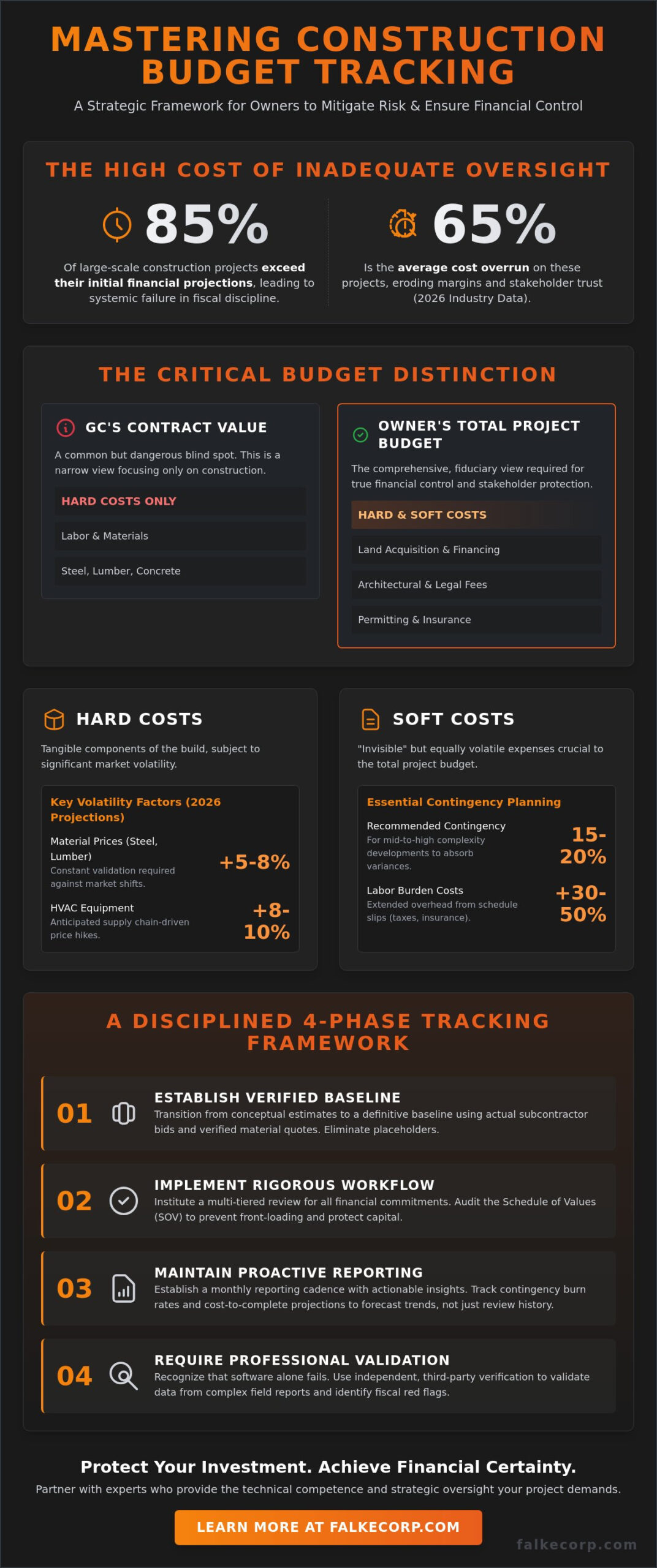
With 85% of large-scale construction projects exceeding their initial financial projections, the average cost overrun now stands at a staggering 65% according to 2026 industry data. For developers and institutional owners, these figures represent a systemic failure in fiscal discipline that erodes margins and compromises stakeholder trust. You’ve likely experienced the frustration of opaque reporting from general contractors or the sudden arrival of unforeseen change orders that threaten your project’s viability. Effective construction budget tracking for owners requires more than passive monitoring; it demands a rigorous, technical framework that distinguishes between hard and soft cost variances with surgical precision.
We recognize that maintaining absolute control over a multi-million dollar development is a complex undertaking that requires unwavering professional oversight and technical competence. This guide provides a strategic methodology to master financial accountability and mitigate the risk of budget bloat through disciplined tracking methodologies. You’ll gain a comprehensive understanding of how to implement a reporting structure that satisfies lenders, protects your fiduciary interests, and ensures that every dollar spent aligns with your project’s long-term stability and quality standards.
Key Takeaways
- Differentiate between the contractor’s contract value and the owner’s total project budget to maintain a comprehensive view of fiduciary responsibilities.
- Implement a disciplined framework for construction budget tracking for owners by transitioning from conceptual estimates to verified baselines and rigorous approval workflows.
- Recognize the limitations of digital tools and the necessity of professional data validation to identify fiscal red flags within complex field reports.
- Navigate the specific financial risks of the South Florida market, including material cost volatility and the impact of regional permitting timelines on project margins.
- Adopt a structured, four-phase methodology to ensure total transparency and protect the financial interests of high-net-worth and hospitality stakeholders.
The Fundamentals of Construction Budget Tracking for Owners
Many owners mistake the General Contractor’s (GC) contract value for the total project cost. This oversight creates a fiscal blind spot that often results in catastrophic overruns. The GC’s contract only represents the “hard” construction costs, while the owner’s total budget must encompass land acquisition, financing, and the myriad of “soft” costs that accumulate before and after the build. Professional construction budget tracking for owners begins with this fundamental separation. It ensures that fiduciary obligations to lenders and stakeholders are met through a comprehensive view of the entire capital stack, rather than a narrow focus on construction labor and materials.
Passive tracking is a reactive posture that inevitably leads to project delays. When an owner relies solely on the GC’s monthly pay application, they’re analyzing historical data rather than forecasting forward-looking trends. A disciplined oversight strategy requires a proactive approach to Project Cost Management, where financial health is mapped directly against the critical path of the schedule. If the project timeline slips, the budget expands due to extended overhead and labor burden costs, which industry data shows can be 30-50% higher than base wages when accounting for taxes and insurance.
Hard Costs vs. Soft Costs: The Owner’s Perspective
Hard costs are the tangible components of the build, including steel, lumber, and site concrete. With material prices expected to rise by 5-8% in 2026, these figures require constant validation against market volatility. Soft costs are often “invisible” but equally volatile. These include architectural fees, legal expenses, and the complex permitting processes specific to Miami-Dade and Broward counties. We recommend a risk-calibrated contingency of 15-20% for mid-to-high complexity developments to absorb these variances and the 8-10% price hikes anticipated for HVAC equipment in the coming year.
The Schedule of Values (SOV) as a Tracking Foundation
The Schedule of Values serves as the technical roadmap for all financial disbursements. A poorly structured SOV allows for front-loading, where the contractor bills for more work than has been physically completed in the early phases. This creates a dangerous imbalance of leverage that can leave an owner exposed. A rigorous framework for construction budget tracking for owners involves auditing the SOV to ensure it aligns with verified, on-site milestones. This technical safeguard ensures the remaining budget is always sufficient to complete the project, providing a layer of protection against contractor default or unforeseen site conditions.
Establishing a Disciplined Budget Tracking Framework
Transitioning from conceptual estimates to a definitive baseline is the primary requirement for mitigating financial risk in large-scale developments. Conceptual estimates often rely on historical averages that fail to account for the 5-8% material price increases projected for 2026. A disciplined framework for construction budget tracking for owners replaces these placeholders with hard numbers derived from actual subcontractor bids and verified material quotes. This process demands a rigorous approval workflow where no financial commitment is authorized without a multi-tiered review. By integrating independent third-party verification into the payment cycle, you ensure that every dollar disbursed matches the physical progress on-site, protecting your capital from premature depletion and contractor over-billing.
Establishing a monthly reporting cadence is essential for maintaining stakeholder confidence and lender compliance. These reports shouldn’t just list expenditures; they must provide actionable insights into cost-to-complete projections and contingency burn rates. Many professionals seek Construction Project Management Training to refine these oversight skills, recognizing that financial stability depends on the technical validation of data. When you maintain a structured rhythm of reporting, you transform construction budget tracking for owners from a clerical task into a strategic oversight tool that identifies fiscal red flags before they compromise the project’s viability.
The 5 Steps to Professional Budget Alignment
- Phase 1: Pre-construction Feasibility: Conduct a detailed site selection analysis and preliminary cost modeling to establish realistic financial boundaries.
- Phase 2: Design Development: Perform procurement cost-benefit reviews to ensure architectural intent aligns with the established budget baseline.
- Phase 3: Procurement and Buy-out: Finalize subcontractor selections and lock in material pricing to insulate the project from market volatility.
- Phase 4: Active Construction Oversight: Implement continuous field verification to ensure pay applications accurately reflect completed work.
- Phase 5: Commissioning and Close-out: Execute a final audit of all financial commitments and warranties to ensure a clean transition to operations.
Managing the Change Order Process
Scope creep is the silent catalyst for budget erosion, often manifesting as minor adjustments that cumulatively compromise project margins. Establishing a formal Change Order Request (COR) protocol is the only way to maintain fiscal discipline. Every request must be accompanied by a technical justification, a detailed cost breakdown, and an analysis of its impact on the critical path. A professional owner rep negotiates these change orders with a technical perspective, ensuring that the owner only pays for necessary, justified deviations from the original scope. Engaging a dedicated development management partner ensures these frameworks remain rigid throughout the project lifecycle.
Strategic Oversight vs. Software: Why Technology Alone Fails
Digital transformation has made real-time cost tracking a standard expectation, yet the persistence of budget overruns proves that software isn’t a substitute for professional vigilance. While AI-powered forecasting and automated work-in-progress reporting provide valuable data, they operate on the “Garbage In, Garbage Out” principle. Software only tracks the information it’s fed; it can’t verify the physical reality of a job site or determine if a contractor’s 20% waste factor for drywall is a legitimate requirement or a hidden margin pad. Effective construction budget tracking for owners requires a layer of human intelligence to validate digital inputs against the technical complexities of a high-density build.
Relying solely on automated dashboards creates a false sense of security that often masks brewing financial crises. A dashboard might show a project is 40% spent, but it won’t signal if the quality of the poured concrete fails to meet the specified PSI or if unapproved material substitutions are being made behind the scenes. Professional construction project management Florida adds value by synthesizing data from disparate sources, including field reports, procurement logs, and municipal permitting updates, into a single, verified source of truth. This level of oversight ensures that the owner’s financial reporting isn’t just a reflection of contractor claims, but an accurate audit of project value.
Identifying Red Flags in Contractor Billing
Front-loading remains one of the most common risks in large-scale developments. Contractors often attempt to bill for 30% of a line item when only 15% of the work is physically in place, essentially using the owner’s capital to fund their own operations. Professional tracking involves spotting these imbalances early. Oversight also detects duplicate billing for equipment rentals or the use of lower-grade materials than those specified in the contract. Site inspections are the only definitive way to validate payment applications, ensuring that the owner only pays for work that meets the established quality and completion standards.
The ROI of Professional Owner Representation
The return on investment for professional oversight is realized through aggressive risk mitigation and cost-benefit optimization. In the pre-construction phase, professional negotiation identifies potential savings by auditing subcontractor bids and material procurement strategies. Beyond immediate cost reductions, oversight prevents the catastrophic financial impact of legal disputes and mechanics’ liens, which are particularly prevalent in the South Florida market. By ensuring project “revenue-readiness” through a disciplined commissioning process, an owner’s representative protects the asset’s long-term value and ensures a seamless transition from construction to operations.
Budget Tracking Challenges in the South Florida Market
South Florida’s construction environment presents a distinct set of fiscal variables that demand a localized approach to cost control. In the Miami Design District and high-density corridors of Broward County, the convergence of intense labor competition and global supply chain pressures creates a volatile pricing floor. Generic financial models fail here because they don’t account for the regional premium associated with specialized trades and the logistical constraints of urban infill projects. Precise construction budget tracking for owners in this market requires a granular understanding of how local labor shortages manifest as higher hourly rates and extended mobilization timelines. It’s a technical reality where the 30-50% labor burden costs common in the industry are often pushed to the higher end of the spectrum due to regional staffing difficulties.
Environmental compliance adds another layer of financial complexity. Projects must integrate climate-resilient materials and storm-resistant designs to satisfy both municipal codes and the increasingly selective requirements of lenders. Budgeting for hurricane season isn’t merely a scheduling task; it’s a fiscal necessity. Mobilization and de-mobilization costs, combined with potential site stabilization expenses during active storm threats, can erode a standard contingency fund in weeks. For complex developments in this region, we recommend a risk-calibrated contingency of 15-20% to absorb these environmental and market-driven variances without compromising the project’s long-term stability or quality standards.
Regulatory and Permitting Cost Factors
The financial impact of permitting delays in Miami-Dade and Broward counties is often the single largest source of soft-cost bloat. Extended approval timelines translate directly to increased carrying costs, interest expenses, and potential escalation in material prices. While global inflation averages 4%, regional delays can expose an owner to the 8-10% price hikes anticipated for HVAC equipment and other long-lead items in 2026. Utilizing professional pre-construction services miami allows owners to identify these regulatory hurdles during the feasibility phase, ensuring that the pro forma reflects realistic municipal timelines rather than optimistic projections.
Vendor and Contractor Management in a High-Demand Market
A crowded market often attracts unvetted subcontractors who lack the technical competence to execute complex designs or manage disciplined reporting. These entities frequently underbid projects only to trigger a cascade of change orders and quality failures during the construction phase. Maintaining budget stability requires a rigorous vendor qualification process and a strategic bidding environment that values technical reliability over the lowest initial price. Leveraging local relationships and market intelligence ensures that you’re partnering with established firms that possess the staffing capacity to meet your schedule. If you require professional oversight to navigate these regional complexities, our team provides the construction phase management expertise necessary to protect your fiduciary interests.
Partnering for Financial Success: The FALKE Atlantic Methodology
The final phase of a development project is often the most financially sensitive period, requiring a shift from active construction to operational readiness. At FALKE Atlantic, we employ a four-phase methodology designed to ensure total project transparency through every stage of the lifecycle. This technical framework transitions from pre-construction feasibility into disciplined oversight, culminating in a rigorous commissioning process that ensures the asset is fully functional. For high-net-worth individuals and hospitality stakeholders, this systematic approach to construction budget tracking for owners serves as a strategic defense against the systemic failures common in large-scale developments. By acting as a technical extension of your team, we provide the unwavering professional oversight necessary to maintain fiscal discipline when complexity is at its peak.
Our methodology prioritizes the validation of technical data over the mere acceptance of contractor-provided reports. This distinction is critical during the most volatile periods of a project’s financial lifecycle. We don’t just monitor spending; we manage the intersection of cost, quality, and schedule to protect your capital stack. This level of construction budget tracking for owners ensures that fiduciary obligations are met with surgical precision, providing lenders and stakeholders with the confidence that the project’s financial health is being managed by experts who take full responsibility for the outcome.
Total Transparency from Concept to Commissioning
Our methodology for commercial project management miami focuses on creating a single source of truth for the owner. As the build progresses, the transition to construction phase management florida involves a shift toward rigorous field-level verification. We ensure that every dollar disbursed contributes directly to the asset’s quality and long-term stability. This phase isn’t complete until every system is commissioned and every warranty is secured, transforming a complex construction site into a high-quality, revenue-ready asset that meets the exacting standards of the luxury hospitality sector.
Next Steps: Securing Your Project’s Financial Future
Maintaining control over your development requires asking the right questions during every budget review. You should evaluate whether your current reporting distinguishes between hard and soft cost variances and if your contingency burn rate aligns with the physical progress on-site. If your current framework lacks this level of detail, your project is likely exposed to unnecessary risk. An independent audit of your current project status can reveal hidden fiscal red flags and identify opportunities for cost recovery before the close-out phase begins.
We invite you to engage in a corporate consultation to discuss your upcoming South Florida developments. Whether you’re in the initial feasibility stage or navigating the complexities of active construction, our team offers the technical competence and professional reliability required to protect your fiduciary interests. Partnering with FALKE Atlantic ensures that your project is managed with the precision and discipline necessary for long-term financial success and stability.
Securing Fiduciary Control in Volatile Development Markets
Mastering the technical complexities of large-scale development requires a transition from passive observation to rigorous fiscal discipline. Professional construction budget tracking for owners isn’t merely an administrative function; it’s a strategic defense mechanism that protects the capital stack from market volatility and systemic operational inefficiencies. By establishing a rigid baseline and prioritizing the human validation of field data over automated dashboards, you ensure that every disbursement aligns with the physical reality of the job site. This level of oversight is essential for maintaining stakeholder trust and ensuring that high-stakes projects remain revenue-ready upon commissioning.
FALKE Atlantic provides the unwavering professional oversight necessary to navigate these high-stakes environments. Our disciplined four-phase methodology ensures total transparency for complex hospitality and retail developments throughout Florida. We leverage deep local market intelligence to anticipate regional regulatory hurdles and labor shifts before they impact your project’s margins. Contact FALKE Atlantic for a Strategic Project Consultation to secure the financial future of your next development. With the right technical partner, you can transform fiscal complexity into a predictable path toward a high-quality, stable asset.
Frequently Asked Questions
What is the most common cause of construction budget overruns for owners?
The most common catalyst for budget overruns is scope creep coupled with inadequate pre-construction feasibility analysis. Industry data from 2026 indicates that 85% of large-scale developments exceed their initial projections, often because conceptual estimates aren’t transitioned into hard, verified numbers early in the process. When owners lack a rigid framework for tracking, they remain exposed to unforeseen variances in material procurement and escalating labor burden costs.
How much contingency should an owner typically budget for a Miami project?
Owners should typically allocate a 15-20% contingency reserve for mid-to-high complexity projects in the South Florida market. This higher threshold is necessary to absorb the 5-8% material price increases projected for 2026 and the 8-10% price hikes anticipated for HVAC equipment. Additionally, this reserve protects the project from the financial impact of hurricane season mobilization and the extended carrying costs associated with regional permitting delays.
What is the difference between a project manager and an owner’s representative in budget tracking?
A project manager typically focuses on the tactical execution of the build, whereas an owner’s representative provides strategic oversight of the entire capital stack. While the project manager ensures the contractor meets site milestones, the owner’s representative manages the fiduciary interests of the developer. This includes comprehensive construction budget tracking for owners that encompasses soft costs, financing, and the long-term stability of the asset.
How can owners prevent change order fraud during construction?
Preventing change order fraud requires a formal Change Order Request (COR) protocol that demands technical justification and a detailed cost breakdown for every deviation. Owners must implement independent field verification to ensure that requested changes aren’t masking contractor errors or unapproved material substitutions. Professional oversight ensures that every COR is audited against the original contract scope before any financial commitment is authorized or disbursed.
What are the essential reports an owner should receive monthly?
Owners should receive a cost-to-complete forecast, a contingency burn rate analysis, and a verified Schedule of Values (SOV) report every month. These documents provide a transparent view of the project’s financial trajectory rather than just a snapshot of historical spending. Actionable insights from these reports allow stakeholders to make informed decisions regarding potential scope adjustments or capital calls before fiscal red flags become crises.
Is construction management software enough to track a multi-million dollar budget?
Software is a valuable tool for data aggregation, but it’s not sufficient for managing a multi-million dollar budget without professional validation. Digital platforms operate on the “Garbage In, Garbage Out” principle and cannot detect fraudulent billing or poor quality work on-site. Effective construction budget tracking for owners requires human expertise to audit digital inputs against physical site reality to ensure fiduciary accuracy.
How does an owner’s representative handle disputes between contractors and architects?
An owner’s representative handles disputes by acting as an objective technical mediator who prioritizes the project’s fiduciary and quality standards over individual party interests. By analyzing the contract documents and architectural specifications, the representative resolves conflicts without escalating to costly legal proceedings. This neutral oversight prevents schedule delays and ensures that both the contractor and architect remain aligned with the owner’s strategic development goals.
What happens to the budget during the project close-out phase?
During the close-out phase, the budget focuses on final audits, the release of retainage, and the costs associated with technical commissioning. This is a critical period where lien releases must be meticulously tracked to protect the owner from future legal liabilities and financial claims. A disciplined close-out ensures that all financial obligations are satisfied and that the asset is fully revenue-ready and transitioned to operational status.