
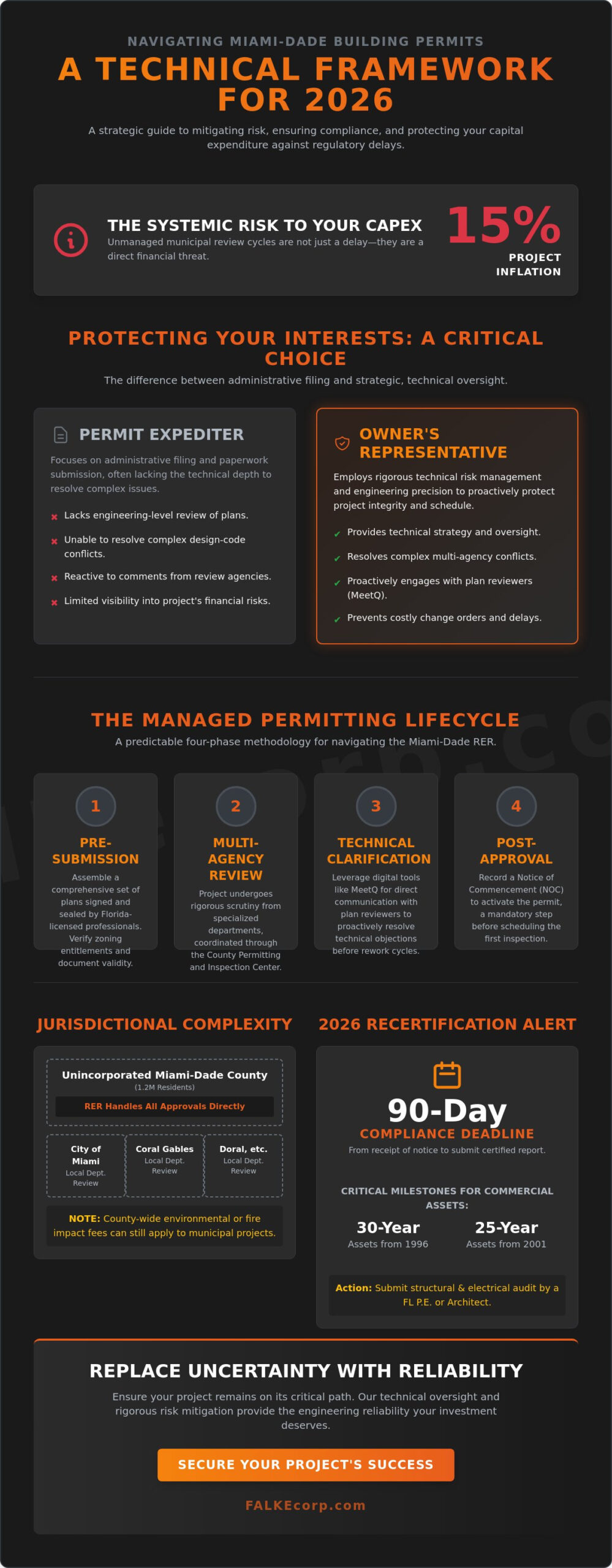
What if the most significant risk to your capital expenditure isn’t the volatility of material costs, but the systemic 15 percent project inflation caused by unmanaged municipal review cycles? It’s a reality many developers face while navigating Miami-Dade County building permits without a structured technical strategy. You’ve likely experienced the frustration of seeing a meticulously planned schedule dissolve due to a single administrative bottleneck or an unexpected multi-agency conflict. We understand that for a sophisticated owner, transparency and technical precision aren’t just preferences; they’re the foundations of financial stability.
This guide provides the technical framework for maintaining control through professional owner representation and rigorous risk mitigation. We’ll examine the specific requirements of the 2026 Florida Building Code and outline the professional oversight necessary to prevent costly change orders. By implementing these methodologies, you ensure your project remains on its critical path from inception to the final certificate of occupancy. Our objective is to replace regulatory uncertainty with the engineering reliability your investment deserves.
Key Takeaways
- Understand why the 2026 regulatory landscape in Miami-Dade demands a shift from administrative filing to rigorous technical risk management and engineering precision.
- Identify the critical milestones within the multi-agency review process to ensure a seamless transition from sealed plans to the final Certificate of Occupancy.
- Learn why navigating Miami-Dade County building permits requires a strategic Owner’s Representative to resolve complex design-code conflicts that standard permit expediters often overlook.
- Implement a structured pre-construction checklist to verify zoning entitlements and document validity before finalizing project designs to prevent costly delays.
- Discover how an integrated four-phase methodology transforms permitting from a bureaucratic hurdle into a predictable, managed component of the overall project lifecycle.
The 2026 Miami-Dade Regulatory Landscape: More Than Just Paperwork
The Regulatory and Economic Resources (RER) department in 2026 operates with a level of digital integration and technical scrutiny that defines the South Florida construction sector. Successfully navigating Miami-Dade County building permits requires more than administrative patience; it demands an understanding of the engineering benchmarks necessitated by the region’s geography. Building codes in this jurisdiction are among the most stringent in the global market, shaped by the High-Velocity Hurricane Zone (HVHZ) standards and evolving sea-level rise projections. These regulations ensure that every commercial structure can withstand extreme wind loads and hydrostatic pressure. The RER has transitioned to a fully automated review process for minor trades, but major structural modifications still undergo rigorous manual audits by county engineers to mitigate long-term liability.
The Impact of the 2026 Recertification Cycle
On January 7, 2026, the County issued a new wave of notices for the Building Recertification program, targeting structures that have reached their established age milestones. Property owners have exactly 90 days from the receipt of this notice to submit a written report from a Florida-registered professional engineer or architect certifying the building’s safety. Failure to meet these deadlines halts all pending renovation or tenant improvement permits, effectively freezing capital expenditure projects until compliance is verified. This cycle is particularly critical for assets built in 1996 and 2001, which are now hitting their 30-year and 25-year marks respectively. For commercial assets, the 2026 recertification scope mandates a comprehensive structural and electrical audit of buildings reaching their 25-year or 30-year milestones to ensure continued occupancy safety.
Jurisdictional Complexity in South Florida
A critical point of failure for many projects is the confusion between municipal and county authority. If a property is located within the limits of the City of Miami, Coral Gables, or Doral, the local building department serves as the primary reviewer for most permit types. However, for the 1.2 million residents and thousands of businesses located in Unincorporated Miami-Dade, the RER handles all approvals directly. Navigating Miami-Dade County building permits often involves managing the overlap where county-wide environmental or fire impact fees apply even to municipal projects. The Florida Building Code provides the baseline, but local amendments in 2026 have introduced specific requirements for electric vehicle (EV) charging infrastructure and enhanced drainage capacity for all new developments exceeding 5,000 square feet. Understanding this hierarchy is essential for maintaining a predictable project timeline.
The Permitting Lifecycle: From Submission to Certificate of Occupancy
Success in navigating Miami-Dade County building permits hinges on a structured, phased approach that prioritizes technical accuracy over speed. The lifecycle begins with Phase 1: Pre-submission. At this stage, project owners must assemble a comprehensive set of plans signed and sealed by Florida-licensed professionals. These documents aren’t merely drawings; they’re the technical foundation that ensures structural integrity and regulatory compliance. Any deviation from the Florida Building Code at this juncture will result in immediate rejection during the intake process.
Phase 2 involves the Multi-Agency Plan Review, where the project undergoes scrutiny from several specialized departments. The Miami-Dade County Permitting and Inspection Center serves as the primary hub for this coordination. During Phase 3, owners should leverage MeetQ, a digital consultation tool that allows for direct communication with plan review staff. This resource is vital for clarifying technical objections before they lead to formal “rework” cycles. Finally, Phase 4 transitions into post-approval requirements. Recording a Notice of Commencement (NOC) is mandatory before the first inspection can be scheduled. Without a recorded NOC, the permit remains inactive, regardless of its approval status.
The Multi-Agency Review Process
The Department of Environmental Resources Management (DERM) often represents the most complex hurdle in the review cycle. DERM evaluations focus on drainage, wastewater, and hazardous materials, frequently causing 25% of total project delays if not managed proactively. Owners must coordinate Fire Safety and Water/Sewer approvals in parallel to prevent sequential bottlenecks. Real-time tracking through the e-permitting portal is essential. Data from 2025 indicates that projects using active digital monitoring experience a 15% reduction in total approval time compared to those relying on passive updates.
Inspections and Final Close-out
Scheduling inspections requires a disciplined construction phase management schedule. Each trade must pass its specific inspection before the project can advance to the next structural milestone. The critical path from a Temporary Certificate of Occupancy (TCO) to a final Certificate of Occupancy (CO) is where many projects stall. Missing final signatures or unresolved minor electrical violations account for approximately 30% of close-out failures in the county. These errors freeze revenue-readiness and prevent the legal occupation of the facility. When navigating Miami-Dade County building permits for high-stakes industrial sites, integrating professional engineering oversight ensures that every technical milestone aligns with the final close-out requirements, eliminating the risk of late-stage delays.
Owner’s Representative vs. Permit Expediter: Protecting Your Interests
Traditional permit expediters function primarily as administrative couriers. They move documents between desks and track status updates within the RER portal. While this role serves a basic logistical purpose, it lacks the technical depth required for navigating Miami-Dade County building permits on complex commercial or industrial assets. When a plan reviewer issues a technical objection regarding life safety or structural integrity, a clerical expediter cannot argue the engineering merits. An Owner’s Representative possesses the technical competence to dissect these comments and determine if the design team or the code official has misinterpreted the Florida Building Code. This distinction is critical for maintaining the project’s financial integrity and timeline.
Permitting delays generate compounding carry costs. On a $25 million development, a 30-day delay in permit issuance can result in over $145,000 in interest and overhead expenses before construction even begins. We manage these risks by synchronizing permit milestones with loan draw schedules. This strategic oversight eliminates “change order fraud,” where contractors attempt to bill for “unforeseen permit requirements” that were actually avoidable design omissions. We hold the design team accountable to their original scope; they must address corrections without inflating the owner’s budget.
Risk Mitigation and Financial Oversight
FALKE Atlantic ensures total transparency during the high-stakes permitting phase by implementing rigorous documentation standards. We don’t just report that a permit is “in review.” We analyze the specific hurdles preventing approval. Our team recently managed complex entitlements for high-end hospitality brands in the Design District, where we resolved 14 distinct zoning conflicts that an expediter would have simply “passed back” to the architect. By acting as a technical shield, an Owner’s Representative Miami protects the capital stack from the erosion caused by bureaucratic inertia.
Strategic Vendor Coordination
Selecting the right MEP (Mechanical, Electrical, and Plumbing) engineers is a prerequisite for Miami-Dade compliance. We vet consultants based on their history of first-round approvals and their ability to handle the county’s unique environmental requirements. Our role involves holding these specialists accountable for “corrections” to prevent schedule creep. We ensure that the transition into construction phase management in Florida is seamless. This means the permit set must be 100% buildable, leaving no room for contractor interpretation or mid-project disputes that lead to litigation or costly delays.
Actionable Guidance: A Strategic Pre-Construction Checklist
Success in navigating Miami-Dade County building permits hinges on the technical precision of the pre-construction phase. Owners often underestimate the administrative rigidity of the Regulatory and Economic Resources (RER) department. A single oversight in documentation can stall a multi-million dollar industrial project for several months. Precision at the outset is the only way to ensure a predictable construction timeline.
- Site feasibility: Confirm zoning entitlements, setbacks, and floor area ratios (FAR) before finalizing structural designs.
- Survey currency: RER requires boundary and topographic surveys to be less than 12 months old at the time of submission.
- License Audit: Validate that all prime and sub-contractors hold active Miami-Dade County Municipal Contractor Licenses and meet specific insurance minimums.
- Schedule buffer: Integrate a “Permit Contingency” of at least 18% into the master project timeline to account for RER’s iterative review cycles.
The Importance of Site Feasibility
Strategic pre-construction services in Miami identify technical bottlenecks before they manifest as costly field changes. This phase must include a thorough search for unrecorded violations or expired permits from previous owners. These legacy issues must be cleared before the RER issues new permits. Early evaluation of utility capacity, particularly through the Water and Sewer Department (WASD), ensures that impact fees are calculated accurately within the initial capital expenditure model. This prevents the 11th-hour financial shocks that often derail project funding.
Documentation and Compliance Standards
Florida Statute 713 requires a certified Notice of Commencement (NOC) to be recorded and posted on-site for any project valued over $5,000. Failure to record this document before the first inspection results in an immediate work stoppage. When navigating Miami-Dade County building permits, owners should maintain a digital permit board. This system ensures RER inspectors can access approved plans via QR codes or organized mobile workstations. If a permit expires in Miami-Dade County, it constitutes a legal cloud on the property title and triggers a mandatory fine equal to double the original permit fee. Maintaining an active status through consistent inspections is a non-negotiable requirement for site management.
Ensure your project meets every technical requirement by engaging with the engineering experts at Falke Corp.
The FALKE Atlantic Methodology: Precision in Miami Development
FALKE Atlantic operates on the principle that regulatory compliance isn’t a secondary administrative task. It’s a critical engineering milestone. Our four-phase methodology integrates permitting directly into the project lifecycle, ensuring that technical requirements dictate the schedule rather than disrupting it. By treating the process as a structured sequence, we eliminate the friction points typically found when navigating Miami-Dade County building permits during active construction.
We function as a strategic partner, not a standard consultancy. This distinction matters for High-Net-Worth (HNW) individuals and hospitality brands facing the 12% to 15% annual cost volatility common in South Florida’s construction sector. We assume responsibility for the technical integrity of the project, managing the interface between municipal reviewers and design teams with a level of professional discipline that mirrors industrial automation standards. Initiating a professional development management engagement with us means securing a project against the delays that erode capital reserves.
Ensuring Revenue-Ready Assets
The final 10% of a project often determines its ultimate financial success. We focus heavily on the commissioning and close-out phases to ensure timely handovers. While large-scale firms often struggle with the bureaucratic inertia of the final inspection cycle, our boutique structure allows for tighter financial control and immediate response times. We don’t accept “standard” delays. Our team pushes for the Certificate of Occupancy with the same technical rigor applied during the foundation pour.
The FALKE promise is built on transparency and uncompromising quality. We provide owners with real-time data regarding permit status and inspection results. This structured information flow allows for better decision-making and ensures that the asset is ready to generate revenue the moment construction concludes. Our methodology removes the ambiguity from the development process, replacing it with a predictable, engineered path to completion.
Contact FALKE Atlantic for Your Next Project
Complex retail and commercial developments in Miami require a specialized advisory approach that accounts for 2026 regulatory shifts. We’re currently accepting consultations for 2026 building recertifications and mandatory structural upgrades required by updated Florida statutes. These mandates are strict; missing a deadline can result in significant municipal penalties and operational shutdowns.
If you’re currently navigating Miami-Dade County building permits for a high-stakes project, contact our office for a comprehensive project audit. We’ll evaluate your current standing, identify potential technical bottlenecks, and implement a recovery or acceleration plan. Our team provides the stability and expertise required to manage the most complex industrial and commercial assets in South Florida. Let’s discuss how our disciplined approach can secure your investment’s future.
Mastering Miami’s 2026 Regulatory Environment
Successfully navigating Miami-Dade County building permits requires more than administrative diligence; it demands a technical mastery of the 2026 regulatory framework. As South Florida’s building codes evolve, the distinction between mere expediting and strategic Owner’s Representation becomes the defining factor in project viability. Owners who prioritize a structured pre-construction checklist mitigate the risks of technical delays that often plague complex luxury developments. FALKE Atlantic applies a disciplined four-phase project management methodology to ensure every technical requirement is met with engineering precision. Our team leverages deep expertise in South Florida’s specific regulatory environments to protect the interests of high-net-worth individuals and global luxury hospitality brands. We don’t just process forms; we manage the entire permitting lifecycle from initial submission to the final Certificate of Occupancy. This rigorous approach transforms a bureaucratic hurdle into a controlled, predictable phase of your development. By aligning with experts who understand the complexity of these institutional processes, you ensure your vision moves from blueprint to reality without compromise.
Secure your investment with expert Owner’s Representation from FALKE Atlantic
With the right technical partnership, the path to a successful Certificate of Occupancy is both clear and achievable.
Frequently Asked Questions
Do I need a permit for minor interior renovations in Miami-Dade County?
Yes, most interior renovations require a permit under Section 105.1 of the Florida Building Code. While cosmetic updates like painting or installing floor finishes under 0.125 inches thick don’t need approval, any work involving structural elements, electrical wiring, or plumbing systems necessitates a formal application. Navigating Miami-Dade County building permits ensures that these technical modifications meet the rigorous safety standards required for high-velocity hurricane zones.
How long does the multi-agency plan review typically take in 2026?
As of 2026, the standard multi-agency review cycle for residential projects averages 35 business days. Commercial developments typically require 65 days because they involve concurrent reviews from the Department of Regulatory and Economic Resources, Fire Rescue, and Water and Sewer departments. These timelines remain subject to the complexity of the engineering documents and the precision of the initial submittal package provided to the county technicians.
What is the difference between a Certificate of Occupancy and a Certificate of Completion?
A Certificate of Occupancy (CO) permits the legal habitation of a new building after all life safety systems pass final inspection. In contrast, a Certificate of Completion (CC) signifies that a specific permitted scope, such as a window replacement or electrical upgrade, finished according to code. The CC doesn’t authorize occupancy for new structures; it merely closes the specific permit record for the specialized work performed by the contractor.
What happens if I start construction before my Miami-Dade permit is issued?
Starting construction without an issued permit triggers a “Work Without Permit” violation under Chapter 8 of the County Code. This violation results in a civil penalty equal to 200% of the standard permit fee and an immediate Stop Work Order. You’ll also have to hire a structural engineer to certify that any completed work meets current code requirements before the county allows the project to resume.
How much are building permit fees in Miami-Dade, and how are they calculated?
Fees follow the RER Fee Schedule, which applies a multiplier of 0.0050 to the total estimated cost of construction for structural permits. Minimum permit fees for minor residential projects start at $130.00 according to the 2025-2026 fiscal budget documents. This calculation excludes additional surcharges for state mandates and regional planning, which typically add 7% to the base permit cost during the final intake process.
Can I expedite the permitting process for affordable housing or green building projects?
Yes, Administrative Order 4-120 establishes an expedited path for projects certified as affordable housing or those reaching LEED Silver status. These applications receive priority ranking in the electronic plan review queue, often reducing wait times by 15 business days. Navigating Miami-Dade County building permits through this specialized track requires specific certification documents from the developer at the time of the initial digital submittal.
What should I do if I receive a 2026 Notice of Required Building Recertification?
You must engage a Florida-registered architect or professional engineer to conduct a comprehensive structural and electrical inspection within 90 days. This mandate applies to buildings that have reached their 25-year or 30-year anniversary as defined by Section 8-11 of the Miami-Dade County Code. The resulting inspection report must be submitted via the county’s portal to verify the building’s continued structural integrity and electrical safety.
Is a separate permit required for electrical and plumbing work in the City of Miami?
Yes, the Florida Building Code requires individual subsidiary permits for electrical, plumbing, and mechanical trades. These sub-permits must link to the master building permit to ensure all technical systems integrate correctly. Each trade contractor must hold a valid municipal contractor license and provide specific engineering schematics that detail the load calculations and pipe sizing for the proposed installation within the structure.