
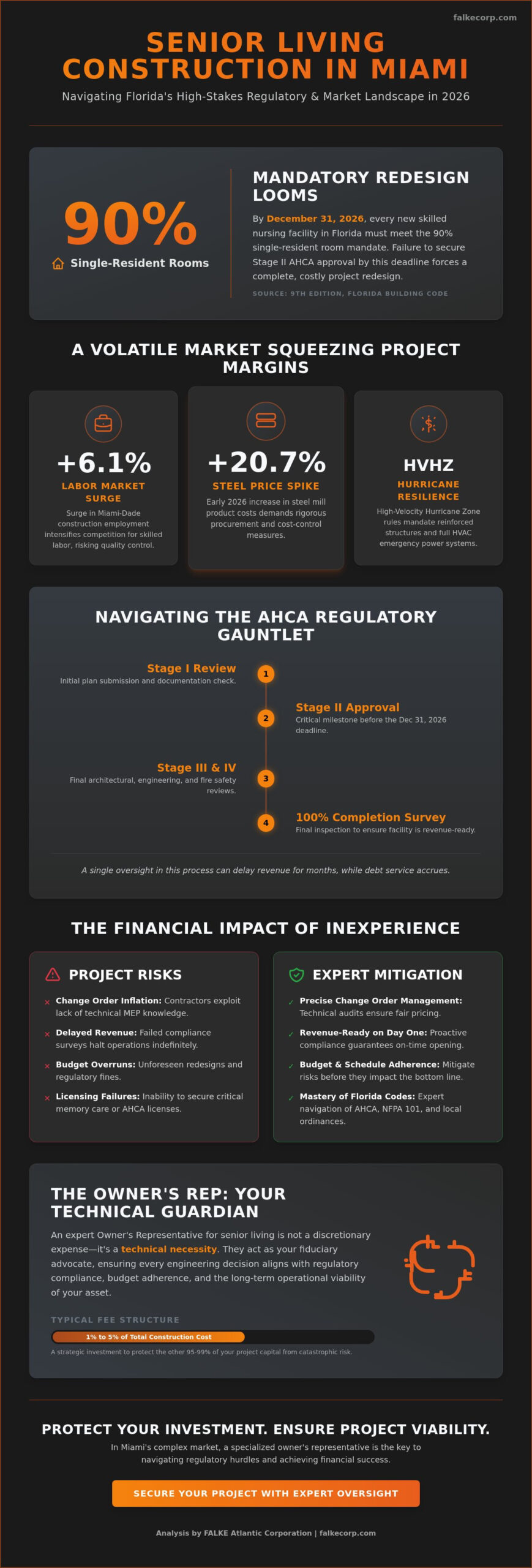
By December 31, 2026, every new skilled nursing facility in Florida must provide at least 90% single-resident rooms or face a mandatory redesign under the 9th edition of the Florida Building Code. This regulatory shift, combined with Miami-Dade’s 6.1% surge in construction employment and the 20.7% spike in steel prices recorded in early 2026, means that project margins are thinner than ever. Engaging an expert owner’s representative for senior living construction in Miami isn’t a discretionary expense; it’s a technical necessity for maintaining project viability in a volatile market.
You’re likely aware that managing specialized MEP systems and hurricane-resilient requirements requires more than just a general contractor’s oversight. The complexity of securing the new October 1, 2026, memory care services license while adhering to NFPA 101 Life Safety Codes creates a high-stakes environment where a single oversight can delay revenue for months. This guide provides the technical framework you need to ensure your facility is revenue-ready on day one with zero compliance failures during final commissioning. We’ll examine current South Florida fee structures, which typically range from 1% to 5% of total construction costs, and detail how to navigate AHCA’s intricate permitting process to maintain strict budget and schedule adherence throughout 2026.
Key Takeaways
- Understand how Miami’s volatile labor market and fluctuating material costs necessitate a strategic technical advocate to maintain project stability and quality.
- Learn the critical steps for navigating Agency for Health Care Administration (AHCA) regulations and the 100% completion survey to prevent operational delays.
- Discover the financial advantages of hiring an owner’s representative for senior living construction in Miami to mitigate risks through precise change order management.
- Identify essential selection criteria for your representative, including a verified track record in Florida healthcare projects and mastery of Miami-Dade Chapter 8 codes.
- Explore a disciplined four-phase methodology designed to ensure total transparency, financial control, and technical precision from pre-construction to final commissioning.
The High Stakes of Senior Living Construction in Miami
In the high-precision environment of South Florida’s healthcare development, an owner’s representative for senior living construction in Miami functions as a technical guardian rather than a mere coordinator. This role provides a strategic layer of protection between the developer’s capital and the inherent risks of the construction phase. Unlike Construction Management, which often focuses on the execution of the build, an owner’s representative acts as a fiduciary advocate. They ensure that every engineering decision aligns with the long-term operational viability of the asset and the safety of its future residents.
Miami’s market presents a unique set of challenges in 2026. With construction employment reaching a record 64,800 workers in 2025, the competition for skilled labor has intensified, often leading to quality control lapses on complex job sites. Simultaneously, the 20.7% increase in steel mill products recorded in early 2026 demands rigorous procurement oversight and cost-control measures. For senior living facilities, these pressures are compounded by the requirements of the High-Velocity Hurricane Zone (HVHZ). Facilities must integrate impact-resistant envelopes and reinforced structural systems that exceed standard residential codes. A delayed opening in this sector isn’t just a scheduling inconvenience; it’s a catastrophic financial event that can cost developers thousands of dollars in lost monthly revenue per unit while debt service continues to accrue.
Why Miami-Dade Regulations Differ for Senior Housing
Miami-Dade’s zoning and entitlement processes are notoriously fragmented across its various municipalities. Navigating these requires integrated pre-construction services miami to identify site-specific risks such as flood zone reclassifications or utility capacity constraints early in the design phase. By 2026, emergency power systems must be sized not just for basic life safety, but for full HVAC load to protect vulnerable residents during extended outages. An expert representative ensures these technical specifications are locked in before the first shovel hits the ground, preventing costly mid-stream redesigns.
The Cost of Inexperience in Healthcare Construction
Generic project managers often lack the technical depth to audit specialized systems like medical gas lines or integrated nurse-call networks. These systems are frequent targets for change order inflation when contractors exploit an owner’s lack of technical knowledge during complex MEP installations. A specialized representative scrutinizes every line item to ensure the engineering matches the billed costs and meets strict healthcare standards. A senior living facility is revenue-ready only when it has achieved 100% AHCA compliance and is fully equipped to provide the precise level of care promised to its residents.
Navigating AHCA and Florida Life Safety Codes
The Agency for Health Care Administration (AHCA) represents the most significant regulatory hurdle for senior living assets in Florida. Success in this sector depends on absolute technical compliance with Florida’s Assisted Living Regulations, which govern everything from physical plant requirements to resident care standards. An owner’s representative for senior living construction in Miami ensures that the architectural vision remains tethered to these rigid state standards throughout the project lifecycle. They facilitate the critical dialogue between the design team and state inspectors, preventing the technical friction that often leads to project stagnation and licensing delays.
The AHCA Review Process: From Stage I to Stage IV
AHCA’s plan review consists of four distinct stages that require meticulous documentation and engineering justification. Managing this progression is vital, particularly with the 9th edition of the Florida Building Code taking effect on December 31, 2026. Projects failing to secure Stage II approval by this deadline must be redesigned to accommodate the new 90% single-resident room mandate for skilled nursing facilities. Implementing rigorous construction phase management florida ensures that the physical build mirrors the approved plans exactly. The owner’s representative coordinates directly with the AHCA Office of Plans and Construction to resolve field deviations before they manifest as permanent compliance failures during the final survey.
MEP and Life Safety Systems for Vulnerable Populations
By 2026, HVAC design for senior living must incorporate advanced infectious disease control measures, including specific air filtration and pressure gradients designed to protect elderly residents. These systems require precise engineering oversight to meet the new memory care services license requirements effective October 1, 2026. The representative monitors the installation of specialized fire suppression and smoke compartmentation, ensuring total redundancy in electrical systems for both life-support and climate control. They also oversee the procurement of long-lead specialized medical equipment, which is frequently a primary cause of schedule slippage in healthcare construction.
The 100% completion survey is the final gate to licensure and operational status. A single failure during this inspection can delay revenue-readiness for months while debt service remains active. A technical expert ensures that every MEP system and life safety protocol is fully commissioned and verified before the inspector arrives on site. If you require a partner to manage these complex technical interfaces, exploring a strategic development partnership can secure your project’s regulatory path and financial stability.
Evaluating the ROI: Owner’s Rep vs. Generic Project Manager
The financial justification for an owner’s representative for senior living construction in Miami rests on the delta between their professional fee and the mitigation of systemic project waste. While professional representation fees in South Florida typically range from 1% to 5% of total construction costs, the return on investment is realized through the aggressive containment of change orders and schedule slippage. A General Contractor operates on an execution model where profit is often linked to labor efficiency and procurement margins. In contrast, an owner’s representative utilizes an advocacy model, ensuring that every technical decision contributes directly to the asset’s fiduciary integrity and operational readiness.
Specialized representation also significantly influences the project’s capital stack. Lenders and insurance providers in 2026 increasingly view the presence of a dedicated representative as a primary risk-mitigation factor, often resulting in more favorable financing terms and reduced construction-period premiums. This oversight is a core component of high-level real estate development management services, where the focus extends beyond the physical build to the long-term performance of the senior living asset.
Quantifying Risk Mitigation
Unmanaged healthcare projects often experience change order volumes exceeding 10% of the initial contract value due to unforeseen AHCA requirements or MEP conflicts. With professional oversight, these variations are typically restricted to less than 3%, as technical discrepancies are resolved during the design and pre-construction phases. For REIT investors and institutional partners, the provision of ‘Audit-Ready’ documentation ensures that every expenditure is justified by engineering data rather than contractor estimates. Accelerating the commissioning process by 30 days allows a 100-unit assisted living facility to capture a median monthly revenue of $541,900 based on 2025 national averages.
Specialized Knowledge as a Cost-Saver
A technical representative identifies ‘gold-plating’ where architectural designs exceed the functional requirements of AHCA or resident care standards without adding tangible value. This form of value engineering maintains compliance while stripping away unnecessary capital expenditures that don’t enhance the resident experience. Implementing construction project management Florida tailored for the senior living sector ensures that the building’s life safety systems are robust but not over-engineered to the point of financial inefficiency. This disciplined approach converts technical expertise into measurable liquidity for the developer, ensuring the project remains viable even as construction cost escalation is anticipated to be between 3% and 4% throughout 2026.
Selection Criteria: Hiring the Right Rep for Senior Living
Choosing an owner’s representative for senior living construction in Miami requires a vetting process that prioritizes technical competence over generic management experience. In the 2026 market, where material costs and labor shortages continue to pressure margins, your representative must demonstrate a verified track record in Florida healthcare or Assisted Living Facility (ALF) projects. This expertise is particularly critical given the October 1, 2026, mandate for the new memory care services license. A qualified firm should provide evidence of a disciplined four-phase methodology that spans from initial concept through to final commissioning. They must also prove their mastery of Miami-Dade Chapter 8 building codes, which contain specific local amendments that can derail projects if not addressed during the design phase.
Technical Competence and Engineering Reliability
The most effective representatives often possess deep backgrounds in engineering or architecture. This technical foundation allows them to produce objective, data-driven reporting that is essential for executive decision-making. During the selection process, you should challenge candidates on their specific experience with AHCA Stage III inspections. Ask how they managed field deviations in previous projects to ensure zero compliance failures. Their ability to speak the language of specialized subcontractors, particularly regarding complex HVAC and life safety systems, is the primary factor in preventing change order fraud and technical bottlenecks. High-level representation doesn’t rely on emotional persuasion; it relies on the precision of engineering reliability to secure the owner’s interests.
The Importance of Local Miami Experience
Miami-Dade County’s labor market reached a peak of 64,800 construction employees in 2025, creating a highly competitive environment for reliable subcontractors. A representative with deep local roots understands the specific labor dynamics of Dade and Broward counties and can leverage existing relationships to ensure your project remains a priority. They must navigate the commercial project management miami landscape with a clear understanding of 2026 permitting timelines and local fee structures. Even for developers with remote stakeholders, the representative acts as the boots-on-the-ground technical lead, providing the transparency and financial control required for institutional-grade assets.
Securing a partner who understands the intersection of Florida healthcare law and South Florida construction logistics is the only way to safeguard your capital. If you are ready to implement a technically superior oversight model for your next asset, contact our senior living experts to review your project’s specific compliance and budgetary requirements.
The FALKE Atlantic Methodology for Senior Living Assets
The methodology employed by FALKE Atlantic Corporation is a disciplined response to the technical volatility inherent in the South Florida development market. This proprietary four-phase approach is engineered specifically for senior living assets, where the margin for error in life safety and mechanical systems is non-existent. By prioritizing transparency and financial control, FALKE Atlantic Corporation acts as a strategic partner for corporations and high-net-worth individuals who require a technical advocate. Our objective is the delivery of a revenue-ready asset that satisfies the most stringent Agency for Health Care Administration (AHCA) requirements without compromising on engineering integrity. We don’t rely on emotional persuasion; we rely on the logic of structured information and engineering reliability to secure your capital.
As a specialized owner’s representative for senior living construction in Miami, we maintain a relentless focus on technical precision from the initial feasibility study to final commissioning. This process ensures that every engineering decision, from the selection of hurricane-resilient envelopes to the integration of infectious disease control in HVAC systems, aligns with the asset’s long-term operational goals. We take full responsibility for the result, ensuring that the transition from a construction site to a licensed healthcare facility is seamless and predictable.
From Concept to Commissioning
The progression from site feasibility to a final AHCA occupancy permit requires a level of coordination that generic management firms cannot provide. Our role as an owner’s representative Miami involves protecting the asset’s long-term value by managing the complex interfaces between architects, engineers, and specialized third-party vendors. FALKE Atlantic Corporation implements rigorous site audits and procurement oversight to ensure that long-lead medical equipment and life safety components are delivered on schedule. This disciplined oversight prevents the technical bottlenecks that often occur during the final Stage IV AHCA inspections, allowing for a 100% compliance rate on day one.
Contact FALKE Atlantic Corporation for a Senior Living Consultation
Our commitment to precision is evidenced by our work on high-profile projects, such as the Prada store in the Miami Design District, where technical excellence was the primary requirement. This same level of engineering rigor is applied to every senior living development we oversee. We invite you to initiate a professional dialogue regarding your upcoming South Florida projects to ensure your development is protected from the regulatory and financial risks of the 2026 market. FALKE Atlantic Corporation offers a technical discovery session to analyze your project’s specific requirements, focusing on AHCA compliance, MEP redundancy, and hurricane resilience. Contact our experts to establish a strategic partnership that ensures your senior living asset is delivered with the highest professional standards, without compromise.
Securing Operational Stability in South Florida’s Senior Living Sector
The 2026 regulatory landscape requires a level of technical foresight that goes beyond standard project management. Success in this sector depends on the precise alignment of engineering decisions with the state’s evolving licensing requirements. By integrating a dedicated owner’s representative for senior living construction in Miami, developers can ensure their capital is protected from the systemic waste often found in complex healthcare builds. This strategic oversight converts technical competence into long-term asset stability.
FALKE Atlantic Corporation provides the engineering reliability necessary to navigate these high-stakes transitions through a disciplined four-phase methodology. Our expertise in Miami-Dade HVHZ requirements and technical competence in AHCA compliance ensures that every life safety protocol is verified to meet the highest professional standards. It’s time to secure your development’s future with a partner who takes full responsibility for the result. Secure Your Senior Living Investment with FALKE Atlantic Corporation and establish a foundation for operational excellence in the Florida market.
Frequently Asked Questions
What is the difference between a project manager and an owner’s rep for senior living?
An owner’s representative for senior living construction in Miami acts as a fiduciary advocate focused on protecting the developer’s capital and long-term asset value. While a project manager often focuses on daily task execution and contractor coordination, the representative manages the entire project lifecycle, including AHCA regulatory strategy and financing compliance. This role provides a technical layer of oversight that ensures architectural and engineering decisions align strictly with the owner’s financial objectives and the facility’s operational requirements.
Why is AHCA compliance so difficult for Miami construction projects?
Miami projects must navigate the intersection of the Florida Building Code’s 9th edition and specific Miami-Dade Chapter 8 amendments. The Agency for Health Care Administration (AHCA) enforces a rigid four-stage review process that penalizes design deviations with significant licensing delays. By December 31, 2026, new facilities must also meet a 90% single-resident room mandate. Managing these state-level healthcare standards alongside local High-Velocity Hurricane Zone requirements creates a complex regulatory environment that demands specialized technical expertise.
How much does an owner’s representative for senior living typically cost?
Professional representation fees in the South Florida market typically range from 1% to 5% of the total construction cost. For large-scale senior living developments in the multi-million dollar range, fees generally stabilize between 1% and 3%. Some firms may provide specialized consulting at hourly rates between $100 and $200. This expenditure is traditionally offset by the mitigation of change orders and the prevention of delayed openings, which can cost thousands in lost daily revenue.
Can an owner’s rep help with site selection for a new assisted living facility in Miami?
Technical site selection is a core component of pre-construction services provided by an owner’s representative. They evaluate potential locations based on zoning entitlements, utility capacity, and flood zone reclassifications that impact insurance premiums. They identify site-specific risks, such as proximity to coastal high-hazard areas, which could necessitate expensive structural reinforcements. This early-stage technical analysis ensures that the chosen site is viable for the specific requirements of an assisted living facility before capital is committed.
What are the 2026 hurricane resilience standards for Florida senior living facilities?
The 9th edition of the Florida Building Code, effective December 31, 2026, reinforces High-Velocity Hurricane Zone (HVHZ) requirements for vulnerable populations. Senior living facilities must integrate impact-resistant envelopes and emergency power systems sized to maintain full HVAC loads, not just basic lighting. These standards ensure that residents can safely shelter in place during extended power outages. A specialized representative verifies that the MEP engineering meets these updated life safety protocols to prevent commissioning failures.
How does an owner’s rep manage construction change orders in a regulated environment?
A representative utilizes technical auditing to scrutinize every contractor request for additional funding or time. They compare proposed changes against the AHCA-approved plans and the original engineering specifications to prevent unnecessary cost inflation. In a regulated environment, any field deviation must be justified by technical data and regulatory necessity. This disciplined oversight ensures that the project remains within the initial budget while maintaining the strict compliance required for final state licensure.