
The reality that 85% of construction projects experience cost overruns serves as a stark reminder of the financial volatility inherent in the South Florida market. With steel prices rising 13% and aluminum escalating by 23% year-over-year, owners often find themselves navigating a landscape where technical transparency is sacrificed for expediency. You likely understand that traditional oversight often fails to prevent change orders from consuming 10% to 15% of your total contract value. Mastering construction change order management miami requires a disciplined, systems-based approach that transcends basic project monitoring. This guide establishes a rigorous framework for financial oversight, ensuring your capital is protected against the complexities of the Florida Building Code and local labor shortages. We will examine a structured four-phase methodology designed to deliver a revenue-ready asset while maintaining absolute fiscal transparency from inception to close-out.
Key Takeaways
- Understand why strategic pre-construction engineering and detailed feasibility studies account for approximately 80% of successful project cost mitigation.
- Establish a rigorous framework for construction change order management miami to effectively distinguish between essential scope adjustments and preventable planning deficiencies.
- Identify the specific impact of South Florida’s regulatory environment, including hurricane-resilient material mandates, on long-term project financial stability.
- Utilize a disciplined four-phase methodology to maintain total technical and financial transparency throughout the entire development lifecycle.
- Learn how professional owner’s representation transforms reactive accounting into a proactive strategy for protecting capital in volatile markets.
The State of Construction Cost Control in Miami (2026)
Effective cost control in the Miami-Dade sector requires a fundamental shift from reactive accounting to proactive oversight. While traditional accounting merely records expenditures after they occur, strategic cost engineering principles demand that owners anticipate financial risks before they manifest as line items. In a market where 85% of projects exceed their original budgets, financial equilibrium depends on the ability to manage variables rather than just reporting them. An Owner’s Representative serves as the technical anchor in this process, ensuring that every dollar spent aligns with the project’s strategic objectives and long-term viability.
The current landscape is defined by extreme labor and material volatility. With 94% of Florida contractors reporting significant difficulty filling skilled positions, labor rates have climbed to between $42 and $58 per hour. Simultaneously, raw material costs for essential metals have surged, with steel rising 13% and aluminum 23% over the last year. These factors make construction change order management miami a critical competency for any developer seeking to preserve their ROI. Traditional budgeting often fails here because it doesn’t account for the rapid shifts in the South Florida climate, both meteorological and economic.
Miami-Dade Regulatory Impacts on Project Budgets
The introduction of the 9th Edition of the Florida Building Code, effective December 31, 2026, necessitates a more rigorous approach to envelope integrity. Stricter 30-year building recertification standards and High-Velocity Hurricane Zone (HVHZ) mandates require specialized glazing and roofing systems that carry a significant price premium compared to standard domestic builds. These regulatory pressures often lead to unforeseen expenses during the construction phase. Navigating this “Miami Premium” requires an expert who understands how these technical requirements influence the procurement phase and long-term maintenance costs. Without this specialized knowledge, owners risk being blindsided by compliance costs that weren’t adequately captured in the initial estimate.
The Escalation Factor: Planning for 2026 Volatility
Managing material lead times is now as vital as managing the budget itself. Delays in specialized equipment or hurricane-rated materials can lead to project stalls that burn through contingency funds at an alarming rate. Escalation clauses in Miami sub-contracts are specific legal provisions that allow for price adjustments based on fluctuating market indices for materials like concrete, steel, or aluminum. We recommend structuring contingency funds to specifically address these market-driven shifts rather than using a flat percentage. Effective construction change order management miami ensures these clauses are monitored and validated against real-time data. This level of oversight prevents the erosion of project margins and keeps the development on a path toward successful delivery.
Strategic Pre-Construction: Where Real Savings are Engineered
The most effective financial safeguards are established long before the first shovel hits the ground. Industry data suggests that approximately 80% of total project cost control is engineered during the pre-construction phase. In the Dade and Broward markets, where entitlements and zoning complexities are significant, this period represents the only time when an owner possesses maximum leverage over the budget. Utilizing comprehensive pre-construction services miami allows for the identification of technical deal-breakers, such as soil contamination or inadequate utility capacity, which often trigger catastrophic budget overruns if discovered later.
This phase also serves as the foundation for Federal Acquisition Regulation on Change Orders principles, which emphasize the importance of clear scope definitions to prevent administrative friction. A disciplined approach to site selection and entitlement coordination ensures that the project remains financially viable through the permitting process. By resolving these variables early, owners can establish a rigorous baseline for construction change order management miami, transforming a traditionally reactive process into a controlled administrative function. We recommend a meticulous review of all pre-construction documents to ensure they align with the final financial objectives.
Value Engineering Without Compromising Quality
Value engineering should never be confused with simple cost-cutting. It is a technical analysis of architectural designs to identify cost-intensive over-engineering that does not contribute to the asset’s functionality or aesthetic intent. For high-end retail and hospitality projects, this involves sourcing alternative materials that meet the rigorous Florida Building Code while protecting the bottom line. By analyzing the building envelope and mechanical systems early, we ensure that design intent is achieved through the most efficient technical means possible.
The GC Bidding and Buyout Strategy
The transition from design to construction is where many budgets erode due to scope gaps. Structuring RFPs to ensure an apples-to-apples comparison between bidders is essential for financial transparency. A specialized Owner’s representative Miami identifies hidden gaps in General Contractor proposals during the buyout phase, ensuring that every subcontracted trade is fully accounted for. This level of technical oversight prevents “placeholder” numbers from becoming the source of future change orders, providing a stable financial foundation for the execution phase.
Managing Change Orders and Mitigating Financial Risk
A change order is a technical instrument intended to address unforeseen site conditions or legitimate shifts in project scope. However, in the South Florida market, these documents frequently serve as a corrective measure for architectural omissions or insufficient pre-construction planning. Statistical evidence indicates that change orders typically account for 10% to 15% of a project’s total contract value. Without a disciplined framework for construction change order management miami, these adjustments can quickly erode a project’s financial feasibility. The process requires a rigorous approval workflow where every request is scrutinized against the original contract documents and technical specifications.
In high-net-worth residential developments, scope creep is a primary driver of financial instability. Minor aesthetic revisions often trigger cascading technical requirements, from structural adjustments to HVAC recalibrations. This complexity is particularly pronounced in Miami-Dade, where hurricane-resilient building envelopes allow little margin for error. An Owner’s Representative acts as the primary safeguard in these scenarios, validating the necessity of each change and ensuring that pricing reflects current market labor rates, which currently range from $42 to $58 per hour. Under the Private Works Change Order Fair Payment Act (SB 440), owners must respond to contractor claims within 30 days, making a streamlined technical review process indispensable.
The Hidden Costs of Construction Delays
Project momentum is a critical component of financial stability. A stalled development incurs significant carrying costs, including debt service, property taxes, and extended insurance premiums. In Miami, weather-related delays, specifically those during the Atlantic hurricane season, must be modeled into the initial schedule to avoid reactive crisis management. Implementing a structured construction phase management florida strategy ensures that the General Contractor maintains the critical path despite localized volatility. This proactive approach minimizes the risk of late-stage change orders that often arise from compressed schedules.
Contractual Protections for the Owner
The choice between Lump Sum and Cost-Plus contracts significantly influences the owner’s risk profile. While Lump Sum agreements provide a degree of cost certainty, they often include higher contingencies to cover the contractor’s risk. Conversely, Cost-Plus contracts offer transparency but require intensive auditing to prevent overbilling. Liquidated damages clauses should be utilized to provide a fair mechanism for recovering costs associated with inexcusable delays. To further mitigate risk, owners should consider Owner’s Protective Professional Indemnity insurance, which provides a dedicated layer of coverage for losses resulting from the professional negligence of design professionals or consultants that exceeds their primary policy limits. This comprehensive approach to construction change order management miami ensures that the owner’s capital remains protected against both human error and market shifts.
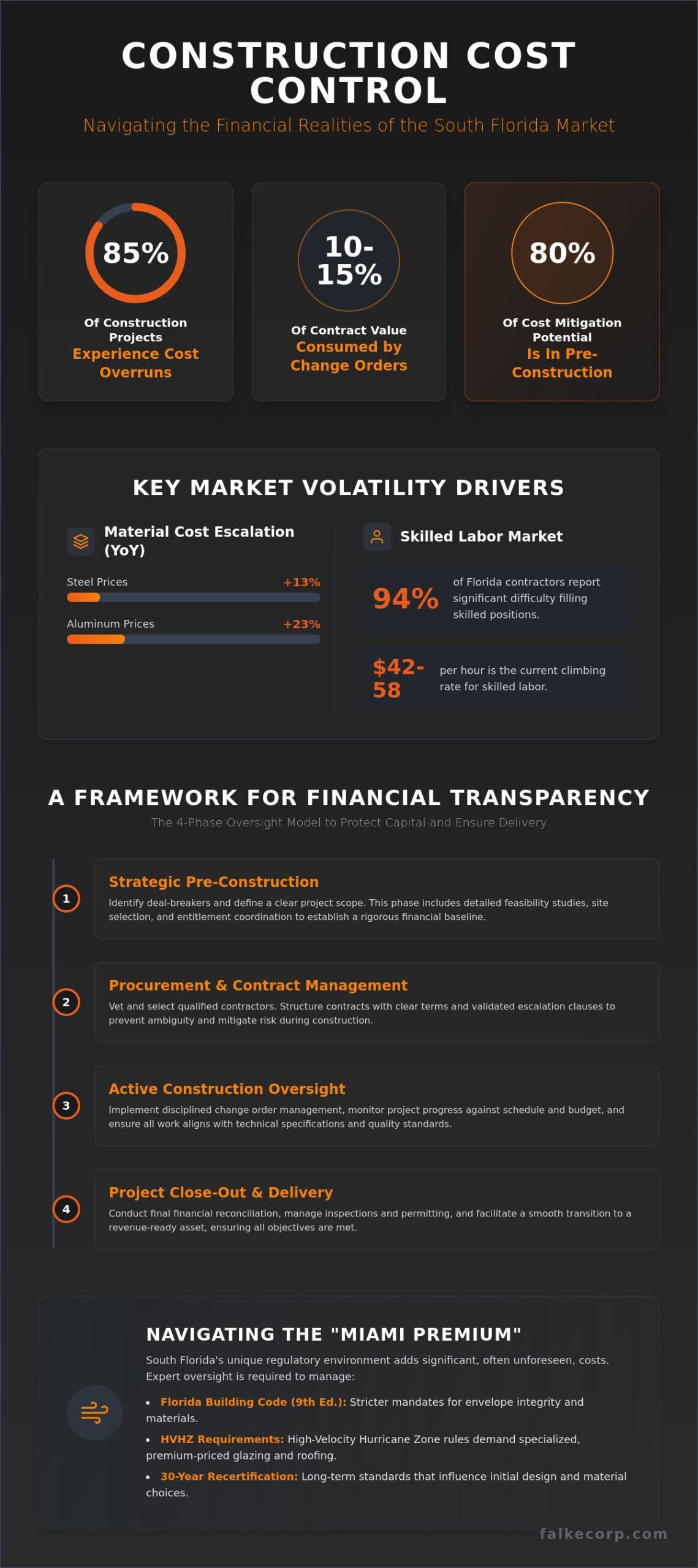
A Framework for Financial Transparency: The 4-Phase Oversight Model
FALKE Atlantic utilizes a disciplined four-phase methodology to ensure absolute financial control throughout the development lifecycle. This system moves beyond the limitations of static estimating, offering a dynamic oversight model that protects the owner’s capital from inception to asset handover. By dividing the project into distinct, manageable stages, we establish a rigid structure for construction change order management miami, ensuring that every financial decision is backed by technical validation and strategic intent. This methodology is particularly vital in Miami’s High-Velocity Hurricane Zones, where technical compliance costs can fluctuate rapidly based on material availability and labor constraints.
- Phase 1: Concept and Feasibility – Establishing the financial baseline through rigorous site analysis, regulatory reviews, and market-driven cost modeling.
- Phase 2: Design and Pre-Construction – Locking in the budget by resolving design conflicts early and securing transparent buyout agreements with vetted trade partners.
- Phase 3: Active Construction – Implementing real-time tracking systems to monitor expenditures and validate every draw request against the established baseline.
- Phase 4: Commissioning and Close-out – Executing a systematic final accounting and ensuring the asset is fully operational and free of legal encumbrances.
Phase 3: Real-Time Financial Reporting
During the active construction phase, financial transparency is maintained through monthly executive summaries that provide owners with a clear view of project health. These reports are not simple data dumps; they are strategic analyses of the project’s financial trajectory. We track Budget vs. Actual figures with precision, identifying potential variances before they compromise the contingency fund. Managing the draw request process is a critical component of this phase. We verify that all work billed has been completed to the specified quality standards and ensure that valid lien waivers are collected from every subcontractor. This rigorous oversight prevents overpayment and protects the project from the legal risks associated with unpaid second-tier vendors, which is essential given the current 7.2% growth in construction wages across Miami-Dade.
Phase 4: Ensuring a Revenue-Ready Asset
A poorly managed close-out can lead to significant financial leakage through unresolved punch lists and lingering mechanics’ liens. Navigating the construction project close-out in Florida requires a methodical approach to final inspections, permit cancellations, and the release of retainage. We oversee the final commissioning process to ensure that all mechanical, electrical, and life-safety systems perform exactly as engineered. This systematic verification ensures that the owner receives a revenue-ready asset that meets all operational requirements without outstanding liabilities. To secure this level of professional oversight for your next development, consider engaging a specialized Owner’s representative Miami to safeguard your capital and ensure project success.
FALKE Atlantic: Your Strategic Partner for Miami Developments
Choosing a boutique consultancy ensures that your project receives the technical scrutiny required for high-stakes developments. Large-scale firms often delegate oversight to junior staff; however, FALKE Atlantic Corporation provides senior-level expertise that is essential for complex environments like the Prada Design District. Our Real estate development management services are designed to align project execution with long-term financial objectives, ensuring that every technical decision enhances the asset’s overall value. Our experience across diverse sectors, including high-end retail and luxury hospitality, allows us to anticipate the specific logistical and regulatory challenges unique to South Florida’s premier districts.
In a market where labor costs have increased by 4.2% year-over-year and material lead times remain unpredictable, the necessity for rigorous construction change order management miami cannot be overstated. We don’t just record costs; we engineer them to ensure project stability. Our commitment to protecting client interests is reflected in our refusal to accept surface-level estimates, opting instead for a granular analysis of every line item. This level of dedication ensures that quality is never sacrificed for the sake of an arbitrary deadline, providing you with a revenue-ready asset that meets the highest professional standards.
The Advantage of Professional Owner’s Representation
An Owner’s Representative functions as the technical conscience of the project. By providing a single point of accountability, we eliminate the communication gaps that typically lead to scope erosion and financial mismanagement. We manage the administrative burden of permit tracking, vendor coordination, and contract compliance, allowing you to focus on the strategic growth of your portfolio. Our methodology ensures total financial transparency in every phase, from the initial feasibility study to the final close-out, ensuring that the General Contractor remains aligned with your fiscal expectations.
Next Steps for Your South Florida Project
With the 9th Edition of the Florida Building Code becoming effective on December 31, 2026, early planning is paramount for any new development. If you are preparing for a 2026 construction start, an initial development management consultation can identify potential regulatory hurdles and technical deal-breakers before they impact your timeline. We provide the technical clarity and disciplined oversight needed to navigate Miami’s volatile market conditions with absolute confidence. Schedule a consultation with FALKE Atlantic Corporation to establish a disciplined framework for your next development and secure your project’s financial future.
Securing Financial Stability for Your Next Miami Development
The successful delivery of a revenue-ready asset in South Florida requires a fundamental transition from reactive accounting to disciplined technical oversight. We’ve explored how 80% of cost control is engineered during the pre-construction phase and why a structured four-phase methodology is essential for maintaining absolute transparency. Implementing a rigorous framework for construction change order management miami ensures that your capital remains protected against market volatility and shifting regulatory requirements. By prioritizing technical validation and professional accountability, you can effectively mitigate the risks of scope creep and unforeseen compliance costs.
Our authority in high-stakes sectors like hospitality and luxury retail, combined with a deep understanding of the Miami-Dade building code, allows us to provide the unwavering stability your development requires. It’s time to secure your project’s financial trajectory with a partner who understands the local landscape. We invite you to partner with FALKE Atlantic for your next Miami development to ensure your vision is realized with the highest professional standards and fiscal precision. You don’t have to navigate these complexities without expert guidance.
Frequently Asked Questions
What is the primary difference between a Project Manager and an Owner’s Rep in Miami?
An Owner’s Representative functions as a strategic fiduciary focused exclusively on the owner’s financial and technical interests, whereas a Project Manager typically handles the tactical execution for a contractor or architectural firm. The Owner’s Rep provides independent oversight of the entire development lifecycle, ensuring that the project’s broader business objectives aren’t sacrificed for the sake of construction expediency. This distinction is critical in Miami’s complex market, where specialized advocacy is required to manage multi-tiered vendor relationships.
How does an Owner’s Representative help with construction cost control?
Professional representation provides a technical shield against budget erosion by validating every draw request and scrutinizing the necessity of every proposed expenditure. We implement rigorous auditing processes that identify over-billing or scope gaps before they impact the project’s bottom line. By maintaining a constant presence during the construction phase, an Owner’s Representative transforms reactive accounting into a proactive financial strategy that protects the asset’s long-term ROI through technical precision.
Why are construction costs in Miami higher than the national average?
Miami’s position within the High-Velocity Hurricane Zone (HVHZ) necessitates stringent building envelope requirements that naturally drive up material and procurement expenses. Local material costs remain approximately 12% above the national average, while specialized labor rates for skilled trades currently range from $42 to $58 per hour. Additionally, the transition to the 9th Edition of the Florida Building Code introduces more rigorous mandates for roofing and impact-resistant systems, contributing to a “Miami Premium” for compliant construction.
What are the most common causes of budget overruns in South Florida projects?
Budget overruns in this region are frequently driven by unforeseen site conditions, weather-related stalls during hurricane season, and insufficient pre-construction planning. Scope creep in high-end residential projects often triggers cascading technical costs that weren’t captured in the initial estimate. Without disciplined construction change order management miami, these variables can lead to contract value increases of 10% to 15%, significantly undermining the project’s financial feasibility if not managed through a structured oversight framework.
How early should I hire a cost control consultant for my Miami project?
Engagement should ideally occur during the initial concept and feasibility phase to maximize financial leverage. Since approximately 80% of total project cost control is engineered before construction begins, early involvement allows for the identification of regulatory deal-breakers and technical risks. Securing a representative during Phase 1 ensures that the financial baseline is realistic and that the subsequent design and pre-construction phases are locked in with absolute technical clarity.
Can an Owner’s Rep help with Miami-Dade building permits and entitlements?
Yes, an Owner’s Representative coordinates the entire permitting strategy, including utilizing programs like the Miami-Dade Same-Day Permitting Program to reduce carrying costs. We manage the communication between the design team and municipal reviewers to ensure that technical submissions comply with the latest Florida Building Code requirements. This coordination minimizes the risk of costly project stalls and ensures that permit fees, which have increased by 5% to 12% recently, are accurately budgeted.
What is Value Engineering and how does it impact construction costs?
Value engineering is a technical analysis of architectural and engineering designs to identify over-engineered systems that don’t contribute to the project’s functional or aesthetic goals. It focuses on optimizing the building envelope and mechanical systems to achieve the same design intent through more cost-efficient means. When performed correctly, value engineering protects the project’s bottom line without compromising the quality or safety standards required by the High-Velocity Hurricane Zone mandates.
How does FALKE Atlantic handle change order management?
FALKE Atlantic utilizes a disciplined four-phase methodology that emphasizes technical validation and real-time reporting for every project adjustment. Our approach to construction change order management miami involves a rigorous approval workflow where each request is scrutinized against the original contract documents and current market labor rates. This system ensures that all changes are legitimate, properly priced, and strategically necessary, maintaining total financial transparency and protecting the owner’s capital from inception to final close-out.