
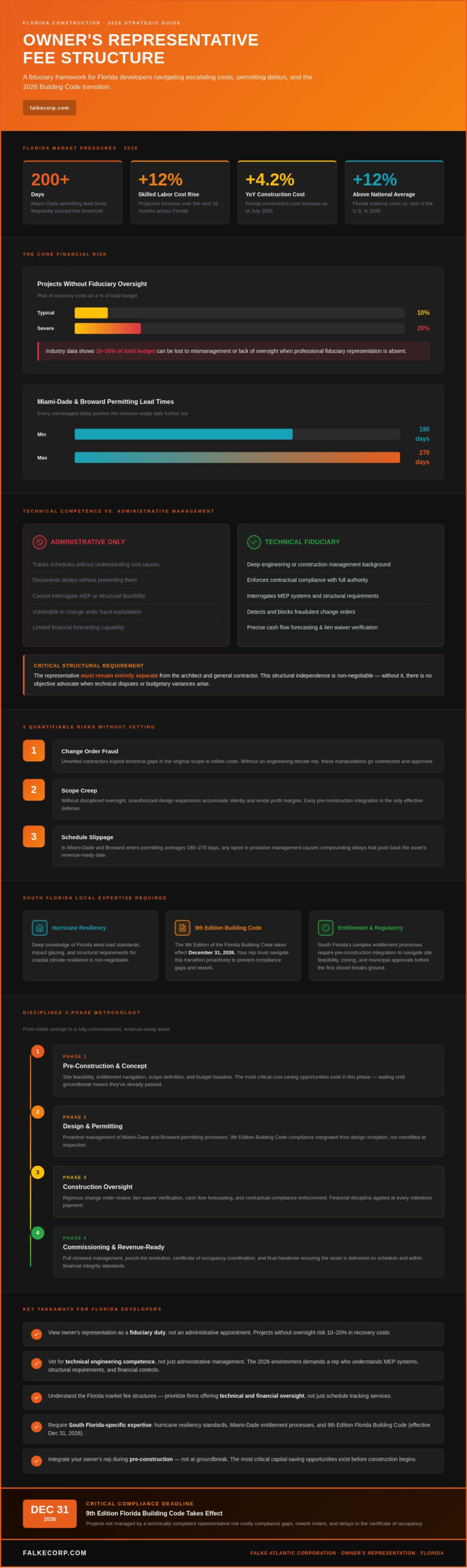
In a market where Miami-Dade permitting lead times now frequently exceed 200 days and skilled labor costs are projected to rise by 12% over the next 18 months, passive project oversight is no longer a viable strategy for Florida developers. You likely recognize that traditional reliance on general contractor reporting often lacks the granular financial transparency required to prevent budget overruns or sophisticated change order fraud. Understanding the standard owner’s representative fee structure Florida firms utilize is the first step toward securing a strategic fiduciary who protects your capital against these escalating regional pressures.
This guide provides the technical framework necessary to master the vetting process, ensuring you identify a partner who maintains absolute control over your project’s schedule and vision. We’ll examine the specific benchmarks for mitigating Florida-specific regulatory and climate risks, including the upcoming implementation of the 9th Edition of the Florida Building Code on December 31, 2026. By the end of this analysis, you’ll have a disciplined methodology for selecting an expert capable of delivering a revenue-ready asset on time and with total financial integrity.
Key Takeaways
- Understand why viewing owner’s representation as a fiduciary duty is essential for mitigating the 10-20% risk associated with unforeseen project recovery costs.
- Learn how to vet for technical engineering competence over simple administrative management to navigate the complexities of high-stakes 2026 construction projects.
- Gain clarity on the owner’s representative fee structure Florida market standards demand to ensure your capital is protected by a strategic, rather than purely operational, partner.
- Identify the specific local expertise required to manage South Florida’s unique regulatory landscape, including hurricane resiliency and the 9th Edition of the Florida Building Code.
- Explore a disciplined four-phase methodology designed to streamline the transition from initial concept to a fully commissioned, revenue-ready asset.
The Strategic Importance of Selecting the Right Owner’s Representative
The selection of an owner’s representative is a foundational decision that dictates the financial trajectory of a development project. It’s not merely an administrative appointment but the establishment of a fiduciary relationship where the representative’s sole obligation is the protection of the owner’s capital and vision. In the high-stakes Florida market, where construction costs have increased by 4.2% year-over-year as of July 2026, this role serves as the primary defense against systemic inefficiencies. Selecting the right partner must be a pre-construction priority rather than a construction-phase afterthought; waiting until the first shovel is in the ground often means the most critical cost-saving opportunities have already passed.
The Fiduciary Role in Modern Florida Construction
An owner’s representative functions as a technical translator, bridging the gap between the granular engineering data provided by contractors and the strategic objectives of the development’s stakeholders. Unlike a consultant who may offer periodic advice, a true representative acts as an agent with the authority to enforce contractual compliance and financial discipline. This independence is non-negotiable. The representative must remain entirely separate from the architect and general contractor to eliminate conflicts of interest. Without this structural separation, you lack an objective advocate when technical disputes or budgetary variances arise during the build.
ROI: Why Professional Fees are a Capital Investment
While the initial discussion often focuses on the owner’s representative fee structure Florida firms present, the actual value lies in the mitigation of project recovery costs. Industry data suggests that projects without professional fiduciary oversight often face recovery expenses ranging from 10% to 20% of the total budget due to mismanagement or lack of oversight. Early integration of the representative during the pre-construction phase is essential for navigating site feasibility and complex entitlement processes in South Florida. An owner’s representative is a strategic shield for project capital.
Failing to vet for technical competence and professional integrity leads to several quantifiable risks that can compromise an entire development. These include:
- Change order fraud: Unvetted contractors may exploit technical gaps in the original scope to inflate costs.
- Scope creep: A lack of disciplined oversight allows for unauthorized design expansions that erode profit margins.
- Schedule slippage: In Miami-Dade and Broward counties, where permitting lead times average 180 to 270 days, any lack of proactive management results in compounding delays that postpone the asset’s revenue-ready date.
By treating the representative as a strategic partner from the concept phase, you ensure that every decision is filtered through the lens of financial stability and technical feasibility. This disciplined approach transforms the representative’s fee from an overhead expense into a high-yield capital investment.
Technical Competence vs. Administrative Management
Selecting an owner’s representative based solely on administrative capability is a common strategic error. In the 2026 Florida construction environment, where material costs remain 12% above the national average, a representative must possess a deep engineering or construction management background. An administrative representative often falls into the paper-pusher trap, tracking schedules and documenting delays without understanding the technical root causes. True technical competence allows a representative to interrogate the feasibility of mechanical, electrical, and plumbing (MEP) systems or the structural requirements of luxury retail tenant improvements before costs escalate.
Financial literacy is equally critical in this role. A representative must manage project accounting with precision, providing accurate cash flow forecasting and ensuring the rigorous verification of lien waivers. When evaluating the owner’s representative fees in Florida, owners should prioritize firms that offer this level of technical and financial oversight. This multidisciplinary expertise ensures that the owner’s representative fee structure Florida developers agree to is justified by the tangible mitigation of technical risks.
Owner’s Representative vs. Project Manager
It’s vital to distinguish between these roles to maintain project integrity. Project managers typically focus on managing specific tasks and often report to their own firm’s internal metrics. In contrast, an owner’s representative serves the owner exclusively, focusing on protecting the long-term value of a revenue-ready asset. For a deeper analysis of these distinctions, review our guide on Construction Project Management in Florida: A Strategic Guide for Owners. This reporting structure ensures that every decision aligns with the owner’s financial interests rather than the contractor’s operational convenience.
The Value of a Disciplined Methodology
A structured, four-phase methodology is superior to ad-hoc management for high-stakes builds. This approach ensures that the representative is deeply involved from the initial concept through to rigorous commissioning and final close-out. Technical depth is the only effective defense against change order fraud during active construction phases. By understanding the build’s technical nuances, the representative can identify when a requested change is a legitimate necessity or an attempt to inflate the contract value. If you’re planning a complex development in South Florida, engaging a partner with pre-construction services expertise can stabilize your project’s financial foundation from the outset.
A Comprehensive Checklist to Select an Owner’s Representative
Identifying a strategic partner requires a vetting process that transcends simple resume reviews. In the competitive South Florida market, the selection must focus on a candidate’s ability to operate as a technical fiduciary. While the owner’s representative fee structure Florida developers typically negotiate is a vital component of the contract, the qualitative attributes of the firm often dictate the project’s ultimate success. A disciplined selection framework ensures that the representative possesses the specific expertise required for hospitality, retail, or high-net-worth luxury residential developments.
A rigorous vetting process should follow these five fundamental steps:
- Sector-Specific Track Record: Verify documented success in your specific asset class. The requirements for a luxury retail flagship in the Miami Design District differ significantly from a high-rise hospitality build in Fort Lauderdale.
- Local Network Depth: Assess their established relationships with consultants and vendors in Miami-Dade and Broward. Local fluency accelerates permitting and ensures access to reliable skilled labor.
- Financial Transparency Protocols: Evaluate the sophistication of their project accounting. They must provide real-time visibility into the budget, ensuring every expenditure aligns with the project’s technical milestones.
- Conflict of Interest Disclosure: Require a formal guarantee that the firm does not “double-dip” by receiving incentives from general contractors or sub-vendors. Their loyalty must remain exclusively with you.
- Communication Proficiency: The representative must demonstrate the ability to translate complex engineering data into actionable insights for non-technical boards or stakeholders.
Vetting Experience and Portfolios
When reviewing portfolios, look beyond the glossy finishes of completed buildings. Request specific case studies detailing “project rescues” where the representative corrected a failing budget or recovered a slipping schedule. It’s also essential to call references from both previous owners and general contractors. A contractor’s perspective reveals whether the representative understands the technical build or merely tracks tasks from a distance. This dual-sided vetting confirms the role of an owner’s representative as a competent leader who commands respect on the job site while protecting the owner’s interests.
Technology and Reporting Standards
Modern developments require a high degree of technological integration. Inquire about their proficiency with Building Information Modeling (BIM) and specialized project management platforms that facilitate real-time budget tracking. A monthly executive financial report should be granular, including updated cash flow forecasts and verified lien waivers. Transparency is the ability to trace every dollar to a specific technical milestone. This level of detail is a standard expectation within a professional owner’s representative fee structure Florida developments require to maintain financial equilibrium. By establishing these standards early, you ensure the project remains on the path to becoming a revenue-ready asset.
Navigating the South Florida Landscape: Local Selection Factors
The South Florida construction environment is defined by a level of regulatory complexity that demands more than general project oversight. A representative lacking granular fluency in Miami-Dade, Broward, and Palm Beach county building codes is a structural liability to any development. With the 9th Edition of the Florida Building Code set to take effect on December 31, 2026, the technical requirements for High-Velocity Hurricane Zone (HVHZ) compliance will become even more stringent. When evaluating the owner’s representative fee structure Florida developers utilize, the cost must be weighed against the representative’s ability to navigate these specific regional mandates without triggering costly redesigns or failed inspections.
Local selection factors also extend to the management of South Florida’s unique subcontractor dynamics. Projections indicate a 12% rise in skilled labor costs over the next 18 months; a representative with “boots on the ground” in Miami understands how to secure reliable trades in a saturated market. They must possess the technical depth to manage tropical building envelopes and sophisticated moisture control systems, which are essential for the long term integrity of hospitality and luxury residential assets.
Regulatory and Permitting Fluency
Managing the local permitting bottleneck is perhaps the most critical function of a Florida-based representative. In Miami-Dade and Broward counties, permitting lead times currently average between 180 and 270 days. A local expert navigates these entitlements and zoning requirements by maintaining active coordination with municipal departments in the City of Miami and Fort Lauderdale. This proactive engagement is a core component of Strategic Pre-Construction Services in Miami: The Owner’s Guide to Risk Mitigation, ensuring that the project reaches the construction phase without avoidable administrative delays.
Climate and Logistics in Florida
Logistical management in Florida requires a specialized approach to the hurricane season, which spans from June through November. A qualified representative implements rigorous site-securing protocols and contingency plans to protect high-value assets during extreme weather events. This level of foresight is essential for successful Construction Phase Management in Florida: The Owner’s Guide to Execution. Beyond weather, they must understand flood-zone requirements and the specific engineering challenges of building on South Florida’s porous limestone substrate. If you are developing a high-stakes project in this region, contact us today to discuss how our Owner’s Representation services can stabilize your development’s trajectory through local expertise.
FALKE Atlantic: Disciplined Methodology for Florida Developments
FALKE Atlantic Corporation operates through a disciplined four-phase methodology: Concept, Pre-Construction, Construction, and Commissioning. This structured framework ensures that the transition from initial design to operational status is governed by technical precision and financial discipline. Our firm doesn’t just manage tasks; we ensure every development matures into a revenue-ready asset. This approach provides the technical rigor necessary to justify the owner’s representative fee structure Florida developers negotiate for high-stakes urban projects. By applying a systems-based mindset to every phase, we eliminate the ambiguities that typically lead to budget overruns or schedule slippage.
Our boutique consultancy model guarantees senior-level attention on every Miami project. We recognize that global brands and high-net-worth individuals require more than administrative reporting; they need an experienced expert who takes full responsibility for the project’s outcome. By maintaining a limited portfolio of high-value developments, we provide the meticulous oversight required to protect your capital and vision against the volatility of the South Florida market. Our commitment to stability and quality is reflected in our unwavering focus on technical competence over simple process management.
A Strategic Partner for Complex Projects
Executing high-stakes developments, such as the Prada flagship in the Miami Design District, demands a partner capable of managing complex third-party vendor networks. We maintain total financial control by interrogating every line item and verifying that each technical milestone is achieved before funds are released. This level of fiduciary oversight is explored in our guide on Owner’s Representative Miami: Protecting Your Real Estate Assets in 2026. Our involvement ensures that the owner’s representative fee structure Florida firms provide is leveraged as a strategic investment in risk mitigation. We act as the primary shield for your capital, ensuring that all consultants remain aligned with the project’s financial and technical objectives.
Securing Your Development’s Future
The final phase of our methodology, Commissioning and Close-out, is essential for a successful project hand-off. We verify that all mechanical, electrical, and life-safety systems function according to the original design intent and comply with the latest regulatory standards. This focus on the final transition ensures the asset is fully prepared for occupancy and revenue generation, preventing the costly operational delays that often plague unmanaged projects. If you seek a partner who prioritizes technical integrity and professional accountability, we invite you to Consult with FALKE Atlantic Corporation for your Miami development. Aligning your project with our disciplined methodology is the most effective way to secure its financial and operational future.
Stabilizing Your Florida Development Trajectory
Securing a technical fiduciary is the most effective method to insulate your capital from the systemic volatility of the 2026 Florida construction market. It’s clear that technical competence and a deep understanding of the owner’s representative fee structure Florida developers utilize are essential for maintaining financial equilibrium. By prioritizing an expert who understands the build’s technical nuances rather than a simple administrator, you move beyond basic task tracking toward comprehensive project control.
FALKE Atlantic provides this rigorous oversight through a disciplined four-phase methodology and specialized expertise across Miami-Dade, Broward, and Palm Beach counties. Our boutique service model ensures every project receives senior-level attention, transforming complex builds into revenue-ready assets. We take full responsibility for the technical and financial integrity of your development, ensuring that every milestone aligns with your strategic vision.
Secure your project’s success with FALKE Atlantic’s expert owner representation. We look forward to establishing a strategic partnership that ensures your vision is realized with uncompromising professional precision.
Frequently Asked Questions
What is the primary difference between an owner’s representative and a construction manager?
An owner’s representative acts as a fiduciary advocate focused exclusively on the owner’s capital and long-term vision, while a construction manager is primarily responsible for site-level operational execution and delivery. The representative maintains technical independence from the build team to ensure objective oversight. This structural separation allows the representative to enforce contractual compliance without the inherent conflicts of interest often found in general contracting or construction management firms.
When is the best time to select an owner’s representative for a new project?
Integration should occur during the concept or pre-construction phase to maximize the impact on project stability. Engaging a representative early allows for disciplined interrogation of site feasibility, entitlements, and preliminary budgets before significant capital is committed. Waiting until the construction phase limits the representative’s ability to influence the foundational decisions that typically dictate a project’s financial success and regulatory compliance.
How are owner’s representative fees typically structured in Florida for 2026?
Professional engagements are market-driven and typically follow a percentage of project cost, fixed monthly retainer, or hourly rate model. A sophisticated owner’s representative fee structure Florida firms implement often utilizes hybrid models that combine a base fee with performance incentives tied to budget savings or schedule acceleration. These structures are designed to align the representative’s fiduciary obligations with the owner’s specific financial objectives and risk profile.
Can an owner’s representative help with site feasibility and permitting in Miami-Dade?
Yes, a local representative is essential for navigating the complex entitlement and zoning requirements across South Florida municipalities. In Miami-Dade, where permitting lead times average 180 to 270 days, the representative manages active coordination with municipal departments to prevent administrative bottlenecks. This proactive oversight ensures that site feasibility assessments and regulatory approvals remain aligned with the project’s critical path.
Does an owner’s representative replace the need for an internal project manager?
While an internal project manager handles day-to-day corporate logistics, an owner’s representative provides the specialized technical depth and engineering expertise required for complex builds. They act as an extension of the owner’s team, offering a layer of fiduciary oversight that internal staff may lack. This partnership ensures that the project benefits from senior-level technical leadership without the overhead of expanding an internal development department.
What certifications or qualifications should I look for when selecting a representative?
Prioritize firms with senior-level degrees in engineering or construction management and a documented track record in your specific asset class. Technical fluency in High-Velocity Hurricane Zone (HVHZ) standards and the 9th Edition of the Florida Building Code is non-negotiable for 2026 developments. You should also verify their proficiency with Building Information Modeling (BIM) and real-time project accounting platforms to ensure total financial transparency.
How does an owner’s representative prevent change order fraud in construction?
Technical interrogation is the primary defense against change order fraud. By maintaining a deep understanding of the build’s engineering requirements, the representative can distinguish between legitimate technical necessities and attempts to inflate the contract value. They verify that every requested change is justified by the original scope and that the associated costs align with current market labor and material rates.
Will hiring an owner’s representative create conflict with my general contractor?
Professional general contractors generally appreciate the clear communication and decisive leadership a technical representative provides. By establishing a disciplined framework for reporting and accountability, the representative reduces the ambiguity that often leads to disputes. This structured environment allows the build team to focus on execution while the representative ensures that all project stakeholders remain aligned with the owner’s financial interests.