In the South Florida market, a construction delay is rarely an act of God; it’s a failure of technical oversight and regulatory navigation. While many owners attribute setbacks to the climate, the reality is that schedule integrity depends on anticipating the 5% to 12% increase in Miami-Dade permit fees and the December 31, 2026, enforcement of the Florida Building Code’s 9th Edition. Learning how to prevent construction delays in South Florida requires moving beyond reactive management into a disciplined, engineering-led framework that prioritizes precision over hope.
You likely recognize that the complexity of High-Velocity Hurricane Zones and the 12% surge in reinforcing steel bids during Q2 2026 make traditional project timelines feel like moving targets. This guide provides the technical and regulatory strategies you need to maintain control and deliver revenue-ready assets on schedule. We’ll analyze the integration of design-build models, the mitigation of third-party vendor risks, and the specific procurement adjustments necessary to stabilize your capital investment against current market volatility. By implementing these rigorous standards, you can ensure that your project transitions from a complex capital plan to a high-performing asset without the friction of unpredictable setbacks.
Key Takeaways
- Understand how localized regulatory fragmentation across Miami-Dade and Broward municipalities creates specific bureaucratic bottlenecks that require specialized permitting strategies.
- Distinguish between legitimate project timelines and tactical “schedule padding” by utilizing independent technical oversight to verify general contractor reporting.
- Discover how to prevent construction delays in South Florida by identifying hyper-local labor shortages and material volatility during the critical pre-construction phase.
- Implement a disciplined four-phase methodology to ensure that complex capital plans are converted into revenue-ready assets through rigorous execution and commissioning.
- Position owner’s representation as a strategic safeguard that prioritizes financial transparency and risk mitigation for high-value hospitality and corporate developments.
The Anatomy of Construction Delays in South Florida’s 2026 Market
In the high-stakes real estate landscape of 2026, a construction delay is not merely a chronological setback; it is a critical disruption of capital efficiency and projected ROI. For institutional owners and high-net-worth developers, understanding how to prevent construction delays in South Florida begins with recognizing that the current market is defined by hyper-local labor shortages and extreme material price volatility. While some regional contractors view delays as an inevitable byproduct of the environment, a sophisticated approach to Construction management treats these variables as technical hurdles that can be mitigated through rigorous oversight and engineering precision.
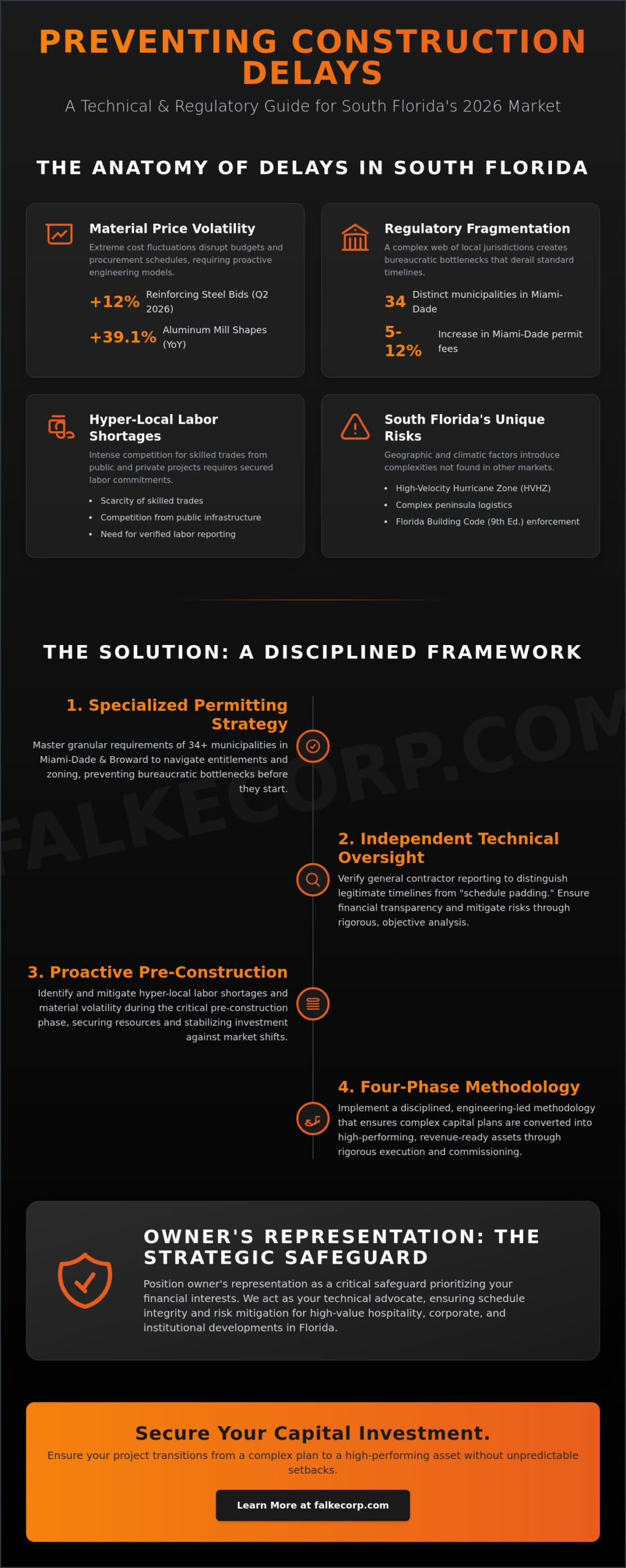
The primary drivers in the 2026 market include a 12% increase in reinforcing steel bids during the second quarter and a 39.1% rise in the cost of aluminum mill shapes between February 2025 and February 2026. These fluctuations, paired with the persistent scarcity of skilled trades, necessitate a transition from reactive management to a proactive engineering model. Failure to account for these technical variables results in a loss of schedule integrity that often becomes visible only when it is too late to correct, leaving owners to absorb the financial fallout of poor planning.
The Financial Velocity of Delay-Related Losses
A 30-day delay on a hospitality or retail asset in Miami-Dade or Broward counties carries a compounding financial penalty. The cost of carry, which includes debt service and interest, represents only a fraction of the total loss. The primary damage occurs through lost revenue opportunities during South Florida’s critical seasonal peaks. Minor schedule slips in the early stages of a project often lead to catastrophic bottlenecks during the commissioning phase; this prevents the asset from being revenue-ready at the moment of peak market demand. Maintaining financial control requires a system that identifies “schedule padding” before it manifests as a hard delay.
South Florida’s Unique Risk Profile
The High-Velocity Hurricane Zone (HVHZ) designation creates a construction cycle that is inextricably linked to the Atlantic hurricane season. Logistics on the Florida peninsula are inherently complex; the geographic isolation complicates the delivery of critical materials and increases the reliance on local supply chains. Additionally, the nearly $10 billion investment in commercial construction recorded through the first three quarters of 2025 has led to intense competition for labor. Large-scale public infrastructure projects frequently exhaust the local workforce, making it essential for private owners to secure labor commitments through technical oversight rather than relying on the general contractor’s unchecked reporting.
Navigating the Regulatory Maze in Miami-Dade and Broward Counties
Permitting in South Florida is a fragmented landscape of 34 municipalities in Miami-Dade alone, each operating with distinct administrative nuances and technical requirements. In the 2026 market, relying on “standard” industry timelines is a technical error that often leads to catastrophic schedule slippage. For instance, developments in the Miami Design District must adhere to specific aesthetic and urban density codes that differ significantly from the Broward County permitting process. Similarly, North Bay Village presents unique environmental and maritime constraints that require early entitlement coordination to prevent work stoppages during the execution phase. Understanding how to prevent construction delays in South Florida requires a granular mastery of these local jurisdictions before the first shovel hits the ground.
Entitlements and Zoning Bottlenecks
Navigating the requirements of the City of Miami versus Miami-Dade County requires a precise understanding of evolving administrative costs. As of 2026, Miami-Dade has implemented a 5% to 12% increase in permit fees to support digital system enhancements, while Broward County maintains a strictly tiered fee schedule where projects valued over $1,000,001 incur a base fee of $5,012.25 plus $2.75 for every additional $1,000. These financial and regulatory variables must be addressed during Strategic Pre-Construction Services in Miami to identify hidden zoning constraints. A pre-construction site feasibility study is not an optional luxury; it’s a technical necessity to ensure that the project’s entitlements align with the December 31, 2026, enforcement of the Florida Building Code’s 9th Edition.
The Modern Permitting Strategy
A sophisticated development strategy utilizes phased permitting to decouple site work from vertical building reviews. This approach allows foundation and shell work to proceed while final architectural details undergo secondary review, effectively compressing the overall schedule. Owners who fail to supervise permit expediters through a technical representative often face late-stage regulatory comments that necessitate expensive change orders and rework. Managing these risks involves more than just administrative filing; it requires an engineering-led review of all submittals to ensure compliance before they reach the reviewer’s desk. To secure your project’s timeline, consider a partner who provides comprehensive technical oversight from the earliest entitlement phases. This level of control ensures that regulatory feedback is integrated into the design in real-time, maintaining the momentum required for a revenue-ready delivery.
Technical Oversight vs. General Contracting: A Comparison Framework
The structural divergence between a General Contractor’s objectives and an owner’s requirements often manifests in the reporting of project milestones. While a General Contractor (GC) operates on a model that prioritizes margin protection and risk insulation, an Owner’s Representative functions through the lens of technical competence and schedule integrity. Learning how to prevent construction delays in South Florida requires moving beyond passive acceptance of GC reports toward a system of independent verification. Technical oversight allows for the identification of “schedule padding,” where contractors build artificial buffers into the timeline to mask inefficiencies or prioritize other projects in their portfolio. By utilizing independent delay-analysis techniques, owners can distinguish between legitimate logistical hurdles and avoidable administrative friction.
The Conflict of Interest in Reporting
Relying solely on GC updates introduces a strategic vulnerability. Without third-party verification, monthly progress reports and pay applications can become disconnected from the actual physical completion on-site. For sophisticated developments, Construction Project Management in Florida must involve a rigorous audit of the critical path to ensure that every reported percentage of completion is backed by tangible engineering milestones. This independent analysis prevents the “end-of-project” shock where hidden delays suddenly materialize during the final 10% of the build, often at the moment when the asset should be transitioning to a revenue-ready state.
Proactive vs. Reactive Risk Mitigation
In the 2026 market, managing long-lead items such as HVAC units and electrical switchgear requires procurement strategies initiated months before site mobilization. A GC often reacts to supply chain disruptions as they occur, citing them as uncontrollable events. In contrast, technical oversight involves a disciplined methodology to manage third-party vendors, architects, and engineers pre-emptively. This approach ensures that technical specifications are finalized and orders are placed to align with the project’s critical path, rather than letting material availability dictate the construction tempo.
| Risk Factor | General Contractor Approach | Technical Oversight Approach |
|---|---|---|
| Weather (Hurricane) | Reactive; claims Force Majeure for any disruption. | Proactive; re-sequences indoor trades to maintain momentum. |
| Quality Control | Focuses on “passing inspection” at the end. | Continuous audits to prevent time-consuming rework. |
| Supply Chain | Reports delays after the delivery window is missed. | Tracks fabrication milestones to ensure on-time delivery. |
Quality control is the most effective tool for maintaining schedule integrity. When technical oversight identifies structural or electrical deviations early, it eliminates the need for the extensive rework that plagues many Miami developments. This rigorous commitment to precision ensures that the project remains on a structured path toward commissioning, free from the compounding delays of corrected errors.
FALKE Atlantic’s Four-Phase Methodology for Schedule Integrity
Effective project delivery in the 2026 market requires a transition from generalized planning to a disciplined, engineering-led framework. While regional guidance often focuses on legal remedies after a disruption occurs, schedule protection is found in the technical details of the initial phases. FALKE Atlantic Corporation utilizes a disciplined four-phase methodology, encompassing Concept, Pre-Construction, Execution, and Commissioning, to convert complex capital plans into revenue-ready assets. This structured approach ensures that every variable, from the December 31, 2026, Florida Building Code updates to hyper-local labor availability, is integrated into the project’s DNA before mobilization begins. Learning how to prevent construction delays in South Florida is fundamentally about controlling the technical trajectory of the build from day one.
Phase I & II: Concept and Pre-Construction Rigor
The Concept phase prioritizes site feasibility and the assembly of a design team specifically calibrated for the Miami-Dade and Broward regulatory environments. Architectural errors are frequently the root cause of downstream delays; therefore, assembling a team with proven HVHZ experience is a technical requirement, not a suggestion. During Pre-Construction, we establish a baseline through rigorous budget and schedule benchmarking that accounts for the 12% increase in reinforcing steel bids observed in early 2026. Critical Path Management serves as the primary tool for delay prevention by identifying the specific sequence of activities that dictate the final completion date.
Phase III & IV: Execution and Revenue-Ready Commissioning
During the Execution phase, technical oversight shifts toward maintaining quality standards to prevent the rework that often derails modern Miami developments. Our approach to Construction Phase Management in Florida involves continuous audits of the critical path and the proactive management of long-lead procurement. The final phase, Commissioning, is designed to avoid the “99% complete” trap where minor punch-list items and administrative oversights prevent the asset from opening. By managing the close-out process with the same engineering precision as the foundation pour, FALKE Atlantic Corporation ensures that hospitality and retail assets are fully operational and ready to generate revenue according to the original pro forma.
To secure your development against the volatility of the 2026 market, you need a partner who views schedule integrity as a technical mandate. Explore how our Owner’s Representation services can stabilize your project’s timeline and protect your capital investment through every phase of the construction lifecycle.
Owner’s Representation: The Strategic Safeguard for Florida Developments
In the complex environment of 2026, positioning an Owner’s Representative as a strategic partner rather than a mere service fee is the final, most critical step in protecting a capital investment. For corporations, hospitality brands, and high-net-worth individuals, the representative acts as a technical extension of the owner’s interests, ensuring that every engineering decision aligns with the broader business objective. Mastering how to prevent construction delays in South Florida is ultimately a matter of having a technical advocate who understands that every unverified report or unvetted change order is a potential risk to the project’s pro forma. This partnership provides the unwavering confidence that even the most intricate industrial and commercial processes remain under disciplined control through the oversight of FALKE Atlantic Corporation.
The Prada store in the Miami Design District serves as a benchmark for this level of high-quality, on-time delivery. In a district where architectural precision and aesthetic standards are non-negotiable, the project’s success was driven by the technical coordination of trades and the proactive management of regulatory reviews. This project demonstrates that when technical competence meets engineering reliability, the result is a revenue-ready asset delivered without the friction of traditional construction setbacks. It’s a testament to the fact that schedule integrity is a product of professional oversight, not environmental luck.
Protecting the High-Net-Worth and Corporate Investor
Remote owners managing South Florida developments face the unique challenge of technical opacity. Our approach to technical reporting is hűvösen elegáns and strictly objective; it prioritizes data-driven transparency over emotional persuasion. This formal style of communication ensures that stakeholders receive a clear, structured view of the project’s trajectory. A primary role of FALKE Atlantic Corporation is the prevention of change order fraud, a common driver of both financial loss and schedule slippage. By auditing technical claims against the original contract and current market indices, we ensure that the owner only pays for legitimate, necessary work. This level of scrutiny preserves the project’s financial stability and prevents administrative friction from eroding the delivery timeline.
Securing Your 2026 Project Success
As the December 31, 2026, enforcement of the Florida Building Code’s 9th Edition approaches, the margin for error in Miami-Dade and Broward developments has effectively vanished. The necessity for expert representation has never been more pronounced. FALKE Atlantic Corporation remains committed to delivering high-quality, revenue-ready assets by maintaining a relentless focus on precision and professional accountability. To secure your real estate assets and ensure your project survives the volatility of the current market, you must engage a partner who views your success through the lens of engineering excellence. Explore our services at Owner’s Representative Miami: Protecting Your Assets to learn how we can stabilize your next development.
Stabilizing Capital Integrity through Technical Excellence
Navigating the 2026 South Florida development landscape requires more than just capital; it demands a technical framework that accounts for every regulatory and logistical variable. By moving beyond the inherent conflicts of contractor-led reporting and adopting an engineering-first approach, owners can secure their assets against the friction of the current market. Mastering how to prevent construction delays in South Florida is the result of a commitment to precision throughout the entire project lifecycle, from the earliest site feasibility study to the final commissioning of complex systems.
FALKE Atlantic Corporation serves as the strategic safeguard necessary to convert ambitious capital plans into high-performing, revenue-ready assets. Our methodology ensures that your project is governed by data-driven transparency and unyielding quality standards, regardless of external market volatility. We invite you to Request a Strategic Consultation for Your South Florida Development to learn how our technical oversight can stabilize your timeline and protect your ROI. Ensuring your development is delivered on schedule isn’t a passive goal; it’s a technical mandate we fulfill with professional rigor.
Frequently Asked Questions
How much do construction delays typically cost owners in South Florida?
Construction delays in South Florida typically cost owners between 1% and 3% of the total project value per month in debt service and lost revenue opportunities. For a mid-to-high-end development with construction costs reaching $800 per square foot, a 30-day setback results in significant carrying costs that erode the project’s pro forma. These financial losses are often compounded when assets miss critical seasonal opening windows in the hospitality or retail sectors.
Can an Owner’s Representative actually speed up the permitting process in Miami?
An Owner’s Representative speeds up the permitting process by implementing a phased permitting strategy that decouples site work from vertical reviews. This technical coordination allows foundation work to proceed while final architectural details undergo secondary review by Miami-Dade authorities. By ensuring all submittals align with the Florida Building Code’s 9th Edition before filing, the representative prevents the administrative rework that often follows the 5% to 12% fee increases implemented in 2026.
What is the difference between an Owner’s Rep and a Construction Project Manager in Florida?
The difference lies in the scope of fiduciary responsibility and technical oversight across the entire project lifecycle. A Construction Project Manager typically focuses on the execution phase for the general contractor, whereas an Owner’s Representative manages the conceptual, pre-construction, and commissioning phases. This broader perspective is essential for how to prevent construction delays in South Florida, as it addresses regulatory and design risks that fall outside a contractor’s standard operational scope.
How does the Florida hurricane season impact construction schedules in 2026?
The 2026 hurricane season impacts schedules through mandatory site securement protocols and the enforcement of stricter wind resistance standards in High-Velocity Hurricane Zones. Proactive managers mitigate these disruptions by re-sequencing interior trades during the peak summer months and securing long-lead items like impact-resistant glass well before the June 1 start date. This ensures that the 20.9% increase in steel mill products observed in early 2026 doesn’t paralyze the project during storm activity.
Is it possible to prevent change orders from causing significant project delays?
Preventing change orders requires a rigorous pre-construction feasibility study and a disciplined methodology that identifies architectural gaps before site mobilization. By assembling a design team with specific Miami-Dade expertise, owners ensure that plans are fully coordinated before the general contractor provides a final bid. This technical precision eliminates the “schedule padding” often used by contractors to account for late-stage design changes that would otherwise stall progress.
What are the most common site planning issues that cause delays in Broward County?
Common issues in Broward County include fragmented drainage requirements and the specific fee structure for projects valued over $1,000,001. Failure to account for the $5,012.25 base fee and the $2.75 per additional $1,000 often leads to budgetary friction that stalls administrative progress. Technical oversight identifies these site-specific constraints during the concept phase to ensure that entitlements are secured without the mid-build work stoppages that plague less prepared developments.
At what stage of development should I hire an Owner’s Representative?
You should hire an Owner’s Representative during the initial Concept and Site Selection phase to maximize risk mitigation and financial control. Engaging an expert before the design team is assembled allows for the establishment of a baseline budget that accounts for the 12% rise in reinforcing steel bids. This early involvement is the most effective strategy for how to prevent construction delays in South Florida, as it prevents technical errors from being baked into the project’s foundation.
How does FALKE Atlantic manage the commissioning and close-out phase?
FALKE Atlantic manages commissioning through a series of technical audits and a structured close-out process that avoids the “99% complete” bottleneck. We ensure that all electrical, mechanical, and automation systems, including PLC programming and switchgear, are fully integrated and tested before the final inspection. This engineering-led approach ensures that the asset is revenue-ready on the exact date specified in the original pro forma, providing a seamless transition from construction to operation.