A 2024 industry analysis reveals that 30% of commercial project delays in South Florida result from a deficiency in integrated technical oversight during the pre-construction phase. You likely recognize that in Miami’s 2026 market, where specialized medical clinics reach construction costs of $450 per square foot, there’s no margin for error regarding technical execution. Engaging a qualified owner’s representative for medical office construction Miami is a structural necessity for any developer aiming to mitigate the 270 day permitting delays typical of Miami-Dade County while ensuring strict adherence to the 8th Edition Florida Building Code.
This strategic guide demonstrates how professional owner’s representation provides the engineering reliability required to protect your capital and ensure your facility meets the 2026 FGI Guidelines. We’ll examine the critical shift toward 90% single-resident room mandates in skilled nursing facilities and provide a roadmap for managing the complex MEP requirements of high-precision medical imaging suites. You’ll gain a comprehensive understanding of the structural milestone inspections and HVHZ standards that define the current South Florida development landscape, ensuring your project achieves technical excellence without compromising your financial objectives.
Key Takeaways
- Understand the critical technical divergence between standard Miami-Dade building permits and mandatory AHCA clinical licensure to prevent catastrophic operational delays.
- Learn why a dedicated owner’s representative for medical office construction Miami provides the necessary fiduciary oversight to audit change orders and protect your capital from contractor-driven cost escalations.
- Identify the essential technical competencies required for South Florida healthcare projects, specifically regarding State Fire Marshal requirements and established local inspector networks.
- Discover how a disciplined “Concept-to-Commissioning” methodology ensures clinical readiness and long-term asset stability through rigorous engineering oversight.
The High Stakes of Medical Office Development in Miami’s 2026 Market
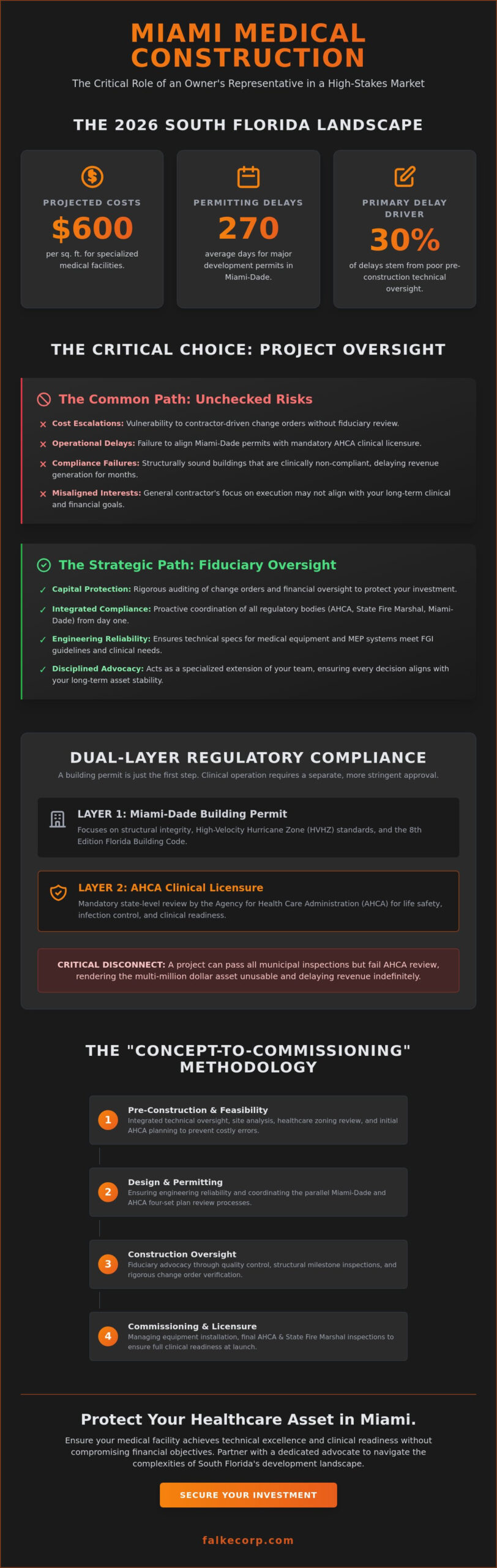
Miami’s healthcare landscape is undergoing a structural transformation as outpatient “medtail” spaces proliferate across the Design District and Coral Gables. This shift reflects a strategic move toward patient-centric delivery models, but it introduces significant technical complexity. In 2026, medical construction costs in South Florida are projected to reach $600 per square foot for specialized facilities, significantly outpacing standard commercial inflation due to specialized MEP requirements and a tightening specialized labor market. For a healthcare executive, a single day of delayed clinical operations doesn’t just represent lost revenue; it disrupts the continuity of care and compromises market positioning in a highly competitive region.
Engaging a professional owner’s representative for medical office construction Miami provides the technical infrastructure your executive team needs to manage these risks. Unlike a general contractor, who focuses on execution, an owner’s representative serves as a fiduciary advocate. By applying disciplined construction management principles, they ensure that every engineering decision aligns with your long-term clinical and financial goals. They function as a specialized extension of your staff, providing the technical competence required to audit complex change orders and verify that specialized equipment installations meet stringent manufacturer tolerances before the first patient arrives.
Defining the Medical Office Building (MOB) Asset Class
There’s a fundamental distinction between Class A clinical space and standard administrative offices. Clinical environments require reinforced floor slabs for heavy diagnostic equipment, specialized medical gas piping, and redundant HVAC systems for infection control. An expert owner’s representative ensures these technical specifications are integrated during the pre-construction phase to protect the asset’s long-term valuation. You can learn more about this strategic oversight in our guide on Owner’s Representative Miami: Protecting Your Real Estate Assets in 2026. Precise engineering at the outset prevents the need for costly structural retrofits during the commissioning phase.
Miami-Dade Healthcare Zoning and Site Feasibility
Navigating Miami-Dade’s 2026 zoning updates requires a granular understanding of healthcare density regulations and Right-of-Way requirements. Medical facilities often face more stringent parking ratios than standard retail, requiring one space per 200 square feet in many South Florida jurisdictions. During pre-construction, your representative must evaluate site suitability for heavy medical equipment like MRI or CT scanners, which require specific shielding and vibration dampening. Given that permitting lead times for major developments in Miami now average up to 270 days, conducting a rigorous site feasibility study is the only way to ensure your project remains viable within the current regulatory framework.
Navigating AHCA Regulations and Florida Healthcare Building Codes
Securing a standard Miami-Dade building permit is merely the first layer of regulatory compliance for healthcare facilities. AHCA oversight, managed by the Agency for Health Care Administration, is the mandatory state-level review process that governs the clinical licensure of Florida healthcare environments. While municipal inspectors focus on the 8th Edition Florida Building Code and High-Velocity Hurricane Zone (HVHZ) standards, the AHCA Office of Plans and Construction enforces specialized life safety and infection control requirements. Failure to distinguish between these two distinct authorities often leads to Stage 3 inspection failures, where a facility is structurally sound but clinically non-compliant, delaying operations for months.
A qualified owner’s representative for medical office construction Miami coordinates the rigorous four-set plan review process. This sequence includes schematic design, design development, 100% construction documents, and the final AHCA submittal. Generalist project managers frequently overlook the technical nuances of the 2026 FGI Guidelines, such as the minimum 90% single-resident room mandate for new skilled nursing facilities. By providing technical advocacy during these reviews, an owner’s representative ensures that the architectural intent remains aligned with AHCA’s evolving, technology-driven audit standards.
Specialized MEP Oversight for Clinical Environments
Medical facilities demand high-precision engineering for medical gas delivery, specialized HVAC filtration, and redundant power systems. MEP Coordination in a medical context is the technical integration of complex mechanical, electrical, and plumbing systems to maintain AHCA-mandated life-safety standards and equipment-specific environmental tolerances. During pre-construction, your representative must verify lead shielding requirements and structural reinforcement for imaging suites, ensuring that vendor-specific tolerances for MRI or CT scanners are met without compromising the building’s electrical load capacity or structural integrity.
Infection Control Risk Assessment (ICRA) During Renovations
Executing a renovation within an active clinical environment requires a disciplined approach to Infection Control Risk Assessment (ICRA). An owner’s representative manages the implementation of negative air pressure zones and dust mitigation protocols to protect patient health while maintaining HIPAA privacy standards. This level of technical oversight prevents cross-contamination and ensures that construction noise does not disrupt sensitive diagnostic procedures. Implementing a structured construction phase management strategy allows for seamless clinical operations during complex retrofits, securing both patient safety and the project’s timeline.
Owner’s Representative vs. General Contractor: A Comparison of Interests
The fundamental distinction between a general contractor and an owner’s representative lies in the nature of their obligation. A general contractor is bound by a legal contract to deliver a specific scope of work, often prioritizing project speed and their own profit margins. In contrast, an owner’s representative for medical office construction Miami operates under a fiduciary duty to the client. This means every recommendation, from material selection to scheduling adjustments, is filtered through the lens of the owner’s financial interest and long-term asset performance. A general contractor cannot objectively audit their own change orders or verify if a proposed technical substitution compromises clinical functionality; they’re essentially “grading their own homework.”
Technical advocacy is particularly vital in mitigating the “medical tax,” an industry phenomenon where specialized vendors apply significant markups to healthcare-related services. An owner’s representative scrutinizes these line items with engineering precision, ensuring that costs remain grounded in market realities rather than perceived “clinical premiums.” By maintaining a hightly structured oversight process, the representative prevents scope creep—a common issue in medical fit-outs where equipment vendors frequently update technical requirements mid-project. This disciplined approach ensures that the project remains a reflection of the owner’s strategic vision rather than a series of reactive, costly adjustments.
Budget Control and Change Order Mitigation
Effective budget management in healthcare development requires a proactive audit of medical equipment submittals against the base building design. It’s a technical reality that approximately 30% of commercial project delays in South Florida stem from a lack of integrated oversight during the pre-construction phase. A representative identifies design gaps—such as insufficient electrical load for a new diagnostic suite or mismatched plumbing for sterilization units—before they manifest as expensive field changes. The ROI of this service is measurable; the early detection of a single MEP conflict often saves more in mitigation costs than the entirety of the representative’s professional fee.
Vendor Management: Beyond the General Contractor
Successful medical projects require the precise coordination of a “triad”: the Architect, the General Contractor, and the Medical Equipment Specialist. An owner’s representative manages these often-conflicting interests to ensure that IT infrastructure and data security protocols are integrated during the earliest construction phases. This prevents the common mistake of treating clinical technology as an “add-on” rather than a core structural component. Engaging in Strategic Pre-Construction Services in Miami: The Owner’s Guide to Risk Mitigation allows you to establish these technical guardrails early, ensuring your facility is both operationally ready and clinically secure from day one.
Selecting the Right Representative for Miami Medical Projects
Selecting an owner’s representative for medical office construction Miami requires a rigorous evaluation of technical credentials rather than general project management experience. Healthcare facilities in South Florida are governed by the State of Florida Fire Marshal’s specific requirements, which are significantly more stringent than standard commercial codes. A qualified representative must possess the engineering depth to verify that smoke dampers, fire-rated assemblies, and emergency power systems are not only installed but also fully integrated and tested. This technical competence ensures that the facility doesn’t just pass a building inspection but meets the exacting standards required for clinical licensure.
Reporting protocols must be equally disciplined. Clinical stakeholders require real-time data on budget variances and schedule adjustments to manage staffing and equipment deliveries. A professional representative utilizes structured reporting that translates complex construction data into actionable business intelligence. This transparency is critical during the commissioning phase, where the focus shifts from structural completion to ensuring the building is revenue-ready. Proper commissioning involves the granular testing of medical gas systems, HVAC pressure differentials, and nurse call systems, ensuring every clinical component functions as intended before the first patient arrives.
Questions to Ask During the Selection Process
When interviewing potential representatives, prioritize technical evidence over marketing claims. You should ask: “How many AHCA-certified projects have you successfully closed in South Florida within the last 24 months?” Inquire about their specific process for managing medical equipment long-lead items, such as MRI shielding or custom surgical lighting, which often have lead times exceeding 180 days. Finally, verify their proficiency with the Florida Agency for Health Care Administration online portal, as this is the primary interface for tracking plan reviews and inspection results in 2026.
The Value of Local Presence in South Florida
A Miami-based representative is vital for navigating the regional labor market and climate-related operational risks. Beyond hurricane preparedness, they must manage the implications of Florida Statute 553.899 regarding Milestone Inspections. For buildings three stories or higher, inspections are now mandatory at 30 years of age and every 10 years thereafter. A local expert understands the specific regulatory nuances of Miami-Dade and Broward counties, ensuring that older medical buildings remain compliant while undergoing modern clinical retrofits. If you require technical advocacy to navigate these complexities, our owner’s representation services provide the engineering reliability your project demands.
FALKE Atlantic: Disciplined Advocacy for Healthcare Assets
FALKE Atlantic operates with a methodology rooted in engineering reliability and professional objectivity. In a market where 30% of commercial project delays result from insufficient technical oversight, our firm provides the structural discipline required to navigate high-stakes healthcare developments. As your owner’s representative for medical office construction Miami, we implement a framework that prioritizes capital protection through every phase of the project lifecycle. We don’t rely on emotional persuasion; our value is demonstrated through the technical competence of our oversight and the precision of our financial auditing.
Our “Concept-to-Commissioning” approach ensures that clinical readiness is never compromised by construction-phase inefficiencies. We adhere to lean construction principles, focusing on the elimination of waste and the optimization of specialized labor resources. By maintaining absolute financial transparency, we provide healthcare executives with the data-driven confidence needed to make informed strategic decisions. This commitment to technical excellence ensures that your medical asset is not only structurally superior but also fully compliant with AHCA standards and revenue-ready on day one.
Our Four-Phase Medical Methodology
The FALKE framework is divided into four distinct phases designed to mitigate risk at every technical junction. Phases 1 and 2 focus on rigorous feasibility studies and pre-construction services, where we lock in medical budgets and identify potential MEP conflicts before they escalate. You can explore our broader approach in our guide on Commercial Project Management in Miami: The Owner’s Strategic Guide (2026). Phases 3 and 4 transition into active construction oversight and a rigorous close-out process. During these final stages, we manage the AHCA-aligned commissioning of all clinical systems, ensuring that every medical gas line and redundant power circuit meets the highest safety benchmarks.
Case Study Insight: Precision in the Design District
Our recent work in the Miami Design District exemplifies the intersection of high-spec MEP requirements and luxury-tier clinical space. In these “medtail” environments, the challenge lies in managing the integration of hospitality-level finishes with stringent medical-grade utility requirements. FALKE successfully navigated these complexities by overseeing the installation of specialized HVAC filtration and diagnostic shielding within a high-aesthetic framework. This project demonstrated that clinical functionality and premium design can coexist when managed with engineering precision. If you are preparing to develop a specialized facility in South Florida, schedule a consultation for your Miami medical project to secure the technical advocacy your asset deserves.
Strategic Technical Advocacy for Miami Healthcare Assets
The 2026 Miami healthcare landscape demands a transition from traditional project management to disciplined technical advocacy. With specialized medical construction costs now exceeding $600 per square foot, the financial risks associated with regulatory non-compliance are unsustainable. Integrating a qualified owner’s representative for medical office construction Miami into your development team ensures that the 270 day permitting lead times and rigorous AHCA “Stage 3” inspections don’t compromise your operational timeline. Success in this market is defined by the early identification of MEP conflicts and the precise execution of clinical safety standards.
FALKE Atlantic provides the engineering reliability required to navigate these complexities through our specialized AHCA and MEP oversight. By utilizing our disciplined 4-Phase Methodology and Miami-Dade local regulatory expertise, we ensure your facility reaches its revenue-ready state without the 30% delays typical of uncoordinated projects. We invite you to Secure Your Healthcare Investment with FALKE Atlantic’s Expert Representation to ensure your next development meets the highest standards of technical excellence. Your clinical vision deserves the protection of unwavering professional objectivity.
Frequently Asked Questions
What is the difference between an owner’s representative and a project manager for a medical office?
An owner’s representative functions as a fiduciary advocate for the property owner, whereas a project manager typically focuses on tactical site execution. While a project manager manages the “how” of the daily construction process, the owner’s representative for medical office construction Miami ensures the “why” remains aligned with the owner’s financial and clinical objectives. This specialized role involves auditing change orders and managing the complex triad of architect, contractor, and medical equipment specialists to maintain the project’s strategic integrity.
Why is AHCA approval so difficult to obtain for Miami medical construction?
AHCA approval is complex because it mandates clinical licensure standards that far exceed standard municipal building codes. The Agency for Health Care Administration enforces specialized life safety systems and infection control protocols, such as the 2026 FGI requirement for 90% single-resident rooms in new skilled nursing facilities. A facility can pass a standard Miami-Dade building inspection yet fail an AHCA Stage 3 inspection if clinical flow or MEP systems don’t meet these stringent state-level mandates.
How much does an owner’s representative typically cost for a healthcare project in Florida?
Professional fees for an owner’s representative in South Florida typically range from 1% to 5% of the total construction cost. For larger developments, the fee usually falls within the 1% to 3% range, while smaller or highly complex medical projects often command 3% to 5%. Alternatively, hourly rates for these specialized consultants in the Miami region can range from $75 to over $200 per hour, depending on the project’s technical complexity and the representative’s level of engineering expertise.
Can an owner’s representative help with medical equipment procurement and installation?
Yes, an owner’s representative provides critical technical oversight during the procurement and installation of medical equipment. They ensure that vendor specifications for high-precision devices, such as MRI or CT scanners, are integrated into the initial MEP design to prevent costly retrofits. By managing long-lead items and coordinating with specialized vendors, the representative ensures that equipment arrives and is installed according to the project’s technical schedule and manufacturer tolerances.
How long does the AHCA plan review process usually take for Miami-Dade projects?
The AHCA plan review process is integrated into Miami’s broader permitting timeline, which currently averages 180 to 270 days for major developments. This duration accounts for the “four-set” plan review sequence, which includes schematic design, design development, and 100% construction documents. Engaging an owner’s representative for medical office construction Miami helps streamline this process by ensuring that submittals are technically accurate and compliant with the 8th Edition Florida Building Code from the initial filing.
Is it necessary to hire an owner’s rep for a small medical office renovation?
Hiring an owner’s representative is essential even for small medical renovations because clinical spaces trigger specific regulatory requirements. Any modification to a licensed healthcare environment must adhere to ICRA protocols and AHCA standards, regardless of the project’s physical footprint. A representative ensures that these small-scale retrofits don’t compromise the existing facility’s licensure or patient safety systems, protecting the owner from unexpected operational shutdowns or clinical non-compliance.
How does the Florida climate affect medical office construction and equipment storage?
The South Florida climate necessitates stringent climate control and adherence to High-Velocity Hurricane Zone (HVHZ) standards. High humidity levels can damage sensitive medical equipment if the building envelope isn’t sealed and dehumidified early in the construction phase. An owner’s representative manages these environmental risks by ensuring that HVAC systems are commissioned to maintain precise pressure differentials and moisture levels, protecting both the building’s structural integrity and its clinical technology.
What are the common causes of budget overruns in South Florida healthcare developments?
Budget overruns in South Florida healthcare developments often stem from uncoordinated MEP requirements and AHCA-mandated design changes. When clinical equipment vendors update their specifications mid-project, it creates a ripple effect throughout the mechanical and electrical systems. Without technical advocacy to audit these changes and mitigate scope creep, owners frequently face “medical tax” markups and expensive remediation costs during the final commissioning phase before the facility can open.