
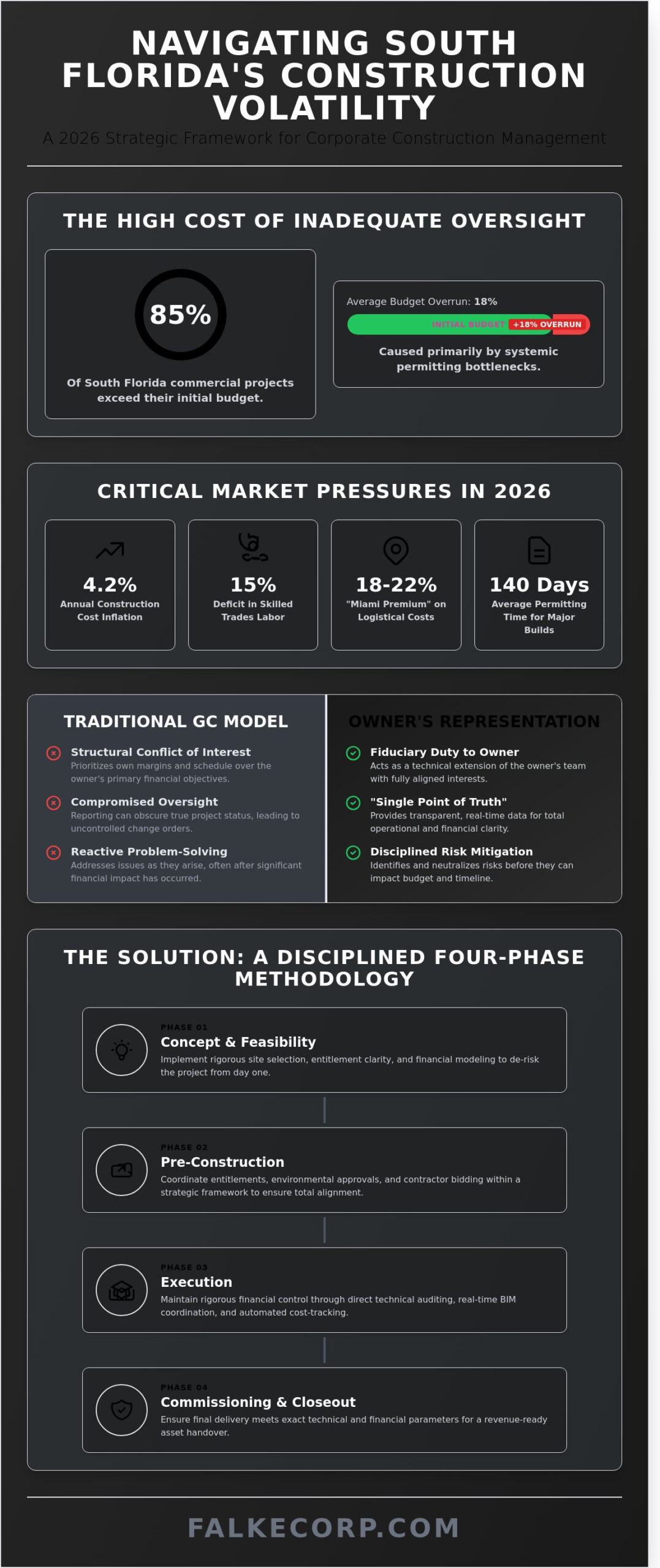
According to the 2024 South Florida Construction Outlook, 85% of commercial projects in the region exceed their initial budget by an average of 18% due to systemic permitting bottlenecks in Miami-Dade and Broward counties. For the sophisticated owner, these fiscal deviations aren’t merely inconveniences. They represent a fundamental failure in the technical oversight of the project lifecycle. You’ve likely observed that the traditional reliance on General Contractors often creates a structural conflict of interest that compromises your primary financial objectives. This 2026 strategic framework for corporate construction management Miami provides the disciplined engineering perspective necessary to mitigate these risks and maintain absolute fiscal control across all four development phases.
Precision is mandatory. By implementing a rigorous methodology for site selection and entitlement clarity, you’ll ensure your asset reaches a revenue-ready state without the burden of litigation or uncontrolled change orders. We’ll examine the specific protocols for navigating local regulatory hurdles and the precise management structures that align contractor performance with your long-term corporate interests.
Key Takeaways
- Identify the technical strategies necessary to navigate the volatility of South Florida’s 2026 market, focusing on disciplined risk mitigation and fiduciary oversight.
- Execute a structured four-phase development lifecycle to maintain rigorous financial control and operational transparency from initial concept through to final commissioning.
- Evaluate the critical distinction between general contracting and owner’s representation to establish a “single point of truth” for corporate boards and stakeholders.
- Navigate the complexities of Miami-Dade and Broward County permitting by coordinating entitlements and environmental approvals within a proven strategic framework.
- Leverage professional corporate construction management miami to serve as a technical extension of your real estate team, ensuring engineering-level precision in every project phase.
Navigating Corporate Construction Management in Miami’s 2026 Landscape
Within the 2026 South Florida economic environment, Construction management functions as a critical fiduciary oversight, ensuring that capital expenditures align strictly with technical execution. For institutional owners and developers, corporate construction management miami requires more than basic scheduling; it demands a rigorous defense of the owner’s interests against a market characterized by 4.2% annual construction cost inflation and a 15% deficit in skilled trades across the Atlantic seaboard. This fiduciary role involves the systematic mitigation of risk through technical auditing and proactive resource allocation.
Traditional project management often collapses under the weight of localized volatility. Standard vendors frequently prioritize their own margins over project integrity, leading to a disconnect between architectural intent and site reality. Without a dedicated Owner’s Representative, the complexity of luxury retail, hospitality, and Grade-A office spaces becomes a liability. In sectors where a 48-hour delay in the Miami Design District can translate to six-figure revenue losses, the presence of a strategic oversight partner is a financial necessity, not an optional service.
The Miami-Dade Construction Climate in 2026
Zoning amendments enacted in late 2025 for Brickell and the Design District have increased density allowances but introduced complex environmental mitigation requirements. The “Miami Premium” represents a quantifiable 18% to 22% increase in logistical costs compared to other Tier-1 markets. Local expertise is the only mechanism for cost control in this environment. Modern project oversight now relies on technological integration, utilizing real-time BIM coordination and automated cost-tracking systems to provide the transparency required for high-stakes corporate construction management miami.
Identifying the Strategic Partner vs. the Vendor
Large-scale mega-firms often operate on volume, which dilutes the precision required for complex industrial or commercial assets. A boutique consultancy offers a level of transparency and technical depth that bureaucratic structures cannot replicate. Success in Dade and Broward counties depends on established relationships with local officials to navigate permitting processes that currently average 140 days for major commercial builds. FALKE Atlantic positions itself as a strategic partner, focusing on the preservation of high-net-worth assets through engineering-grade reliability and structured accountability. We provide:
- Direct technical auditing of all site activities.
- Logistical coordination to bypass local supply chain bottlenecks.
- Rigorous financial oversight to eliminate “Miami Premium” redundancies.
Effective management isn’t about hope; it’s about the application of engineering logic to the chaos of the construction site. By treating every project as a complex system of interdependent variables, we ensure that the final delivery meets the exact technical and financial parameters established at the outset.
The Four-Phase Methodology: A Disciplined Approach to Development
The lifecycle of a high-stakes development in South Florida demands a structured sequence to mitigate the volatility of labor markets and material lead times. Effective corporate construction management in Miami isn’t merely about oversight; it’s a rigorous four-phase methodology comprising Concept, Pre-construction, Execution, and Commissioning. This disciplined approach ensures that financial control and transparency remain constant at every milestone. Industry data from 2024 suggests that nearly 65% of capital project failures are rooted in inadequate front-end loading. By segmenting the project into distinct, measurable stages, owners can identify risks before they manifest as costly delays.
A phased framework provides a logical progression where every decision is backed by technical data. This level of precision is essential for maintaining the stability of the project’s internal rate of return. It prevents the common pitfalls of “scope creep” and unmanaged change orders that often plague less structured developments. The objective is to create a predictable environment where the owner’s interests are protected through engineering reliability and technical competence.
Phase 1 & 2: Concept and Pre-Construction Rigour
The success of a project is often determined before the first shovel hits the ground. During the initial phases, feasibility studies and site selection are critical to avoid “dead-on-arrival” projects. In Miami’s current regulatory environment, ignoring local zoning shifts or sea-level rise mitigation can lead to catastrophic financial losses. Owners must prioritize the assembly of a design team where architect and engineer selection is based on technical merit and historical ROI performance.
Early cost estimating and value engineering are not just cost-cutting exercises; they’re essential tools for aligning the project’s technical specifications with the owner’s business objectives. This stage requires a deep dive into the mechanical, electrical, and plumbing (MEP) requirements to ensure long-term operational efficiency. For a detailed breakdown of these early-stage requirements, review our guide on Strategic Pre-Construction Services in Miami: The Owner’s Guide to Risk Mitigation.
Phase 3 & 4: Construction Phase and Close-out
The execution phase demands unwavering on-site oversight to manage an increasingly complex web of third-party vendors and contractors. Corporate construction management in Miami requires a physical presence that enforces adherence to the technical blueprints and safety protocols. Real-time reporting and structured communication channels ensure that the owner is never left in the dark regarding the project’s status. Maintaining this level of control is the primary focus of Construction Phase Management in Florida: The Owner’s Guide to Execution.
The final phase, commissioning and close-out, is where the asset transitions to a revenue-ready state. This isn’t just a hand-over of keys; it’s a comprehensive verification of all integrated systems. Every PLC program, electrical circuit, and HVAC component must be tested to ensure it meets the high-performance standards set during the design phase. A meticulous close-out process ensures that the transition from construction to operations is seamless and that the facility is prepared for immediate occupancy. If you’re looking for a partner to manage these complexities, Falke Corp offers the technical expertise required for sophisticated industrial and corporate projects.
Owner’s Representation vs. General Contracting: Resolving the Conflict of Interest
The structural framework of a construction project often creates a fundamental tension between the General Contractor (GC) and the corporate owner. While the GC focuses on project execution and profit margins, their objectives rarely align perfectly with the owner’s long-term asset performance. Relying solely on a GC to manage their own progress creates a lack of transparency that can lead to unchecked budget expansions. Professional corporate construction management miami requires a dedicated Owner’s Rep to act as the single point of truth for the board of directors. This role provides the technical competence necessary to audit GC performance without the bias of self-interest.
Contract structures dictate the management intensity required. In a lump-sum agreement, the GC assumes the financial risk but may prioritize speed over quality to protect margins. Conversely, cost-plus contracts transfer risk to the owner, necessitating a rigorous oversight process to verify every labor hour and material invoice. An independent representative ensures that the chosen contract type serves the project’s technical requirements rather than the contractor’s cash flow needs.
Fiduciary Responsibility in Miami Construction
Protecting capital in the 2026 Miami market demands more than basic project management. It requires a specialized discipline focused on technical auditing and risk mitigation. Change order management is a primary failure point; industry data from 2024 indicates that unverified change orders can inflate project costs by 12% to 18% if left to the GC’s discretion. A dedicated Owner’s Representative Miami: Protecting Your Real Estate Assets in 2026 implements a rigorous validation process for every deviation from the initial scope.
This oversight is vital for large-scale hospitality and retail build-outs where technical complexity is high. The representative ensures that the engineering specifications meet the owner’s standards, preventing the “value engineering” traps that often result in higher maintenance costs later. They bridge the gap between the corporate board’s financial objectives and the site’s mechanical realities.
Case Study Insights: Retail and Hospitality Success
The Miami Design District and South Beach serve as benchmarks for high-stakes corporate construction management miami. In these environments, tenant improvements involve complex MEP (Mechanical, Electrical, Plumbing) integration within existing luxury shells. Success in the Design District often hinges on managing tight logistics and strict noise ordinances that can derail a GC’s schedule. Lessons from 2025 luxury renovations show that projects with independent oversight reduced delivery delays by 22% compared to those managed solely by the primary contractor.
Effective Tenant Improvement Project Management in Miami: A Strategic Owner’s Guide (2026) focuses on the precision of the hand-off between shell construction and interior fit-out. In South Beach hospitality projects, where saltwater corrosion impacts material selection, the Owner’s Rep ensures that the GC doesn’t substitute specified high-grade alloys for inferior alternatives to save on immediate costs. This engineering-led approach secures the asset’s structural integrity for its entire lifecycle.
Miami-Dade and Broward County Permitting: A Strategic Framework
Effective project execution in South Florida hinges on a granular understanding of the “Permit Trap.” Within municipalities such as North Bay Village or Coral Gables, fragmented administrative processes often lead to 14-month delays for basic shell and core approvals. This isn’t merely an administrative hurdle; it’s a financial drain that impacts the internal rate of return for corporate stakeholders. Navigating these complexities requires a technical framework that integrates entitlements with environmental approvals from the earliest design phases. In 2026, the intersection of municipal zoning and county-level environmental oversight has become more rigid, making it vital to secure Real Estate Development Management Services in Miami: A 2026 Strategic Guide to synchronize these moving parts.
Strategic site feasibility studies must now account for the 2026 sea-level rise projections. These data points dictate finish floor elevations and drainage infrastructure requirements that go beyond standard municipal codes. Utilizing specialized corporate construction management miami ensures that these environmental variables are factored into the initial budget and schedule, preventing costly mid-cycle design revisions. The objective is to move from a reactive posture to a predictive one, where coastal regulations are treated as engineering parameters rather than bureaucratic obstacles.
Navigating Local Jurisdictions
Permitting speed varies significantly across the tri-county area. While Fort Lauderdale has digitized 95% of its intake process to reduce review cycles by 20%, Miami-Dade’s Department of Regulatory and Economic Resources (RER) maintains more rigorous, multi-layered review protocols. A qualified Owner’s Rep accelerates the design team assembly to ensure that mechanical, electrical, and plumbing (MEP) drawings are ready for concurrent review. Implementing a “dry-run” permit process allows for the identification of code conflicts before the official submission; this method often saves 90 to 120 days of the critical path schedule.
Risk Mitigation for Coastal Developments
The 2026 Florida Building Code updates introduce stringent structural requirements for wind resistance and flood elevation. Corporate assets must integrate these standards to maintain insurability in a volatile South Florida market. Sustainability isn’t a marketing slogan; it’s a technical necessity for modern corporate mandates. Designing for resilience involves:
- Elevating critical electrical components 3 feet above the 50-year flood plain.
- Utilizing salt-spray resistant materials to reduce 20-year maintenance cycles.
- Integrating gray-water recycling systems to comply with new municipal water-usage caps.
These engineering choices ensure the long-term stability of the asset and align with global ESG requirements. For a technical consultation on your next project, reach out to our team for specialized corporate construction management miami solutions.
FALKE Atlantic: Your Fiduciary Partner for Miami Construction
FALKE Atlantic operates as a dedicated fiduciary representative, prioritizing the owner’s capital and long-term asset performance throughout the development lifecycle. Our boutique approach focuses on the technical precision required for complex development management, ensuring that every decision aligns with the client’s financial and operational objectives. By functioning as a strategic extension of your internal corporate real estate team, we provide the technical oversight necessary to navigate the 2026 regulatory environment. Our primary objective remains constant: delivering projects that are revenue-ready, fully compliant with evolving South Florida codes, and strictly under budget.
The complexity of corporate construction management miami demands more than just scheduling; it requires a deep understanding of local infrastructure and vendor accountability. We integrate seamlessly into your existing structure to manage the high-stakes variables that typically cause delays. For detailed insights into our methodology, you can explore our resource on Commercial Project Management in Miami: The Owner’s Strategic Guide (2026).
Tailored Solutions for Diverse Clients
Our firm applies a rigorous engineering-based logic to a variety of specialized sectors across the Miami metropolitan area:
- Brickell Financial District: We manage corporate office relocations where vertical logistics and 24-hour operational constraints require minute-by-minute coordination.
- Premium Retail: For expansions in South Florida’s high-end malls, we focus on accelerated delivery to meet strict lease commencement dates and brand standards.
- HNWI Residential: We provide strategic oversight for high-net-worth individual developments, ensuring that complex architectural visions are grounded in structural reality and cost efficiency.
Begin Your Development with Strategic Oversight
The concept phase is where the most significant financial savings are realized. Industry data from 2024 indicates that over 15% of total project costs can be optimized during the initial 10% of the project timeline. By engaging FALKE Atlantic during the earliest stages of planning, owners can implement value engineering and risk mitigation strategies before capital is committed to suboptimal designs. This proactive stance prevents the reactive, costly corrections that often plague Miami developments during the mid-construction phase.
Successful corporate construction management miami starts with a foundation of technical transparency and data-driven decision-making. We invite you to secure the stability of your next project by initiating a professional dialogue with our team. You can request a consultation for your Miami development to review your project’s technical requirements and establish a framework for successful execution.
Securing Operational Excellence in the 2026 Miami Market
The 2026 development cycle requires a technical framework rooted in engineering precision and fiduciary responsibility. Owners must utilize a disciplined four-phase methodology to systematically mitigate the risks inherent in South Florida’s infrastructure projects. Navigating the specific regulatory requirements of Miami-Dade and Broward County jurisdictions is critical, as these local standards dictate the trajectory of every industrial development. Effective corporate construction management miami provides the necessary oversight to ensure that project objectives remain aligned with the owner’s long-term strategic goals. By adopting a fiduciary-first approach, FALKE Atlantic eliminates the inherent conflicts of interest often found in traditional general contracting models. We provide the technical competence and structural stability required to manage complex industrial processes with unwavering reliability. This structured methodology transforms technical challenges into predictable outcomes, ensuring that every project phase meets the highest professional standards. Your development deserves the stability of a partner who prioritizes engineering integrity over superficial promises.
Secure Your Miami Development with FALKE Atlantic
We’re ready to bring disciplined execution to your next South Florida project.
Frequently Asked Questions
What is the difference between a General Contractor and an Owner’s Representative in Miami?
A General Contractor manages the physical execution and subcontractors while an Owner’s Representative acts as the owner’s fiduciary advocate to oversee the entire project lifecycle. In Miami, the GC focuses on the Florida Building Code compliance at the site level. The Owner’s Rep ensures the GC meets the 2026 performance benchmarks and budget constraints. This distinction prevents conflicts of interest that often arise when a contractor’s left to self-police their own schedule and quality.
How much does corporate construction management cost in South Florida?
Corporate construction management fees in South Florida typically range from 3% to 5% of the total project value according to recent industry benchmarks. These percentages vary based on the project’s complexity and the specific scope of services required. Owners don’t just recover this investment; they mitigate 15% to 20% in potential cost overruns. Utilizing professional corporate construction management miami services provides a structured approach to financial risk management.
Why is the pre-construction phase critical for Miami-Dade projects?
Pre-construction is critical because it addresses Miami-Dade’s unique environmental regulations and the Department of Regulatory and Economic Resources (RER) permitting timelines. Projects that bypass rigorous pre-planning face an average delay of 120 days due to late-stage discovery of utility conflicts or sea-level rise mitigation requirements. We use this phase to finalize 100% of the technical specifications. This precision ensures that subsequent procurement and mobilization phases don’t suffer the typical friction of urban South Florida development.
Can an Owner’s Rep help with site selection in Broward County?
An Owner’s Representative provides essential technical due diligence during site selection in Broward County to evaluate infrastructure capacity and zoning constraints. We analyze the 2026 municipal master plans to ensure the chosen location supports the intended corporate operations. This analysis includes assessing power grid reliability and traffic impact fees which can exceed $50,000 for large-scale developments. Identifying these variables early prevents the acquisition of sites that don’t meet long-term operational needs.
What are the common causes of construction delays in Miami in 2026?
Primary delays in 2026 stem from global supply chain volatility affecting specialized electrical components and a 12% shortage in skilled MEP labor across South Florida. Municipal permit backlogs in the City of Miami also contribute to schedule slippage. Our framework mitigates these risks by implementing long-lead item procurement strategies six months before the groundbreaking date. We maintain a rigorous tracking matrix so we don’t lose sight of any critical path component during the execution phase.
How does FALKE Atlantic manage change orders to prevent cost overruns?
FALKE Atlantic manages change orders through a strict technical validation protocol that requires a root cause analysis for every request. We implement a 48-hour audit window where our engineers verify the necessity and market pricing of the proposed change. This disciplined approach reduces the volume of non-essential modifications by 25% on average. By enforcing contract transparency, we ensure that the owner doesn’t pay for documented value additions that aren’t justified by the project scope.
What sectors does FALKE Atlantic specialize in for corporate management?
FALKE Atlantic specializes in the industrial automation, data center, and high-tech corporate headquarters sectors. Our expertise is tailored for complex facilities exceeding 50,000 square feet where technical systems integration is paramount. We focus on projects that require advanced engineering reliability and precise electrical infrastructure. This specialization allows us to apply deep domain knowledge to the unique challenges of the corporate construction management miami market so our clients’ investments remain secure.
Is an Owner’s Rep necessary for smaller tenant improvement projects?
An Owner’s Rep is necessary for tenant improvements if the project involves critical infrastructure or budgets exceeding $1 million. Even smaller TI projects in Miami’s Class A office towers require coordination with building management and adherence to strict 2026 fire safety codes. We provide the technical oversight needed to manage these complexities without disrupting existing building operations. Professional management ensures that the accelerated timelines typical of TI work don’t compromise long-term facility stability.