
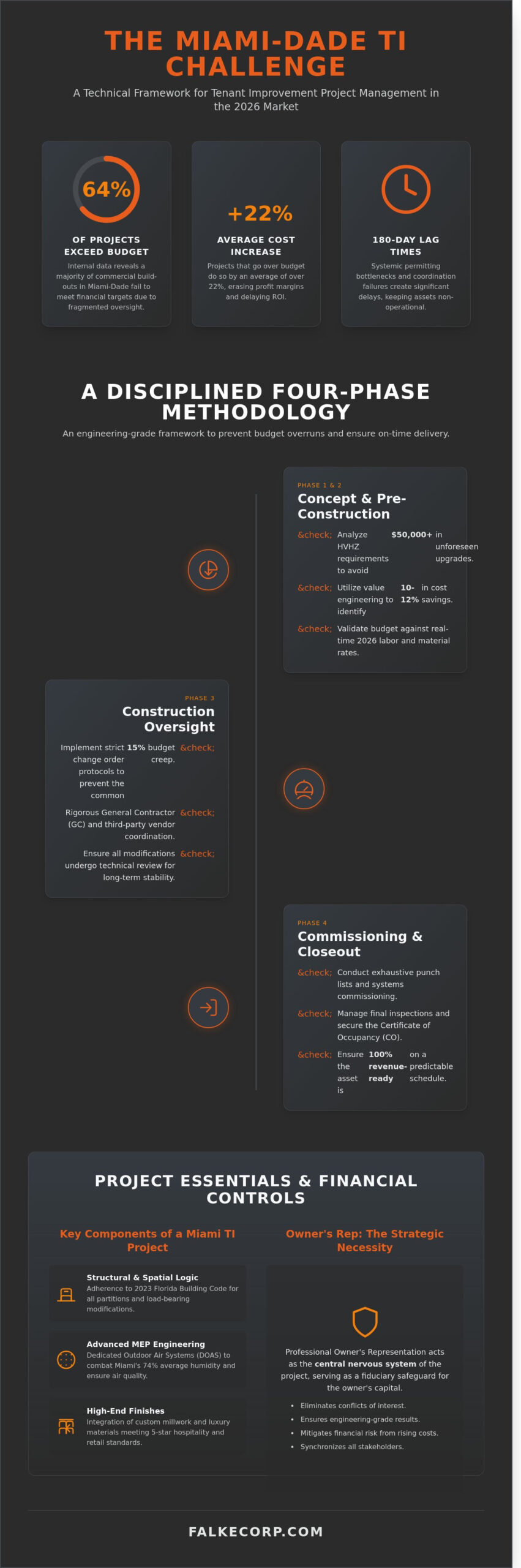
In 2025, internal industry data indicated that 64% of commercial build-outs in Miami-Dade County exceeded their initial budgets by more than 22% due to fragmented oversight and systemic permitting bottlenecks. You recognize that a commercial lease remains a liability rather than an asset until the moment the space becomes fully operational. The inherent friction between architectural vision and the local regulatory reality often creates a vacuum where capital and time disappear without clear accountability. It’s a challenge that demands more than simple coordination; it requires a disciplined engineering mindset.
This guide establishes a technical framework for tenant improvement project management that prioritizes structural transparency and rigid financial milestones. By implementing a disciplined, owner-centric approach, you’ll learn to mitigate the specific 180-day lag times common in South Florida’s current construction environment. We’ll examine the critical path from pre-construction auditing to the final certificate of occupancy to ensure your asset is revenue-ready on a predictable schedule. Our analysis covers everything from municipal navigation to contractor auditing, providing the precision necessary for the 2026 market.
Key Takeaways
- Establish a clear technical distinction between shell-and-core assets and bespoke tenant fit-outs to ensure a precise foundation for your commercial space requirements.
- Deploy a disciplined four-phase methodology for tenant improvement project management that prioritizes technical rigor and financial transparency at every milestone.
- Master the complex regulatory landscape of South Florida, specifically addressing the stringent High-Velocity Hurricane Zone (HVHZ) requirements and local permitting hurdles.
- Optimize financial outcomes by strategically leveraging Tenant Improvement Allowances and utilizing competitive bidding to mitigate costs in an inflated construction market.
- Recognize the strategic necessity of professional owner’s representation to eliminate conflicts of interest and ensure the delivery of high-standard, engineering-grade results.
Defining Tenant Improvement (TI) Project Management in the Miami Market
Tenant improvement project management represents the technical execution of customizing a leased commercial interior to meet precise operational specifications. In the South Florida landscape, this process bifurcates into two distinct phases: the delivery of the “Shell and Core” and the subsequent “Tenant Fit-Out.” While the landlord provides the structural envelope and primary utility risers, the fit-out encompasses the specialized systems required for the tenant’s specific workflow. This distinction is critical for owners in 2026, as Miami’s commercial inventory increasingly shifts toward high-performance, mixed-use developments where technical integration determines long-term asset value.
Effective management serves as a fiduciary safeguard for the owner’s capital. With construction costs in Miami-Dade County rising by 4.2% annually since 2023, every engineering decision impacts the bottom line. A structured Property Management Overview reveals that oversight isn’t merely about scheduling; it’s about mitigating the financial risks inherent in complex build-outs. For luxury retail brands in the Design District or hospitality groups in Brickell, the margin for error is non-existent. Specialized oversight ensures that the technical vision translates into a functional reality without exceeding the allocated TI allowance.
Key Components of a Miami TI Project
- Structural and Spatial Logic: Implementation of interior partitions and load-bearing modifications that adhere to the 2023 Florida Building Code.
- Advanced MEP Engineering: Miami’s average 74% humidity requires dedicated outdoor air systems (DOAS) and precision HVAC controls to prevent microbial growth and maintain air quality.
- High-End Finishes: Integration of custom millwork and imported materials that meet the aesthetic standards of 5-star hospitality and luxury retail sectors.
The Stakeholders: Who Manages What?
The division of responsibility between landlord and tenant is defined by the Work Letter, a document that outlines who pays for and executes specific improvements. The Architect of Record handles local compliance and permitting through the City of Miami Building Department. However, the Project Manager functions as the central nervous system of the development. They synchronize these disparate parties to maintain the critical path. Without this central coordination, tenant improvement project management fails to address the logistical bottlenecks common in high-density urban environments like Wynwood or the Financial District.
A Disciplined Four-Phase Methodology for TI Success
Effective tenant improvement project management requires an engineering-grade approach to every variable. In Miami’s 2026 commercial market, where construction costs have stabilized at a 4.2% annual growth rate, owners can’t afford fragmented workflows. A structured four-phase methodology ensures that technical specifications align with fiscal constraints before the first permit is pulled. This disciplined framework prevents the 15% budget overruns common in unmanaged renovations; it creates a clear audit trail from the initial site assessment to the final mechanical commissioning. For larger commercial developments requiring comprehensive oversight, implementing corporate construction management Miami strategies becomes essential to maintain absolute fiscal control across all development phases.
Phase 1 & 2: Concept Development and Pre-Construction
Feasibility begins with a granular analysis of Miami-Dade’s 2023 High-Velocity Hurricane Zone (HVHZ) requirements. Selecting a site without verifying existing MEP (Mechanical, Electrical, Plumbing) capacity often leads to $50,000 in unforeseen infrastructure upgrades. We assemble a team of architects and engineers who prioritize technical value engineering. This process identifies 10% to 12% cost savings by substituting materials without degrading the structural integrity or design intent. Every decision during these phases validates the budget against real-time 2026 labor rates to ensure financial transparency.
Phase 3 & 4: Construction Oversight and Commissioning
Once construction begins, the focus shifts to rigorous General Contractor (GC) oversight and third-party vendor coordination. We implement a strict change order management protocol to prevent budget creep. Every modification undergoes a technical review to ensure it serves the project’s long-term stability. The final 10% of the timeline involves exhaustive punch lists and the pursuit of the Certificate of Occupancy (CO). By maintaining a strategic project framework, owners ensure that the transition from construction to operations occurs without the 30-day delays typically associated with administrative bottlenecks.
- Risk Mitigation: Structured decision-making protocols eliminate emotional bias during procurement.
- Financial Transparency: Milestone-based reporting tracks every dollar against the initial pro forma.
- Technical Rigor: Commissioning agents verify that all HVAC and life safety systems meet 2026 Florida Building Code standards.
Precision in the early stages dictates the success of the delivery. A project that lacks a defined methodology will inevitably succumb to the complexities of the Miami permit office and supply chain volatility. Professional management transforms these risks into a controlled, predictable sequence of engineering milestones.
Navigating Miami-Dade and Broward County Regulatory Requirements
Tenant improvement project management in South Florida demands a rigorous understanding of the 8th Edition Florida Building Code, which became mandatory on December 31, 2023. Project owners often underestimate the 30 to 45 day technical review cycle required by the City of Miami Building Department. In Fort Lauderdale, specific zoning overlays in the Downtown Area (RAC-CC) impose strict floor-area ratio limits that dictate the scale of interior build-outs. Success depends on aligning architectural plans with the High-Velocity Hurricane Zone (HVHZ) standards, which apply to all structures within Miami-Dade and Broward Counties regardless of their distance from the coast.
Compliance isn’t just about structural integrity; it’s about navigating the 20% rule for ADA improvements. If a tenant improvement cost exceeds 20% of the building’s appraised value, the Florida Building Code requires additional accessibility upgrades to the path of travel, including restrooms and parking. This fiscal threshold necessitates a precise cost-benefit analysis during the pre-construction phase to avoid unforeseen capital expenditures in older assets built before 1990. Technical precision in these early stages prevents the 15% to 25% budget overruns commonly seen when regulatory hurdles are ignored.
Permitting and Inspections in South Florida
Expediting a project requires a dual-track strategy. Utilizing a Dry Run process allows for a preliminary plan review before formal submission, reducing the likelihood of a Rejection Notice that can stall a schedule by 14 days. Developers must secure a Master Permit before specialized trade permits for electrical or mechanical work are issued. Coordination with the Department of Environmental Resources Management (DERM) is critical, especially for hospitality projects where grease trap sizing and sanitary sewer capacity certifications are required under 2025 revised municipal guidelines. Life safety inspections, specifically for NFPA 101 compliance, must be scheduled at least 72 hours in advance to maintain the project timeline.
Climate-Specific Technical Considerations
The subtropical environment dictates specific engineering parameters for every commercial interior. HVAC systems must be sized using Manual N calculations to handle Miami’s 90-degree design temperature and high latent heat loads. Failure to implement advanced moisture mitigation, such as desiccant dehumidification during the drywall phase, often leads to microbial growth. For storefronts, all glazing must meet TAS 201, 202, and 203 impact standards to withstand wind speeds exceeding 175 mph. These technical requirements ensure the asset remains resilient and insurable within the volatile Florida market. Effective tenant improvement project management integrates these climate-specific variables into the initial procurement list to avoid long lead times for hurricane-rated components.
Financial Control: TI Allowances, Bidding, and Cost Mitigation
Effective tenant improvement project management requires a rigorous financial framework to counteract Miami’s 8.2% annual construction inflation rate recorded in early 2026. Owners shouldn’t view the budget as a static document but as a dynamic risk management tool. Precision in financial oversight ensures that technical requirements don’t deplete capital reserves before the project reaches substantial completion.
Managing the TI Allowance (TIA)
Landlords typically structure the Tenant Improvement Allowance to cover “hard costs” like drywall and electrical systems, yet 24% of South Florida lease disputes stem from “soft cost” exclusions. These exclusions often involve architectural fees, MEP engineering, or expedited permitting costs that the tenant must then cover out-of-pocket. Negotiating a comprehensive Work Letter is the primary defense against these gaps. It’s vital to define the exact scope of the Landlord’s Work versus the Tenant’s Work to prevent redundant billing. Falke Corp manages the tracking of fund disbursements through a verification protocol where every draw request is matched against executed lien waivers. This process ensures subcontractors are paid directly and prevents legal encumbrances from stalling the 2026 delivery timeline.
The Bidding and Procurement Process
Qualifying a General Contractor in Miami-Dade or Broward requires more than a simple price comparison. We analyze bidders based on their 2025 safety records and their specific experience with high-rise logistics or Class A office standards. Choosing the right contract structure is a strategic decision that impacts the final bottom line:
- Lump Sum Contracts: These provide price certainty but often include a 15% risk premium embedded by the contractor to cover market volatility.
- Cost Plus Contracts: These offer maximum transparency and potential savings if the project stays under budget, though they require intensive audit-ready oversight to manage.
An Owner’s Contingency is a standard 10% buffer for Miami renovations. This reserve is essential for addressing hidden costs, such as mandatory fire alarm upgrades triggered by the 2023 Florida Building Code or structural remediation found during the demolition of older Brickell or Downtown properties. Falke Corp maintains the financial integrity of every project through structured reporting that provides stakeholders with real-time visibility into the remaining TIA balance and projected cash flow requirements.
Ensure your capital is deployed with engineering precision by leveraging our technical tenant improvement project management services for your next South Florida asset.
Why Professional Owner’s Representation is the Logical Conclusion
Relying solely on a General Contractor for tenant improvement project management creates an inherent conflict of interest. A contractor’s primary objective involves the optimization of their own labor margins and schedule efficiency. They don’t possess the fiduciary mandate to challenge their own change orders or audit their own progress against the owner’s long-term financial interests. An Owner’s Representative functions as a technical extension of the owner’s executive team. This partnership is essential for high-net-worth individuals and global brands who require 100% alignment between project execution and capital expenditure.
In the Miami Design District, managing complex retail developments often involves coordinating over 12 specialized subcontractors simultaneously. In a 2024 luxury flagship build-out, the introduction of professional oversight identified $142,000 in redundant HVAC specifications during the pre-construction phase. This level of technical scrutiny ensures that brand standards remain intact while stripping away the inefficiencies common in South Florida’s fragmented construction market. Professional representation reduces the owner’s administrative burden by 85% while maintaining absolute transparency over every dollar spent. For hotel and resort developments, the complexity increases exponentially, requiring specialized hospitality project management expertise to navigate the unique operational requirements and regulatory standards specific to the accommodation sector. When managing larger commercial portfolios or multi-phase developments, implementing comprehensive corporate construction management Miami protocols becomes essential to maintain fiscal control and eliminate conflicts of interest across all project phases.
- Elimination of information asymmetry between the owner and the build team.
- Rigorous auditing of monthly pay applications and lien waivers.
- Technical validation of all engineering and architectural specifications.
- Strategic risk mitigation regarding Miami-Dade permitting timelines.
FALKE Atlantic: Your Fiduciary in South Florida
We provide technical excellence rooted in engineering precision. Our team protects your brand’s standards from the initial design through the final delivery phase. We don’t just oversee a site; we manage the risk profile of your entire investment. Learn more about our Owner’s Representation services and how we maintain stability in the most complex Miami build environments.
Getting Started with Your Miami TI Project
The most critical decisions occur before a single hammer hits a nail. Early-phase advisory and site selection support in North Bay Village or Miami can prevent structural missteps that cost 20% of the total budget later. Contact FALKE to secure a technical partner who understands the specific geological and regulatory landscape of South Florida. Schedule a strategic consultation for your next project to establish a foundation of engineering reliability.
Securing Your Capital Investment in the 2026 Miami Market
Asset owners in South Florida face a volatile construction landscape where cost overruns often exceed 15% without rigorous technical oversight. Success in this environment requires a disciplined four-phase methodology that integrates pre-construction validation with strict financial controls. Our deep expertise in high-end sectors, specifically within the Miami Design District and luxury hospitality developments, ensures that complex regulatory hurdles in Miami-Dade and Broward counties don’t derail your critical path timelines. We operate with a fiduciary-first mandate, which means every engineering decision and procurement choice serves to protect the owner’s capital. Effective tenant improvement project management isn’t merely about interior aesthetics; it’s a technical discipline rooted in engineering precision and unwavering accountability. By prioritizing structural reliability and budget transparency, you ensure your asset remains competitive in an evolving marketplace. We’re ready to bring this level of professional rigor to your next development. Partner with FALKE Atlantic for your Miami TI Project Management to secure your project’s technical and financial integrity. Your vision deserves the stability of expert engineering.
Frequently Asked Questions
What is the average cost per square foot for tenant improvements in Miami?
Standard professional office build-outs in the Miami market currently range from $85 to $165 per square foot for high-quality finishes and modern infrastructure. These costs fluctuate based on the 2026 pricing for raw materials and the technical complexity of the required electrical or mechanical systems. Medical facilities or laboratory spaces often see these figures rise above $210 per square foot due to specialized plumbing and ventilation requirements.
How long does the permitting process take for a TI project in Miami-Dade County?
The permitting phase in Miami-Dade County typically requires 18 to 26 weeks to move from initial submission to final issuance. You can reduce this timeline by approximately 35 percent if you hire a private provider for plan review and inspections. Our data shows that projects involving structural modifications or changes in occupancy type consistently sit at the higher end of this duration due to the multiple municipal departments involved in the approval chain.
Who is responsible for overages in a tenant improvement project?
Financial liability for cost increases depends entirely on the specific language of your lease agreement. In a Tenant Improvement Allowance (TIA) scenario, the tenant is responsible for every dollar spent beyond the landlord’s contributed cap, which makes precise tenant improvement project management essential for budget stability. If you’ve negotiated a turnkey agreement, the landlord generally absorbs the risk of cost overruns, provided the scope of work remains within the original specifications.
Can I use my own architect for a Miami TI project if the landlord has a preferred vendor?
Tenants usually have the contractual right to appoint their own architect, though the landlord must formally approve the selection based on the firm’s insurance coverage and local experience. While landlords prefer their own vendors to maintain consistency across the building’s mechanical systems, an independent architect ensures the design prioritizes your specific operational efficiency. It’s common for landlords to charge a small coordination fee, often 2 to 4 percent of the project cost, if you choose an outside design team.
What is a “Turnkey” TI project vs. a TI Allowance?
A turnkey project is a delivery method where the landlord manages the entire design and construction process to deliver a space that’s ready for immediate occupancy. This eliminates the tenant’s direct risk but often limits the customization of technical systems. A TI Allowance is a cash incentive, such as $60 per square foot, provided by the landlord for the tenant to manage their own build-out. This second option offers superior control over the quality of the installation but requires the tenant to handle all procurement and contractor oversight.
How does the High-Velocity Hurricane Zone (HVHZ) affect interior renovations?
The HVHZ designation requires all renovations that touch the building envelope to meet strict Florida Building Code standards for wind resistance and pressure. If your interior project includes new perimeter windows or roof-mounted HVAC equipment, these components must possess valid Florida Product Approvals for 175 mph wind zones. Failure to document these approvals during the permit process will result in immediate rejection by Miami-Dade inspectors; it’s a technical requirement that adds roughly 12 percent to the cost of exterior-facing components.
What happens if the TI project is not completed by the lease commencement date?
If the space isn’t ready by the commencement date, the tenant may be forced to pay rent on an unusable space unless the lease includes a “delivery of possession” clause. Most professional agreements include a penalty of one day of free rent for every day the project is delayed beyond the target date. We recommend including a 30-day “force majeure” buffer in your schedule to account for potential delays in specialized equipment delivery or final fire marshal inspections.
Is a project manager different from a construction manager in Florida?
A project manager acts as the owner’s strategic representative, overseeing everything from lease technical reviews to the final move-in process. A construction manager focuses strictly on the physical build, trade coordination, and site safety protocols. Comprehensive tenant improvement project management bridges the gap between these roles, ensuring that the engineering details of the construction phase don’t compromise the long-term financial goals of the tenant. In Florida, these roles are distinct but must function in a synchronized manner to meet rigid 2026 compliance standards.