
In the current Miami regulatory environment, treating the appointment of a professional owner’s representative for condo association Miami as a secondary consideration is a strategic error that frequently results in significant financial exposure. As the December 31, 2026, implementation of the Florida Building Code’s 9th Edition nears, the technical demands placed on volunteer boards have surpassed the threshold of standard administrative capability. You’re likely concerned about the 18% average maintenance fee increases hitting the city and the potential for resident backlash following mandatory special assessments for structural integrity.
It’s a reality that most boards lack the deep engineering and project management expertise required to effectively challenge contractor change-orders or verify complex SIRS compliance. This guide details how to identify a representative who will serve as your technical shield, safeguarding your budget through transparent vendor bidding and rigorous construction phase management. You’ll learn the specific protocols necessary to ensure project completion under budget while maintaining absolute regulatory alignment. By applying these professional oversight standards, your board can mitigate construction risks and fulfill its fiduciary duties with technical precision.
Key Takeaways
- Understand why an owner’s representative for condo association Miami is essential for navigating the stringent 2026 SIRS requirements and mandatory building milestone inspections.
- Learn to establish a transparent audit trail that protects your association’s budget from contractor change-order fraud and unforeseen technical mismanagement.
- Discover the critical differences in the “Standard of Care” between a fiduciary owner’s representative and a standard project manager to ensure your board’s interests are prioritized.
- Identify the specific selection criteria needed to verify a firm’s technical competence and their ability to manage Miami-Dade’s unique environmental and permitting complexities.
- Gain a structured framework for overseeing the four essential project phases—Concept, Design, Construction, and Commissioning—to ensure on-time delivery and full liability protection.
The Strategic Role of an Owner’s Representative for Miami Condo Associations
An owner’s representative for condo association Miami functions as a fiduciary extension of the board, providing the technical competence required to manage high-stakes construction and restoration projects. Volunteer boards often find themselves at a disadvantage when negotiating with sophisticated general contractors who possess superior industry knowledge. This expertise gap creates significant risks, ranging from schedule slippage to financial mismanagement. By integrating project management principles with deep local engineering insights, the representative ensures that the association’s interests are protected throughout the project lifecycle. They don’t simply observe the work; they dictate the standard of execution and financial accountability.
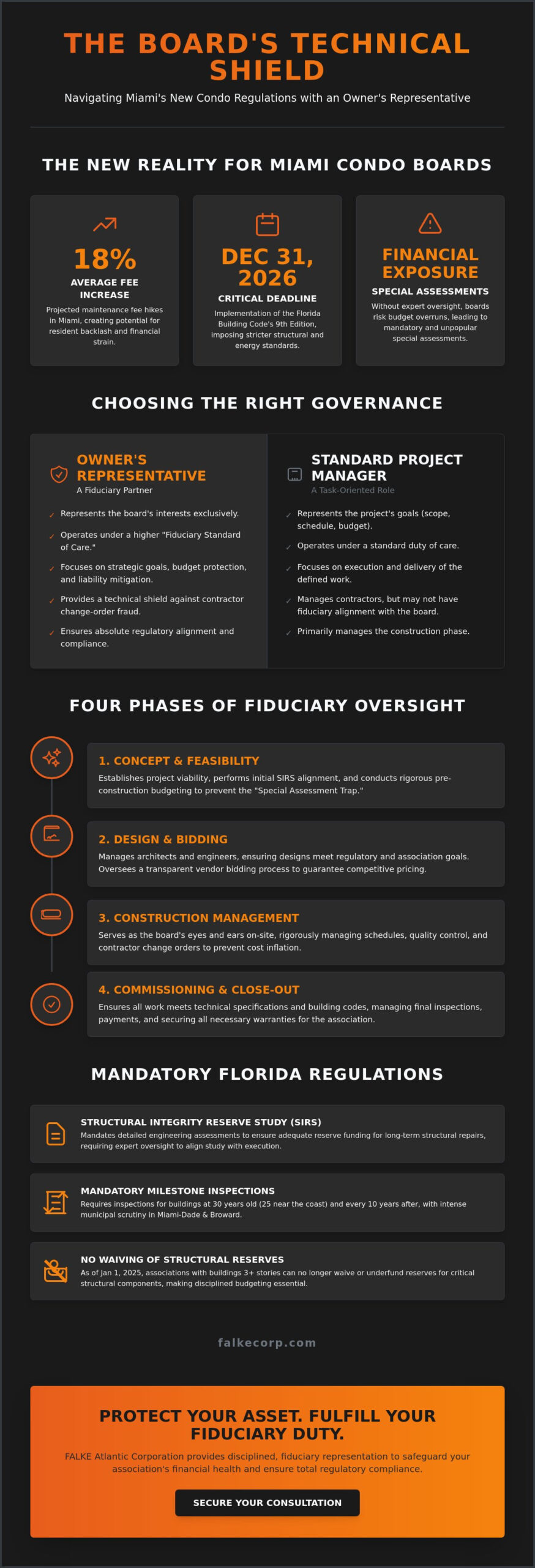
The regulatory environment in Florida has shifted fundamentally. As of January 1, 2025, condo associations with buildings three stories or higher are prohibited from waiving or reducing reserves for structural repairs. This mandate, coupled with the upcoming December 31, 2026, implementation of the Florida Building Code’s 9th Edition, transforms project oversight from a choice into a necessity. An owner’s representative for condo association Miami manages the direct alignment of the Structural Integrity Reserve Study (SIRS) with physical execution, ensuring that every dollar spent contributes to statutory compliance and building longevity.
Navigating Florida’s Strict Condo Safety Regulations
In Miami-Dade and Broward counties, the 30-year milestone inspection and subsequent recertification projects are now subject to intense municipal scrutiny. A representative manages the complex interplay between engineering findings and municipal permitting, which currently averages 180 to 270 days in the Miami area. They ensure that every phase of remediation adheres to the newest energy and structural provisions of the 9th Edition building code. This technical oversight prevents the board from inadvertently violating state mandates, which is critical since board member accountability has increased and taking kickbacks is now a third-degree felony.
The Financial Impact of Expert Representation
Expert representation is the most effective defense against the “Special Assessment Trap.” By conducting rigorous pre-construction budgeting, a representative identifies hidden costs and discrepancies in contractor bids before any binding agreements are signed. This prevents the common issue of contractor change-order fraud, which often inflates costs mid-project. With Miami condo maintenance fees estimated to increase by an average of 18% in 2026, protecting reserve funds through disciplined fiscal oversight is paramount. The representative establishes a transparent audit trail, ensuring that the association’s capital is deployed with maximum efficiency and zero waste.
Core Responsibilities: What a Representative Delivers to the Board
The role of an owner’s representative for condo association Miami extends far beyond simple project monitoring; it involves a systematic management of the four critical project phases: Concept, Design, Construction, and Commissioning. By maintaining a presence from the initial feasibility study through the final close-out, the representative ensures that technical specifications aren’t compromised for the sake of contractor convenience. They provide a singular point of accountability, establishing a transparent audit trail for every expense and change order. This level of oversight is particularly vital given that construction costs in Florida are currently rising by 4.2% annually, making budget precision a non-negotiable requirement for association boards.
A primary deliverable is the systematic coordination of the design team, including architects, structural engineers, and specialty consultants. The representative ensures their outputs are cohesive and strictly aligned with the association’s long-term objectives. They also oversee the bidding process, stripping away the ambiguity often found in vendor proposals to ensure the board receives genuine fair market value. This disciplined approach prevents the common issue of scope gaps that lead to expensive mid-project corrections.
Pre-Construction and Design Management
During the early stages, the representative facilitates site feasibility studies and entitlements within Miami’s complex zoning environment. They review architectural plans specifically for constructability and budget alignment, identifying potential conflicts before they manifest on-site. Negotiating vendor contracts is another core function; the representative ensures these documents contain protective clauses that favor the association’s interests. Engaging in strategic pre-construction services in Miami at this stage is the most effective way to eliminate the risks associated with inadequate planning.
Construction Phase Oversight and Quality Control
Once construction begins, the representative shifts to active on-site monitoring to verify that the work performed matches the approved plans and meets the technical standards set by the Florida Building Code. Managing the project schedule is critical to prevent the “delay creep” that often plagues South Florida projects. With skilled labor costs in South Florida projected to increase by 12% over the next 18 months, maintaining a strict timeline is essential for cost control. The representative ensures that every milestone is met without sacrificing quality or safety. For boards seeking to institutionalize this level of precision, integrating professional construction phase management provides the necessary technical security.
Owner’s Representative vs. Project Manager: Choosing the Right Governance
Distinguishing between professional roles is critical for effective board governance. While many industry professionals use the terms interchangeably, the operational and legal differences between an owner’s representative and a project manager are profound. The selection of an owner’s representative for condo association Miami represents a commitment to fiduciary advocacy rather than mere project coordination. A project manager typically focuses on the tactical execution of specific tasks; they ensure that the schedule is met and resources are allocated according to the contractor’s plan. In contrast, the owner’s representative for condo association Miami operates at a strategic level, ensuring every decision aligns with the board’s long-term financial and legal objectives.
The reporting structure defines the professional’s loyalty. A standard project manager may report to the general contractor or a lead architect, potentially creating a conflict of interest when technical errors or budget overruns occur. The owner’s representative, however, reports directly to the board. This direct line of communication ensures that the board receives unfiltered, technical data regarding project health. A common misconception among Miami boards is that a property manager can assume these responsibilities. While property managers are skilled in operational maintenance, they rarely possess the engineering depth or construction law expertise required to oversee complex structural renovations or manage the $50,000 per-unit insurance deductible mandates effective July 1, 2026.
The Fiduciary Distinction
An owner’s representative is legally and professionally obligated to act in the board’s best financial interest. This fiduciary “Standard of Care” is the primary differentiator from a construction manager. A construction manager’s performance is often measured by the profitability of the build, which can lead to the prioritization of cost-cutting measures over long-term structural integrity. In high-stakes Miami real estate, where construction costs are volatile, having an advocate who rigorously audits every line item is a necessity. They provide the technical oversight required to challenge contractor assumptions and ensure the association doesn’t pay for inefficiencies or contractor-driven errors.
When to Hire Which Role
The complexity of the project determines the required governance structure. For minor aesthetic updates, a project manager might suffice. However, for major capital improvements, milestone inspections, or structural remediations, the board requires the strategic depth of a representative. You can consult the Construction Project Management Florida guide for a deeper analysis of how these roles interact. For the most complex assets, the representative often manages the project manager, creating a double-layered defense. This structure ensures that tactical execution remains under the strict control of a strategic advocate, protecting the board from liability and financial exposure.
Hiring Guide: Selection Criteria for Miami Condo Associations
Selecting an owner’s representative for condo association Miami requires a rigorous evaluation process that transcends basic credential checks. For boards overseeing premier high-rise assets, the selection rubric must prioritize technical depth in structural remediations and a sophisticated understanding of South Florida’s environmental constraints. A firm must demonstrate a disciplined, multi-phase methodology rather than offering ad-hoc support, as the standard of execution for luxury condominiums differs significantly from standard commercial builds. Verification of professional certifications and comprehensive Errors and Omissions (E&O) insurance is mandatory to protect the association from professional negligence during complex remediations.
A firm’s track record with similar-sized associations serves as a primary indicator of their ability to handle the internal politics and fiduciary pressures unique to condo boards. You should look for a partner who doesn’t just manage tasks but provides a strategic framework for the entire asset lifecycle. This includes a proven ability to reconcile the Structural Integrity Reserve Study (SIRS) with actual site conditions, ensuring that mandatory repairs don’t result in unnecessary financial strain on the residents or technical non-compliance with the latest building codes.
Interview Questions for Potential Representatives
When interviewing candidates, the board must probe the firm’s ability to handle conflict and technical ambiguity. Essential questions include:
- Dispute Resolution: How do you handle technical or financial disputes between the board and the general contractor to ensure progress doesn’t stall?
- SIRS Optimization: Can you provide documented examples of cost-savings achieved on SIRS-related projects through value engineering or bid scrubbing?
- Change Order Protocol: What is your specific process for managing change orders during the construction phase to ensure they’re technically justified and fairly priced?
Analyzing the Fee Structure
The fee structure should be scrutinized to ensure it aligns the representative’s incentives with the association’s budget goals. Common models include percentage-of-construction costs or fixed monthly retainers. While a percentage-based fee is traditional, a fixed retainer can sometimes provide more predictable budgeting for the association during multi-year projects. Boards must be wary of the “cheapest” option; firms offering lower fees often lack the engineering depth required to identify sophisticated contractor fraud or technical errors. This lack of oversight frequently leads to much higher total project costs due to unvetted change orders and schedule overruns. For boards seeking a partner who prioritizes technical precision over low-cost shortcuts, engaging professional owner’s representation from FALKE Atlantic Corporation is the most secure path to project success.
FALKE Atlantic Corporation: Disciplined Representation for South Florida’s Premier Assets
FALKE Atlantic Corporation provides a specialized tier of project oversight, specifically engineered for the high-stakes environment of South Florida’s luxury real estate. As a premier owner’s representative for condo association Miami, our corporation bridges the gap between complex engineering requirements and the board’s fiduciary responsibilities. We operate with a level of technical precision that is often absent in standard project management, focusing on the preservation of long-term asset value. Our extensive experience within Miami’s Design District and the luxury hospitality sector has institutionalized a standard of care that prioritizes stability, quality, and rigorous financial accountability. We don’t just observe; we lead.
The convergence of the 2026 Florida Building Code updates and mandatory SIRS funding requires a partner who understands the entire lifecycle of a physical asset. FALKE Atlantic Corporation doesn’t offer ad-hoc solutions. Instead, we provide a comprehensive management system designed to mitigate construction risks before they manifest as financial liabilities. By integrating technical expertise with a deep understanding of South Florida’s vendor networks, we ensure that every project phase remains under strict control, protecting the association from the volatility of rising material and labor costs.
The FALKE Four-Phase Methodology
Our systematic approach is divided into four distinct phases to ensure absolute clarity and accountability throughout the project:
- Phase 1 & 2: Concept and Design Oversight. FALKE Atlantic Corporation establishes a technical foundation through exhaustive site feasibility studies and constructability reviews. This prevents the “Special Assessment Trap” by aligning architectural plans with realistic budgets and municipal entitlements during the pre-construction stage.
- Phase 3: Construction Phase Management. Our team provides on-site monitoring to verify that all work adheres to approved specifications and safety codes. We manage the project schedule with discipline, preventing the delay creep that often escalates labor costs in the South Florida market.
- Phase 4: Commissioning and Close-out. We ensure the building is fully operational and compliant with all local regulations. This final phase includes a rigorous audit of all project documentation to guarantee the asset is truly ready for long-term use.
Why Miami Boards Trust FALKE Atlantic Corporation
Boards trust our firm because we provide a strategic defense against the inherent risks of major capital improvements. Our proven expertise in real estate development management services allows us to navigate the complexities of Miami-Dade’s regulatory landscape with unwavering confidence. We understand that the role of an owner’s representative for condo association Miami is to act as a technical advocate, ensuring that the board fulfills its legal obligations while protecting the interests of every unit owner. Partnering with FALKE Atlantic Corporation means choosing a disciplined path toward project completion, where quality is never sacrificed for convenience.
Institutionalizing Strategic Oversight for Miami’s Evolving Regulatory Climate
The transition toward more stringent structural and financial mandates in South Florida necessitates a shift from volunteer-led project management to professional technical advocacy. As boards face the complexities of the 2026 Building Code implementation and mandatory SIRS funding, the presence of a dedicated owner’s representative for condo association Miami becomes the primary safeguard against construction volatility. This level of oversight ensures that major capital improvements are executed with technical precision, effectively protecting both the physical integrity of the asset and the board’s professional standing. Relying on specialized expertise is no longer a luxury; it’s a necessary component of responsible building governance.
FALKE Atlantic Corporation provides the structured framework required to manage these transitions through a disciplined four-phase methodology. Our firm’s expertise in high-net-worth and luxury asset management, combined with deep Miami-Dade and Broward county regulatory knowledge, allows associations to proceed with absolute confidence. You can secure your association’s future with a FALKE Atlantic Corporation consultation to ensure your next major project remains on schedule and within budget. Taking these proactive steps today reinforces the long-term stability and value of your community’s most significant investment.
Frequently Asked Questions
What is the difference between an owner’s representative and a project manager in Florida?
An owner’s representative serves as a fiduciary advocate for the board, whereas a project manager typically focuses on tactical execution and task completion. While a project manager ensures that specific construction activities stay on schedule, the representative provides strategic oversight of the entire asset lifecycle. This professional reports directly to the board, ensuring that technical decisions align with the association’s long-term financial interests rather than the contractor’s profit margins.
How much does an owner’s representative typically cost for a condo association?
Fee structures for professional representation are generally categorized into two models: a percentage of the total construction cost or a fixed monthly retainer. The specific arrangement depends on the technical complexity and anticipated duration of the project. While associations may seek the lowest possible fee, it’s essential to recognize that inadequate oversight often results in significantly higher total project costs through unvetted change orders and schedule overruns.
Does a Miami condo association legally need an owner’s representative?
Florida statutes do not explicitly mandate the hiring of an owner’s representative for condo association Miami, but the legal burden of fiduciary duty makes it a practical necessity. With the implementation of Florida SB-4D and the 2026 Building Code updates, board members face increased personal and professional liability for structural safety and financial transparency. Engaging a professional advocate ensures that the board meets these stringent statutory requirements with technical precision.
Can our property manager act as the owner’s representative during construction?
Property managers are specialized in operational maintenance and resident relations, but they rarely possess the engineering depth or construction law expertise required for major renovations. Assigning these responsibilities to a property manager creates a significant expertise gap and potential conflicts of interest. Major structural remediations require a dedicated professional who understands complex construction phase management and specialized vendor contract negotiation.
When is the best time to engage an owner’s rep for a condo renovation project?
The most effective time to appoint a representative is during the concept or pre-construction phase, before any design contracts are signed. Early involvement allows the professional to conduct site feasibility studies and rigorous design reviews, which identify potential conflicts before they manifest as expensive site errors. This proactive approach establishes a disciplined technical and financial foundation for the entire project.
How does an owner’s representative help with SIRS and Florida SB-4D compliance?
The representative translates the technical findings of a Structural Integrity Reserve Study (SIRS) into a disciplined, multi-phase execution plan. They ensure that all remediation work aligns with the mandatory timelines set by Florida SB-4D and the milestone inspection requirements. By managing the deployment of reserve funds with technical oversight, they prevent the association from falling into a cycle of non-compliance and emergency special assessments.
What qualifications should we look for in a Miami-based owner’s rep?
A qualified owner’s representative for condo association Miami must demonstrate deep experience with Miami-Dade’s unique environmental and permitting complexities. Boards should verify the firm’s professional certifications, comprehensive Errors and Omissions (E&O) insurance, and a proven methodology for managing luxury or high-rise assets. A track record of successfully reconciling engineering mandates with association budgets is a primary indicator of technical competence.
How does an owner’s rep prevent construction change order fraud?
Prevention is achieved through rigorous bid scrubbing and the technical verification of all site conditions before approving additional expenditures. The representative unbundles contractor proposals to identify hidden costs and ensures that any requested change order is justified by actual physical requirements. This disciplined audit trail ensures that the association only pays for work that is essential to the project’s structural and aesthetic integrity.