
With 672 construction fatalities recorded in Florida between 2011 and 2022, the state remains one of the most hazardous jurisdictions for capital projects in the nation. For a sophisticated developer, these figures represent more than just tragic loss; they signify a systemic failure in risk management that threatens the very viability of an investment. You likely recognize that delegating safety entirely to a general contractor doesn’t absolve you of vicarious liability or the financial fallout of an OSHA stop-work order. Ensuring construction site safety and compliance Florida requires a shift from passive observation to rigorous, top-down oversight that integrates safety into the project’s financial and operational DNA.
This guide examines how owners and developers can implement strategic safety frameworks to mitigate legal exposure and protect project timelines against the backdrop of the 9th Edition Florida Building Code and rising OSHA penalties. We’ll clarify the distinction between federal enforcement and local jurisdictional requirements, providing a roadmap for complete transparency into contractor performance. By the end of this analysis, you’ll understand the mechanisms of development management and pre-construction planning that ensure a project remains on schedule and within budget without compromising the integrity of the work site.
Key Takeaways
- Understand the owner’s legal accountability under the General Duty Clause and why delegating safety entirely to a general contractor is an insufficient risk management strategy.
- Clarify the jurisdictional landscape by distinguishing between federal OSHA enforcement and the secondary health-focused oversight of Florida’s state programs.
- Implement a rigorous pre-construction framework for ensuring construction site safety and compliance Florida by pre-qualifying partners based on their Experience Modification Rate (EMR).
- Establish an independent layer of oversight through Owner’s Representation to audit Site-Specific Safety Plans (SSSP) and ensure field-level adherence to technical protocols.
- Protect the project’s financial trajectory and asset ROI by proactively mitigating the triggers for OSHA stop-work orders and long-term litigation.
The Strategic Importance of Construction Safety Compliance in Florida
Safety compliance in the Florida market is often misconstrued as a localized field responsibility delegated entirely to the general contractor. In reality, it represents the technical intersection of federal Occupational Safety and Health Administration (OSHA) mandates and the specific health regulations overseen by state-level programs. For the sophisticated owner, ensuring construction site safety and compliance Florida is a prerequisite for protecting the asset’s capitalization and long-term viability. Regulatory bodies increasingly leverage the General Duty Clause to hold developers accountable for site conditions. This shift means you can’t simply outsource risk; you must govern it through active oversight. A comprehensive approach to Construction site safety acts as a primary defense against systemic delays that threaten project IRR.
The Financial Risk of Non-Compliance
The fiscal consequences of safety failures are immediate and compounding. As of January 2026, OSHA fines for willful or repeated violations have reached up to $165,514 per instance, while failure to abate a hazard can cost $16,550 per day. While these penalties are substantial, they often pale in comparison to the cascading costs of a stop-work order. When a site is shuttered for non-compliance, debt service continues, investor returns erode, and the project’s reputation in the capital markets suffers. Vicarious liability in Florida real estate development dictates that an owner may be held legally responsible for the negligence of a contractor if the owner retained sufficient control over the project’s safety oversight or failed to exercise due diligence in contractor selection.
Safety as a Driver of Quality and ROI
A disciplined safety culture isn’t merely about avoiding litigation; it’s a proxy for operational excellence. Sites that prioritize rigorous compliance typically experience lower material waste and fewer instances of rework because the same discipline required for safety translates to technical precision. Organized sites are inherently efficient sites. By enforcing high safety standards during the pre-construction phase and throughout construction management, you attract tier-1 subcontractors who prioritize quality. This alignment ensures that the physical asset meets the highest standards while staying within the projected budgetary framework. Proactive safety oversight reduces the likelihood of insurance premium spikes, keeping the project’s carrying costs predictable and the exit strategy secure.
Navigating Florida’s Regulatory Landscape: OSHA vs. OSHP
Understanding the jurisdictional hierarchy is the first step in ensuring construction site safety and compliance Florida. In this state, federal OSHA maintains primary enforcement authority over private-sector construction sites. Owners often confuse this federal oversight with the Florida Department of Health’s Occupational Health and Safety Program (OSHP). While OSHA focuses on field-level enforcement and punitive measures, OSHP operates as a surveillance and data-driven entity that tracks work-related injuries and illnesses. It doesn’t conduct independent safety inspections but provides the statistical foundation for regional safety initiatives. For a developer, compliance means satisfying the rigorous documentation standards of federal law, including the maintenance of OSHA 300 logs and the implementation of a comprehensive Site-Specific Safety Plan (SSSP).
As we move into 2026, regulatory focus has sharpened on heat illness prevention and respiratory protection protocols. These aren’t merely suggestions; they’re technical requirements that must be integrated into the project’s operational framework during the pre-construction phase. Failure to document training for these specific hazards can trigger willful violation citations, which carry the maximum penalty tiers discussed previously. Effective Owner’s Representation ensures these mandates are translated from legal text into field-level reality through continuous audit cycles.
Federal vs. State Enforcement
Federal inspectors take precedence on Florida job sites, particularly when evaluating high-risk activities like scaffolding and structural assembly. The 9th Edition of the Florida Building Code, taking effect on December 31, 2026, adopts the ASCE 7-22 wind load standards. This change necessitates higher design pressures for safety structures and temporary works. A critical requirement often overlooked is the “Competent Person” designation. OSHA defines this individual as someone capable of identifying existing and predictable hazards who has the authorization to take prompt corrective measures. If your contractor fails to have a designated competent person for excavations or scaffolding, the project is technically non-compliant from the moment work begins.
Environmental Compliance in South Florida
The Owner’s Representative’s Role in Safety Oversight
Relying solely on a general contractor’s internal safety apparatus introduces a layer of institutional bias that can compromise an owner’s risk profile. While a contractor’s safety officer is responsible for field-level execution, their reporting line often prioritizes production speed and project milestones over absolute compliance. An Owner’s Representative serves as an autonomous technical auditor, providing the necessary checks and balances for ensuring construction site safety and compliance Florida. This oversight isn’t merely reactive; it’s a strategic layer of governance that identifies systemic weaknesses before they manifest as field incidents. By adopting principles advocated by the Associated General Contractors of America, the representative facilitates “Prevention through Design.” This methodology ensures that safety considerations, such as permanent fall protection anchors or safe maintenance access, are integrated into the architectural and engineering phases before the construction phase begins.
Independent Safety Auditing
Verification of safety protocols requires more than reviewing paper logs in a job site trailer. A disciplined representative conducts unannounced site observations to evaluate real-world adherence to the Site-Specific Safety Plan (SSSP). This technical scrutiny begins during the pre-construction bidding phase, where we analyze a contractor’s Experience Modification Rate (EMR) and past OSHA citation history to filter out high-risk entities. Integrating these safety metrics into a comprehensive framework for Construction Project Management in Florida ensures that only the most technically competent partners manage your capital investment. Monthly project management reports must feature detailed safety performance data, transforming safety from a field-level checkbox into a high-level KPI for stakeholders.
Risk Mitigation through Contract Administration
Contractual precision is the foundation of safety governance in the Florida market. The Owner’s Rep ensures that safety requirements aren’t vague expectations but explicit, enforceable obligations within the Prime Contract. This administration includes the continuous monitoring of insurance certificates and workers’ compensation compliance to ensure no gaps in coverage occur during the project lifecycle. By centralizing the flow of safety-related information, the representative provides developers with a transparent view of the project’s risk health. This methodical approach to contract administration prevents the administrative lapses that often lead to vicarious liability claims. It ensures that every subcontractor on-site is fully aligned with the project’s rigorous safety and quality standards, protecting the asset from the financial fallout of third-party negligence.
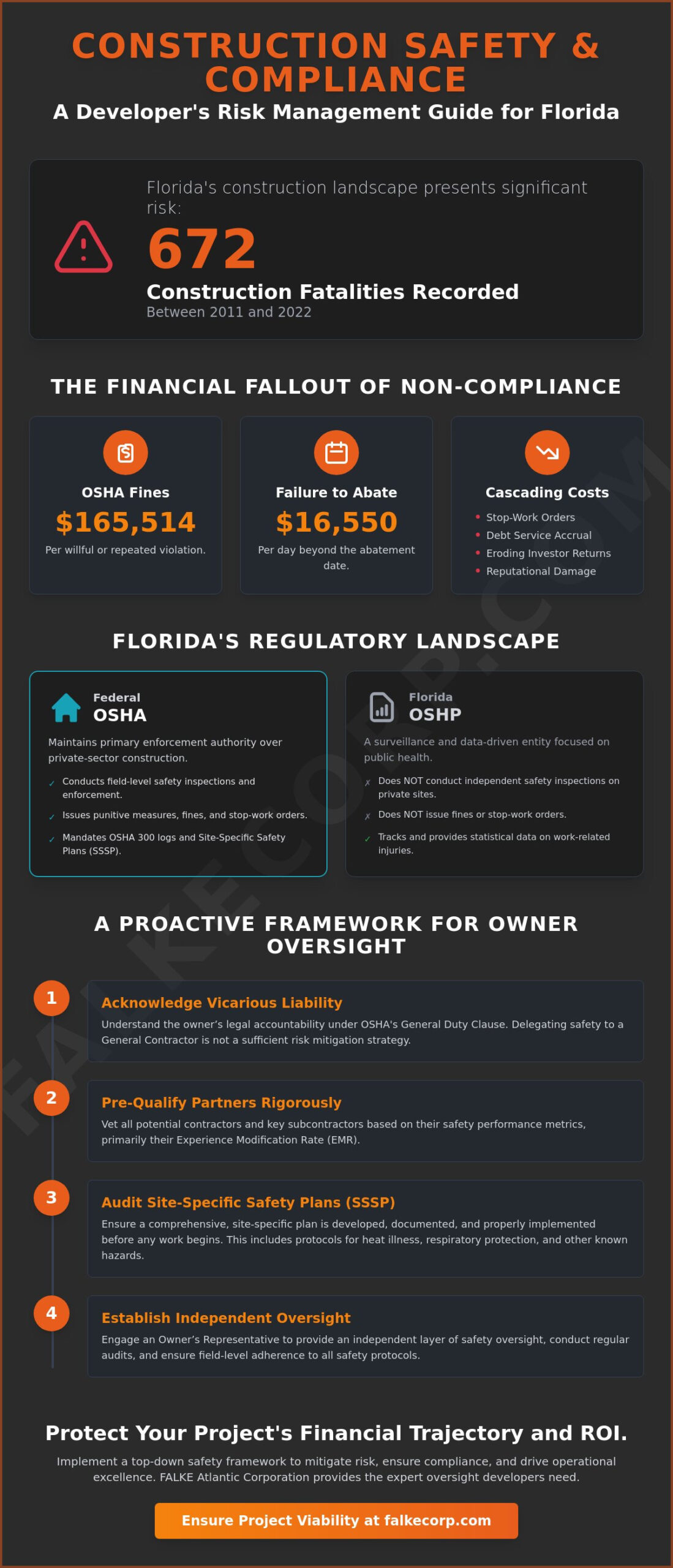
A Framework for Ensuring Site Safety in South Florida
Implementing a disciplined framework is essential for ensuring construction site safety and compliance Florida. This structured approach moves beyond baseline OSHA requirements to establish a project-wide culture of risk mitigation that protects both the workforce and the asset’s capitalization. A methodical sequence ensures that safety is treated as a technical deliverable rather than an administrative afterthought.
- Step 1: Pre-qualify contractors based on their Experience Modification Rate (EMR). An EMR below 1.0 is the technical benchmark for tier-1 partners, as it reflects a superior safety record that directly lowers workers’ compensation premiums.
- Step 2: Establish a Site-Specific Safety Plan (SSSP) before breaking ground to address unique structural, logistical, and environmental hazards.
- Step 3: Implement regular third-party safety inspections to maintain an objective, independent audit trail of field-level compliance.
- Step 4: Conduct mandatory safety orientations for all personnel and visitors to ensure a uniform understanding of site-specific protocols and emergency exits.
- Step 5: Review and update hurricane and emergency response protocols seasonally, with a primary focus on the June 1 through November 30 window.
Pre-Construction Safety Planning
Technical safety governance starts well before the first shovel hits the ground. Utilizing pre-construction services in Miami allows developers to identify site-specific hazards, such as overhead power lines or adjacent structural vulnerabilities, during the early design phases. This early intervention permits the team to evaluate the safety budget within the initial project estimate, ensuring that compliance initiatives are never underfunded. Establishing a clear escalation path for safety violations during this phase creates a culture of accountability. It defines exactly how field-level non-compliance will be addressed by ownership, preventing the administrative ambiguity that often precedes major site incidents.
Active Phase Monitoring in Miami-Dade
Managing active construction in high-density environments like the Miami Design District requires specialized security and public safety measures. Site perimeters must be rigorously maintained to protect pedestrians from struck-by hazards and falling debris. Modern developers utilize technology, including drones and high-definition site cameras, to provide remote safety monitoring and real-time documentation of field conditions. Drones are particularly effective for inspecting facade assembly and crane clearances in tight urban corridors where traditional access is restricted. These tools complement quarterly safety reviews where project stakeholders analyze safety KPIs. This data-driven approach ensures that the project’s risk profile remains within acceptable parameters as the structure rises.
Secure your investment with a partner who prioritizes technical precision. Consult with our Development Management experts to implement a safety framework that protects your asset from the initial phase to project close-out.
Protecting Your Asset with FALKE Atlantic Corporation
FALKE Atlantic Corporation provides the technical governance necessary for ensuring construction site safety and compliance Florida in a market defined by increasing regulatory complexity and heightened liability. Our approach acknowledges that for sophisticated developers, safety is not merely a moral obligation but a critical component of financial risk management. We implement a disciplined four-phase methodology that integrates safety oversight into the project’s broader development management framework. This system provides high-net-worth and corporate owners with the transparency required to maintain absolute control over their capital investments in Miami and Palm Beach. By assuming the technical burden of oversight, we allow ownership to focus on strategic decision-making while we manage the granular details of field-level compliance.
The FALKE Advantage in Compliance
Our commitment to protecting client interests is rooted in rigorous vendor management and proactive risk identification. We don’t wait for an inspector’s arrival to identify vulnerabilities. Instead, we utilize unannounced audits and technical reviews to ensure that every contractor and subcontractor adheres to the project’s Site-Specific Safety Plan. This level of scrutiny is particularly vital during the execution phase, where the speed of construction can often lead to administrative lapses. Our methodology for Construction Phase Management in Florida ensures that safety protocols are never sacrificed for schedule acceleration. This disciplined oversight prevents the costly project delays and insurance premium spikes that characterize poorly managed sites.
Ensuring a Revenue-Ready Asset
The ultimate objective of any development is the delivery of a revenue-ready asset that meets institutional quality standards. Safety compliance plays a pivotal role in the transition from construction to operations. A site with a clean safety record and documented compliance history facilitates a smoother commissioning and close-out process. It eliminates the “tail” of potential litigation and regulatory liens that can hinder a project’s exit strategy or permanent financing. We ensure that all safety-related documentation, from final inspections under the 9th Edition Florida Building Code to completed OSHA logs, is organized and verified before the final certificate of occupancy is issued. This attention to detail ensures that the physical asset is not only structurally sound but also legally and financially insulated.
Managing high-stakes developments in South Florida requires a partner with the technical competence to navigate a shifting regulatory landscape. Our team provides the stability and precision needed to safeguard your project’s ROI against the variables of the construction industry. We invite you to contact us to discuss how our strategic oversight can be integrated into your next South Florida development to ensure a compliant, high-quality, and on-schedule delivery.
Optimizing Project Resiliency Through Safety Governance
The complexity of the Florida regulatory environment requires a shift from field-level delegation to a centralized risk management strategy. By implementing a structured framework that prioritizes contractor pre-qualification and independent auditing, owners can insulate their capital from the financial volatility of OSHA citations and stop-work orders. Success in the South Florida market doesn’t depend on luck but on the technical alignment of safety protocols with the rigorous standards of the 9th Edition Florida Building Code. Ensuring construction site safety and compliance Florida is not merely a compliance exercise; it’s a fundamental pillar of asset protection and long-term investment stability.
Secure your project with FALKE Atlantic’s professional Owner’s Representation. Our disciplined four-phase methodology and extensive expertise in high-stakes Miami-Dade developments provide the strategic focus on risk mitigation and financial control necessary for complex builds. We stand ready to help you navigate these technical requirements to ensure your next project is delivered with the precision and stability your investment deserves.
Frequently Asked Questions
What is the General Duty Clause in OSHA, and how does it affect Florida owners?
The General Duty Clause, Section 5(a)(1) of the Occupational Safety and Health Act, mandates that every employer furnish a place of employment free from recognized hazards likely to cause death or serious physical harm. In the Florida market, this clause allows federal inspectors to cite owners or developers who possess knowledge of site hazards but fail to exercise their authority to rectify them. It establishes a baseline of accountability that transcends specific technical standards, making the owner a participant in the project’s safety outcomes.
Do I need a separate safety consultant if I have a General Contractor?
Engaging an independent safety auditor or Owner’s Representative is a strategic necessity for ensuring construction site safety and compliance Florida. While a General Contractor employs internal safety officers, their objectives often conflict with production schedules and budgetary constraints. Independent oversight provides an unbiased technical audit of site conditions. This ensures that safety protocols are strictly enforced without the institutional bias inherent in a contractor’s internal reporting structure, protecting the owner’s legal and financial interests.
How does Florida’s hurricane season affect construction site safety compliance?
Hurricane season, spanning from June 1 to November 30, necessitates the implementation of specialized emergency response protocols and structural securing procedures. Compliance requires documented plans for the stowage of loose materials, the stabilization of scaffolding, and the precise positioning of cranes during tropical alerts. Failure to maintain a current hurricane preparedness plan can lead to significant OSHA citations. It also increases liability if wind-borne debris causes off-site property damage or injury during a storm event.
What is an Experience Modification Rate (EMR) and why should I care?
An Experience Modification Rate is a numerical multiplier used by insurance carriers to gauge a contractor’s past cost of injuries and future risk. A rate below 1.0 indicates a safety record that is superior to the industry average, directly resulting in lower workers’ compensation premiums. Owners should prioritize EMR during the pre-construction phase as a technical indicator of a contractor’s operational discipline. It serves as a reliable metric for predicting the likelihood of safety-related delays on a capital project.
What are the most common OSHA violations on Miami construction sites?
Fall protection violations consistently rank as the most frequent citation on Miami-Dade job sites, often occurring during structural assembly or facade work. Other common infractions include improper scaffolding construction, lack of eye protection, and inadequate ladder safety. Given that falls accounted for nearly 40% of national construction fatalities in 2023, inspectors in the South Florida region prioritize these high-risk areas. Ensuring rigorous compliance in these categories is essential for avoiding the maximum penalty tiers for willful violations.
How can an Owner’s Representative help reduce my liability for site accidents?
An Owner’s Representative reduces liability by establishing a rigorous administrative and field-level audit trail that demonstrates due diligence. By managing the flow of safety documentation and conducting unannounced site inspections, the representative ensures that the developer is not passively accepting the contractor’s risk. This proactive governance helps shield the owner from vicarious liability claims. It proves that ownership exercised reasonable care in monitoring ensuring construction site safety and compliance Florida throughout the project lifecycle.
Are there specific safety requirements for luxury retail construction in Miami?
Luxury retail developments in high-density areas like the Miami Design District require specialized public safety and logistics protocols. Compliance involves rigorous perimeter management to prevent pedestrian incursions and the implementation of noise mitigation systems to protect adjacent active businesses. These projects often necessitate off-hours material delivery and specialized crane operations. Every phase must be coordinated with local municipal authorities to maintain structural integrity and public safety in constrained urban corridors.
What happens if OSHA issues a stop-work order on my project?
An OSHA stop-work order immediately halts all site activity, triggering daily failure-to-abate fines that can reach $16,550 per day as of 2026. Beyond direct penalties, the order causes catastrophic schedule delays that disrupt debt service and investor distributions. Resuming work requires a formal abatement plan and a follow-up inspection to verify that all technical hazards have been rectified. This process can take weeks, significantly eroding the project’s internal rate of return and reputation in the market.