
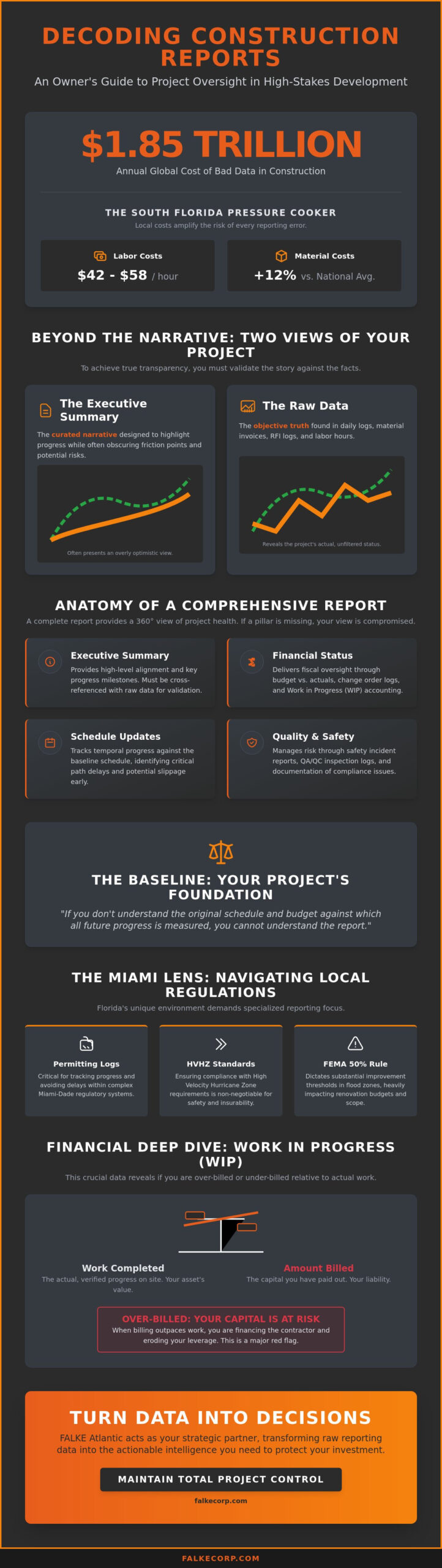
A construction report isn’t a record of what happened; it’s a diagnostic tool for what will go wrong next. In a global industry where bad data costs an estimated $1.85 trillion annually, a 100-page reporting deck can easily become a smokescreen for project slippage rather than a clear window into operations. For owners managing high-stakes Miami developments, learning how to read a construction project report is the only way to move beyond contractor narratives and into objective oversight. When labor costs in South Florida average between $42 and $58 per hour and material costs sit 12% above the national average, you can’t afford to overlook the subtle indicators of budget overruns or scheduling delays that often hide within technical narratives.
It’s natural to feel overwhelmed by the sheer volume of data, especially when change order surprises threaten your capital and erode the trust you’ve placed in your project team. You likely suspect that the progress photos and status updates aren’t telling the full story of your project’s health. This guide will teach you to master the art of interpreting complex construction data to protect your investment and maintain total project control. We’ll examine how to identify hidden risks, ensure financial transparency, and hold your team accountable through the lens of specific Miami-Dade requirements like HVHZ standards and the FEMA 50% rule.
Key Takeaways
- Distinguish between executive summaries and raw data to move beyond curated narratives and achieve true operational transparency.
- Master the methodology of how to read a construction project report by focusing on variance analysis to identify early signs of slippage.
- Interpret Work in Progress (WIP) accounting from an owner’s perspective to ensure financial transparency and prevent unexpected capital depletion.
- Navigate the complexities of Miami-specific reporting, including permitting logs and South Florida weather-preparedness metrics, to maintain control over local regulatory timelines.
- Understand how FALKE Atlantic acts as a strategic partner to transform raw reporting data into actionable intelligence for high-stakes development decisions.
The Owner’s Perspective: Why Construction Reporting is Your Financial Safeguard
Construction project reporting serves as the primary mechanism for maintaining financial and operational transparency throughout the lifecycle of a build. It isn’t merely a clerical exercise; it’s a technical requirement for safeguarding capital. Within the complex environment of construction management, these documents function as the definitive source of truth, translating field activities into measurable financial data. Understanding how to read a construction project report allows you to bridge the gap between the physical site and the financial ledger, ensuring that project narratives match the reality on the ground.
Many owners rely solely on Executive Summaries, which are curated narratives designed to highlight progress while often obscuring friction points. While these summaries offer a high-level overview, they must be validated against Raw Data, such as daily logs, material invoices, and labor hours. You need both to ensure the contractor’s story aligns with the project’s actual status. In high-stakes Miami developments, where construction costs rose 4.74% from 2025 to 2026, even minor discrepancies in reporting can lead to significant capital erosion. Disciplined reporting prevents the most common cause of project failure: the erosion of accountability. When reporting is vague, responsibility becomes diffuse. Precise reporting ensures every dollar spent is accounted for against the original scope.
Transparency as a Risk Mitigation Strategy
Rigorous documentation creates an immutable paper trail essential for navigating insurance claims or legal disputes, particularly in Florida’s litigious environment. There’s also a clear psychological component to this process. When a contractor knows their data is being scrutinized with technical precision, the quality of performance naturally improves. You must demand owner-centric reporting rather than accepting standard contractor templates. Standard templates are often optimized for a contractor’s internal workflows, not for an owner’s strategic oversight or risk mitigation needs.
The Four-Phase Methodology and Reporting Frequency
The depth of your reporting should align with the specific phases of real estate development. During the pre-construction phase, reports focus on budget refinement and permitting logs, whereas construction phase reporting shifts toward production rates and safety metrics. Determining the right frequency is equally vital. While monthly reports are standard for institutional lenders, weekly cycles are necessary for active project management to catch slippage before it compounds. Everything hinges on the Baseline. This document establishes the original schedule and budget against which all future progress is measured. If you don’t understand the baseline, you cannot understand the report.
Decoding the Anatomy: Key Sections of a Comprehensive Construction Report
Mastering how to read a construction project report requires a technical understanding of the document’s internal hierarchy. A professional report isn’t a flat narrative; it’s a structured data set designed to provide a 360-degree view of the project’s health. For a deeper technical breakdown, referencing a comprehensive guide to construction reporting can provide additional context on standardized industry formats. Every comprehensive report should contain four primary pillars: the Executive Summary for high-level alignment, Financial Status for fiscal oversight, Schedule Updates for temporal tracking, and Quality/Safety logs for risk management. If any of these pillars are missing, the report’s utility as a diagnostic tool is compromised.
Work in Progress (WIP) accounting is a critical component that owners often overlook. From your perspective, WIP data reveals whether you’re over-billed or under-billed relative to the actual work performed. Over-billing suggests you’re essentially providing an interest-free loan to the contractor, which can lead to cash flow friction as the project nears completion. This financial scrutiny must extend to the Change Order Log and Pending Claims section. These logs track every deviation from the original contract. Unresolved claims represent latent liabilities that can deplete your contingency fund if they aren’t managed with precision. Engaging professional Owner’s Representation from FALKE Atlantic Corporation ensures these logs are not just viewed but rigorously audited against the project’s baseline.
Monitoring Materials and Procurement updates is vital for anticipating supply chain disruptions. In the Miami market, where material costs sit approximately 12% above the national average, early procurement of long-lead items is a prerequisite for success. A report that fails to track the fabrication status of critical components, such as impact-rated glazing or HVAC units, leaves the project vulnerable to avoidable delays.
The Financial Dashboard: Budget vs. Actuals
Don’t confuse ‘Committed Costs’ with ‘Cash Flow.’ Committed costs represent the total value of contracts signed, while cash flow reflects the actual liquidity leaving your accounts. The most important metric in this section is the Anticipated Cost at Completion (EAC). This figure forecasts the final project cost based on current performance trends and known risks. You must also watch for ‘Front-Loading’ in the Schedule of Values. This occurs when a contractor assigns higher values to early-stage tasks to accelerate their cash intake, leaving you with insufficient funds to finish the remaining work if the contractor defaults.
The Schedule Analysis: Critical Path and Milestones
The Critical Path is the sequence of tasks that dictates the project’s minimum duration. Any delay on this path directly pushes back the final completion date. Understanding how to read a construction project report involves identifying this path and monitoring ‘Float’—the amount of time a non-critical task can be delayed without affecting the overall timeline. Finally, every report must include a 30-60 day ‘Look-Ahead’ schedule. This section verifies that the project team is planning ahead rather than reacting to daily crises as they arise.
Beyond the Numbers: How to Spot Red Flags and Project Variance
Variance Analysis is the most potent diagnostic tool available to an owner. It measures the delta between the established baseline and the actual performance on the ground. When you’re learning how to read a construction project report, you must understand that any deviation from the baseline is a signal of risk. Variance doesn’t always indicate failure, but it always requires an explanation. A professional report should clearly delineate whether a variance is a one-time anomaly or a systemic trend that will compound over the project’s duration. If the data shows a consistent 100% on-time completion rate across all milestones, it’s often more suspicious than a report showing minor, explained delays. Real-world construction involves friction; a report that lacks it is likely being massaged to maintain a false sense of security.
To verify the accuracy of the narrative, you should cross-reference the Daily Log with the Monthly Executive Summary. The Daily Log is the raw, unvarnished record of site activity. If the daily logs mention labor shortages or failed inspections, but the monthly summary describes the project as “on track with no significant issues,” there’s a fundamental breakdown in transparency. This disconnect is often where the most significant risks hide. Effective oversight requires you to look for these inconsistencies to ensure that the intelligence you’re receiving is grounded in field reality.
The Warning Signs of Budget Creep
Budget erosion rarely happens all at once; it’s a gradual process of “creep” that manifests in specific sections of the report. You should scrutinize sudden increases in General Conditions or General Requirements costs. These are time-related expenses, such as site management and equipment rentals. If these costs rise without a corresponding increase in scope, the project is likely suffering from hidden schedule slippage. Similarly, a growing log of “unforeseen conditions” should be questioned. In the Miami market, factors like high water tables or specific soil compositions are known variables. Using contingency funds for routine tasks is another red flag. Contingency is for true unknowns, not for covering up poor estimating or inefficient execution.
Schedule Slippage and Quiet Delays
Schedule slippage often begins with “quiet” delays that don’t immediately impact the final completion date but erode the project’s float. One major indicator is Schedule Compression. This occurs when a contractor acknowledges a delay but promises to “catch up” in future phases without a documented plan for adding labor or extending shifts. Without increased resources, these promises are mathematically improbable. You must also monitor Submittal delays. If the submittal process for long-lead items is lagging, field delays are inevitable. Finally, watch for Resource Thinning. If the report shows a drop in the number of skilled tradespeople on-site, your contractor might be moving their best crews to other projects, leaving your development at risk of substandard quality or further delays.
The Florida Context: Reading Reports Through the Lens of Miami Development
In South Florida, the technical environment is dictated by the High-Velocity Hurricane Zone (HVHZ) designation and a rigorous regulatory framework that demands specialized oversight. Knowing how to read a construction project report in this region requires more than just financial literacy; it requires a deep understanding of localized risk factors. For instance, the 9th Edition of the Florida Building Code, effective December 31, 2026, introduces stricter wind speed maps and impact-rated product requirements. Your project reports must explicitly track compliance with these evolving standards to avoid costly retrofits or insurance disqualifications. When material costs in Miami sit 12% above the national average, any failure to document compliance with HVHZ standards or Miami-Dade Notice of Acceptance (NOA) requirements represents a significant financial liability.
The permitting log is perhaps the most critical regional component of your report. Navigating Miami building permits requires a dedicated section that tracks progress against the mandates of HB 267. This 2024 law requires local governments to approve or deny complete permit applications within 30 business days for smaller residential projects and 60 business days for larger non-residential or multifamily projects. If your report shows permitting delays exceeding these statutory windows without a clear explanation or a default approval claim, it indicates a breakdown in coordination with local agencies. Professional oversight ensures these milestones are not just listed but actively managed against Florida’s legal deadlines.
Permitting and Entitlement Tracking in South Florida
You must scrutinize the Agency Comment log to understand the true trajectory of your permitting timeline. It’s not enough to see a status of “pending”; you need to see the specific feedback from DERM (Department of Environmental Resources Management) or Water & Sewer. These agencies often represent the true critical path for Miami developments. An Owner’s Rep ensures these hurdles are reported with technical accuracy, preventing the contractor from using “permitting” as a vague excuse for broader project slippage. With permit costs in Miami-Dade ranging from $12,000 to $22,000, ensuring this process is efficient is a prerequisite for capital protection.
Environmental and Climate Risk Reporting
Climate-specific reporting is non-negotiable in South Florida. Your monthly reports should track “Weather Days” with precision, particularly during the Atlantic hurricane season. This includes reading the Storm Preparedness plan within the safety report to verify that the site can be secured within 48 hours of a tropical event. Furthermore, heat-related productivity loss during Miami’s summer months must be accounted for in the labor logs. For coastal builds, soil and dewatering reports are critical financial documents. If dewatering volumes exceed original estimates, your “unforeseen conditions” log will likely see a surge in claims. To ensure your project data reflects these complex regional realities, engage FALKE Atlantic Corporation for comprehensive development management and oversight.
Turning Data into Decisions: The Value of Professional Owner’s Representation
FALKE Atlantic Corporation acts as your strategic partner, translating raw reporting into actionable intelligence. We don’t just review the documents; we scrutinize the underlying logic of the contractor’s claims. When a report indicates a variance, we investigate the root cause, whether it’s a labor productivity issue or a procurement failure. This level of oversight is essential for closing the loop during your next construction phase management meeting. By arriving with verified data, you shift the power dynamic from passive recipient to informed decision-maker, ensuring that the project team remains focused on your specific objectives.
FALKE Atlantic Corporation’s Disciplined Methodology
Our 4-phase approach ensures that every report serves your ROI. We maintain report integrity by managing third-party vendors and contractors with a level of technical rigor that discourages data “massaging” or the obscuring of critical path delays. For high-net-worth individuals and corporate entities, this financial oversight is the primary defense against capital depletion. We ensure that the reporting structure remains owner-centric, focusing on the metrics that impact project viability and asset value rather than just contractor convenience. Our methodology prioritizes stability and quality, providing you with the security that even the most complex processes are under expert supervision by FALKE Atlantic Corporation.
Taking the Next Step for Your Development
Complex hospitality or retail projects require a level of precision that goes beyond basic tracking. As an owner, you must transition from simply reading reports to actively directing your project team based on the intelligence those reports provide. Professional oversight allows you to anticipate crises before they manifest as financial losses. If your current reporting lacks transparency or if you suspect your project data is incomplete, it’s time to engage expert representation. Contact FALKE Atlantic Corporation for expert Owner’s Representation in Miami to secure your project’s future and ensure the highest standards of professional execution.
Securing Your Development Through Strategic Oversight
Mastering how to read a construction project report is the definitive boundary between being a passive investor and an active director of your capital. You now understand that reports aren’t just historical records; they’re predictive tools that reveal the true trajectory of your budget and schedule. By scrutinizing variance analysis and navigating the specific regulatory hurdles of Miami-Dade and Broward counties, you ensure that your project remains resilient against both market volatility and environmental risks. Professional oversight transforms these documents from a source of information overload into a strategic roadmap for success.
FALKE Atlantic provides the technical rigor necessary to transform complex reporting into actionable certainty. Our disciplined four-phase methodology and deep expertise in South Florida regulations position us as the premier strategic partner for high-net-worth and hospitality developments. We verify every data point and audit every site activity to protect your interests without compromise. This level of oversight ensures that your vision is executed to the highest professional standards, maintaining stability throughout the most complex build cycles.
Schedule a Strategic Consultation with FALKE Atlantic to bring professional precision to your next development. You have the tools to identify risks; now you have the partner to eliminate them. Your project deserves a management team that values transparency and technical excellence as much as you do.
Frequently Asked Questions
What is the most important section of a construction project report for an owner?
The Financial Status and Schedule updates are the most critical components for any capital provider. Specifically, you must focus on the Anticipated Cost at Completion (EAC) and the Critical Path analysis. These sections provide a forecast of your final capital requirement and the minimum timeline for delivery. Without these metrics, a report is merely a historical record rather than a strategic tool for maintaining project control.
How do I know if my contractor is hiding a budget overrun in the report?
Scrutinize the General Conditions and General Requirements costs for unexplained increases. These time-related expenses often surge when a project is suffering from hidden delays. In the South Florida market, where material costs sit approximately 12% above the national average, any discrepancy between procurement logs and actual site inventory suggests that an overrun is being obscured within technical narratives. Consistent monitoring of these logs is essential for financial transparency.
What is ‘Variance’ in construction reporting and why should I care?
Variance is the mathematical delta between your project’s original baseline and its actual performance. You should care because variance is the earliest diagnostic signal of project drift. A negative variance in labor productivity indicates that your project is consuming capital faster than it is creating physical value. Understanding this gap allows you to intervene before a minor deviation compounds into a full-scale financial crisis.
How often should I receive a project report for a large-scale Miami development?
While monthly executive reports are standard for institutional lenders, active development management requires weekly progress updates. In Miami’s volatile market, where labor rates average between $42 and $58 per hour, waiting thirty days to identify a negative trend is a high-risk strategy. Weekly reporting cycles ensure that your project team remains disciplined and that slippage is identified in real-time.
What is the difference between a Daily Report and a Monthly Executive Report?
A Daily Report is a raw field log documenting site-specific activities, such as labor headcounts, weather conditions, and material deliveries. A Monthly Executive Report is a strategic synthesis of this data, designed for high-level oversight. While the daily log provides the technical evidence of work performed, the monthly report provides the financial and temporal intelligence required to manage your overall investment.
Can a construction report help me prevent change order fraud?
A rigorous report prevents fraud by maintaining a comprehensive Change Order Log that requires a technical justification for every deviation from the original contract. By mastering how to read a construction project report, you can verify that “unforeseen conditions” are documented with field photos and daily logs. This prevents contractors from using your contingency funds to cover their own estimating errors or inefficient execution.
How do I read a construction schedule if I don’t have technical training?
Focus your attention on the 30-60 day Look-Ahead schedule and the Critical Path milestones. You don’t need to interpret complex Gantt charts to see if the contractor is meeting their own short-term targets. If the Look-Ahead milestones are consistently missed, the project is slipping. This simple observation allows you to hold the project team accountable without needing a degree in civil engineering.
Should I use software to read my construction reports or hire a consultant?
Software is an effective tool for data aggregation, but it lacks the strategic judgment required to interpret contractor intent or site reality. A professional Owner’s Representative provides the technical expertise to audit digital reports against physical progress. While software provides the data, a consultant provides the intelligence needed to protect high-net-worth assets and ensure long-term project stability.