
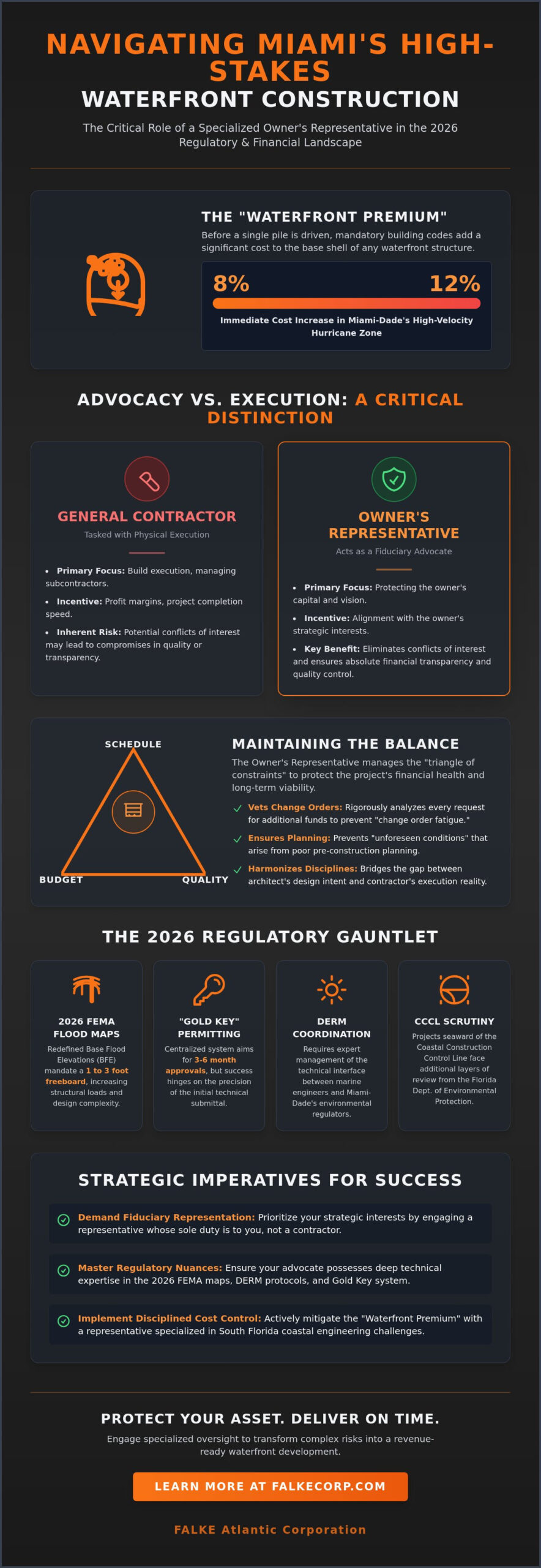
In the High-Velocity Hurricane Zone of Miami-Dade, the rigorous technical requirements of the Florida Building Code, 8th Edition, add an immediate 8% to 12% to the base shell cost of any waterfront structure before the first pile is driven. Engaging a specialized owner’s rep for waterfront property construction Miami has become a fundamental requirement for stakeholders who must navigate the convergence of the 2026 FEMA flood maps and the Gold Key centralized permitting system.
You understand that the inherent friction between architectural intent and general contractor execution often results in significant cost overruns, particularly when addressing mandatory freeboard requirements or the complex 50% FEMA rule. This guide details how a technical representative mitigates these specific environmental and regulatory risks while maintaining absolute financial transparency. You’ll discover a strategic framework for managing specialized engineering and multi-jurisdictional approvals to ensure your asset is delivered revenue-ready and on schedule.
Key Takeaways
- Define the critical distinction between a fiduciary representative and a general contractor to ensure your strategic interests are prioritized throughout the development lifecycle.
- Learn how an expert owner’s rep for waterfront property construction Miami navigates the complex 2026 regulatory landscape, including updated FEMA flood maps and DERM permitting protocols.
- Identify and mitigate the “Waterfront Premium” by implementing disciplined cost control measures specifically designed for the technical challenges of South Florida coastal engineering.
- Establish rigorous selection criteria based on specialized technical competence and a proven, phase-based methodology for managing high-value Miami real estate assets.
- Understand the necessity of strategic oversight in harmonizing the conflicting objectives of architects and contractors to deliver a revenue-ready project on schedule.
Defining the Role of an Owner’s Rep for Miami Waterfront Projects
In the sophisticated 2026 Miami real estate market, the complexity of coastal development has necessitated a transition from traditional project management to a more rigorous model of technical advocacy. An owner’s rep for waterfront property construction Miami functions as a fiduciary, operating with the sole objective of protecting the principal’s capital and vision. Unlike a General Contractor, who is tasked with the physical execution of the build, or an Architect, who focuses on aesthetic and spatial design, the representative provides a layer of strategic oversight that bridges these disciplines. This role has evolved into a necessity because the margin for error on the Biscayne Bay or Atlantic coastline has effectively vanished due to tightening environmental and structural mandates.
The representative acts as the owner’s eyes and ears, ensuring that every decision aligns with the long term viability of the asset. For a foundational understanding of how these professional structures interact within the industry, this Construction Management Overview provides context on the standard hierarchies. However, in the high stakes environment of Miami’s “Gold Key” permitting era, the standard model is often insufficient. You require a partner who understands the technicality of the Florida Building Code, 8th Edition, as deeply as the financial implications of a delayed DERM approval.
Advocacy vs. Execution: Why the Distinction Matters
The primary value of an owner’s representative lies in the elimination of the conflict of interest inherent in GC led projects. A General Contractor’s primary incentive is often tied to their own profit margins and sub contractor relationships, which can lead to compromises in quality or transparency. Your representative maintains the “triangle of constraints,” which is the delicate balance between budget, schedule, and quality. They protect you from change order fatigue by rigorously vetting every request for additional funds, ensuring that “unforeseen conditions” aren’t simply a result of poor pre construction planning. It’s a disciplined approach that prioritizes the owner’s financial health over the contractor’s convenience.
Waterfront Specialization: Beyond Standard Project Management
Constructing on the water isn’t merely about luxury finishes; it’s a complex engineering challenge involving the interface between upland structures and marine environments. A specialized owner’s rep for waterfront property construction Miami manages the critical coordination between seawall engineers, geotechnical experts, and the primary design team. They ensure that the project accounts for saltwater intrusion and storm surge resilience from day one. By selecting consultants who specialize in Miami’s unique limestone geology and coastal hydrology, the representative ensures the structure remains a stable, revenue ready asset capable of withstanding the projected sea level rises of 2050 and beyond.
Navigating the 2026 Regulatory Landscape for South Florida Coastal Construction
The regulatory environment in South Florida has shifted from a static set of guidelines to a complex, multi-jurisdictional system. Projects located seaward of the Coastal Construction Control Line (CCCL) face additional layers of scrutiny from the Florida Department of Environmental Protection. An owner’s rep for waterfront property construction Miami provides the technical oversight necessary to harmonize these requirements with local zoning. The 2026 FEMA flood maps have redefined Base Flood Elevation (BFE) standards, necessitating a mandatory freeboard of 1 to 3 feet. This ensures the structure is resilient against sea level rise projections through 2050, but it also complicates the vertical integration of the design and increases the structural burden on the foundation.
Environmental Permitting and DERM Coordination
Miami-Dade’s July 1, 2025, seawall reform ordinance introduced the “Gold Key” system to streamline the historically sluggish permitting process. While this centralized track aims for 3 to 6 month approval timelines, success depends on the precision of the initial submittal. Your representative manages the technical interface between marine engineers and environmental regulators. They coordinate essential seagrass surveys and manatee protection protocols, ensuring that DERM requirements don’t become a bottleneck. By maintaining a disciplined communication channel with the U.S. Army Corps of Engineers and local municipal boards in Coral Gables or the City of Miami, the representative mitigates the risk of iterative design changes that often plague waterfront developments.
Resiliency Standards and 2026 Building Codes
The Florida Building Code, 8th Edition, mandates adherence to the ASCE 7-22 standard, which is particularly rigorous within the High-Velocity Hurricane Zone (HVHZ). These requirements typically increase base shell costs by 8% to 12% due to enhanced wind resistance and impact protection mandates. A specialized owner’s rep for waterfront property construction Miami oversees the selection of materials and construction methods that meet these coastal resiliency benchmarks. They ensure the project complies with the Florida Building Safety Act, focusing on structural waterproofing and the mitigation of saltwater intrusion. This level of oversight is vital for maintaining the asset’s market value and ensuring it remains outside the scope of the restrictive “50% FEMA rule” during future renovations. It’s a proactive approach that prioritizes long term stability over short term cost savings.
Financial Oversight: Mitigating Waterfront Construction Risks and Cost Overruns
Managing the fiscal health of a coastal development requires a departure from standard residential budgeting. The “Waterfront Premium” encompasses more than just high-end finishes; it involves the substantial costs associated with marine-grade materials and specialized site preparation. In 2026, construction input prices saw a year-over-year increase of approximately 5%, a factor that can quickly erode a project’s contingency fund if not managed with precision. An owner’s rep for waterfront property construction Miami identifies these hidden drivers early, ensuring the budget reflects the reality of the South Florida market.
Technical auditing of pay applications serves as a primary defense against financial leakage. Your representative doesn’t simply process invoices; they verify that the value of work completed aligns with the draw requested. This involves on-site verification of material quality, ensuring that the marine-grade components specified in the design are the ones actually installed. In a volatile 2026 supply chain, strategic procurement becomes a critical function. The representative tracks lead times for specialized items like high-impact glazing and salt-resistant alloys, preventing the costly delays that arise from late-stage procurement failures.
Budgeting for Marine and Foundation Complexity
Miami’s unique geology, characterized by a porous limestone shelf, necessitates complex foundation systems that often exceed standard engineering costs. Managing the high expense of specialized piling and deep-foundation structures is a core competency of a qualified representative. They account for seawall restoration or elevation as a primary budget line item rather than a secondary consideration. Utilizing comprehensive pre-construction services miami allows for the development of accurate cost estimates that reflect the true complexity of the site. This phase ensures that the structural shell, which can cost 8% to 12% more in High-Velocity Hurricane Zones, is fully funded before vertical construction commences.
Change Order Management and Financial Transparency
Scope creep is the most common cause of budget failure in luxury waterfront builds. An owner’s representative establishes a rigorous approval process where every change order is scrutinized for technical necessity and fair market pricing. They use independent estimates to challenge contractor figures, ensuring the owner doesn’t pay a premium for “unforeseen” conditions that should’ve been identified during the design phase. This disciplined oversight results in financial reporting that is clean, transparent, and revenue-ready for the owner’s accounting team. It transforms a potentially chaotic process into a structured financial operation, protecting the principal’s total capital investment.
Evaluating an Owner’s Representative: Critical Criteria for High-Value Assets
Selecting the right advocate for a coastal development is a strategic decision that transcends general project management credentials. In a market where permitting lead times consistently range from 180 to 270 days, the candidate must demonstrate a profound understanding of local jurisdictional nuances. An owner’s rep for waterfront property construction Miami shouldn’t just manage a schedule; they must anticipate technical friction points before they manifest as costly delays. The complexity of the 2026 regulatory landscape requires a partner who operates with the precision of an engineer and the fiduciary responsibility of a financial officer. You should expect total transparency in reporting, with data-driven insights that allow for informed decision-making at every milestone.
A qualified representative possesses a robust network of local sub-consultants and vendors who specialize in the High-Velocity Hurricane Zone. This network is vital for vetting the technical competence of the design team and the general contractor. If you’re seeking a partner to provide this level of rigorous oversight, you can explore our development management services to ensure your project remains on a disciplined track.
Experience in Miami’s Specific Waterfront Enclaves
Construction logic that applies to mainland Miami often fails when applied to exclusive enclaves like Star Island, Indian Creek, or the barrier islands of Miami Beach. These locations present unique logistical, security, and environmental challenges that require specific historical experience. A seasoned owner’s rep for waterfront property construction Miami brings a proven track record with high-net-worth principals and luxury hospitality brands. They maintain established relationships with officials from Miami-Dade and the City of Miami, which is essential for navigating the Gold Key permitting system. This local capital is as important as technical skill, as it allows for more efficient problem-solving when agency reviews encounter bottlenecks.
Methodology and Four-Phase Oversight
A disciplined, phase-based methodology is the only reliable framework for delivering a revenue-ready asset. The representative’s involvement must be comprehensive, spanning the entire lifecycle of the development. This structured approach prevents the fragmentation of information that typically leads to scope creep and budget overruns.
- Phase 1: Concept and Feasibility—The representative evaluates site-specific risks, including sea-level rise projections and 2026 FEMA flood map implications, before the owner commits to a design direction.
- Phase 2: Design and Pre-construction—Assembling the “A-Team” of architects, marine engineers, and consultants who possess specialized coastal expertise.
- Phase 3: Construction Phase—Active field oversight and quality control to ensure the build adheres to the Florida Building Code, 8th Edition, and the owner’s quality standards.
- Phase 4: Commissioning and Close-out—Ensuring a punch-list-free delivery and the seamless transition of all technical documentation to the asset management team.
The FALKE Atlantic Methodology: Strategic Oversight for Miami’s Prime Real Estate
The FALKE Atlantic methodology is built upon a foundation of technical precision and unwavering fiduciary responsibility. In a landscape where coastal development is increasingly defined by regulatory volatility and engineering complexity, our approach provides the stability required to deliver high-value assets. As an owner’s rep for waterfront property construction Miami, we operate as a strategic partner rather than a mere coordinator. Our team integrates deep technical competence with a disciplined management structure, ensuring that the owner’s vision is protected from the conceptual phase through to the final commissioning of the structure. This methodology has been refined through extensive experience with high-end retail and luxury hospitality assets, where operational deadlines and quality standards are absolute.
Protecting Your Investment with Disciplined Management
Our commitment to financial control and schedule adherence is rooted in a systems-oriented mindset. We manage the complex web of third-party vendor relationships on the owner’s behalf, ensuring that architects, engineers, and contractors remain aligned with the project’s overarching objectives. This oversight is particularly critical in the South Florida market, where the interface between marine engineering and upland construction requires constant vigilance. By integrating localized knowledge of both Miami-Dade and Broward counties, we anticipate the specific jurisdictional hurdles that can derail a timeline. We don’t just report on progress; we actively manage the “triangle of constraints” to mitigate risk and ensure that every dollar of capital is deployed with maximum efficiency.
The Path to a Revenue-Ready Waterfront Asset
The complexity of modern coastal builds necessitates early involvement from a technical advocate. Waiting until the construction phase to engage oversight often results in missed opportunities for value engineering and risk mitigation during the design process. FALKE Atlantic is the preferred Owner’s representative Miami for discerning clients who require more than standard project management. We ensure that the 2026 FEMA flood map requirements and the latest Florida Building Code enhancements are seamlessly integrated into the project’s feasibility and design phases. This proactive involvement is the only reliable way to ensure a project is delivered on schedule and fully compliant with the 2026 regulatory environment.
Initiating a consultation for your 2026 Miami project allows for a comprehensive review of your development objectives and the specific technical challenges of your site. FALKE Atlantic provides bespoke representation services tailored to the unique requirements of waterfront real estate. By establishing a strategic partnership early in the lifecycle, you ensure that your asset is not only built to the highest professional standards but is also delivered as a revenue-ready investment. Contact our team to discuss how our disciplined oversight can protect your interests in the South Florida market.
Strategic Oversight for Your Next Coastal Development
High-value waterfront assets in South Florida demand more than standard oversight; they require a technical advocate who understands the intersection of marine engineering and the 2026 regulatory environment. By prioritizing total financial transparency and adhering to a phase-based management structure, you effectively mitigate the risks associated with Miami’s unique limestone geology and tightening FEMA mandates. Engaging a specialized owner’s rep for waterfront property construction Miami ensures that your project remains a stable, revenue-ready investment despite the inherent volatility of the coastal market.
FALKE Atlantic Corporation acts as a strategic partner for HNW individuals and luxury hospitality brands, providing the expertise in Miami-Dade and Broward county regulations necessary for seamless execution. Our disciplined four-phase methodology provides a rigorous framework for project success, from initial feasibility through to final commissioning. It’s time to Secure Your Miami Investment with FALKE Atlantic Corporation and ensure your vision is realized to the highest professional standards. We look forward to bringing stability and precision to your next development.
Frequently Asked Questions
What is the difference between an owner’s rep and a project manager in Miami?
An owner’s representative acts as a fiduciary with strategic oversight across the entire development lifecycle, whereas a project manager often focuses on specific task execution within the construction phase. In the Miami market, the representative manages the broader “triangle of constraints,” ensuring that the architect and contractor remain aligned with the owner’s financial objectives. This role provides a layer of technical advocacy that transcends standard coordination, focusing on long term asset protection.
When is the best time to hire an owner’s representative for a waterfront project?
Engagement should ideally occur during the concept and feasibility phase to ensure the site selection and design align with the 2026 FEMA flood maps. Early involvement allows an owner’s rep for waterfront property construction Miami to vet the design team and establish a realistic pre-construction schedule before capital is committed to a specific architectural direction. This proactive approach prevents the technical mismatches that often lead to permit denials or structural redesigns.
How does an owner’s rep handle permitting delays with DERM in Miami-Dade?
We utilize the “Gold Key” centralized permitting system, which was established in 2025 to bring legally enforceable timelines to Class I permits. By coordinating technical submittals for seagrass surveys and manatee protection protocols directly with DERM officials, the representative mitigates the iterative review cycles that traditionally delay waterfront projects. This disciplined communication ensures that environmental requirements are addressed during the design phase rather than as a reactive measure during construction.
Can an owner’s rep help with seawall and dock construction oversight?
Yes, specialized oversight for seawall and dock construction is a core component of waterfront development management. The representative manages the critical interface between marine engineers and upland contractors, ensuring that coastal reinforcement and bulkhead elevations comply with the latest Miami-Dade seawall legislation. This coordination is vital for protecting the structure against saltwater intrusion and ensuring the marine components are integrated seamlessly with the primary foundation.
What are the typical fees for an owner’s representative in South Florida?
Professional fees for representative services in South Florida typically vary based on project scale, complexity, and the specific scope of fiduciary involvement required. While industry standards fluctuate, these fees are generally structured as a percentage of the total construction cost or a fixed monthly retainer, reflecting the level of technical advocacy provided. It’s important to view these fees as a risk mitigation investment that protects the principal from much larger cost overruns.
Does an owner’s rep replace the need for a general contractor?
No, the representative provides strategic oversight and fiduciary protection but does not perform the physical execution of the build. The general contractor remains responsible for site safety and labor management, while the owner’s rep for waterfront property construction Miami ensures the contractor’s execution meets the owner’s quality and financial benchmarks. This separation of roles eliminates the conflict of interest inherent in projects where the builder is also the primary advisor.
How do 2026 flood map changes affect my waterfront construction budget?
The 2026 FEMA flood maps have raised Base Flood Elevations (BFE) for the barrier islands, requiring a mandatory freeboard of 1 to 3 feet above the BFE. This change increases foundation and structural shell costs, often adding significant expense to the vertical integration of the building’s systems and coastal reinforcement. A representative ensures these costs are identified during the pre-construction phase to prevent budget failure once the project is seaward of the Coastal Construction Control Line.
What specialized insurance should an owner’s rep verify for coastal projects?
A representative verifies that all parties maintain adequate Builder’s Risk coverage with specific wind and flood endorsements for High-Velocity Hurricane Zones. They also ensure that marine contractors carry appropriate environmental and professional liability insurance to protect the principal against risks related to saltwater intrusion or coastal erosion. This verification process is a critical part of the phase-based oversight that safeguards the owner’s total capital investment throughout the construction lifecycle.