
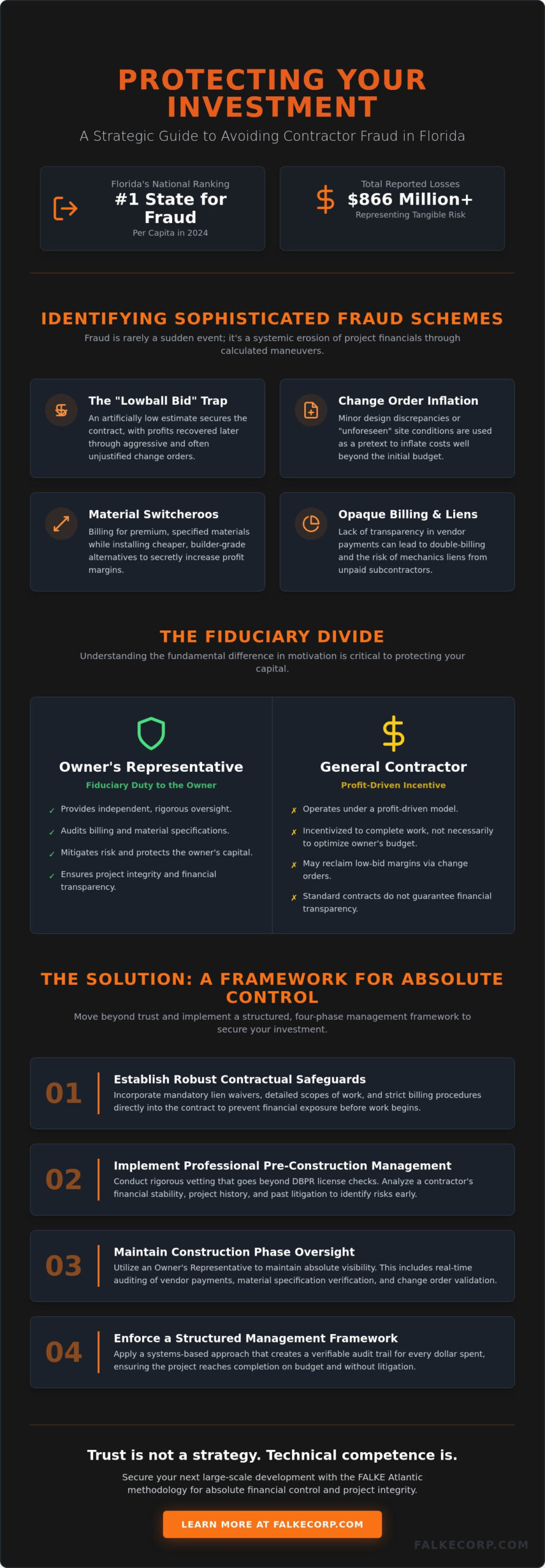
In 2024, Florida secured the unenviable position of being the top state in the nation for fraud per capita, with residents reporting over $866 million in losses. For real estate developers and property owners, these statistics aren’t just abstract figures. They represent the tangible risks of opaque billing, unjustified change orders, and the threat of mechanics liens that frequently plague large-scale projects. You likely recognize that while a standard contract provides a legal framework, it doesn’t inherently guarantee financial transparency or protection against sophisticated construction schemes. Successfully avoiding contractor fraud in Florida requires moving beyond simple trust and into a realm of rigorous, independent oversight.
This guide provides a strategic roadmap for identifying systemic financial leakage and implementing professional project management to protect your investment. You’ll learn how to navigate the complexities of new legislative requirements, such as SB 290 and the updated Florida Building Code, while maintaining absolute visibility into vendor payments. We’ll examine the specific methodologies used to mitigate Florida-specific construction risks, ensuring your project reaches completion on budget and without the burden of litigation. By the end of this analysis, you’ll understand how to leverage technical competence to secure the stability of your most complex development processes.
Key Takeaways
- Identify sophisticated tactics like “material switcheroos” and change order inflation that compromise project integrity and inflate baseline budgets.
- Distinguish the fiduciary obligations of an Owner’s Representative from the profit-driven incentives inherent in the standard General Contractor model.
- Establish robust contractual safeguards, including mandatory lien waivers, to prevent financial exposure and the risk of mechanics liens.
- Apply a structured, four-phase management framework as a primary strategy for avoiding contractor fraud in Florida and securing large-scale capital investments.
- Utilize professional pre-construction and construction phase management to maintain absolute visibility into vendor billing and material specifications throughout the project lifecycle.
The Landscape of Construction Risk in Florida
The Florida construction market operates at a velocity that often outpaces standard oversight mechanisms. This high-velocity environment attracts premier engineering talent, but it also provides fertile ground for predatory entities. Investors often fall into the trap of assuming that a high-profile market guarantees high-profile ethics. In reality, the lack of structured process management often turns a promising development into a case study for the necessity of avoiding contractor fraud in Florida. Trust is not a management strategy; technical competence and rigorous oversight are the only reliable defenses against financial erosion.
The distinction between criminal fraud and operational negligence is often thin. While a contractor vanishing with a deposit is clearly criminal, the gradual inflation of change orders or the systemic lack of transparency in vendor payments is far more common. These “grey-area” actions are often the result of a deliberate strategy to reclaim margins lost during a lowball bidding process. Owners must recognize that informal “handshake” agreements are the primary entry point for financial mismanagement. Without a systems-based approach, these verbal understandings lack the technical checkpoints required to verify actual work against monthly billing cycles.
Regulatory Standards and the DBPR
The Florida Department of Business and Professional Regulation (DBPR) serves as the primary governing body for licensure. Every contractor must hold a valid state license to operate legally. However, state-level enforcement typically focuses on clear-cut violations of administrative code. In complex commercial disputes involving sophisticated financial mismanagement, the DBPR’s reach is often limited. Owners shouldn’t view a license as a seal of absolute integrity; it’s merely a minimum barrier to entry. Verifying a contractor’s history of complaints and administrative actions through the DBPR portal is a necessary first step, yet it rarely reveals the operational negligence that erodes project margins. When a contractor fails to provide the honest services promised, they’ve effectively breached their fiduciary duty to the owner, regardless of their licensing status.
The Economic Drivers of Fraud in South Florida
South Florida, particularly the Miami and Palm Beach corridors, experiences unique economic pressures that bad actors exploit. Supply chain volatility is frequently used as a pretext for unjustified price hikes or “unforeseen” surcharges. This market also sees an influx of “storm chasers” who lack deep roots in the community and may prioritize short-term gains over long-term project quality. In these high-demand zones, contractors may bill for premium materials while installing builder-grade alternatives. Avoiding contractor fraud in Florida requires a shift toward professional project management that can audit these material substitutions in real-time. Professional oversight ensures that every dollar spent is accounted for through rigorous documentation and structured audit trails.
Identifying Sophisticated Fraud Schemes in Large-Scale Projects
Sophisticated construction fraud in high-value developments rarely involves the sudden disappearance of a contractor. Instead, it manifests as a systemic erosion of the project’s financial health through institutionalized accounting maneuvers. Avoiding contractor fraud in Florida requires an analytical approach to the contractor’s financial reporting, specifically focusing on how they translate a technical scope into a billing schedule. When an owner lacks the technical expertise to audit these processes, they inadvertently allow the general contractor to shift project risks and costs onto the owner’s balance sheet.
Change Order Manipulation and Scope Creep
The most frequent scheme begins during the pre-construction phase with the “lowball bid” trap. A contractor submits an artificially low estimate to secure the award, intending to recover their profit margins through aggressive change order requests once the project is underway. These requests often cite “unforeseen” site conditions or minor design discrepancies that should’ve been addressed during initial vetting. Scope creep in the context of Florida building codes often manifests as a series of forced technical revisions that exploit the owner’s lack of familiarity with 9th Edition requirements to justify excessive cost adjustments. Implementing rigorous pre-construction services allows for a comprehensive peer review of the bid, identifying these pricing gaps before the contract is signed.
Beyond bid manipulation, owners must remain vigilant against the “Material Switcheroo.” This occurs when a contractor bills for premium, high-performance specifications while installing builder-grade alternatives that meet only the minimum regulatory requirements. This practice not only inflates the contractor’s margin but also compromises the long-term asset value and resiliency of the structure. Non-competitive bidding within a contractor’s preferred vendor network can lead to hidden kickbacks, where the owner pays a premium that is eventually shared between the general contractor and their subcontractors.
Financial Opacity and Payment Application Fraud
Financial mismanagement often centers on the manipulation of the Schedule of Values (SOV). Contractors may “front-load” the SOV, assigning disproportionately high values to early-stage tasks like mobilization or site clearing. This allows them to receive significant capital before substantial work is performed, creating a “commingling of funds” scenario where your project’s liquidity is used to finance the contractor’s struggling projects elsewhere. If the contractor faces a financial collapse, your project is left underfunded and exposed to legal action from unpaid suppliers.
Auditing a payment application requires more than just checking boxes; it demands independent site inspections to verify that the percentage of completion reported matches the physical reality on the ground. While Florida law provides avenues to report construction fraud to local authorities, such actions are reactive and rarely recover lost time or capital. Effective oversight ensures that every progress payment is backed by verified milestones and unconditional lien waivers, protecting the owner from the risk of double payment and ensuring that project funds remain dedicated to their intended purpose.
The Owner’s Representative vs. General Contractor Fiduciary Duty
The standard general contracting model contains an inherent conflict of interest that owners frequently overlook. A General Contractor (GC) is a profit-seeking entity whose financial success is often tied to maximizing their own margins, sometimes at the expense of the project’s total value. While most contractors operate within legal boundaries, the pressure to maintain profitability in a volatile market creates an environment where “grey-area” decisions become standard practice. This structural reality is why avoiding contractor fraud in Florida requires a management layer that is entirely decoupled from the contractor’s profit incentives. Establishing an independent oversight mechanism is the only way to ensure that the owner’s capital is protected by a genuine fiduciary obligation.
An Owner’s Representative acts as a technical extension of your own executive or family office. They don’t simply manage the schedule; they audit the underlying processes to ensure absolute contract compliance. By maintaining an arms-length relationship with the GC and their vendor network, the Owner’s Rep can verify that every billing cycle reflects actual progress and that all material specifications are met without compromise. This professional oversight transforms the management of the project from a reactive struggle over change orders into a disciplined, transparent workflow.
Fiduciary Responsibility in Construction
The distinction between a GC and an Owner’s Representative is rooted in their primary goal. The GC’s objective is to deliver the project while protecting their internal bottom line. In contrast, the Owner’s Representative is legally and ethically bound to act solely in the owner’s best interest. This fiduciary duty is critical when navigating the complexities of South Florida’s real estate market. Utilizing Owner’s representative Miami services allows investors to bridge the technical knowledge gap, ensuring that they aren’t forced to rely on the GC’s self-reported data. This independent advocacy is essential for maintaining financial control and preventing the subtle “leakage” that often precedes more significant fraud schemes.
Comparing Management Structures
Understanding who holds the risk in different management models is vital for long-term asset protection. While a Project Manager focuses on the “how” and “when” of construction, the Owner’s Representative focuses on the “why” and the “cost.” Professional oversight directly impacts the total project ROI by identifying inefficiencies and preventing overpayment before capital is deployed.
| Role | Primary Driver | Fiduciary Duty | Risk Ownership |
|---|---|---|---|
| General Contractor | Profit Margin | No (Contractual Only) | Performance and Labor |
| Project Manager | Schedule Execution | Limited | Logistics and Timeline |
| Owner’s Representative | Total Project Success | Yes (Absolute) | Owner’s Financial Risk |
Avoiding contractor fraud in Florida is not merely about finding an honest contractor; it’s about establishing a management structure where fraud is technically impossible to execute without detection. When you implement professional oversight, you’re not just hiring a consultant. You’re installing a system of checks and balances that aligns every participant’s actions with your financial objectives.
Strategic Safeguards: Vetting and Contractual Protection
Vetting a contractor in the Florida market requires a methodology that extends significantly beyond a simple DBPR license verification. While a valid license is a legal prerequisite, it offers no insight into a firm’s current liquidity or its history of operational negligence. Avoiding contractor fraud in Florida is predicated on the owner’s ability to verify a firm’s financial solvency and historical performance under actual project stress. This process must be clinical and data-driven, removing the emotional bias that often accompanies high-stakes real estate negotiations. Establishing rigorous contractual safeguards serves as the primary line of defense against systemic financial erosion.
Advanced Contractor Vetting
A firm’s bonding capacity serves as a reliable proxy for its overall financial health. Because a surety company assumes the financial risk of a contractor’s failure, their willingness to issue a high-value performance bond indicates that the contractor has passed a rigorous third-party financial audit. Owners should also bypass curated reference lists in favor of direct interviews with past project owners, focusing specifically on the contractor’s transparency during the close-out phase. Utilizing professional pre-construction services miami allows for a comprehensive peer review of the delivery team, ensuring the selected contractor possesses the technical competence required for complex, high-resiliency structures.
Contractual Clauses that Mitigate Fraud
The contract must be structured to enforce transparency through technical checkpoints. A “Right to Audit” clause is essential, granting the owner or their representative the authority to inspect the contractor’s financial records related to the project at any time. This prevents the commingling of funds and ensures that project capital is being deployed as intended. The implementation of unconditional lien waivers must be a non-negotiable condition for every progress payment. This protects the owner from mechanics liens filed by subcontractors who may’ve been left unpaid by a predatory general contractor despite the owner’s timely disbursements.
- Daily Progress Documentation: Mandating detailed daily reports and photographic evidence ensures that the reported percentage of completion aligns with physical reality.
- Markup Caps: Capping markups on change orders at a fixed percentage prevents price gouging during the construction phase.
- Liquidated Damages: Including specific financial penalties for unexcused delays incentivizes the contractor to maintain the agreed-upon schedule.
For high-value developments, establishing a project-specific escrow account provides an additional layer of security. This structure ensures that funds are only released upon the verification of specific milestones by an independent third party. Technical oversight is the only mechanism that can effectively neutralize the inherent conflicts of interest within the construction industry. Secure the stability of your next project by implementing professional Development Management oversight to manage these complex contractual obligations.
The FALKE Atlantic Methodology: Absolute Financial Control
Effective risk mitigation in the construction sector requires more than just reactive auditing; it demands a proactive, systems-based approach that spans the entire project lifecycle. The FALKE Atlantic methodology is designed to provide this level of absolute financial control by replacing traditional trust with technical verification. By integrating professional construction project management Florida investors can rely on, the firm eliminates the information asymmetry that often allows for financial mismanagement. This disciplined framework ensures that every decision, from the initial feasibility study to the final commissioning, is backed by rigorous technical analysis and transparent reporting, making it the definitive solution for avoiding contractor fraud in Florida.
From Concept to Commissioning
The methodology is structured into four distinct phases, each serving as a technical checkpoint to ensure the project’s financial and structural integrity. This progression ensures that the transition from architectural design to physical execution is managed without the loss of critical data or the introduction of unvetted costs.
- Phase 1: Feasibility and Risk Assessment: Before a single dollar is committed to physical construction, the project undergoes a comprehensive review to identify potential regulatory, technical, or financial hurdles. This pre-emptive analysis ensures that the baseline budget is realistic and defensible.
- Phase 2: Procurement and Bid Management: This phase focuses on establishing market-rate pricing and conducting the deep-level vetting of the delivery team discussed earlier. It ensures that the contract structure favors transparency and owner protection.
- Phase 3: Execution Oversight: During this phase, meticulous construction phase management florida developers require becomes the primary defense against scope creep. Real-time financial reporting and independent site inspections ensure that every progress payment is verified against physical completion.
This lifecycle approach concludes with Phase 4, focusing on commissioning and close-out. This final stage ensures that all warranties are in place, all subcontractors have been paid, and the asset is ready for operation without the threat of lingering legal or financial encumbrances.
Securing Your Investment with FALKE Atlantic
Choosing a boutique consultancy like FALKE Atlantic offers a level of protection that large, impersonal firms often struggle to provide. In the high-stakes markets of Miami and Fort Lauderdale, a strategic partner who understands local nuances and regulatory shifts is invaluable. This personalized approach ensures that high-net-worth interests are managed with the precision and confidentiality they demand, providing a level of oversight that is both clinical and unwavering. Avoiding contractor fraud in Florida is the natural result of a management philosophy that prioritizes the owner’s financial stability and technical requirements above all else.
The complexity of modern development requires a partner who takes full responsibility for the project’s outcome. By implementing a framework of absolute transparency, FALKE Atlantic ensures that your capital is protected and your project is delivered to the highest professional standards. Schedule a consultation with FALKE Atlantic to secure your next development and establish the professional oversight your investment deserves.
Securing the Integrity of Your Florida Real Estate Assets
Navigating the high-velocity construction market in South Florida requires a fundamental shift from reactive monitoring to proactive, technical management. We’ve examined how sophisticated schemes, such as material substitutions and front-loaded billing, can erode project margins without rigorous oversight. Establishing a management structure where an independent advocate holds an absolute fiduciary duty is no longer optional for high-value developments; it’s a prerequisite for financial stability. By prioritizing technical competence and disciplined contractual safeguards, you ensure that your capital remains dedicated to project success rather than contractor profit inflation.
Avoiding contractor fraud in Florida is a matter of implementing the right systems before the first shovel hits the ground. FALKE Atlantic Corporation offers a disciplined four-phase project methodology and deep expertise in high-value Miami-Dade and Broward county projects to provide the strategic fiduciary oversight high-net-worth individuals require. You can protect your development with FALKE Atlantic Corporation and ensure your investment is managed with the precision it deserves. Build with the confidence that comes from unwavering professional supervision and technical excellence.
Frequently Asked Questions
How can I tell if a Florida contractor is legitimate?
Verification begins with the Florida Department of Business and Professional Regulation (DBPR) portal, where you must confirm the active status of the license and review any history of administrative complaints. A truly legitimate entity will also provide a current Certificate of Insurance covering General Liability and Workers’ Compensation, alongside a verifiable bonding capacity that aligns with your project’s total valuation. Technical legitimacy is further proven through a clean performance record on projects of similar complexity and scale.
What is the most common type of construction fraud in Miami?
Change order inflation and material substitutions are the most prevalent schemes in the high-velocity Miami market. Contractors often secure an award with a low initial bid and then utilize “unforeseen” technical issues or supply chain volatility to justify excessive surcharges. Successfully avoiding contractor fraud in Florida requires technical oversight to audit these claims against the original project specifications and market-rate pricing to prevent the erosion of your project’s financial health.
Does a performance bond protect me from all types of fraud?
A performance bond primarily ensures project completion if a contractor faces total default or insolvency. It doesn’t typically provide protection against sophisticated accounting fraud, such as front-loaded billing, vendor kickbacks, or minor material substitutions, which fall under operational negligence. Fiduciary oversight through an Owner’s Representative is necessary to manage the specific financial risks and “grey-area” mismanagement that standard bonds aren’t designed to address.
What should I do if I suspect my contractor is overcharging for materials?
You should immediately exercise your “Right to Audit” as defined in the construction agreement to demand original, third-party vendor invoices for all materials delivered to the site. Cross-referencing these documents with the reported Schedule of Values allows you to identify discrepancies between billed amounts and actual material costs. Professional project management is the most effective tool for avoiding contractor fraud in Florida when material specifications or pricing are compromised.
Are verbal change orders legally binding in Florida?
Verbal change orders are rarely binding if the underlying contract stipulates that all modifications must be in writing and signed by both parties. Florida courts frequently uphold these written requirements to prevent scope creep and unauthorized financial expansion that occurs without owner consent. Relying on verbal agreements introduces significant legal risk and is a primary entry point for the financial mismanagement discussed throughout this guide.
How does an Owner’s Representative prevent mechanics liens?
An Owner’s Representative prevents mechanics liens by mandating unconditional lien waivers from all subcontractors and suppliers as a non-negotiable condition for every progress payment. This process ensures that the general contractor has fulfilled their financial obligations to the entire vendor network before additional capital is released. This technical verification eliminates the risk of double payment and secures the property’s title against third-party claims throughout the construction lifecycle.
What are the red flags of a “lowball” bid in South Florida?
Red flags include missing scope items, disproportionately low labor estimates compared to current market rates, and a front-loaded Schedule of Values that requests excessive capital during the mobilization phase. A “lowball” bid is often a strategic maneuver to recover lost margins through aggressive change order requests once construction has commenced. Independent pre-construction vetting is essential to identify these pricing anomalies and ensure the contractor’s financial model is sustainable.