
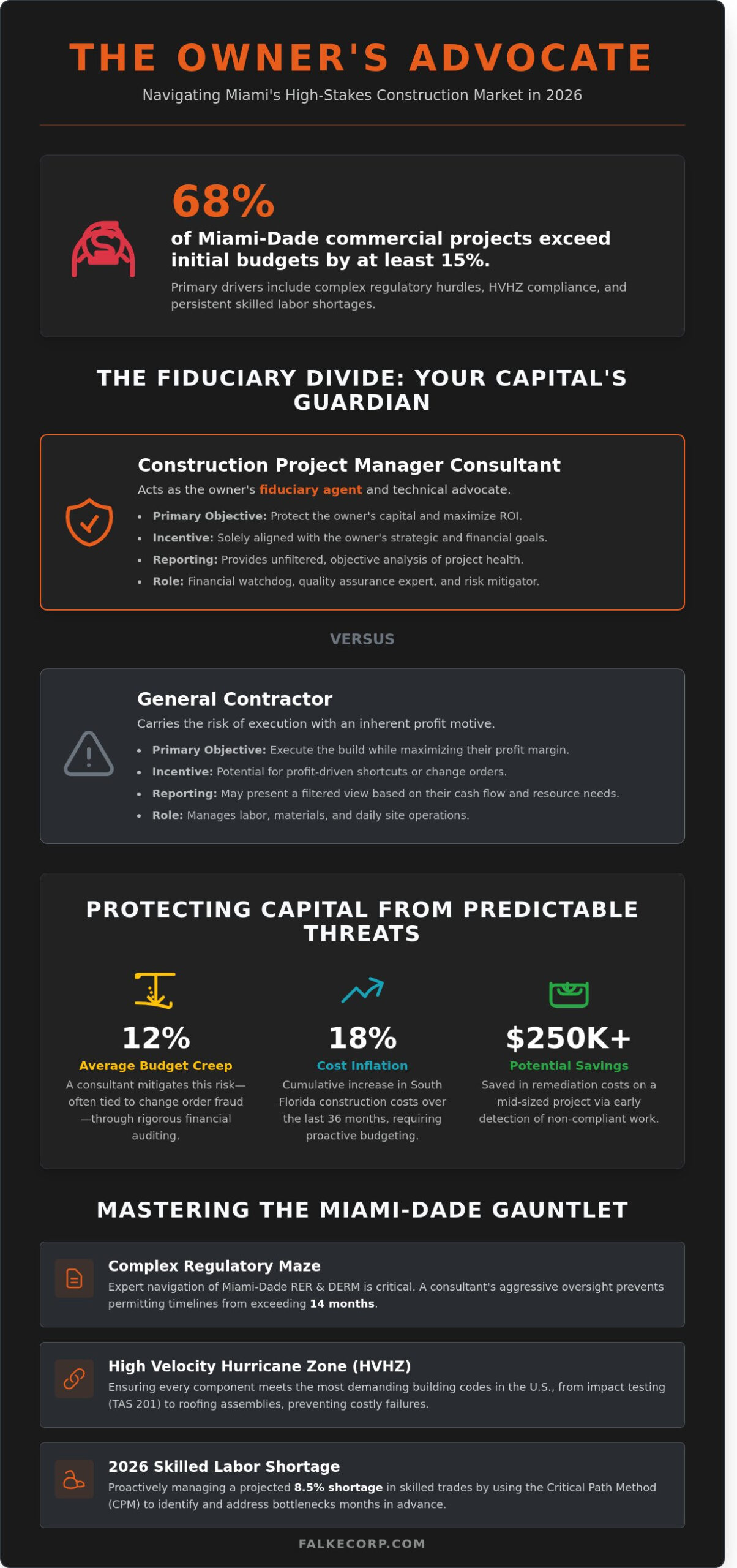
According to 2024 industry data, over 68% of commercial developments in Miami-Dade County exceed their initial budgets by at least 15% due to regulatory hurdles and labor shortages. You’re likely aware that the South Florida market demands more than just a general contractor; it requires a specialized construction project manager consultant who understands the technical nuances of High Velocity Hurricane Zone (HVHZ) requirements. Managing a capital-intensive project in 2026 without rigorous, engineering-led oversight isn’t a calculated risk; it’s a predictable financial failure.
This strategic guide provides a technical framework to protect your capital from the 12% average cost increase often associated with change order fraud and budget creep. We’ll examine how a professional construction project manager consultant mitigates risk through precise schedule auditing and transparent financial reporting. You’ll gain a roadmap for addressing the 2026 labor market and ensuring your asset is revenue-ready on schedule, allowing you to focus on your portfolio rather than daily site disputes.
Key Takeaways
- Understand the critical fiduciary distinction between a general contractor and a construction project manager consultant, ensuring your capital is protected by an advocate whose primary objective is your strategic return on investment.
- Gain technical insights into navigating South Florida’s unique regulatory landscape, including the specific permitting requirements of the Miami-Dade RER and DERM environmental compliance for coastal projects.
- Identify why a structured four-phase methodology—spanning from initial concept to final commissioning—is essential for maintaining transparency and rigorous financial control over complex developments.
- Evaluate essential selection criteria for Miami-based projects to ensure your representative possesses the local entitlement expertise necessary to prevent costly delays caused by regional legislative nuances.
What is a Construction Project Manager Consultant in the Miami Context?
In the high-stakes environment of 2026 Miami real estate, a construction project manager consultant serves as a specialized fiduciary agent for the property owner. This role transcends simple coordination; it provides a rigorous layer of technical oversight that ensures every dollar spent translates into measurable asset value. While the broad discipline of Construction management encompasses various delivery methods, the consultant remains distinct by maintaining no financial interest in the labor or materials used. This independence is critical in a market where construction costs in South Florida have seen a cumulative increase of 18% over the last thirty-six months. Under Florida law, specifically within the framework of professional service contracts, this consultant acts as the owner’s technical proxy, distinguishing themselves from a licensed General Contractor (GC) who carries the risk of execution but also the inherent incentive for profit-driven shortcuts.
The 2026 development climate in Miami, fueled by the $5.5 billion infrastructure expansion and the influx of international corporate headquarters, demands a level of precision that traditional oversight cannot provide. Owners can’t rely solely on the “Owner’s Representative” label, which in Florida often describes a wider range of administrative roles. A consultant provides the specialized engineering and financial expertise necessary to audit complex industrial and commercial builds. Their primary objective is the absolute alignment of the physical build with the owner’s long-term strategic and financial mandates.
The Core Responsibilities of an Owner’s Consultant
Effective budget development requires a forensic approach to cost control that begins during the pre-construction phase. The consultant establishes a baseline budget that accounts for the 7% volatility currently seen in raw material pricing, such as reinforced steel and specialized glazing. They implement rigorous cost-tracking protocols that prevent the “scope creep” often responsible for 15% budget overruns in South Florida luxury and commercial sectors.
Schedule management utilizes the Critical Path Method (CPM) to navigate the complexities of the Miami labor market. With a projected 8.5% shortage in skilled trades for the 2026 season, the consultant identifies potential bottlenecks months in advance. Quality assurance is centered on the High Velocity Hurricane Zone (HVHZ) requirements of the Miami-Dade Building Code. The consultant ensures that every component, from TAS 201 impact testing to roofing assemblies, meets these stringent standards, which are the most demanding in the United States.
Fiduciary Duty: Why Your Consultant Works Only for You
Maintaining an “arms-length” relationship between the consultant and the design-build teams is the only way to ensure objective reporting. When a General Contractor manages the schedule, their priority is often their own cash flow and resource allocation across multiple sites. Retaining a construction project manager consultant ensures that the owner receives an unfiltered view of project health, free from the conflicts of interest that arise when the entity performing the work is also the one reporting on its quality. This structure allows for the early detection of non-compliant work, which can save an owner upwards of $250,000 in remediation costs on a mid-sized project.
Defining the fiduciary role of a Miami PM consultant, they act as a dedicated financial watchdog who protects the owner’s capital from predatory pricing and technical non-compliance throughout the project lifecycle.
Navigating South Florida’s Unique Construction Challenges
Construction in South Florida requires more than just a site supervisor; it demands a technical partner who understands the granular details of local bureaucracy. A construction project manager consultant serves as the owner’s technical advocate, specifically when interfacing with the Miami-Dade Department of Regulatory and Economic Resources (RER). In 2026, permitting timelines for complex mixed-use projects often exceed 14 months without aggressive oversight. This consultant ensures that submittals aren’t just filed but are tracked through every municipal department to avoid stagnant cycles.
For coastal assets, managing the Department of Environmental Resources Management (DERM) is a critical technical requirement. Compliance involves strict adherence to sea-level rise mitigation protocols and the installation of hurricane-rated glazing that meets the High Velocity Hurricane Zone (HVHZ) standards. These specifications aren’t optional; they’re the baseline for structural integrity in a climate-vulnerable region. According to the Occupational Outlook Handbook for Construction Managers, the professional oversight required to manage these complex variables involves high-level coordination and technical analysis. This expertise distinguishes a consultant from a standard general contractor who may focus solely on labor execution.
The labor market in Ft. Lauderdale and Miami remains volatile. Skilled trade costs in South Florida have risen by 11% annually since 2024, making vendor management a core financial pillar. A consultant manages these dynamics by vetting subcontractors for financial stability and technical competence, ensuring the project isn’t derailed by the rising costs of specialized labor.
The ‘Miami Factor’ in Project Scheduling
The master schedule must account for the Atlantic hurricane season, which runs from June 1st to November 30th. A consultant builds in specific “weather days” and mobilization windows to prevent liquidated damages. Logistics in dense corridors like the Miami Design District or North Bay Village require navigating restrictive noise ordinances and limited staging areas. Proactive procurement for 2026 focuses on long-lead items like custom glazing and electrical switchgear, which currently carry 35-week lead times.
Cost Control in a High-Inflation Market
Owners face hidden expenses such as impact fees that can reach $18,000 per unit or utility connection delays that stall occupancy for months. Real-time cost estimating uses current South Florida material indices rather than national averages to maintain budget accuracy. Effective construction cost control in Miami involves identifying these risks during the pre-construction phase. For owners seeking technical precision in project delivery, exploring integrated management solutions ensures that engineering standards remain uncompromised throughout the build.
Consultant vs. General Contractor: The Fiduciary Gap
The relationship between an owner and a General Contractor (GC) is inherently transactional, governed by a contract where the GC’s primary objective is the execution of a defined scope within a specific profit margin. In contrast, a construction project manager consultant operates as a fiduciary, aligning exclusively with the owner’s Return on Investment (ROI) and long-term risk profile. This distinction is critical because a GC cannot objectively audit their own performance. When schedule delays occur or change orders arise, the GC’s perspective is naturally influenced by their overhead and subcontractor obligations. The consultant serves as the single point of truth, distilling complex site data into clear, objective reports that allow the owner to make decisions based on facts rather than project site noise.
The two roles must collaborate to ensure a project, such as a luxury retail build in Palm Beach, stays on track, but their motivations remain distinct. While the GC manages the labor and material flow, the consultant monitors the broader strategic horizon. This oversight ensures that the technical execution doesn’t compromise the owner’s financial or operational goals. It’s a system of checks and balances that transforms a standard construction site into a disciplined engineering environment.
Managing Change Orders and Scope Creep
Every change order requires a rigorous technical audit to verify its validity against the original contract documents. Without a consultant, owners often fall victim to fee stacking. This happens when multiple tiers of subcontractors apply markups to the same task, inflating costs by 18% to 22% unnecessarily. For instance, in high-end retail developments, proactive consultant project management has historically identified redundant line items that saved owners six-figure sums before a single dollar was paid out. This level of oversight requires the technical depth taught in a Construction Project Management Certificate program, which emphasizes cost control and rigorous contract administration as the foundation of project success.
Quality Assurance Beyond the Building Code
For a luxury hospitality project in Miami, simply passing a municipal inspection is an insufficient benchmark. Code compliance ensures basic safety; however, it doesn’t guarantee the level of finish required for a revenue-ready asset. The construction project manager consultant manages the punch-list process with a focus on engineering precision, ensuring that millwork, lighting, and HVAC systems meet the exact specifications of the design intent. Integrating commissioning early in the construction phase prevents post-occupancy failures, such as humidity imbalances or electrical surges. These issues frequently disrupt operations in 35% of new commercial builds during the first year, making the consultant’s early intervention a vital layer of protection for the owner’s capital.
Selection Criteria: Hiring a Consultant in Miami-Dade and Broward
Selecting a construction project manager consultant requires more than a review of past portfolios; it demands a rigorous audit of their technical alignment with Florida’s specific regulatory and environmental constraints. A consultant from New York or Chicago often lacks the nuanced understanding of the Florida Building Code’s High Velocity Hurricane Zone (HVHZ) requirements. These standards dictate glazing specifications and roof assembly protocols that differ significantly from northern seismic or snow load codes. Without local expertise, an out-of-state consultant might miss critical wind-load certifications, leading to costly retrofits during the inspection phase.
Falke Corp advocates for a structured Four-Phase methodology to ensure project stability: Pre-construction, Procurement, Construction Management, and Close-out. This framework ensures that every milestone is backed by empirical data rather than optimistic estimates. Technical competence is non-negotiable. Leading firms utilize Procore for document control and BIM for clash detection. This level of integration provides remote owners with 24/7 visibility into site progress through real-time reporting dashboards. You can’t manage what you can’t measure, and digital transparency is the only way to maintain accountability from a distance.
An experienced construction project manager consultant also brings a vetted network of local professionals. In South Florida, established relationships with the 450+ licensed contractors and specialized MEP engineers in Miami-Dade can accelerate procurement by 15% or more. These connections are vital when navigating the volatile labor market typical of the Atlantic Coast region.
Key Questions for Your Prospective Miami Consultant
Owners should probe the consultant’s familiarity with the Department of Regulatory and Economic Resources (RER). Ask specifically: “How do you manage the RER permitting process in the City of Miami to avoid the typical 180-day backlog?” Inquire about their protocol for auditing contractor pay applications to prevent over-billing. Request documented examples of hospitality or retail assets managed along the Atlantic Coast since 2023 to verify their recent performance in high-stakes environments.
Understanding Fee Structures
Fee models usually fall into two categories: a percentage of construction cost, typically ranging from 3% to 5%, or a fixed monthly retainer. Fixed retainers often align interests better by removing the incentive for project costs to escalate. A high-performing consultant aims to offset their entire fee through value engineering and cost-savings identified during the pre-construction phase. For a deeper analysis on vendor evaluation, see our guide on selecting building project management companies in Miami.
Secure your South Florida investment by partnering with technical experts. Contact Falke Corp today for a comprehensive project audit.
FALKE Atlantic’s Disciplined Approach to Project Management
FALKE Atlantic operates on the principle that technical competence is the only true hedge against capital risk. As a specialized construction project manager consultant, we don’t merely observe the process; we engineer the outcome through a rigorous four-phase methodology. This cycle encompasses Concept, Pre-Construction, Execution, and Commissioning. Our team acts as a strategic extension of the owner’s office, ensuring that financial controls are as rigorous as the structural engineering itself. In the 2026 Miami market, where labor costs and supply chain volatility remain persistent, this level of oversight prevents the 15% to 20% budget overruns common in less structured projects.
Our boutique approach prioritizes accountability over volume. Unlike large, national firms where projects are often handed off to junior associates after the contract is signed, our senior experts maintain direct involvement from day one. This ensures that the technical integrity of the project isn’t lost in communication gaps. We provide the stability and precision required for complex developments in Miami’s luxury retail, hospitality, and residential sectors.
From Concept to Revenue-Ready Asset
Managing the design team requires a balance of architectural vision and “buildable” reality. We conduct comprehensive site feasibility studies to identify subsurface risks or zoning constraints before the first shovel hits the ground. Our team scrutinizes every drawing to ensure the project remains within budget without compromising the aesthetic standards of luxury developments. During the final phase, we focus on rapid asset activation. We manage the close-out process to ensure every permit is finalized and every system is calibrated, allowing the property to transition from a construction site to a revenue-generating asset without the typical 45-day delay seen in unmanaged handovers.
The FALKE Difference in South Florida
Our commitment to technical competence and engineering-grade precision defines our presence in the South Florida market. We understand the unique environmental and regulatory challenges of the Atlantic Coast. Our services are tailored for high-stakes projects in the following areas:
- Miami Beach: Navigating strict coastal codes and historic preservation requirements.
- North Bay Village: Managing complex infrastructure and waterfront logistics.
- The Greater Atlantic Coast: Delivering high-end hospitality and retail spaces with uncompromising quality.
We serve as a construction project manager consultant that values long-term stability over short-term shortcuts. By integrating professional engineering standards into the project management framework, we ensure that your investment is protected against the unpredictability of the construction industry. If you require a partner who treats your capital with the same respect as the structures we build, it’s time to elevate your project’s leadership.
Take the first step toward a more disciplined development process. Request a consultation for your Miami development project to secure a strategic partner for your next venture.
Maximizing Asset Value Through Engineering Precision
Navigating the Miami-Dade and Broward regulatory landscape in 2026 requires more than general oversight. It demands technical alignment with building codes that have become increasingly complex since the legislative shifts of 2021. Owners who operate without a dedicated construction project manager consultant often see a 15% to 20% increase in unforeseen change orders because they lack a fiduciary partner to bridge the gap between design and execution. Our data shows that early-stage intervention prevents these systemic budget overruns. Implementing comprehensive construction cost control Miami protocols during the pre-construction phase ensures that financial projections remain accurate throughout the project lifecycle.
FALKE Atlantic’s disciplined four-phase project management methodology provides the structural framework necessary to maintain financial transparency throughout the project lifecycle. We don’t just oversee the site; we enforce a rigorous standard of engineering reliability that protects your capital from the volatility of South Florida’s construction market. By prioritizing your interests over the contractor’s profit margins, we ensure that every technical decision serves the project’s long-term stability. Secure your project’s ROI with FALKE Atlantic’s expert owner representation. Your development’s success depends on the meticulous coordination of every moving part, and we’re ready to provide that stability.
Frequently Asked Questions
What’s the difference between a construction manager and a project management consultant?
A construction manager focuses on trade coordination and site safety, whereas a construction project manager consultant represents the owner’s interests across the entire project lifecycle. They handle financial auditing, risk mitigation, and contract administration. This role ensures that the general contractor adheres to the technical specifications defined in the 2023 Florida Building Code. It’s a fiduciary relationship where the consultant’s primary loyalty is to the owner’s budget and timeline.
Why is a project manager consultant especially important for Miami construction?
Miami’s unique environmental and regulatory landscape, specifically the High Velocity Hurricane Zone (HVHZ) requirements, necessitates specialized technical expertise. A consultant ensures that structural designs meet the 175 mph wind load standards required in Miami-Dade County. They navigate the regional logistics of the 2026 market, where supply chain volatility often impacts the delivery of specialized glazing and reinforced steel. You can’t afford to overlook these regional complexities.
How much does it cost to hire a construction project manager consultant in Florida?
Professional fees for a construction project manager consultant in Florida typically range from 3% to 6% of the total project value. For a $10 million commercial development, this represents an investment of $300,000 to $600,000. These costs are often offset by the consultant’s ability to identify 10% to 15% in cost savings through value engineering and rigorous change order management. It’s a strategic expenditure that protects the project’s bottom line.
Can a consultant help with Miami-Dade building permit delays?
Consultants reduce permit lead times by approximately 25% through meticulous document control and direct coordination with the Miami-Dade Regulatory and Economic Resources (RER) department. They identify potential stop-work triggers before plans are submitted. By ensuring 100% technical compliance with municipal zoning and environmental ordinances, they prevent the 4 to 6 week delays common in the Miami permitting process. Their presence ensures the project doesn’t stall in administrative cycles.
At what stage of the project should I hire a consultant?
You should engage a consultant during the pre-design or feasibility phase, which is usually 8 to 12 months before construction starts. Early involvement allows for a more accurate pro forma analysis and site selection. This timing ensures that the project’s technical foundation and budget constraints are established before the architect completes the final construction drawings. If you wait until the ground breaks, you’ve already missed the most critical cost-saving opportunities.
Does a project management consultant replace the need for an architect?
A consultant doesn’t replace an architect; instead, they manage the architect’s deliverables to ensure they align with the owner’s commercial objectives. The architect focuses on design and code compliance, while the consultant manages the integration of these designs with the project’s financial and temporal constraints. This synergy prevents design creep, which often accounts for 20% of budget overruns in high-end Miami developments. Both roles are essential for a successful delivery.
What happens if my project is already behind schedule or over budget?
The consultant conducts a forensic audit to stabilize the budget and re-establish the critical path. They implement recovery schedules that can reclaim up to 15% of lost time by re-sequencing trade activities and optimizing resource allocation. Their objective approach identifies whether the delays stem from procurement failures, labor shortages, or poor site management. They don’t just report problems; they provide the engineering solutions required to bring the project back to baseline.
How does a consultant manage hurricane-related risks during construction?
Consultants manage hurricane risks by enforcing a 72-hour site securement protocol during the June 1 to November 30 season. They ensure all loose materials are removed and crane booms are feathered according to ASCE 7-22 standards. This systematic approach minimizes structural damage and insurance liability, protecting the owner’s capital investment during extreme weather events. They’ll also review your builder’s risk insurance to ensure coverage is sufficient for 2026 replacement costs.