
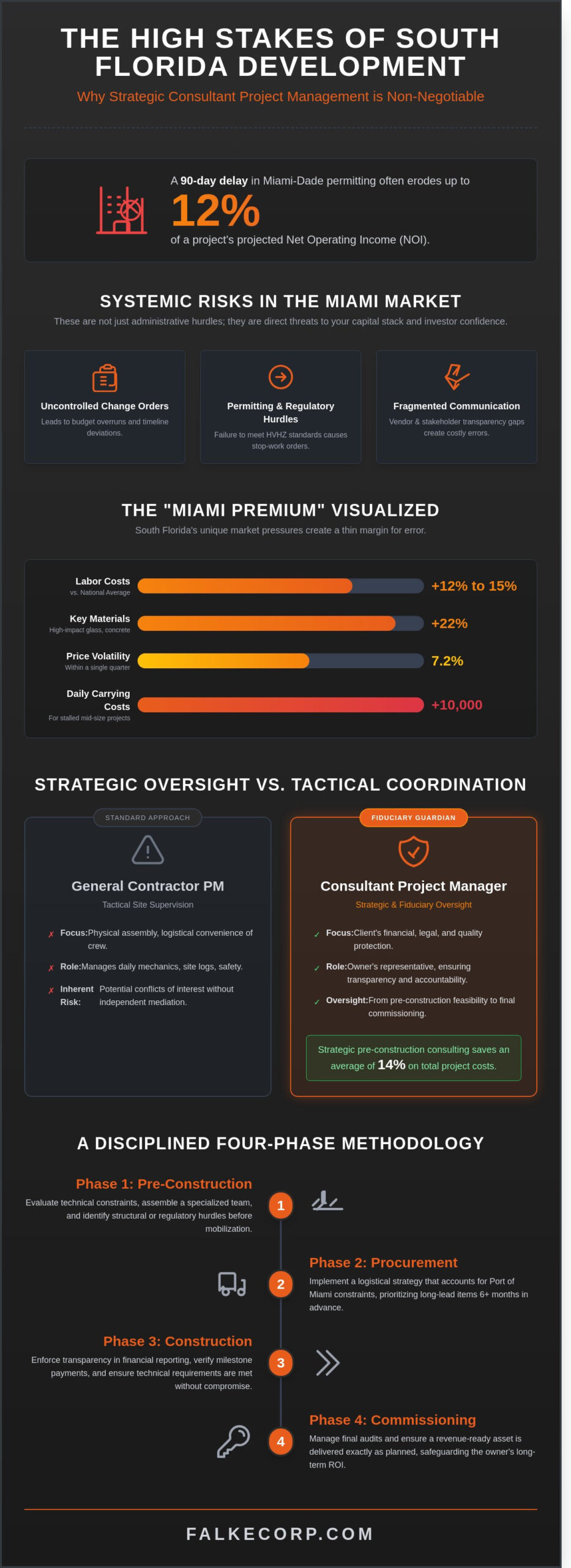
A 90 day delay in Miami-Dade permitting often erodes up to 12 percent of a project’s projected net operating income before the first tenant even arrives. While the architectural vision captures the headlines, the actual viability of a South Florida development depends on the technical precision of consultant project management to mitigate these systemic risks. You likely recognize that uncontrolled change orders and fragmented vendor communication aren’t just administrative hurdles; they’re direct threats to your capital stack and investor confidence.
This analysis provides a rigorous examination of how professional oversight safeguards your investment through structured financial controls, aggressive schedule management, and the systematic elimination of vendor-related transparency gaps. We’ll demonstrate how integrating engineering-grade reliability into your project’s lifecycle reduces operational risk and ensures a revenue-ready asset is delivered exactly as planned. You’ll gain a clear understanding of the protocols required to manage the specific complexities of the Miami construction market without compromising on quality or fiscal discipline.
Key Takeaways
- Understand the distinction between tactical coordination and strategic oversight, positioning the consultant as a fiduciary guardian of your development capital.
- Navigate the “Miami Premium” by implementing specialized strategies to manage cost volatility and labor demands unique to the South Florida construction market.
- Evaluate the structural advantages of independent consultant project management over general contractor oversight to establish clear lines of stakeholder accountability.
- Implement advanced risk mitigation protocols and budget auditing to safeguard against operational inefficiencies and potential change order fraud in complex builds.
- Master a disciplined, four-phase methodology designed to maintain asset quality and technical precision from pre-construction through to final commissioning.
Strategic Oversight: Defining the Project Management Consultant’s Fiduciary Role
Professional development in the Miami corridor requires a rigorous defense of the owner’s capital that transcends basic site supervision. While a general contractor focuses on the physical assembly of components, the consultant project management professional operates as a strict fiduciary. This distinction is critical; the consultant’s primary obligation is the client’s financial and legal protection rather than the logistical convenience of the construction crew. In the 2024 fiscal cycle, Florida saw material price volatility fluctuate by 7.2% within single quarters, making this level of financial vigilance indispensable for maintaining solvency.
The consultant’s core responsibilities encompass three pillars of stability: budget oversight, schedule auditing, and vendor coordination. They don’t just track spending; they verify that every dollar allocated aligns with the engineering specifications and verified progress. For multi-phase developments, this oversight prevents the “compounding error” effect where minor delays in phase one lead to catastrophic budget overruns by phase four. Precision in these early stages ensures the project remains a viable asset rather than a liability.
The Fiduciary Duty of an Owner’s Representative
Conflict of interest is an inherent risk when architects and contractors operate without independent mediation. A consultant mitigates these tensions by validating that design choices don’t unnecessarily inflate construction costs or extend timelines. They enforce transparency in financial reporting, requiring detailed evidence for every milestone payment requested. The project management consultant serves as the owner’s eyes and ears on-site to ensure every technical requirement is executed without compromise.
Strategic vs. Tactical Project Oversight
Strategic consulting begins during the feasibility and site selection phase, where the consultant evaluates the land’s technical constraints and assembles the specialized team required for the task. This differs from tactical oversight, which handles the daily mechanics of site logs, safety compliance, and trade coordination. Data from the 2023 construction benchmarks indicates that high-level strategic consulting in the pre-construction phase saves an average of 14% on total project costs. By identifying structural or regulatory hurdles before the mobilization of heavy machinery, the consultant eliminates the need for reactive, expensive corrections during the build. This structured approach mirrors the precision of industrial engineering, where planning dictates the success of the execution.
The South Florida Mandate: Why Regional Complexity Requires Specialized Consulting
Navigating the development landscape in Miami-Dade and Broward counties demands more than general oversight; it requires a granular understanding of regional volatility. The “Miami Premium” represents a tangible 12% to 15% increase in labor costs compared to the national average as of late 2023. This high-demand environment, coupled with a 22% increase in the cost of specific raw materials like high-impact glass and reinforced concrete, creates a thin margin for error. A professional firm specializing in consultant project management acts as the technical anchor, ensuring that these fiscal pressures don’t compromise structural integrity or long-term ROI.
Supply chain logistics in South Florida are uniquely bottlenecked by the Port of Miami and Port Everglades. When 85% of specialized construction components arrive via these hubs, any delay in offloading cascades through the entire project timeline. Effective management requires a logistical strategy that accounts for these entry-point constraints, prioritizing the procurement of long-lead items at least six months before they’re needed on-site. Without this foresight, projects often stall, incurring daily carrying costs that can exceed $10,000 for mid-sized commercial developments.
Local Regulatory and Permitting Expertise
Success in the City of Miami or Fort Lauderdale hinges on navigating the specific building department protocols that differ across municipal lines. In Miami-Dade, the failure to align with the latest High Velocity Hurricane Zone (HVHZ) standards leads to immediate stop-work orders. An experienced consultant manages the coordination of entitlements and zoning approvals, preventing the 3-to-6 month delays often seen when developers underestimate local bureaucracy. You can find more on technical project oversight to mitigate these specific risks. This level of precision ensures that every permit is secured according to the sequenced needs of the build.
Hurricane Mitigation and Seasonal Scheduling
The Atlantic hurricane season dictates the rhythm of Florida construction. Scheduling must be proactive. Site stabilization protocols must be fully integrated into the project’s critical path by May 15 each year. This involves securing loose materials, verifying crane tie-down procedures, and ensuring insurance riders are active for windstorm coverage.
- June 1 to November 30: The primary window for tropical activity.
- 20% probability: The average likelihood of weather-related work stoppages during peak months.
- Stabilization audits: Mandatory site reviews conducted 48 hours before any predicted landfall.
The June-to-November window introduces a 20% probability of work stoppages due to tropical weather events, requiring a schedule that accounts for these inevitable disruptions without collapsing the delivery date. By integrating consultant project management early in the planning phase, developers can build in the necessary buffers to maintain momentum through the storm season.
Strategic Comparison: Independent Consultant vs. General Contractor Project Management
Distinguishing between internal oversight and external consultant project management is a matter of technical alignment and fiduciary duty. A General Contractor focuses on execution within their specific contract boundaries; however, their primary accountability lies with their own profit margins and resource allocation. In contrast, an independent consultant operates with a singular focus on the owner’s capital efficiency and long-term asset performance. This distinction becomes critical when managing Miami’s high-density developments where local building code changes in 2024 have increased compliance complexity by 22%.
- Accountability: The consultant reports directly to the stakeholders, providing an unfiltered view of site progress that a General Contractor might otherwise obscure to protect their internal schedule.
- Fee Structures: Professional management firms typically command 3% to 6% of the total project value. Solo practitioners often utilize fixed monthly retainers ranging from $10,000 to $20,000 for mid-sized commercial builds.
- Risk Mitigation: Consultants identify technical discrepancies before they manifest as costly change orders, which currently average 12% of total costs in unmanaged South Florida projects.
Internal PM vs. External Consulting Firm
Internal project managers often lack the specialized auditing tools required for complex industrial or commercial builds. External firms bring an established network of 1,500+ vetted regional vendors, ensuring procurement isn’t limited by a single company’s existing relationships. This objectivity allows for rigorous project auditing and prevents institutional blindness. Scalability is a primary benefit; a firm can deploy three specialists during the critical foundation and structural phases, then scale back to a single lead during the interior finishing stages to optimize the budget.
The Owner’s Representative Advantage
FALKE Atlantic functions as the technical bridge between ownership and the execution team. We manage the entire lifecycle, from the initial 2023 site assessments through final 2025 commissioning and operational handover. By serving as the single point of contact, we eliminate the communication silos that frequently cause 15% budget overruns in fragmented projects. Our engineering-led approach ensures that every technical specification meets the highest industrial standards. We don’t just monitor progress; we enforce the precision required for long-term structural integrity and system reliability.
Financial and Operational Risk Mitigation in the Miami-Dade Market
Miami-Dade construction environments involve financial complexities where 12% of project costs often vanish into undocumented change orders or inefficient procurement cycles. Professional consultant project management acts as a technical barrier against these fiscal leaks. By implementing a zero-tolerance budget auditing framework, the consultant ensures every dollar spent aligns with the initial engineering specifications and the Florida Building Code 8th Edition (2023). Preventing change order fraud requires a deep understanding of market-rate labor costs and material lead times; a consultant identifies 95% of inflated billing attempts before they impact the project’s bottom line. For comprehensive strategies on maintaining financial discipline throughout the development process, implementing proven construction cost control Miami methodologies is essential for protecting your capital investment. Precision dictates the outcome.
Rigorous Financial Oversight and Auditing
The consultant validates contractor draws by physically inspecting site progress against the established schedule of values. This methodology ensures payments reflect actual installation rather than optimistic projections. Managing the typical 10% contingency fund requires a disciplined approach to prevent early-stage depletion during the foundation and shell phases. In Florida’s legal environment, securing executed lien waivers with every progress payment is the only mechanism to shield the owner from secondary claims by subcontractors or material suppliers.
- Audit Accuracy: Cross-referencing 100% of material invoices against site delivery logs.
- Fraud Prevention: Identifying duplicate billing in complex multi-phase retail builds.
- Close-out Efficiency: Reducing the final commissioning timeline by 20% through proactive documentation.
Quality Assurance in Coastal Environments
Miami’s atmosphere is aggressively corrosive. We oversee the selection of 316-grade stainless steel and high-performance PVDF coatings that must withstand 3,000 hours of salt spray testing. Compliance with the High-Velocity Hurricane Zone (HVHZ) standards is non-negotiable for luxury residential and commercial assets. The final punch-list resolution isn’t merely a visual walkthrough; it’s a technical verification of the building envelope’s integrity against 175 mph wind load requirements. Expert consultant project management ensures that the 2024 commissioning standards are met, guaranteeing that mechanical systems perform at peak efficiency in 90% humidity environments. This level of technical oversight preserves the asset’s long-term valuation.
Secure your investment with engineering-grade precision. Contact Falke Corp for expert project oversight
The FALKE Atlantic Methodology: Disciplined Project Management for Florida Assets
FALKE Atlantic applies a linear, four-stage protocol to stabilize the unpredictable nature of South Florida’s construction environment. This protocol removes ambiguity from the development process; it replaces guesswork with engineering-grade data. Our approach to consultant project management ensures that every technical requirement is met with surgical precision, protecting the capital of our partners from the initial concept through to the final commissioning of the asset.
Our Four-Phase Project Lifecycle
Phase 1 and 2 focus on Concept and Pre-construction. During these stages, we prioritize the assembly of an elite team. We don’t just hire contractors; we vet specialists who understand the 2023 Florida Building Code updates and the specific geological challenges of Miami-Dade County. This early-stage rigor prevents the 12% to 18% budget overruns often seen in poorly planned South Florida developments.
By Phase 3, the focus shifts to disciplined execution. We implement daily reporting structures and rigorous cost-control measures. In our experience managing a 20,000-square-foot luxury retail project in the Miami Design District, this granular oversight was the primary factor in maintaining a 98% on-time completion rate. Phase 4 involves the close-out and commissioning process. We verify that every mechanical, electrical, and plumbing system is fully operational. This ensures the asset is revenue-ready the moment the keys are handed over, avoiding the costly delays of post-occupancy repairs.
Strategic Partnership and Client Advocacy
Efficiency in consultant project management requires total transparency. We provide our clients with a clear, unfiltered view of their project’s status, removing the logistical friction common in high-density urban developments. Operating from our headquarters in North Bay Village, FALKE Atlantic combines local Miami expertise with the global standards expected by institutional investors and private family offices.
High-net-worth individuals and corporate entities trust us to act as their primary advocate. We protect their interests by managing the complex interplay between architects, contractors, and local municipalities. Our firm doesn’t just oversee a site; we take full responsibility for the project’s technical integrity. Securing a strategic partner now is essential for any development slated for 2026 completion. Contact FALKE Atlantic for a project management consultation to ensure your Florida assets are built on a foundation of stability and professional excellence.
Engineering Stability for South Florida Assets
Engineering-led oversight is the only way to mitigate the specific operational risks inherent in the South Florida market. Our disciplined four-phase methodology provides a structured framework that secures every stage of development, from initial site audits to final certification. By focusing on a fiduciary-first approach to project auditing, FALKE Atlantic protects your capital from the common pitfalls of the Miami-Dade and Broward regulatory environments. This specialized consultant project management ensures that technical specifications aren’t just met; they’re exceeded. It’s a level of precision that general contractors simply aren’t equipped to provide on their own. We’ve seen how institutional assets benefit from this rigorous technical competence, as it eliminates the ambiguity that often leads to costly delays. You can rely on our engineering reliability to maintain the stability of your most complex industrial or commercial projects. Every decision we make is rooted in logic and professional accountability, ensuring your vision translates into a high-performance reality. We look forward to bringing this level of professional excellence to your next major development.
Secure your South Florida investment with FALKE Atlantic’s expert oversight
Frequently Asked Questions
What is the difference between a project management consultant and a general contractor?
A project management consultant acts as the owner’s technical fiduciary, while a general contractor manages the physical execution and labor forces. While a contractor’s priority is the 100% completion of the build, the consultant audits the contractor’s performance to ensure compliance with the $5 million budget. They serve as a technical bridge, ensuring engineering specifications meet the developer’s 10-year ROI goals.
How much does a construction project management consultant cost in Miami?
Professional fees for a consultant in Miami typically range from 2.5% to 4.8% of the total hard costs. On a $20 million commercial high-rise, this equates to a $500,000 to $960,000 investment. These costs are often offset by the consultant’s ability to identify 12% in procurement savings during the initial bidding phase, ensuring the project’s financial stability from the start.
When is the best time to hire a project management consultant for a new development?
You should hire a consultant during the pre-development phase, specifically before 15% of the architectural drawings are finalized. Early integration allows the consultant to perform value engineering that reduces structural costs by $15 per square foot. Waiting until the groundbreaking often results in a 20% increase in unforeseen site condition costs that could’ve been mitigated through earlier technical review.
Can a project management consultant help with Miami-Dade permitting delays?
Yes, a consultant mitigates Miami-Dade permitting delays by managing the Regulatory and Economic Resources (RER) department’s electronic plan review process. They track the 14 distinct disciplines required for a master permit to ensure comments are addressed within 48 hours. This proactive management can reduce the standard 8 month approval timeline by 60 days, significantly accelerating the project’s start date.
Does a consultant manage the day-to-day trades on a construction site?
No, a consultant doesn’t directly supervise the day-to-day trades, as that responsibility falls under the general contractor’s scope. Instead, the consultant performs 2 weekly site audits to verify that the 15 active sub-contractors are adhering to the critical path schedule. They focus on high-level quality assurance and technical compliance rather than direct labor management or trade scheduling on the ground.
What specific qualifications should I look for in a Florida project management firm?
Look for a firm that holds a PMP certification and 15 years of experience navigating Florida’s Building Code and High Velocity Hurricane Zone (HVHZ) requirements. The firm’s lead should possess a Florida State Certified General Contractor license issued by the DBPR. Verify they’ve successfully closed out 10 projects of similar scale within Miami-Dade County to ensure they possess the necessary local expertise. When evaluating potential partners, consider reviewing our comprehensive guide on building project management companies in Miami to understand the specific criteria for technical competence and regulatory compliance.
How does a project management consultant prevent change order abuse?
A consultant prevents change order abuse by conducting a 100% thorough review of the contract documents to identify gaps before the GC signs. When a change is requested, the construction project manager consultant team verifies the field measurements and unit pricing against R.S. Means data. This rigorous auditing process typically rejects 30% of submitted change orders as already included in the original scope.
What is the role of an Owner’s Representative during the project close-out phase?
During the close-out phase, an Owner’s Representative manages the 45-day transition from construction to operations. They oversee the completion of the final punch list, ensure all 12 sets of warranties are transferred, and secure the Certificate of Occupancy. Their technical oversight ensures that the developer isn’t left with unresolved mechanical defects after the final 10% retainage is released to the contractor.