What if the primary risk to your Miami capital isn’t the market volatility of 2026, but the absence of a structured, phase-gate methodology in your development pipeline? It’s a reality that navigating the Miami-Dade permitting landscape or managing the 12.5% annual escalation in South Florida construction costs requires more than just a general contractor’s assurance; you likely recognize that without technical transparency and rigorous engineering oversight, a project’s internal rate of return can erode long before the first concrete pour. This guide establishes the disciplined framework necessary to master the four phases of real estate development, ensuring you maintain absolute financial control and operational readiness throughout the property lifecycle.
By implementing these professional standards, you’ll protect your capital through a systematic approach that mitigates the unpredictability of regional labor markets and regulatory bottlenecks. We’ll examine the critical milestones from initial feasibility and site acquisition to the final commissioning of a revenue-ready asset. This technical overview provides the clarity needed to transform complex residential or industrial ambitions into stable, high-performance physical assets that meet the highest professional standards.
Key Takeaways
- Execute precise site selection and feasibility assessments to ensure your project’s foundational viability against the specific market demands of the 2026 Miami landscape.
- Navigate the technical complexities of the Miami-Dade entitlement process by coordinating disciplined communication between architectural teams and municipal authorities.
- Master the four critical phases of real estate development to safeguard capital deployment against regional environmental risks and hurricane season disruptions.
- Optimize the transition from a construction site to a revenue-generating asset by streamlining the final commissioning process and securing the Certificate of Occupancy.
- Implement a structured owner’s representation framework to maintain absolute financial control and technical quality throughout the entire project lifecycle.
Phase 1: Site Selection and Feasibility in the Miami Market
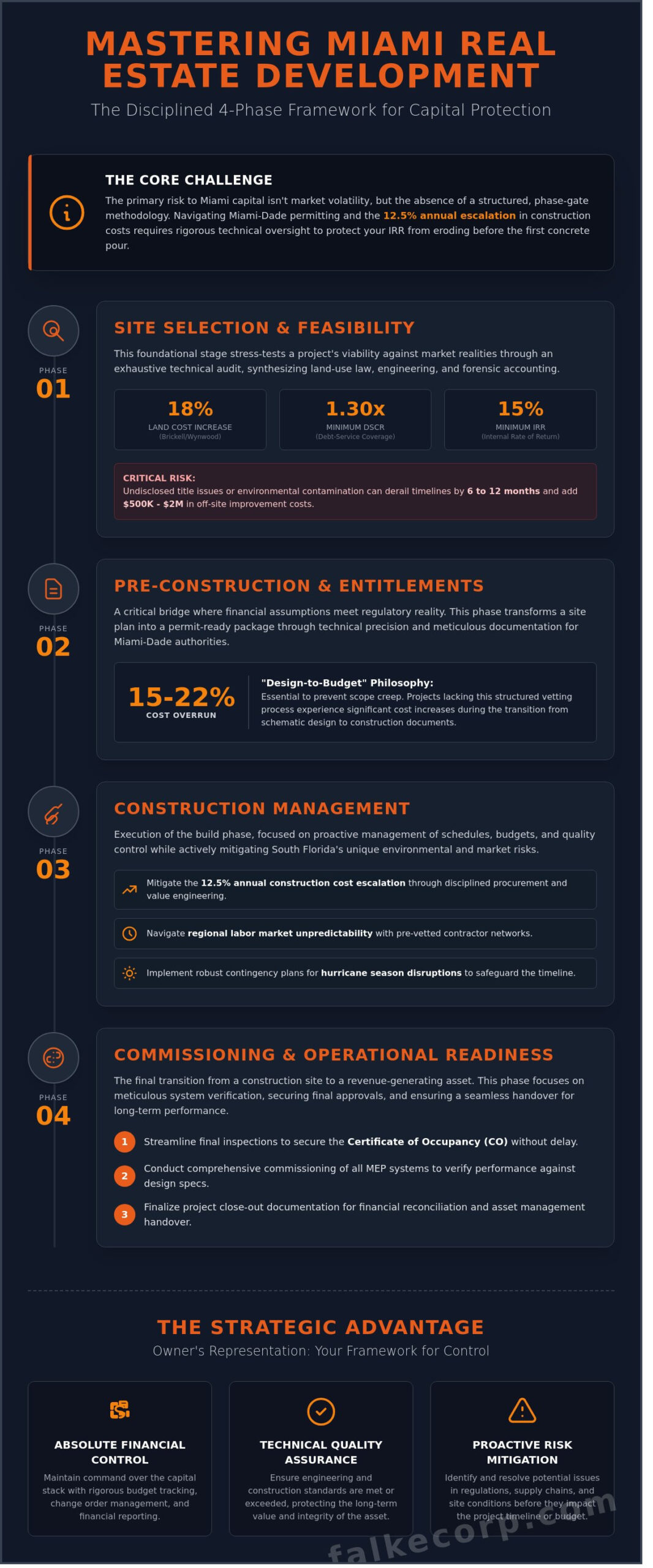
Phase 1 represents the foundational stage where a project’s viability is stress-tested against rigorous market realities. In the 2026 South Florida landscape, this isn’t a mere preliminary check. It’s an exhaustive technical audit. Success during the initial phases of real estate development depends on the Owner’s Representative’s ability to assemble a team of specialists who prioritize empirical data over speculative trends. This stage requires a synthesis of land-use law, civil engineering, and forensic accounting to ensure the project’s Pro Forma remains resilient under shifting economic pressures.
Selecting a site in Miami requires more than identifying a high-traffic location. It involves a deep dive into the real estate development process to secure preliminary land acquisition strategies that mitigate risk. Owners must account for the 18% increase in land costs observed in the Brickell and Wynwood submarkets since 2024. The Owner’s Representative acts as the lead integrator, coordinating between the land-use attorney and the environmental consultant to identify encumbrances that could derail the timeline by 6 to 12 months. Analytical precision is the only hedge against the volatility of the South Florida land market.
Preliminary Due Diligence and Site Evaluation
The evaluation process centers on the Miami 21 zoning code and specific Miami-Dade overlays. Engineers must verify the capacity of the electrical grid and the Miami-Dade Water and Sewer Department (WASD) infrastructure. By 2026, many districts face capacity constraints that require developers to fund off-site improvements, adding $500,000 to $2,000,000 to initial budgets. Identifying red flags such as undisclosed clouding of land titles or historical environmental contamination is vital. These factors often represent the difference between a high-yield asset and a stalled liability.
Financial Analysis and Pro Forma Development
Developing a 2026 Pro Forma requires a cold, analytical approach to costs. Insurance premiums in Florida have stabilized but remain 25% higher than the national average, a figure that must be hard-coded into the operational budget. Capital markets in South Florida currently demand a Debt-Service Coverage Ratio (DSCR) of at least 1.30x for most commercial ventures. Determining the Highest and Best Use (HBU) involves simulating multiple scenarios, from luxury residential to mixed-use medical facilities, to ensure the selected path drives a minimum 15% internal rate of return (IRR). Precision at this stage prevents catastrophic financial leakage during the later phases of real estate development.
Phase 2: Pre-Construction and the Miami-Dade Entitlement Process
Transitioning from a conceptual vision to a buildable design requires a shift from abstract strategy to technical precision. This stage of the phases of real estate development serves as the critical bridge where financial assumptions meet regulatory reality. Owners must manage a sophisticated network of architects, MEP (mechanical, electrical, plumbing) engineers, and city officials to transform a site plan into a permit-ready package. Misalignment during this phase often results in significant delays, as the City of Miami’s review process remains one of the most rigorous in the United States.
Adopting a strict “Design-to-Budget” philosophy is essential to prevent the scope creep that frequently plagues South Florida projects. Without this discipline, architectural ambitions can quickly outpace the capital stack. Data from 2024 and 2025 suggests that projects lacking a structured pre-construction vetting process experience a 15% to 22% increase in costs during the transition from schematic design to construction documents. By enforcing budgetary constraints early, owners ensure that the engineering solutions remain cost-effective without compromising structural integrity or aesthetic value.
The Permitting and Entitlement Roadmap
Navigating the Miami-Dade regulatory landscape involves a sequential, multi-agency approval process that demands meticulous documentation. The process generally follows these three milestones:
- Step 1: Submitting the site plan for initial municipal review. This involves verifying Floor Area Ratio (FAR) compliance and ensuring the project meets the specific “Miami 21” zoning code requirements.
- Step 2: Addressing technical comments from the Miami-Dade Building Department and the Fire Marshal. It’s common to undergo three or more rounds of revisions to satisfy Florida’s stringent 2026 life-safety and energy efficiency standards.
- Step 3: Securing the final Master Permit along with specialty trade permits. This step requires all impact fees to be paid and all utility concurrency letters to be finalized.
Design Team Assembly and Management
Selecting a design team requires more than an appreciation for portfolio aesthetics. It’s vital to hire architects and structural engineers who possess a deep understanding of the High-Velocity Hurricane Zone (HVHZ) requirements unique to the Atlantic Coast. These professionals must coordinate the production of 100% Construction Drawings (CDs) to provide a firm basis for competitive bidding. Vague drawings lead to change orders, which can erode a project’s contingency fund within the first 90 days of construction.
Integrating pre-construction services Miami into the workflow allows the team to identify long-lead items early. For example, specialized electrical switchgear and custom glazing systems currently face procurement lead times exceeding 26 weeks. Early identification ensures these components are ordered well before they’re needed on-site. Owners who prioritize this level of technical foresight can partner with Falke Corp to ensure their project maintains its schedule and budget through rigorous engineering oversight. This disciplined approach is what separates successful phases of real estate development from those that stall in the entitlement phase.
Phase 3: Construction Management and Florida’s Build Environment
Phase 3 represents the transition from theoretical planning to physical execution. It’s the most capital-intensive stage of the phases of real estate development, typically requiring the deployment of 65% to 75% of the project’s total budget. In Miami, this period is governed by the 183-day Atlantic hurricane season, which necessitates a sophisticated approach to site stabilization and weather-contingency planning. Owners must move beyond passive observation, instead adopting a role of rigorous technical oversight to protect their equity and ensure the structural integrity of the asset.
Execution and Schedule Management
2026 standards require real-time data integration to monitor the General Contractor’s critical path. Lead times for specialized electrical switchgear and HVAC components now frequently exceed 40 weeks, making proactive procurement a prerequisite for staying on schedule. Owners must adopt construction phase management Florida strategies that prioritize logistical sequencing and the early identification of supply chain bottlenecks. If a primary supplier fails to meet a milestone, the project’s critical path must be adjusted immediately to prevent cascading liquidated damages that can erode 2% to 5% of the total project margin.
Quality Control and Compliance
The Florida Building Code, specifically the High Velocity Hurricane Zone (HVHZ) requirements, dictates the engineering standards for every structural element in the Miami-Dade area. Quality assurance during this stage of the phases of real estate development involves a systematic verification process rather than simple visual inspections. Technical reliability is maintained through several key protocols:
- Structural Integrity Testing: Conducting third-party compressive strength tests on concrete at 7, 14, and 28-day intervals to ensure compliance with PSI specifications.
- Soil and Foundation Analysis: Verifying soil density and compaction levels to mitigate the risks associated with South Florida’s porous limestone geography.
- Envelope Verification: Ensuring that all hurricane-rated glazing systems and roofing assemblies are installed in strict accordance with their respective Product Approvals.
Maintaining strict financial control is achieved through a disciplined change order management system. Every deviation from the approved construction documents must be quantified, justified, and vetted for its impact on the budget. The Owner’s Representative functions as a technical auditor, verifying that work performed matches the payment applications while ensuring that site safety protocols meet OSHA standards. This methodical oversight prevents the cost overruns that often jeopardize project feasibility during the final 20% of the build. It’s the difference between a project that’s merely completed and one that’s delivered with engineering precision.
Phase 4: Commissioning, Close-out, and Operational Readiness
Phase 4 represents the final pivot point in the phases of real estate development. It’s the systematic conversion of a static construction site into a functional, revenue-generating asset. This stage requires a transition from heavy civil engineering to precise systems integration. We don’t simply “finish” a building; we activate a complex machine. Every mechanical, electrical, and plumbing (MEP) component must perform at the 98% efficiency levels defined in the initial engineering specifications. In the 2026 Miami market, where energy codes like the Florida Building Code 8th Edition demand rigorous compliance, this technical verification isn’t optional. It’s the bedrock of the project’s long-term viability.
Commissioning involves a sequence of rigorous stress tests. We verify that HVAC systems, life safety protocols, and building automation softwares function as a unified ecosystem. For instance, integrated fire alarm testing must trigger specific elevator recalls and smoke evacuation sequences without failure. These protocols ensure that when the property management team takes control, they’re inheriting a fully optimized environment rather than a list of unresolved technical debt. This phase bridges the gap between the physical structure and the operational business model.
The Punch List and Final Inspections
Precision defines the final 15% of the project timeline. We execute a comprehensive punch list that adheres to FALKE standards, ensuring every architectural detail and technical installation is flawless. Navigating the Miami-Dade Building Department requires a methodical approach to Chapter 8 of the County Code. We coordinate final walk-throughs to secure the Temporary Certificate of Occupancy (TCO) and the subsequent Certificate of Occupancy (CO). Our team compiles all as-built drawings, NFPA 72 life safety certifications, and manufacturer warranties into a digital twin for the owner. This documentation ensures the facility remains maintainable for decades.
Financial Reconciliation and Project Close-out
The final stage of the phases of real estate development focuses on financial finality. We resolve all outstanding payment applications and release the final 5% to 10% retainage only after verifying all contractual obligations. It’s vital to secure final lien waivers from every subcontractor to protect the owner’s title from future encumbrances. We conduct a post-mortem financial analysis, comparing the actual construction costs against the Phase 1 Pro Forma. This data-driven review confirms the final ROI and provides a clear baseline for the asset’s operational budget. You can consult with our engineering experts to ensure your project meets these rigorous close-out standards.
The Strategic Advantage of Owner’s Representation in South Florida
Traditional project management models frequently prioritize the contractor’s delivery schedule or the architect’s aesthetic vision over the owner’s capital preservation. This misalignment of interests often leads to budget overruns that can erode 12% to 18% of the projected equity during the final execution stages. FALKE Atlantic addresses this systemic inefficiency through a disciplined methodology rooted in technical competence and engineering reliability. By maintaining strict financial control and absolute transparency, we ensure that the complex phases of real estate development remain aligned with the owner’s original investment thesis throughout the project lifecycle.
A localized partner provides more than just oversight; they provide a shield against the volatile regulatory environment of Miami. Navigating the 2026 building codes requires a granular understanding of municipal requirements and utility coordination. Our approach focuses on three core pillars:
- Technical Transparency: Real-time reporting on structural integrity and systems integration.
- Financial Discipline: Rigorous audit of pay applications to prevent over-billing.
- Quality Assurance: Constant field inspections to verify that materials match the approved specifications.
Protecting the Owner’s Interest
High-net-worth individuals and corporate developers require a technical advocate to serve as their primary eyes and ears on the construction site. We bridge the communication gap between the design team and the construction firm, ensuring that technical specifications are met without compromise. Utilizing expert Owner’s representative Miami services reduces operational risk by identifying potential conflicts before they manifest as costly change orders. Our role involves rigorous oversight of the South Florida regulatory landscape, where local zoning requirements demand precise technical adherence to avoid significant delays in the permitting process.
Maximizing Asset Value in 2026
A successful project is defined by its ability to generate returns from the first hour of occupancy. We focus on ensuring the final asset is revenue-ready, coordinating the transition from construction to operations with surgical precision. Our experience in hospitality and retail sectors allows us to implement specialized systems that enhance long-term asset performance and reduce maintenance costs by up to 10% annually. Owners looking to secure their position in the competitive Florida market can initiate a formal engagement by requesting a strategic real estate development management services proposal. This document provides a structured framework for managing the intricate phases of real estate development, ensuring that technical execution meets the highest professional standards.
To begin a professional development management consultation, contact FALKE Atlantic to review your project’s technical requirements and financial objectives. Our team provides the stability and quality necessary to deliver complex industrial and commercial assets in the 2026 South Florida market.
Securing Project Viability in the 2026 Miami Market
Navigating the South Florida landscape requires a rigorous adherence to the technical requirements found within each of the four phases of real estate development. Success hinges on a precise execution of the Miami-Dade entitlement process and a disciplined approach to construction management within Florida’s specific build environment. We’ve observed that projects lacking a structured methodology often face 15% to 20% cost overruns during the commissioning stage. Owners who prioritize total financial control through integrated representation mitigate these risks effectively.
FALKE Atlantic operates as a boutique consultancy, bringing regional expertise that was instrumental in managing high-profile projects like the 4,800 square foot Prada store in the Miami Design District. Our four-phase disciplined methodology ensures that every technical milestone, from initial site feasibility to final operational readiness, meets the highest engineering standards. This structured oversight provides the stability necessary for complex industrial and commercial assets. For owners seeking comprehensive guidance through Miami’s evolving regulatory landscape, our real estate development consulting Miami services provide the technical precision required to navigate permitting bottlenecks and environmental compliance issues that affect over 35% of major commercial projects. Leveraging comprehensive real estate development consulting services ensures that your project benefits from expert guidance through every phase, from initial feasibility studies to final occupancy. It’s the most reliable way to maintain quality while navigating the complexities of the 2026 market.
Secure your Miami development with FALKE Atlantic’s expert representation. Your vision deserves the precision of a partner committed to technical excellence and long-term project stability.
Frequently Asked Questions
What are the 4 stages of real estate development according to FALKE?
FALKE identifies the four primary phases of real estate development as Pre-Development, Design and Permitting, Construction, and Project Close-out. This technical framework ensures that engineering reliability and professional oversight remain constant throughout the asset’s lifecycle. Each stage involves specific milestones, such as securing 100 percent of necessary financing or obtaining a final Certificate of Occupancy, to mitigate operational risks for the owner.
How long does the pre-development phase typically take in Miami-Dade County?
The pre-development phase in Miami-Dade County typically requires 12 to 24 months to complete due to complex zoning and environmental regulations. Administrative reviews for Environmental Resource Permitting (ERP) and municipal site plan approvals often extend this timeline beyond initial projections. Data indicates that 85 percent of project delays originate during this phase because of intricate utility coordination and regulatory bottlenecks.
What is the most risky phase of real estate development in Florida?
Pre-development is the most risky of the phases of real estate development in Florida because it requires significant capital commitment before project viability is legally confirmed. Investors often spend 5 percent to 10 percent of their total budget on soft costs like architectural fees and legal filings without a guaranteed permit. Market shifts and geotechnical discoveries during this period can compromise the entire investment’s feasibility.
Why is a feasibility study critical for Miami property development?
A feasibility study provides a quantitative assessment of a project’s technical and financial viability based on current 2023 Florida Building Code standards and sea-level rise data. This 40 to 60 page technical analysis evaluates specific variables like soil density and local market absorption rates. Without this data, owners risk miscalculating their potential Return on Investment (ROI) by as much as 20 percent.
What is the difference between an Owner’s Rep and a Project Manager in Florida?
An Owner’s Rep acts as the principal advocate for the owner across all phases of real estate development, while a Project Manager focuses on specific construction execution. The Owner’s Rep manages high-level strategy, including financial oversight and multi-vendor contract negotiations. Conversely, the Project Manager monitors daily site operations and ensures the general contractor adheres to 14-day schedule intervals to prevent timeline slippage.
How do hurricane codes affect the construction phase of development?
Hurricane codes dictate specific structural engineering requirements that increase the construction budget but ensure long-term asset stability in High Velocity Hurricane Zones (HVHZ). These standards require reinforced concrete and impact-resistant glazing capable of withstanding 175 mph winds. Implementing these 2026-compliant safety measures typically adds 15 percent to structural costs compared to inland projects while reducing future insurance premiums.
What happens during the project close-out phase in commercial real estate?
The project close-out phase involves a rigorous 25-point verification process to transition the building from construction to active operations. This period includes finalizing the punch list, securing the permanent Certificate of Occupancy, and transferring technical warranties to the management team. This phase usually lasts 60 to 90 days and concludes when the owner releases the final 10 percent retainage to the contractor.
Can an Owner’s Representative help with site selection in South Florida?
An Owner’s Representative provides essential technical due diligence during site selection to identify hidden risks that could inflate future development costs. They analyze the 19.5 percent average increase in South Florida land prices alongside current infrastructure capacity and municipal master plans. By evaluating GIS data and environmental constraints, they ensure the chosen parcel aligns with the owner’s specific 2026 investment objectives.