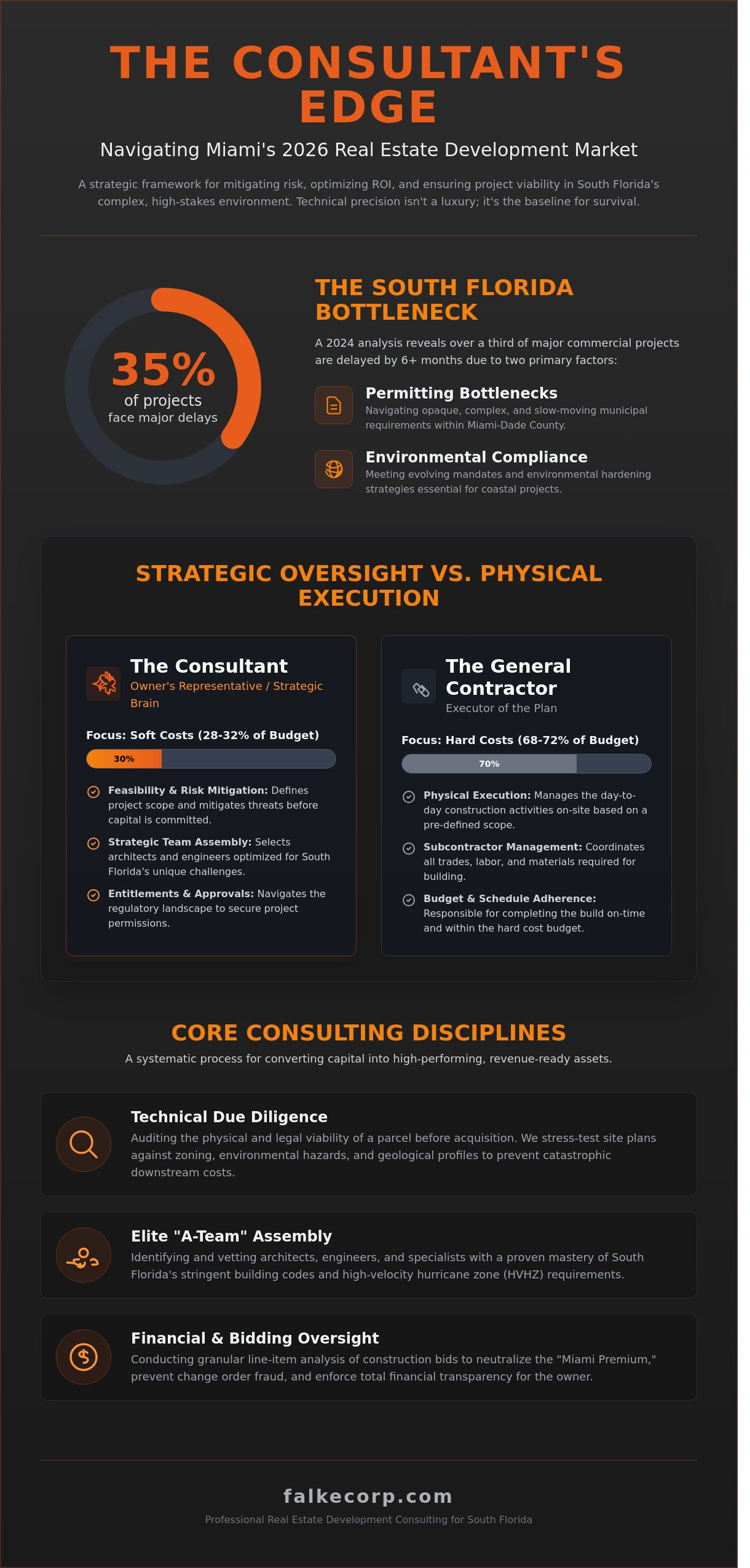
While Miami’s skyline continues to expand, a 2024 analysis of South Florida municipal data indicates that over 35% of major commercial projects face delays exceeding six months due to permitting bottlenecks and environmental compliance issues. Owners often find themselves trapped between volatile construction costs and the opaque regulatory requirements of Miami-Dade County. You understand that in this market, technical precision isn’t a luxury; it’s the baseline for project viability. Professional real estate development consulting acts as the necessary bridge between a conceptual vision and a commissioned, revenue-ready asset.
This guide provides a strategic framework for 2026 to help you mitigate unforeseen climate risks and ensure financial transparency throughout the project lifecycle. We’ll examine the specific methodologies required to address South Florida’s evolving environmental mandates and the logistical complexities of modern urban construction. By the end of this analysis, you’ll have a clear roadmap to optimize your ROI while maintaining strict adherence to technical and budgetary constraints.
Key Takeaways
- Differentiate between execution-level contracting and the strategic oversight required for the 2026 Miami market through professional real estate development consulting.
- Implement rigorous due diligence and advanced financial modeling to stabilize project budgets amidst shifting interest rates and complex regulatory frameworks.
- Apply a structured four-phase methodology to ensure every development stage, from feasibility to entitlement, is grounded in precise data and technical validation.
- Navigate the technical requirements of the 2026 Florida Building Code and environmental hardening strategies essential for coastal and North Bay Village projects.
- Establish a selection framework that prioritizes technical competence and transparency to ensure the long-term viability of your South Florida assets.
Defining Real Estate Development Consulting in the Miami Landscape
Miami’s 2026 real estate market demands a level of technical precision that exceeds traditional project management. Real estate development consulting operates as the strategic brain before the first shovel hits the dirt. While a general contractor focuses on the physical execution of a pre-defined scope, the consultant defines that scope through rigorous feasibility studies and risk mitigation protocols. Real estate development is a multi-layered engineering and financial challenge that requires a holistic view of the project lifecycle. This distinction is critical in South Florida; the consultant manages the soft costs, which frequently account for 28% to 32% of a project’s total budget, while the contractor handles the hard costs of construction. By acting as the Owner’s Representative, the consultant ensures that every technical decision aligns with the client’s financial objectives and the long-term stability of the asset.
Consulting vs. Management: Understanding the Strategic Layer
Advisory services extend far beyond daily site supervision. Effective real estate development consulting involves complex site selection based on 2026 zoning shifts and demographic projections. It focuses on team assembly, ensuring that architects and engineers are not just qualified, but optimized for the specific project type. This strategic layer prioritizes long-term asset value over short-term construction milestones. It treats the development as a holistic system where every component, from electrical capacity to LEED certification levels, impacts the eventual exit cap rate. Consultants bridge the gap between initial concept and construction by securing entitlements and refining the pro forma before capital is committed to the field.
The Value Proposition for Miami Property Owners
Miami property owners frequently encounter the ‘Miami Premium,’ a phenomenon where local vendor costs can escalate by 18% compared to national averages due to high demand and specialized labor shortages. A consultant provides the technical transparency required to audit these variables and secure competitive bidding. For out-of-state investors, this expertise serves as a critical barrier against local market opacity and complex municipal permitting processes. By 2026, luxury retail and hospitality trends will favor hyper-integrated mixed-use spaces that prioritize advanced automation and carbon-neutral energy systems. A professional consultant ensures the project design reflects these specific 2026 market demands, preventing asset obsolescence before the ribbon-cutting ceremony. This methodical approach transforms a speculative venture into a disciplined engineering process.
Core Functions: How Consultants Drive ROI and Mitigate Risk
Professional real estate development consulting functions as a technical safeguard against the systemic inefficiencies that frequently erode project margins in South Florida. The consultant’s primary objective is the conversion of raw capital into built assets through a process of rigorous engineering and financial discipline. This begins with comprehensive due diligence, where the physical and legal viability of a parcel is audited long before any site work commences. In the 2026 market, technical competence in evaluating subsurface conditions and environmental hazards is mandatory to prevent the catastrophic cost overruns associated with Miami’s unique geological profile.
Assembling the ‘A-Team’ requires a hűvösen elegáns approach to professional selection. A consultant identifies architects and engineers whose specific portfolios demonstrate a mastery of South Florida’s stringent building codes and high-velocity hurricane zone requirements. Beyond selection, the consultant provides strategic oversight of the construction bidding process. This involves a granular analysis of line-item costs to prevent change order fraud, a risk that has increased by 18% in complex urban developments over the last three fiscal years. By enforcing transparency in the bidding phase, owners secure a contract structure that prioritizes stability and engineering integrity.
Feasibility and Site Selection in Dade and Broward
Site feasibility in Miami’s 2026 landscape of extreme land scarcity is the technical verification that a specific parcel can legally and physically sustain its intended density while remaining financially solvent. Consultants analyze zoning entitlements under Florida’s land development regulations to determine the maximum achievable floor area ratio. This analysis includes an audit of hidden liabilities such as soil contamination or jurisdictional wetlands which can delay a project by 12 to 24 months if not identified during the initial acquisition phase. Owners who prioritize these technical audits ensure their capital isn’t locked in non-performing assets.
Financial Control and Cost Segregation
In a volatile interest rate environment, financial modeling must account for more than just debt service. Consultants establish realistic project contingencies, typically ranging from 12% to 15%, to absorb the impact of persistent South Florida labor shortages and material price fluctuations. They monitor the capital stack with precision, coordinating the flow of information between owners, lenders, and equity partners to maintain liquidity throughout the project lifecycle. For those requiring integrated oversight, real estate development management services provide the structural framework necessary to align construction milestones with financial draws. This level of control is essential for maintaining the trust of institutional investors. To ensure your next project adheres to these rigorous standards, consider a technical consultation at falkecorp.com to review your current site plans.
A Disciplined Methodology: The Four Phases of Development Management
Successful project delivery in South Florida’s volatile market requires more than just a vision; it demands a rigorous, four-stage framework that prioritizes technical precision over speculative optimism. Our approach to real estate development consulting transforms the owner’s intent into a structured execution plan. We eliminate ambiguity by validating every architectural decision against current Miami-Dade County geospatial data and zoning constraints. This methodology ensures that capital is only deployed when risk is quantified and mitigated.
Phase 1 & 2: Setting the Foundation for Success
The entitlement phase in South Florida is a high-stakes environment where regulatory nuances dictate the project’s ultimate viability. Securing permits in the City of Miami involves navigating the ePlan system and the Urban Development Review Board (UDRB), whereas Miami Beach projects often face the scrutiny of the Historic Preservation Board. These local bodies have vastly different requirements for sea-level rise mitigation and floor-area ratio (FAR) calculations. A consultant’s role is to bridge the gap between aesthetic ambition and the 8th Edition of the Florida Building Code.
A robust Master Schedule is the most critical tool during pre-construction. It must account for specific regional variables that out-of-state developers often overlook:
- Regulatory Lead Times: DERM (Department of Environmental Resources Management) approvals can take 12 to 16 weeks depending on site contamination profiles.
- Seasonal Weather Impacts: The June through November hurricane season historically results in a 15% reduction in site productivity due to mandatory securing protocols and lightning delays.
- Utility Coordination: Florida Power & Light (FPL) transformer lead times currently exceed 40 weeks, necessitating early procurement strategies.
Phase 3 & 4: From Groundbreaking to Ribbon Cutting
Execution in Miami’s tropical climate requires specialized oversight to prevent moisture-related structural issues. High humidity levels during the drying-in phase can lead to latent defects if HVAC systems aren’t commissioned with precision. We maintain a constant presence on-site to ensure vendor management aligns with the technical specifications. This level of construction phase management florida protects the owner from the costly litigation that often follows poorly executed waterproofing or envelope sealing.
The final 5% of a project determines its long-term profitability. As we transition into Phase 4, the focus shifts to the punch list and final commissioning. We don’t consider a project complete until every life-safety system is verified and the Certificate of Occupancy is secured. This disciplined close-out ensures the asset is revenue-ready on day one. By integrating real estate development consulting into the final commissioning stage, we verify that the finished product meets the exact engineering standards established during the feasibility phase.
Navigating South Florida’s Unique Regulatory and Environmental Landscape
The 2026 Florida Building Code mandates rigorous structural integrity standards that prioritize hurricane hardening and high-velocity hurricane zone (HVHZ) compliance. Owners must integrate impact-resistant glazing and reinforced roofing systems that exceed previous 175 mph wind load thresholds. Technical real estate development consulting experts now analyze structural load paths with increased precision to mitigate the risk of catastrophic failure during extreme weather events. In North Bay Village, where Sea Level Rise (SLR) projections indicate a potential 10-inch increase by 2030, the municipal government has implemented strict elevation requirements for new construction. Developers must navigate these local ordinances alongside the 2026 state-wide mandates to ensure long-term asset viability and structural resilience.
Managing local community engagement and municipal entitlement hearings requires a methodical approach to public relations and technical presentation. Local boards in Miami-Dade County often scrutinize traffic impact studies and environmental footprints with high intensity. Success in these hearings depends on the consultant’s ability to present data-driven solutions that address neighborhood concerns while maintaining the project’s economic objectives. It’s essential to secure support from local stakeholders through transparent communication and evidence-based planning before the formal hearing process begins.
Miami-Dade Permitting and Zoning Nuances
Miami-Dade County requires a 1.5% allocation of total construction costs toward the ‘Art in Public Places’ program for projects exceeding $1 million in value. This fiscal obligation, combined with rising impact fees for road and fire services, necessitates a detailed pro forma analysis early in the design phase. A consultant facilitates the approval process by coordinating with the Department of Regulatory and Economic Resources (RER) to address zoning variances. These mandates often require LEED Silver certification or equivalent sustainability benchmarks for projects over 50,000 square feet to secure final occupancy permits. Technical experts expedite these approvals by ensuring every engineering document aligns with the specific zoning overlay of the municipality.
Climate Resilience as a Development Strategy
Resilience is no longer a secondary consideration; it’s a core engineering requirement for 2026 developments. Elevated slab designs and advanced flood mitigation systems, such as hydrostatic vents and flood-proofed mechanical rooms, protect critical infrastructure from storm surges. The Coastal Construction Control Line (CCCL) represents the regulatory boundary established by the Florida Department of Environmental Protection to protect the beach and dune system from imprudent construction that could jeopardize the shoreline. For Palm Beach County developments, the CCCL dictates specific setback requirements and foundation depths to withstand 100-year storm events. Integrating real estate development consulting into the early site-planning phase ensures that these environmental constraints don’t compromise the project’s architectural vision or financial feasibility.
Selecting the Right Consulting Partner for Your Miami Project
Selecting a partner for real estate development consulting in South Florida requires a shift from seeking “connections” to demanding technical accountability. While local political ties might expedite a permit in 2025, they don’t solve structural engineering failures or budget overruns during the 2026 construction cycle. Owners must prioritize a consultant’s ability to analyze complex data over their ability to secure a lunch meeting with city officials. True reliability stems from a deep understanding of the Florida Building Code and the financial mechanics that keep a project solvent when interest rates or material costs fluctuate.
Criteria for Selection: Experience and Methodology
A consultant’s track record in the hospitality and retail sectors provides the clearest indicator of future performance. In Miami, where land costs often exceed 35% of total project capitalization, a disciplined methodology is non-negotiable. Generic project management lacks the rigor needed for high-stakes urban infill. You need a partner who understands the transition from Owner’s representative Miami duties into full-scale construction oversight. This transition is where most projects fail; the consultant must move from theoretical planning to the aggressive protection of the owner’s capital on the job site. For comprehensive guidance on navigating Miami’s complex development landscape, consider exploring real estate development consulting services that address the unique challenges of the 2026 market.
Before engagement, owners should subject potential consultants to a rigorous technical interview. The goal is to move past marketing presentations and into the mechanics of project delivery. Use these specific questions to gauge competence:
- How does your team reconcile pro forma estimates with real-time 2026 material cost fluctuations in the South Florida market?
- What specific protocols do you use to manage the transition from pre-development planning to active construction site management?
- Can you demonstrate a project where your intervention saved at least 12% of the initial hard cost budget through precise value engineering?
- How do you handle the technical auditing of subcontractors to ensure compliance with specialized Miami-Dade wind-load requirements?
The FALKE Atlantic Advantage
FALKE Atlantic utilizes a four-phase approach designed to protect equity and maintain project solvency from inception to closeout. We focus our expertise on North Bay Village and the broader Miami Atlantic Coast markets, where environmental and zoning complexities are most acute. Our boutique structure ensures that senior-level engineers handle every line item of your development. This model provides a level of transparency that larger, decentralized firms cannot match. Owners ready to secure their project’s future should request a strategic real estate development consulting session via FALKE Atlantic to begin the technical auditing process. We don’t offer vague promises; we provide a structured roadmap to project completion.
Strategic Execution for Miami’s 2026 Development Cycle
The evolving landscape of Miami-Dade and Broward counties requires a rigorous approach to project management that transcends traditional oversight. Success in the 2026 market depends on navigating the specific regulatory and environmental mandates of South Florida with technical precision. By adhering to a disciplined four-phase methodology, owners can systematically mitigate risk while optimizing capital allocation within the hospitality and retail sectors. Professional real estate development consulting provides the engineering-grade reliability necessary to manage complex workflows and ensure project stability from initial feasibility through final delivery. It’s a strategic framework where data-driven decisions replace speculation, allowing for the precise execution of large-scale urban investments. Investors who prioritize these structured management protocols will find themselves better positioned to maintain quality standards and achieve predictable outcomes in a competitive environment. This level of professional rigor ensures that every technical detail aligns with the broader financial objectives of the project. Secure your Miami development investment with FALKE Atlantic’s expert oversight. Your project deserves the stability and technical excellence that only seasoned industry specialists can provide.
Frequently Asked Questions
What is the difference between a real estate development consultant and a project manager?
A real estate development consultant focuses on strategic feasibility and capital structure, while a project manager oversees the daily execution of the construction site. Consultants evaluate the 15% to 20% internal rate of return potential before a shovel hits the ground. Project managers ensure the 2026 delivery schedule remains intact through contractor oversight. You need both roles to bridge the gap between financial theory and physical assembly.
How much does real estate development consulting cost in Florida?
Real estate development consulting fees typically range from 2% to 5% of the total project cost according to industry benchmarks for the Southeastern United States. Some firms utilize a monthly retainer model based on the complexity of the 2026 Florida Building Code requirements. These costs represent a technical investment aimed at preventing the 10% to 15% budget overruns common in unmanaged South Florida builds.
When is the best time to hire a development consultant for a Miami project?
The optimal time to engage a consultant is during the pre-acquisition phase or within the first 30 days of site control. Early involvement allows for a rigorous analysis of the Miami 21 zoning code before capital is committed. Waiting until the design phase often leads to expensive structural revisions that could’ve been avoided through initial technical vetting. Efficient planning starts before the first architectural draft is finalized.
Can a consultant help with Miami-Dade County permitting delays?
Consultants mitigate Miami-Dade County permitting delays by utilizing the Expedited Building Permit Program or the “Dry Run” process. In 2024, the county reported average processing times that can exceed six months for complex commercial builds. A consultant manages the concurrent reviews between the Department of Regulatory and Economic Resources and municipal utilities to prevent sequential bottlenecks. This technical oversight keeps the project timeline from fracturing under administrative weight.
What specific environmental risks should consultants look for in South Florida?
Consultants prioritize sea-level rise projections and the “muck” layer depth typical of South Florida’s limestone geology. The 2023 Florida Department of Environmental Protection guidelines require specific mitigation for high water tables and salt-air corrosion. Technical assessments must also include Phase I Environmental Site Assessments to identify legacy contaminants from the region’s historical industrial or agricultural usage. Ignoring these geological realities leads to massive foundation cost overruns.
How does a development consultant improve the ROI of a commercial project?
A development consultant improves ROI by optimizing the Net Leasable Area (NLA) through precise floor plate engineering. By reducing non-revenue generating spaces by even 3%, the long-term valuation of a Miami commercial asset increases by hundreds of thousands of dollars. They also negotiate impact fees and utility connection costs, which can represent 5% of a project’s soft costs. Every square foot is treated as a financial asset.
What is an Owner’s Representative and do I need one in addition to a consultant?
An Owner’s Representative acts as your primary fiduciary agent with decision-making authority, whereas a consultant provides specialized technical expertise for specific project phases. You’ll likely require an Owner’s Representative for a multi-year Miami development to manage the 12 to 15 different subcontractors and vendors involved. The consultant provides the high-level data that the representative uses to make informed financial choices. They perform distinct but complementary functions. For property owners seeking similar management and real estate expertise in the Central Florida market, morganpropertysolutions.com offers comprehensive support for maintaining asset performance.
Does FALKE Atlantic handle both residential and commercial development consulting?
FALKE Atlantic provides comprehensive real estate development consulting for both high-density residential and large-scale commercial assets. Our engineering-led approach applies the same technical rigor to a 100-unit multifamily complex as it does to an industrial warehouse facility. We focus on the structural integrity and operational efficiency of the build, ensuring every project meets the 2026 Florida energy efficiency standards. Our methodology remains consistent across all asset classes.