
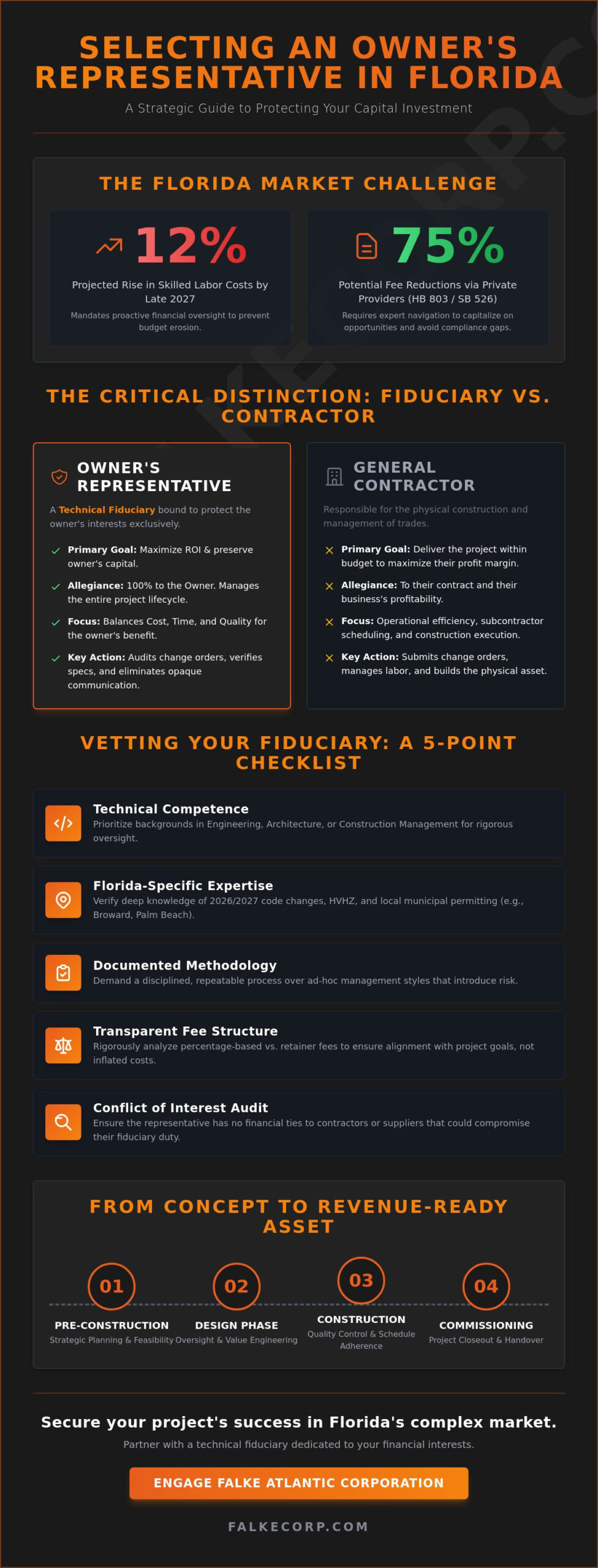
In a market where South Florida skilled labor costs are projected to rise 12% through late 2027, hiring an owner’s representative isn’t a luxury of scale; it’s a mandatory technical safeguard for capital preservation. You likely recognize that Florida’s shifting regulatory environment, specifically the 2026 implementation of House Bill 803 and Senate Bill 526, creates both significant fee reduction opportunities and dangerous compliance gaps for the unprepared. Mastering how to select an owner’s representative in Florida who functions as a technical fiduciary is the only way to eliminate opaque contractor communication and the budget erosion caused by uncontrolled change orders.
The complexity of modern project delivery requires a partner who masters the intersection of engineering precision and financial transparency. You deserve a project that transitions from a construction site to a revenue-ready asset without the friction of regulatory delays or liability exposure. This strategic guide outlines the rigorous selection criteria necessary to secure professional oversight that protects your interests from pre-construction through final commissioning. We’ll detail the specific competencies required to navigate the new statewide building codes and the expanded role of private providers to ensure your capital remains secure and your schedule remains intact.
Key Takeaways
- Distinguish between a technical fiduciary and a general contractor to ensure your interests are prioritized throughout the development lifecycle.
- Master how to select an owner’s representative in Florida by prioritizing technical backgrounds in engineering or construction management over general administration.
- Implement a strategic vetting process that includes a conflict of interest audit and a rigorous analysis of percentage-based versus retainer fee structures.
- Utilize a structured checklist to verify local compliance expertise regarding the 2026 Florida Building Code and private provider inspection updates.
- Leverage the FALKE Atlantic Corporation four-phase methodology to transition complex projects from initial concept to a revenue-ready asset.
Defining the Role: Why Florida Projects Require an Owner’s Representative
An owner’s representative serves as a specialized technical fiduciary, providing a layer of professional oversight that bridges the gap between the owner’s financial vision and the technical execution of a project. This role isn’t merely an administrative convenience; it’s a strategic necessity in an environment where capital risk is amplified by shifting regulations and volatile labor markets. Understanding how to select an owner’s representative in Florida requires a clear distinction between this advocate and a general contractor. While the contractor is responsible for the physical assembly of the asset, the owner’s representative manages the entire development lifecycle, ensuring that every decision serves the owner’s long-term interests rather than the contractor’s operational margins.
The Fiduciary Duty to the Owner
The primary responsibility of an owner’s representative is the preservation of the owner’s capital through rigorous construction management principles. This fiduciary duty establishes an ethical and legal obligation to prioritize the owner’s objectives above all other project participants. Unlike a general contractor, who may prioritize profit-driven efficiencies or subcontractor relationships, the representative focuses on the “triangle of constraints”: cost, time, and quality. They provide the technical expertise needed to audit change orders, verify material specifications, and ensure that the project remains on schedule. This early-stage representation is critical for maximizing ROI, as the most impactful cost-saving decisions occur during the pre-construction and design phases, long before the first shovel hits the ground.
Florida-Specific Regulatory and Climate Challenges
Florida’s construction landscape in 2026 is defined by unprecedented legislative shifts and environmental requirements. Effective July 1, 2026, House Bill 803 and Senate Bill 526 have transformed permitting protocols, offering substantial fee reductions of up to 75% for certain services when utilizing private providers for inspections and plan reviews. A qualified representative must navigate these changes while ensuring compliance with the Miami-Dade high-velocity hurricane zones (HVHZ) and the rigorous environmental standards set by the Department of Environmental Protection for Water Quality Enhancement Areas. In counties like Broward and Palm Beach, where municipal permitting can be exceptionally complex, having an advocate who understands the nuances of local codes is essential. This expertise is particularly vital as the Florida Building Commission prepares for the transition to a new statewide building code in July 2027, making it imperative to know how to select an owner’s representative in Florida who is already integrated into these future standards.
Key Selection Criteria: Technical Competence and Local Expertise
Technical competence serves as the foundation for effective project oversight. When evaluating how to select an owner’s representative in Florida, the candidate’s academic and professional background in engineering, architecture, or construction management provides the necessary framework for complex decision-making. This expertise allows the representative to interpret technical specifications and identify potential design flaws before they manifest as costly field errors. The duties of construction managers often overlap with the technical oversight required of an owner’s rep, specifically in the coordination of multi-disciplinary teams. A qualified representative must synchronize the efforts of architects, MEP engineers, and interior designers, ensuring that technical silos don’t lead to operational inefficiencies. Engaging a firm like FALKE Atlantic provides the multi-disciplinary oversight necessary to maintain project integrity.
Methodology over Personality
A disciplined, documented methodology is superior to ad-hoc management styles that rely on individual personality. Professional construction project management in Florida requires a rigorous four-phase approach: feasibility, pre-construction, execution, and commissioning. This structured framework ensures that project milestones are met with technical precision. Financial transparency tools and structured reporting must be integrated into this process, providing the owner with real-time data regarding budget utilization and schedule variances. Without a repeatable system, a project remains vulnerable to the inconsistencies of human error and communication breakdowns.
The Value of a Local Vendor Network
National experience often fails to account for the idiosyncratic nature of the South Florida market. Success in Miami and Ft. Lauderdale depends on a representative’s established local history and their ability to vet subcontractors within a specific geographic context. This local presence is vital for streamlining procurement and securing materials amidst volatile lead times. By leveraging deep-rooted vendor relationships, a representative can protect the owner from the “hurricane” or “solar” premium price gouging that often targets out-of-state developers. Understanding how to select an owner’s representative in Florida involves verifying their ability to navigate local labor shortages, which are projected to drive costs up by 12% through late 2027. This localized insight ensures that procurement strategies remain resilient against regional market fluctuations.
Vetting the Candidate: The Strategic Interview and Fee Analysis
The selection of a technical advocate requires a rigorous vetting process that transcends superficial reference checks. When determining how to select an owner’s representative in Florida, you must prioritize a candidate’s ability to demonstrate technical problem-solving within the specific 2026 regulatory framework. A strategic interview should move beyond general experience to address specific scenarios, such as the management of private provider inspections under HB 803 or the mitigation of the regional labor cost increases. Case studies must be scrutinized not only for aesthetic outcomes but for their adherence to original budget and schedule parameters, specifically within the retail or hospitality sectors where operational timing is critical.
The Conflict of Interest Audit
Maintaining absolute independence is the cornerstone of effective oversight. A representative must operate without financial entanglements to general contractors or architectural firms to ensure their recommendations remain objective. FALKE Atlantic Corporation maintains a strict independence policy, which eliminates the risk of biased vendor selection or the concealment of contractor errors. Red flags often include a representative’s insistence on a closed list of preferred vendors without providing a transparent bidding process or technical justification. A true fiduciary provides a clear audit trail for every procurement decision, ensuring that the owner’s capital is never compromised by undisclosed industry relationships.
Analyzing the Service Fee Structure
Professional Owner’s Representation fees in the Florida market typically follow two primary models: monthly retainers or a percentage of the total project cost. Industry data from May 2026 indicates that percentage-based fees generally range from 3% to 5% of the total budget, while hourly rates in South Florida often start at $175 and can exceed $200 for specialized expertise. While a percentage-based model aligns the representative’s compensation with the project’s scale, fixed monthly retainers can provide more predictable cash flow management for the owner. The cost-to-benefit ratio remains the most critical metric; an expert representative frequently pays for their own fee through the identification of pre-construction inefficiencies and the rigorous management of change orders. Understanding these structures is a vital component of how to select an owner’s representative in Florida who provides maximum value relative to their professional cost.
The Florida Selection Checklist: Essential Steps for Owners
A systematic approach to procurement prevents the selection of an under-qualified advocate. When determining how to select an owner’s representative in Florida, you must follow a structured vetting sequence that prioritizes technical evidence over general assurances. This checklist provides a framework for evaluating a firm’s capacity to manage the specific economic and regulatory pressures of the 2026 market.
- Step 1: Define your project’s specific goals and constraints. Establish whether your project requires comprehensive development management or strictly construction phase oversight. Clearly defined parameters regarding budget, timeline, and quality standards are essential before engaging a representative.
- Step 2: Verify the firm’s experience. Ensure the candidate has a documented history in Construction Project Management in Florida. This verification should include their success in navigating regional labor shortages and volatile material lead times.
- Step 3: Request a process breakdown. A professional representative should provide a detailed methodology for pre-construction services and commissioning. This must include their strategy for managing the 2026 updates to the Florida Building Code.
- Step 4: Conduct site visits. Inspect active projects currently under the firm’s management. Observe the quality of site organization, the rigor of technical reporting, and the dynamic between the representative and the general contractor.
- Step 5: Finalize the agreement. Ensure the contract includes clear KPIs and a rigid reporting schedule. This document must establish the representative’s authority in auditing change orders and managing the project’s financial transparency.
Defining Project Scope and Goals
The level of involvement required often depends on whether the owner is a local developer or a remote investor. You must align the representative’s expertise with your specific asset class, whether it’s hospitality, retail, or high-end residential. A hospitality project requires a deep understanding of brand standards and complex MEP systems, while a retail development may prioritize rapid delivery to meet lease commencement dates. Determining these requirements early ensures the representative’s technical background matches the project’s complexity.
Verifying Local Compliance Expertise
Florida’s regulatory environment requires hyper-local knowledge. You must confirm the representative’s familiarity with the specific permitting cycles of Miami-Dade and Broward counties. Effective July 1, 2026, House Bill 803 expanded the role of private providers for inspections, a shift that can significantly accelerate schedules if managed correctly. Your representative must also possess the foresight to prepare for the statewide building code transition scheduled for July 2027. This localized expertise extends to managing infrastructure requirements and utility provider coordination, ensuring that your asset becomes revenue-ready without municipal delays. To ensure your project benefits from this level of technical oversight, schedule a strategic project review with our team today.
FALKE Atlantic Corporation: Mastering the Four Phases of Florida Development
FALKE Atlantic Corporation operates as a technical fiduciary, providing a systematic framework designed to convert capital investment into high-performing real estate assets. Our four-phase methodology, spanning from concept to commissioning, serves as the technical backbone for every engagement. When evaluating how to select an owner’s representative in Florida, investors must prioritize this level of structured process management over generalized consulting. Our strategic focus remains on creating revenue-ready assets, particularly for hospitality and retail brands where every day of delay represents significant lost income. By integrating Commercial Project Management in Miami into the earliest stages of development, we eliminate the friction points that typically cause schedule slippage and budget erosion.
From Concept to Pre-Construction
The viability of a project is often determined before the first shovel hits the ground. Our Strategic Pre-Construction Services focus on rigorous risk mitigation through feasibility analysis and precise design team assembly. We ensure the project’s scope remains aligned with the established budget during the complex entitlement phase. This phase is critical for establishing the technical parameters that will govern the construction process. From the Miami Design District to complex high-end residential developments, our oversight ensures that architectural ambition is balanced with financial reality and local regulatory constraints.
Execution and Commissioning
Operational readiness is the ultimate metric of project success. Our approach to Construction Phase Management in Florida prioritizes transparency and technical precision. While many firms conclude their services at substantial completion, we emphasize the commissioning phase as the bridge to operational success. This involves verifying that all MEP systems, life safety protocols, and brand-specific requirements are fully functional and compliant with the latest building codes.
Final close-out isn’t merely the end of a construction contract; it’s the delivery of a revenue-ready asset. Identifying how to select an owner’s representative in Florida requires finding a partner who takes full responsibility for this transition. We ensure your asset is ready for its intended use, protecting both your capital and your brand’s reputation. This comprehensive oversight guarantees that the finished product meets the highest professional standards, allowing owners to focus on their core business operations while we manage the technical complexities of delivery.
Strategic Asset Preservation for the 2026 Florida Market
The decision of how to select an owner’s representative in Florida ultimately determines the stability of your capital and the operational success of your asset. You’ve seen that technical competence must outweigh personality, and a disciplined four-phase methodology is the only reliable defense against the labor cost increases currently affecting South Florida. By prioritizing a representative with deep local expertise and a proven track record in high-stakes environments, you ensure that your project transitions seamlessly from concept to a revenue-ready asset without the friction of regulatory delays.
Once the technical hurdles are cleared and your project is on track, you can fully enjoy the unique environment of the Sunshine State; for those looking to experience the best of Florida’s natural resources, you can discover Bass Online for professional fishing trips in iconic locations like Lake Okeechobee.
At FALKE Atlantic, we leverage our experience with high-profile projects, such as those in the Miami Design District, to provide unwavering professional oversight. Our commitment to technical precision and financial transparency protects your interests through every phase of development, from pre-construction to final commissioning. It’s our responsibility to ensure your vision is realized according to the highest professional standards. We invite you to Schedule a Strategic Consultation with FALKE Atlantic to discuss how our methodology can secure your next commercial or high-end residential project. Your investment deserves the protection of uncompromising expertise.
Frequently Asked Questions
What is the primary difference between an owner’s representative and a project manager?
An owner’s representative functions as a technical fiduciary with authority over the entire development lifecycle; whereas a project manager typically focuses on the tactical execution of specific construction tasks. The representative manages the multi-disciplinary team, including architects and engineers, to ensure the owner’s strategic objectives are met. This role provides a higher level of professional oversight that transcends the day-to-day operational focus of a standard project manager.
How much does it cost to hire an owner’s representative in Florida?
Fee structures for professional representation in the Florida market generally follow two models: a percentage of the total project budget or a fixed monthly retainer. The specific cost depends on the project’s complexity and the required level of technical oversight. Owners should evaluate these fees against the anticipated cost savings generated through pre-construction efficiencies and the mitigation of expensive change orders. A professional advocate often pays for their own engagement through the prevention of budget erosion.
Does an owner’s representative need a specific license in Florida?
Florida doesn’t mandate a specific “Owner’s Representative” license; however, determining how to select an owner’s representative in Florida involves verifying credentials in engineering, architecture, or construction management. Technical competence is established through these professional backgrounds and a documented track record of managing complex assets. You should prioritize firms that demonstrate a deep understanding of the 2026 legislative updates, such as HB 803 and SB 526.
Can an architect act as the owner’s representative?
While an architect possesses technical knowledge, having them act as the owner’s representative can create a conflict of interest during the design review and construction phases. A truly independent representative provides objective oversight of the design team’s performance. This ensures that technical specifications serve the owner’s budget rather than the architect’s aesthetic preferences. Independence is the cornerstone of effective fiduciary advocacy.
At what stage of the project should I select an owner’s representative?
You should initiate the process of how to select an owner’s representative in Florida during the initial concept or feasibility phase. Engaging a representative before the design team is assembled allows for professional oversight during site selection and entitlement. This early involvement maximizes risk mitigation. It ensures that the project’s financial foundation is secure before construction contracts are finalized.
How does an owner’s representative manage construction change orders?
A representative manages change orders through a rigorous technical audit of every contractor request. They verify the necessity of the additional work against the original contract documents and current market labor rates. This process prevents “scope creep” and ensures that the owner only pays for verified, essential modifications. It’s a disciplined approach that maintains financial transparency throughout the execution phase.
What are the benefits of hiring a local Miami owner’s rep for a remote developer?
A local Miami representative provides a remote developer with essential regional intelligence regarding permitting cycles and vendor reliability. They navigate the specific complexities of Miami-Dade municipal requirements and the 2026 private provider inspection updates. This local presence eliminates the need for the owner to be physically present while maintaining unwavering professional oversight of the site. It’s a strategic partnership that bridges the geographic gap.
How does an owner’s representative ensure a project is ‘revenue-ready’?
An owner’s representative ensures a project is ‘revenue-ready’ by managing the commissioning phase with technical precision. This involves verifying that all MEP systems and life safety protocols are operational and compliant with the latest building codes. The goal is a seamless transition from construction to occupancy. This allows hospitality or retail brands to commence operations without technical or regulatory delays.