
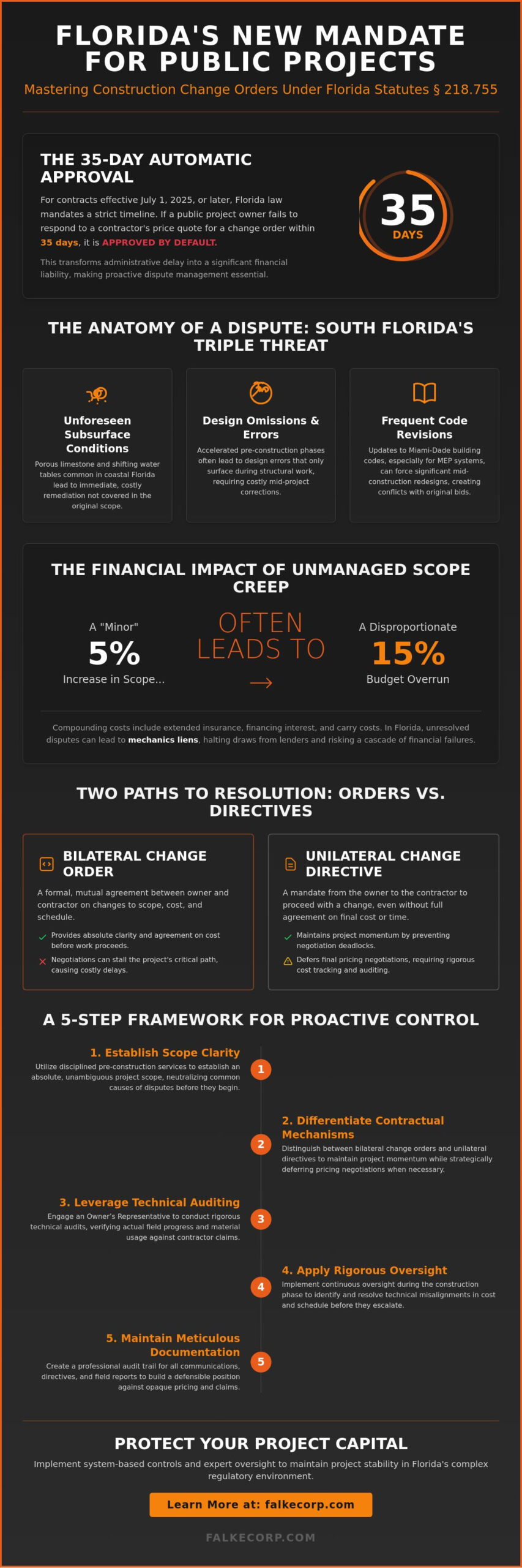
Did you know that failing to respond to a contractor’s price quote within 35 days on a public project in Florida now results in an automatic approval by default? This mandate, applicable to contracts initiated on or after July 1, 2025, under Florida Statutes Section 218.755, transforms administrative delay into a significant financial liability. For owners, the traditional approach to managing construction change order disputes often feels like a defensive battle against opaque pricing and uncontrolled scope creep. You recognize that every unverified line item threatens your project capital and risks stalling critical momentum.
This article provides the technical and contractual frameworks required to master these conflicts through rigorous auditing rather than mere legal posturing. We’ll explore how to leverage precise documentation and understand the 8.44% statutory interest rates for 2026 to protect your interests. By implementing these strategic oversight protocols, you’ll reduce financial exposure and ensure your development remains on schedule from pre-construction through final commissioning. Our analysis moves beyond simple negotiation, focusing instead on the system-based controls necessary to maintain project stability in a complex regulatory environment.
Key Takeaways
- Distinguish between bilateral change orders and unilateral directives to maintain project momentum while deferring final pricing negotiations.
- Leverage the technical auditing capabilities of an Owner’s Representative to verify actual field progress against contractor claims.
- Master a five-step technical framework for managing construction change order disputes that ensures every adjustment aligns with the original contractual scope.
- Utilize disciplined pre-construction services to establish absolute scope clarity, effectively neutralizing the common causes of cost overruns.
- Protect project capital by applying rigorous oversight during the construction phase to resolve technical misalignments in cost and schedule.
The Anatomy of Change Order Disputes in South Florida
A change order dispute is rarely a singular event. It’s the culmination of a technical misalignment where the established scope, projected cost, and critical path schedule no longer converge. Understanding What is a Change Order? provides the necessary baseline, but in the South Florida market, these deviations carry unique complexities. Effectively managing construction change order disputes requires a granular understanding of how minor deviations transform into project-threatening liabilities. When the technical framework of a contract isn’t strictly maintained, the resulting friction creates a vacuum where transparency is lost.
The “Triple Threat” specific to Miami construction involves unforeseen subsurface conditions, design omissions, and frequent code revisions. These elements represent the primary catalysts for friction. When these factors collide, the relationship between owner and contractor often shifts from a collaborative partnership to an adversarial one. Trust erodes as the project’s financial stability is questioned. This transition often happens quietly. It begins with a small field adjustment and ends with a formal claim that threatens the project’s capital stack. Without a professional audit trail, the owner is left defending against opaque pricing structures.
Common Triggers for Disputes in 2026
In 2026, coastal Florida developments face heightened geotechnical risks. Porous limestone and shifting water tables lead to unforeseen subsurface conditions that demand immediate, costly remediation. Additionally, the pressure to break ground has led to accelerated pre-construction phases, frequently resulting in design errors that only surface during the structural phase. Regulatory shifts are equally impactful. Recent updates to Miami-Dade building codes, specifically regarding MEP systems and energy efficiency, have forced significant mid-construction redesigns. These changes create a direct conflict between original bid prices and the actual cost of execution.
The Financial Impact of Unmanaged Scope Creep
Scope creep is a deceptive process. A seemingly minor 5% increase in project scope often results in a 15% budget overrun due to compounding costs. These include not just material and labor, but also the secondary impact on carry costs, extended insurance premiums, and financing interest. In Florida, the risk is further amplified by the potential for mechanics liens. An unresolved dispute can encumber a property, halting draws from lenders and creating a cascade of financial failures. Owners who prioritize technical oversight find that managing construction change order disputes becomes a matter of precise auditing rather than emotional negotiation. Maintaining a clear documentation trail is the only way to ensure project momentum remains unburdened by these financial encumbrances.
Change Orders vs. Change Directives: Technical Mechanisms
The administrative friction inherent in bilateral negotiations often necessitates a more decisive contractual instrument to protect the project’s critical path. While a standard Change Order represents a bilateral agreement between the owner and contractor regarding scope, cost, and time, it’s not the only mechanism available. When a consensus cannot be reached, the Construction Change Directive (CCD) serves as a unilateral mandate. This tool allows an owner to order changes in the work despite a lack of total agreement on price or schedule adjustments. The impacts of delayed change orders can be catastrophic for a project’s liquidity; therefore, understanding these technical distinctions is vital for managing construction change order disputes effectively.
The Architect of Record plays a pivotal role in this process by validating the technical necessity of the change before any directive is issued. This validation ensures that the requested modification isn’t a result of contractor inefficiency but a legitimate requirement of the evolving project. For public projects in Florida, the regulatory environment is even more stringent. Under Florida Statutes Section 218.755, applicable to contracts entered into on or after July 1, 2025, a governmental entity must approve or deny a contractor’s price quote within 35 days. Failure to provide a written response within this window deems the change order approved by default. This statutory clock emphasizes the need for rigorous administrative discipline.
When to Issue a Change Directive
A Change Directive is most effective when project momentum outweighs the immediate need for cost finalization. It prevents a contractor from halting work during a price deadlock. In these scenarios, the “Force Account” method is often employed. This requires the contractor to track actual labor, equipment, and material costs in real-time, which are then audited by the owner’s representative. While this method carries the risk of an unknown final cost, it eliminates the leverage a contractor might hold by threatening delays. Engaging a professional firm for construction phase management provides the technical oversight needed to audit these force account records as they’re generated in the field.
Standard AIA Contract Provisions for Disputes
Article 7 of the AIA A201 General Conditions governs these modifications. It establishes the framework for how changes are processed and how disputes are escalated. A critical component is the Initial Decision Maker (IDM), who serves as the first filter for conflicts before they reach formal mediation or arbitration. To preserve the right to a claim, owners and contractors must adhere to strict, time-sensitive filing requirements. Typically, a “notice of claim” must be filed within 21 days of the event giving rise to the dispute. Missing these contractual windows can result in the forfeiture of the right to challenge an unfair price or schedule impact, making managing construction change order disputes a matter of precise calendar management.
The Strategic Role of the Owner’s Representative
The Owner’s Representative serves as the primary technical filter through which all contractor claims must pass. While general contractors focus on execution and architects on design intent, the representative operates as a technical auditor. This role is the first line of defense against contractor overreach, particularly when managing construction change order disputes that arise from vague pricing or inflated labor estimates. By maintaining a constant presence on-site, the representative ensures that “percentage of completion” claims align with actual physical progress. This level of oversight prevents the common industry practice of front-loading costs, which often leaves owners with insufficient capital to finish the project if a dispute escalates.
A technical validation of scope differs fundamentally from a legal interpretation. While an attorney analyzes the contract’s language to determine liability, the representative analyzes the engineering necessity of the requested change. This involves cross-referencing field conditions against the original construction documents to verify if a claim is truly “unforeseen” or merely a result of poor planning. Practical experience in administering change orders shows that objective, data-driven reporting is the most effective way to mitigate adversarial friction. When an owner presents a contractor with a detailed audit of material quantities and man-hours, the conversation shifts from subjective argument to factual reconciliation.
Owner’s Rep vs. Legal Counsel
Technical oversight is frequently more effective than legal threats in resolving project friction. Legal counsel is a reactive measure, often engaged only after a relationship has fractured beyond repair. In contrast, an Owner’s Representative provides proactive management that prevents the need for litigation. The cost-benefit analysis is clear: the expense of professional technical oversight is a fraction of the cost associated with a protracted legal battle or a project shutdown. If a dispute does reach a formal stage, the representative’s technical findings provide the empirical foundation for a legal position, ensuring that the owner’s counsel has the specific data needed to prevail. To find out more about how Matthew Fornaro, P.A. assists with business law and construction disputes, visit their website.
Cost Control through Rigorous Documentation
Effective cost control in 2026 relies on a granular documentation trail that leaves no room for ambiguity. This includes the daily reconciliation of field reports against any pending change order requests. Advanced tools such as 3D site scans and high-resolution photographic evidence have become the standard for verifying work in place. These digital records provide an indisputable “truth” that can be referenced months after the work is covered by drywall or concrete. For owners seeking a comprehensive approach to project stability, implementing a strategy for Construction Project Management in Florida ensures that these documentation protocols are strictly enforced from day one. This disciplined approach to record-keeping is what ultimately protects project capital and maintains construction momentum.
A 5-Step Framework for Resolving Disputes
Resolving friction requires a systematic approach that removes emotional bias from the equation. Managing construction change order disputes is most effective when executed through a structured five-step framework designed to validate every claim against empirical project data. This process ensures that the owner’s capital remains protected while project momentum is preserved. Each step requires a high degree of technical precision to ensure the final reconciliation is both fair and contractually sound.
- Step 1: Technical Audit. Verify the engineering necessity of the requested change. The objective is to determine if the work is a legitimate addition to the scope or a “silent” correction of a contractor-induced inefficiency.
- Step 2: Contractual Alignment. Cross-reference the claim with the original Scope of Work and General Conditions. This step identifies whether the “extra” work was already implied in the base contract or if it constitutes a genuine deviation.
- Step 3: Independent Cost Estimating. Challenge the contractor’s pricing with current market benchmarks. In the volatile South Florida market, where earthwork bids rose from $12 per cubic yard in fiscal year 2025 to $29 in the first quarter of fiscal year 2026, relying on contractor-provided quotes without independent verification is a significant risk.
- Step 4: Structured Negotiation. Prioritize the discussion of “merit” before addressing “quantum” (the dollar value). If the contractor cannot prove the technical merit of the claim, the financial value becomes irrelevant.
- Step 5: Formal Execution or Mediation. Once reconciled, the Change Order is executed. If a deadlock persists, the dispute is escalated to a pre-defined third-party mediator as per the contract’s dispute resolution clause to avoid halting construction.
Independent Cost Estimating in South Florida
Benchmarking claims against local labor rates in Miami and Fort Lauderdale is essential for maintaining budget integrity. Owners must verify material lead times and “hurricane premiums” that contractors often bake into their pricing during the Atlantic storm season. A rigorous audit of subcontractor quotes often reveals hidden markups or duplicated overhead costs that can be negotiated out of the final settlement. For owners seeking a proactive defense against these cost escalations, engaging a firm for pre-construction services establishes a clear cost baseline before the first shovel hits the ground.
Negotiation Tactics for Project Owners
A successful negotiation strategy utilizes the “Separation of Powers” by separating the technical approval from the final financial sign-off. This prevents field personnel from making unauthorized financial commitments during high-pressure site meetings. Owners should also leverage “No-Damage-for-Delay” clauses to neutralize claims for extended general conditions when the delay isn’t the owner’s responsibility. The focus must always remain on protecting the critical path. While off-path changes are negotiated, the primary construction schedule must remain unencumbered to avoid the compounding costs of a project shutdown.
FALKE Atlantic’s Methodology: Discipline in Execution
FALKE Atlantic Corporation implements a disciplined four-phase methodology designed to neutralize the operational inefficiencies that lead to project friction. By applying a systems-based approach, the firm ensures that every project stage is governed by technical precision and unwavering oversight. This methodology is particularly effective when managing construction change order disputes, as it establishes an empirical baseline for all work performed. Rather than reacting to claims as they arise, the process identifies potential misalignments before they impact the project’s financial stability or schedule.
Pre-Construction: The Foundation of Dispute Prevention
The most effective way to manage a dispute is to prevent its technical basis from ever forming. The approach utilized by FALKE Atlantic Corporation prioritizes Pre-Construction Services in Miami to achieve absolute scope clarity. This phase involves a rigorous design review that identifies omissions and code conflicts before the Guaranteed Maximum Price (GMP) is finalized. By establishing clear communication protocols for all third-party vendors, the firm ensures the owner’s intent is perfectly translated into the construction documents. This proactive auditing eliminates the ambiguity that contractors often exploit to justify mid-project cost escalations, ensuring the budget remains a stable reflection of reality.
During the execution phase, real-time oversight prevents field issues from crystallizing into formal claims. For example, when managing complex retail developments in the Miami Design District, the team at FALKE Atlantic Corporation utilized high-frequency site inspections and technical audits to resolve subsurface and structural misalignments immediately. This constant presence ensures that any deviations are documented and reconciled within days, keeping the project on its critical path. By maintaining this level of visibility, the owner is never forced into a defensive position during a negotiation.
Commissioning and Close-out: Ensuring a Clean Exit
The final phase of the methodology focuses on the orderly transition from construction to operations. A “clean exit” requires the meticulous management of the final punch list and the reconciliation of any remaining outstanding change orders. As a dedicated Owner’s Representative Miami, FALKE Atlantic Corporation ensures that all warranties, O&M manuals, and technical specifications are delivered in full before final payment is authorized. This disciplined close-out process protects the owner from trailing liabilities and ensures that the project’s capital investment is fully realized without the burden of unresolved administrative friction. The goal is a seamless handover where all contractual obligations are verified against the highest professional standards.
Securing Project Integrity Through Technical Oversight
Mastering the complexities of the South Florida development landscape requires a shift from reactive negotiation to proactive technical auditing. By establishing absolute scope clarity during pre-construction and utilizing rigorous field documentation, owners neutralize the administrative friction that leads to financial overruns. The transition from a collaborative partnership to an adversarial state is often preventable through the application of a disciplined, systems-based management protocol. Professional oversight ensures that every technical deviation is reconciled against empirical data rather than subjective contractor claims.
FALKE Atlantic Corporation operates as a boutique consultancy with over 10 years of South Florida expertise, specializing in the unique demands of high-net-worth and luxury retail developments. Our disciplined four-phase methodology provides the structural framework necessary for managing construction change order disputes with unwavering precision. We oversee every phase from initial design review to final commissioning, ensuring your project capital remains protected against the risks of uncontrolled scope creep. Protect your project capital—Consult with FALKE Atlantic Corporation today to ensure your next development is governed by technical competence and professional stability. Your vision deserves the security of expert supervision.
Frequently Asked Questions
How do I know if a change order is legitimate or just scope creep?
A legitimate change order arises from a verifiable deviation from the original construction documents or unforeseen site conditions that weren’t discoverable during pre-construction. You must cross-reference the request against the technical specifications and the detailed drawings. If the work involves correcting a contractor’s error or enhancing a feature already defined in the base contract, it’s scope creep rather than a valid change.
Can a contractor stop work if a change order is in dispute?
Standard AIA contract provisions generally prohibit a contractor from halting work due to a pending dispute, provided the owner continues to pay for undisputed portions of the project. Contractors are contractually obligated to maintain the project’s critical path while the disagreement is reconciled through formal channels. Stopping work without a specific contractual right often constitutes a material breach, exposing the contractor to liquidated damages and potential termination.
What is the notice period for a change order in Florida construction contracts?
Most private contracts follow the AIA standard of 21 days for a “notice of claim” following the event that triggered the change. For Florida public projects initiated on or after July 1, 2025, a governmental entity has a 35-day window to approve or deny a contractor’s price quote. Managing construction change order disputes effectively requires strict adherence to these timelines, as missing a deadline can result in the automatic approval of the claim or the forfeiture of the right to contest it.
How does an Owner’s Representative help reduce change order costs?
The representative reduces costs through independent cost estimating and technical auditing of every line item in a contractor’s proposal. By benchmarking labor rates and material costs against current South Florida market data, they identify inflated markups and duplicated overhead. This level of oversight ensures that the owner only pays the fair market value for legitimate additions, preventing the 10% to 15% budget overruns commonly seen in unmanaged projects.
What is the difference between a Change Order and a Construction Change Directive?
A Change Order is a bilateral agreement where both the owner and contractor agree on the scope, price, and schedule adjustment. In contrast, a Construction Change Directive is a unilateral instruction from the owner that mandates the work proceed immediately, even if a final price hasn’t been established. This mechanism is essential for preserving project momentum when a price deadlock threatens to stall the construction schedule.
Should I hire a lawyer or an Owner’s Rep for a change order dispute?
You should engage an Owner’s Representative for the technical validation of the claim and a lawyer for the formal legal enforcement of the contract. The representative provides the empirical evidence, such as man-hour audits and material verifications, that a lawyer needs to build a successful case. Technical experts often resolve friction at the site level, preventing the need for expensive litigation and keeping the project out of the courtroom.
How do I handle unforeseen conditions claims in Miami coastal projects?
Handling these claims requires a thorough review of the original geotechnical reports and pre-construction site surveys. In Miami, where limestone porosity and high water tables are frequent issues, you must determine if the condition was truly undiscoverable or if it should’ve been reasonably anticipated by a competent contractor. Professional auditing of subsurface data is the only way to challenge “unforeseen” claims that are actually the result of inadequate site investigation.
What documentation is essential to win a change order dispute?
The most critical documentation includes daily field reports, high-resolution site photography, and a complete log of all Requests for Information (RFIs). These records provide the evidentiary foundation for managing construction change order disputes by establishing a clear timeline of events. Digital tools like 3D site scans are also vital in 2026, offering indisputable proof of work-in-place that can be used to audit the accuracy of a contractor’s percentage-of-completion claims.