
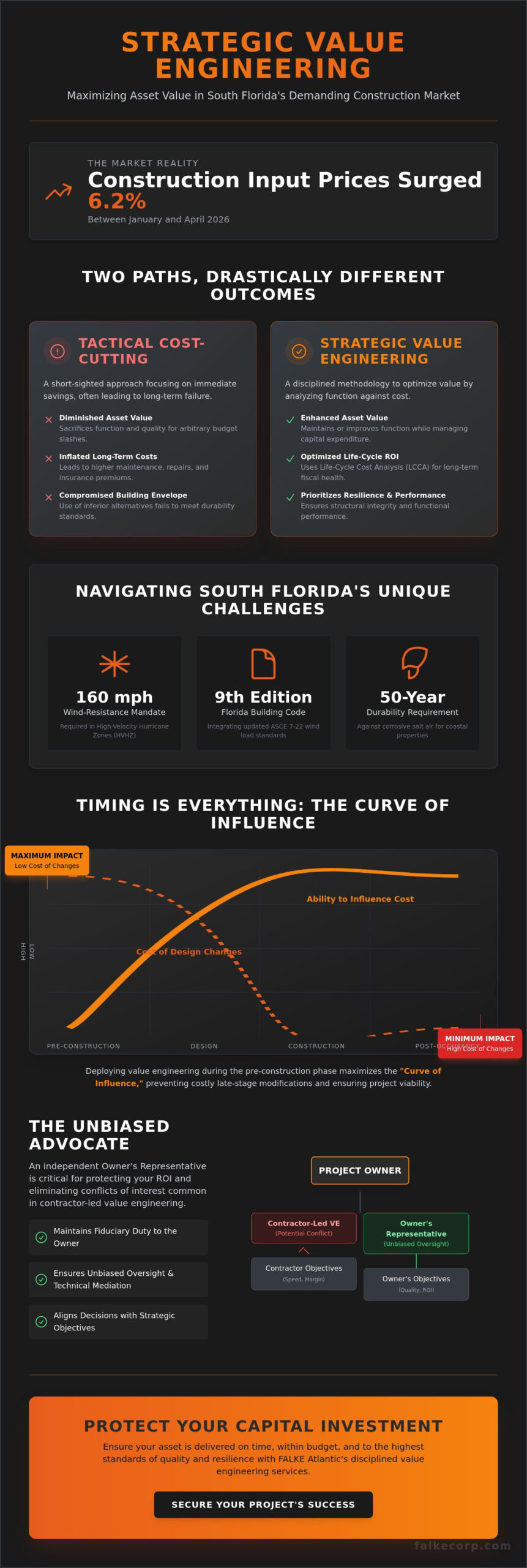
With construction input prices having surged by 6.2% between January and April 2026, the conventional method of reactive cost-cutting often results in diminished asset value rather than genuine fiscal efficiency. You understand that maintaining project viability in a volatile market requires a sophisticated methodology that prioritizes structural resilience and functional performance over superficial savings. Engaging specialized value engineering services South Florida developers utilize ensures that every budgetary adjustment is grounded in technical data and long-term life-cycle analysis. This strategic approach prevents the common pitfall of accepting inferior alternatives that inevitably lead to inflated maintenance costs and compromised building envelopes.
This guide provides a rigorous framework for optimizing your capital investment while adhering to the stringent 160 mph wind-resistance standards and the updated ASCE 7-22 requirements of the 9th Edition Florida Building Code. You’ll learn how a disciplined pre-construction phase and transparent decision-making processes result in a revenue-ready asset delivered within its financial parameters. We will detail the specific technical protocols that align construction phase management with your fiduciary responsibilities to ensure the final delivery meets the highest professional standards.
Key Takeaways
- Distinguish between tactical cost-reduction and strategic value engineering to prioritize long-term asset health and functional performance over immediate savings.
- Utilize specialized value engineering services South Florida to navigate regional technicalities, such as salt-air corrosion and the 160 mph wind-resistance mandates of the 9th Edition Florida Building Code.
- Leverage an independent Owner’s Representative to ensure unbiased oversight and eliminate the structural conflicts of interest often present in contractor-led value engineering.
- Deploy value engineering protocols during the pre-construction phase to maximize the curve of influence and prevent the high costs associated with late-stage design modifications.
- Analyze the life-cycle ROI of high-performance materials, such as hurricane-resilient glazing, to optimize insurance premiums and long-term asset durability.
Defining Strategic Value Engineering in the South Florida Market
Value engineering is a disciplined, systematic method designed to enhance the utility of a project by analyzing its core functions. It’s not merely a process of expense reduction. It’s a calculation where value equals function divided by cost. In the current 2026 South Florida environment, where construction input prices rose 6.2% in the first quarter, this distinction is critical. Strategic value engineering services South Florida developers utilize focus on maintaining or increasing the function of a building while managing the capital expenditure required to achieve it. If function is sacrificed to lower costs, the value of the asset decreases. Conversely, if function is improved while keeping costs stable, value increases.
The Difference Between Cost Cutting and Value Optimization
Tactical cost-cutting often involves arbitrary budget slashes that ignore the long-term operational impact. When a developer chooses “cheap” alternatives for mechanical systems or building envelopes, they risk higher maintenance costs and significantly increased insurance premiums. Strategic optimization uses Life-Cycle Cost Analysis (LCCA) to evaluate the total cost of ownership over several decades. This methodology is essential for coastal properties where materials must withstand the 50-year durability requirement against corrosive salt air. Choosing a lower-grade finish might save capital today, but it will fail prematurely, destroying the asset’s net present value through early replacement cycles.
Why South Florida Developers Require a Localized VE Approach
South Florida’s regulatory environment is unique and demanding. Miami-Dade and Broward counties operate within the High-Velocity Hurricane Zone (HVHZ), which mandates the most stringent wind-resistance standards in the United States. Value engineering in this region requires deep technical knowledge of NOA (Notice of Acceptance) approvals, as these certifications dictate which products are legally permissible for use. A localized approach also accounts for the fragmented permitting processes across 31 municipalities, where delays can erode the financial benefits of any material substitution. By integrating these regulatory realities into the pre-construction phase, owners can achieve a revenue-ready asset that meets the 2026 code requirements without unnecessary overspending.
The 9th Edition of the Florida Building Code, scheduled for late 2026, integrates ASCE 7-22 standards. This change alters how wind loads are calculated for commercial roofs and cladding. A strategic VE process doesn’t just look for cheaper materials; it identifies the most efficient way to meet these new, higher-performance thresholds. It’s about finding the intersection of regulatory compliance, structural integrity, and financial discipline. This ensures that the project remains viable even as labor markets for specialized trades remain tight and material costs for non-wood components continue to rise.
The Owner’s Representative Perspective: Protecting Quality and ROI
The technical effectiveness of value engineering services South Florida depends on the impartiality of the entity conducting the analysis. When a General Contractor leads the process, an inherent conflict of interest often emerges. Their primary objective typically centers on construction speed and immediate margin protection, which might lead to material substitutions that simplify installation but degrade long-term performance. An Owner’s Representative serves as the only unbiased party, maintaining a fiduciary duty to the project’s financial health and the quality of the final asset. By providing disciplined oversight, we ensure that every proposed modification serves your strategic objectives rather than the contractor’s logistical convenience.
FALKE acts as the technical mediator between the architect’s design vision and the contractor’s budgetary constraints. Architects naturally prioritize the aesthetic and functional perfection of the design intent, while contractors focus on the practicalities of the construction phase management. Our role is to synthesize these competing priorities into a transparent decision-making framework. This ensures that transparency and financial control remain at the forefront of the value engineering services South Florida owners depend on to protect their ROI. Owners seeking to stabilize their project’s financial trajectory often find that professional Owner’s Representation provides the necessary technical leverage to maintain quality.
FALKE’s Four-Phase Methodology for Value Management
Our approach integrates value management from the initial concept and site feasibility phases, where the highest level of influence over total project costs exists. We facilitate a rigorous evaluation during the design team assembly and permitting stages to ensure that technical specifications align with the budget without compromising the project’s architectural integrity. This integration is a core component of our strategic pre-construction services in Miami, where we analyze risk profiles before any physical work begins. By establishing a baseline of quality during the early design phases, we prevent the reactive and often destructive cost-cutting that occurs when projects exceed their financial limits late in the cycle.
Mitigating Financial and Operational Risks
Strategic value engineering identifies potential change orders before they manifest during the construction phase. Our methodology involves extensive third-party vendor management to source high-quality, cost-effective alternatives that meet the specific requirements of luxury retail or hospitality brands. We focus on delivering a revenue-ready asset that adheres to the brand’s global standards while optimizing the initial capital outlay. This requires a deep understanding of commissioning and close-out requirements, ensuring that the transition from construction to operations is seamless and the building performs as engineered from day one. By prioritizing life-cycle performance, we ensure the asset remains competitive in the high-stakes South Florida market.
South Florida Specific Factors: Climate, Regulations, and Materiality
Construction in the subtropics requires a specialized understanding of environmental stressors that are non-existent in other markets. Value engineering services South Florida providers must prioritize material resilience against the specific corrosive atmospheric conditions of the Atlantic coast. Exterior finish selections for assets in coastal Miami and Fort Lauderdale aren’t purely aesthetic decisions; they’re technical choices that determine the asset’s maintenance trajectory over a 20-year horizon. Aluminum components, for instance, must be specified with high-performance fluoropolymer coatings to withstand salt-air degradation. Choosing a standard powder coat often results in premature oxidation and costly remediation that destroys the project’s initial savings.
Hurricane-resilient glazing represents a significant capital investment, but its value is realized through optimized insurance premiums and the mitigation of catastrophic operational risk. While standard options might meet baseline codes, exceeding these requirements often yields a superior return on investment by securing the building envelope against the 160 mph wind-resistance thresholds mandated for high-risk structures. Strategic thermoregulation also serves as a primary priority in this tropical climate. High-performance insulation and solar-reflective glass reduce the long-term load on mechanical systems, ensuring that the building’s energy efficiency remains a competitive advantage for the owner.
Hurricane Resilience as a Value Driver
Resilient design serves as a primary driver of long-term value for hospitality and corporate assets. The cost-benefit analysis of exceeding minimum code requirements reveals that the initial expense of superior storm protection is offset by the reduction in potential business interruption. Every material alternative proposed during the VE process must pass through the filter of the Notice of Acceptance (NOA) process. This rigorous documentation ensures that substitutions don’t compromise the structural integrity required within the High-Velocity Hurricane Zone (HVHZ). In these zones, arbitrary swaps of fasteners or cladding systems are legally prohibited and technically unsound.
Navigating Miami-Dade and Broward Regulatory Hurdles
Navigating the regulatory landscape of Miami-Dade and Broward counties requires specialized local expertise to avoid costly permitting delays. In jurisdictions like West Palm Beach or Miami, an unmanaged VE choice can trigger a full re-permitting cycle, which erodes any projected savings through extended carry costs and labor inflation. Our role as an owner’s representative involves ensuring that value engineering decisions remain within the entitlements and approved plans of the specific municipality. This disciplined oversight ensures that the project maintains its timeline while achieving the desired financial and operational optimizations without triggering unnecessary regulatory scrutiny or entitlement resets.
Implementation Timeline: When to Deploy Value Engineering Services
The strategic timing of value engineering determines the delta between a project’s theoretical budget and its actual financial performance. Within the construction industry, the “Curve of Influence” illustrates a critical reality: the capacity to impact project costs is greatest during the earliest stages of design, while the cost of implementing changes increases exponentially as the project moves toward completion. Engaging professional value engineering services South Florida owners rely on during the pre-construction phase ensures that technical optimizations are integrated before they require expensive redesigns or trigger regulatory delays. Waiting until the construction phase to identify savings typically results in reactive cost-cutting rather than strategic value enhancement.
To maximize ROI, value reviews must occur at three specific design milestones. During Schematic Design, we evaluate the fundamental building systems and massing to ensure alignment with the pro forma. In the Design Development phase, the focus shifts to refining mechanical, electrical, and plumbing (MEP) systems alongside the building envelope. By the time the project reaches the Construction Documents stage, value engineering serves as a final technical audit to verify that specifications are precise and competitive. This disciplined progression prevents the “Late-Stage VE” trap, where modifications often necessitate permit revisions and disrupt the labor schedules of specialized trades.
Pre-Construction: The Golden Window for Savings
Early feasibility studies are the most effective tool for preventing expensive design dead ends. By analyzing site-specific constraints and entitlement requirements before the design is finalized, we establish a realistic financial and technical framework for the project. This proactive oversight is a cornerstone of professional Owner’s Representative Miami: Protecting Your Real Estate Assets. Early coordination ensures that site selection and utility infrastructure decisions are optimized for long-term operational efficiency, reducing the need for corrective measures after the ground has been broken.
Construction Phase Oversight and Quality Control
Once active construction begins, the role of value engineering shifts toward the rigorous management of change orders and site-specific technical challenges. It is vital to ensure that field-level adjustments do not undermine the established value goals or compromise the structural integrity of the asset. Our disciplined construction phase management in Florida includes regular site inspections to verify that all material substitutions meet the high-performance standards required for the regional climate. This phase concludes with commissioning and close-out, where we confirm that every system performs according to the optimized design intent. For owners seeking to maintain strict financial discipline throughout the project lifecycle, engaging an expert in Owner’s Representation is the most effective way to secure the asset’s value.
FALKE Atlantic: Disciplined Value Engineering for High-Stakes Assets
FALKE Atlantic operates with a methodology rooted in technical precision and unwavering financial control. For high-stakes assets in the 2026 South Florida market, value engineering is not merely an exercise in cost reduction; it is a fiduciary responsibility to protect the owner’s capital and long-term vision. Our commitment to transparency ensures that every technical optimization is backed by rigorous data and a thorough understanding of the asset’s intended performance. By maintaining a hovelly elegant and professional distance from the inherent conflicts of the construction site, we provide a level of oversight that secures the project’s stability from the initial concept through to final commissioning.
Our experience with high-profile projects, such as the Prada Design District store, demonstrates our ability to manage the most demanding aesthetic and technical requirements. In luxury retail, where design intent is paramount, our value engineering services South Florida developers trust ensure that the architectural integrity is never sacrificed for the sake of a budget line item. We act as a strategic partner, mediating between the high-pressure demands of the construction phase and the owner’s requirement for a pristine, revenue-ready asset. This disciplined approach positions FALKE Atlantic as the premier choice for commercial project management in Miami.
Experience Across Hospitality, Retail, and High-Net-Worth Residential
Each asset class requires a specific technical lens to evaluate value accurately. In hospitality, we focus on durability and life-cycle costs to protect the operator’s margins. In high-net-worth residential projects, the priority shifts to the seamless integration of complex building systems and bespoke finishes. A boutique consultancy approach allows us to adapt our value engineering framework to these unique revenue drivers. The firm maintains a track record of delivering high-quality, revenue-ready assets that perform to the highest technical specifications without exceeding their financial parameters. This versatility is essential for managing the diverse portfolios of modern South Florida developers.
Your Strategic Partner in South Florida Construction
Success in the South Florida construction landscape requires a professional advocate who can manage the complex interdependencies between architects, contractors, and vendors. Our role is to ensure that your vision remains the primary directive throughout the development lifecycle. By providing expert oversight, we eliminate the ambiguity that often leads to cost overruns and technical failures. To secure your next investment, you can initiate a consultation for development management or owner’s representation by contacting our Miami office. We offer the stability, precision, and security required to navigate the most complex construction processes in the region. Your asset deserves a level of expertise that accepts no compromises in quality or professional standards.
Mastering Asset Viability in the 2026 South Florida Market
The technical complexity of the current regulatory landscape dictates that asset preservation must begin with rigorous foresight. Integrating professional value engineering services South Florida developers trust ensures that project budgets remain resilient against market volatility while meeting the 160 mph wind-resistance requirements of the 9th Edition Florida Building Code. By prioritizing function and life-cycle performance during the pre-construction phase, you secure the long-term viability of your investment. This disciplined approach eliminates the risks of reactive cost-cutting; it’s the only way to ensure your asset arrives on the market revenue-ready and structurally superior.
FALKE Atlantic provides the technical competence and local expertise across Miami-Dade, Broward, and Palm Beach necessary to navigate these high-stakes processes. Our disciplined four-phase methodology has been proven on complex developments for high-profile brands like Prada, where precision is the only acceptable standard. We act as your strategic advocate, managing every technical interdependency to protect your vision. Secure your project’s financial future with FALKE Atlantic’s expert Owner’s Representation. Your success in the South Florida market depends on the quality of your oversight, and we’re ready to provide the stability your project requires.
Frequently Asked Questions
What exactly is value engineering in the context of South Florida construction?
Value engineering in South Florida is a disciplined methodology used to optimize the ratio of a building’s function to its total cost. It involves a technical analysis of structural systems, building envelopes, and mechanical components to ensure they meet the 160 mph wind-resistance standards of the 9th Edition Florida Building Code. This process ensures that every dollar spent contributes to the long-term performance and regulatory compliance of the asset.
How does value engineering differ from simple cost-cutting?
Value engineering differs from cost-cutting by prioritizing the asset’s life-cycle performance rather than just immediate capital savings. While cost-cutting involves arbitrary budget slashes that often increase maintenance expenses, strategic value engineering uses Life-Cycle Cost Analysis to evaluate the long-term impact of material selections. This methodology ensures that reductions in initial expenditure don’t compromise the building’s durability or functional utility over its operational lifespan.
When is the most effective time to start the value engineering process?
The most effective time to initiate the value engineering process is during the pre-construction phase, specifically during schematic design. Engaging value engineering services South Florida owners utilize early in the development cycle allows for the highest degree of influence over project costs with the lowest implementation expense. Waiting until the construction phase typically limits options to minor material swaps that offer diminishing returns and may trigger permit revisions.
Can value engineering help with hurricane resilience and insurance costs?
Value engineering directly enhances hurricane resilience by identifying the most efficient ways to exceed minimum High-Velocity Hurricane Zone (HVHZ) requirements. By optimizing the building envelope with impact-resistant glazing and reinforced roofing systems, owners can significantly reduce long-term operational risk. These technical improvements often lead to lower insurance premiums and higher asset valuations, as the building is better equipped to withstand the 2026 storm standards.
Why do I need an Owner’s Representative to manage value engineering instead of my General Contractor?
An Owner’s Representative provides an unbiased perspective that a General Contractor cannot offer due to inherent conflicts of interest regarding margins and schedules. While a contractor might suggest substitutions that simplify installation, an Owner’s Rep ensures that every change aligns with your fiduciary goals and long-term quality standards. This professional oversight maintains the integrity of the project’s financial and technical objectives throughout the construction phase management.
Does value engineering always lead to a change in building materials?
Value engineering does not always necessitate a change in physical materials; it frequently involves optimizing construction sequences, building systems, or logistical frameworks. The goal is to identify efficiencies in how components are integrated or how the site is managed during the development process. By refining the mechanical design or structural layout, we can often achieve significant financial savings while maintaining the original material specifications and aesthetic quality.
How does FALKE Atlantic ensure that design intent isn’t lost during VE?
FALKE Atlantic ensures that design intent remains intact by acting as a technical mediator between the architect and the contractor. We use a disciplined four-phase methodology to evaluate proposed optimizations against the project’s aesthetic and functional goals. This rigorous oversight ensures that the vision of high-profile brands is preserved while maintaining strict financial control, delivering a revenue-ready asset that fulfills the original architectural promise.
What are the common risks of ignoring value engineering in the Miami market?
Ignoring value engineering services South Florida providers offer exposes developers to uncontrolled cost overruns and the risk of non-compliance with evolving 2026 building codes. Without a structured review process, projects often fall victim to reactive field-level changes that trigger expensive re-permitting cycles and labor delays. Neglecting life-cycle analysis during the selection of exterior finishes can lead to premature degradation from salt-air corrosion, significantly increasing the asset’s total cost of ownership.